#Manchester #climate nuggets June 18 2012

Hi all,

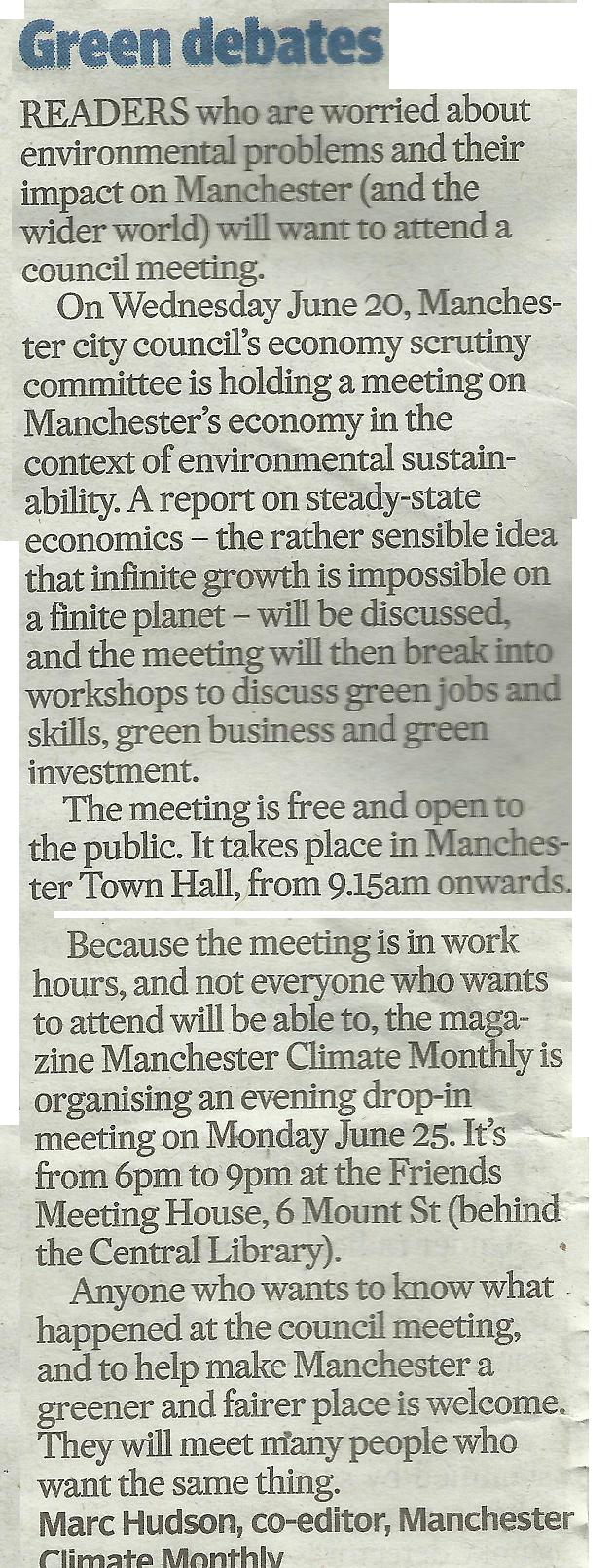
this Wednesday morning there’s a public meeting at Manchester Town Hall where the “green economy” will be discussed and workshops conducted. (see here for more details)  Be there if you can – we meet at the Waterhouse pub from 8.30am.  We will, of course, be blogging it.  We are organising a follow-up meeting for Monday 25th June, from 6pm to 9pm (it’s drop-in – just come for a bit) at the Friends Meeting House.

Best wishes, and, as ever, if you want to volunteer some time and/or energy to MCFly, get in touch with us via mcmonthly@gmail.com…

Arwa Aburawa and Marc Hudson

Coming up this week

Weds 20, 9.15 to 12 noon “Manchester’s Economy in the context of Environmental Sustainability” – report and workshops; a special meeting of the “Economy Scrutiny Committee” Manchester Town Hall.  See here for more information. If you cannot make this meeting, there is a follow-up, organised by MCFly, on Monday 25th June.
PRE-MEETING IN THE WATERHOUSE PUB (they do good veggie breakfasts!) FROM 8.30pm
Weds 20th June 1.30pm – 4.30pm Food Futures Forum – Children and Young People’s Food Venue: Friends Meeting House www.manchester.gov.uk/health/jhu
www.foodfutures.info

Weds 20 NCVO BME organisations and Climate Change workshop

Thursday 21st June, 4pmReal Clothes for the Emperor: Facing the Challenges of Climate Change” by Professor Kevin Anderson on(room H18, Pariser Building, Sackville Street).  C1 in the George Begg Building and will start at 4.30pm. Refreshments will be provided from 4pm and the seminar will start at 4.30pm.

Sat 23 Jun: Bike Fabulous
Friends of the Earth’s third Bike Fabulous event will take place in Manchester Arndale Centre

Stories you may have missed on the MCFly website

Lessons we like to pretend we have learnt
No term is safe from recuperation.  Technology will always fail.  And relationships matter.  Here ends this week’s oblique sententiousness…

Things worth reading
http://thelearningplanet.wordpress.com/2012/06/17/radical-edgeryders/

Mad Cycle Lanes of Manchester looks in detail at this “Cycling Strategy” boost/boast from the Council

Posted in Uncategorized | 1 Comment

Event Report: Skype-ing down to Rio* from #Manchester

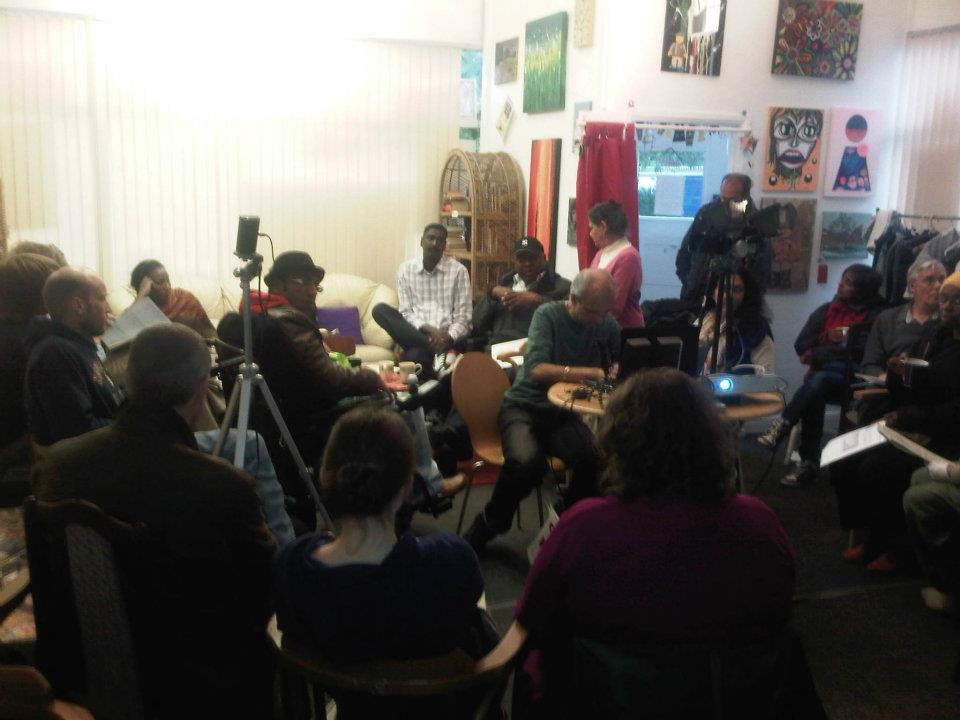
Technological failure was overcome by social success last night at a cafe in Whalley Range, when Manchester-based people tried to talk with environmental activists gathered in Rio de Janeiro for the “Rio +20 Earth Summit”.

The event – a gathering and largely unsuccessful ‘skype’ session – was organised by Southern Voices, “a network of people committed to bringing the knowledge and understanding of southern and Black people to the global issues that are central to education and to living in the world today” in association with the Creative Corner cafe, Hulme Green Party and other organisations.

Around twenty people were present, in a diversity of age, race and gender that MCFly has rarely witnessed (1).  In the absence of more than a text-based conversation (the video-link never worked – despite successful tests over the previous day) a wide-ranging discussion was held.

Deyika Nzeribe of Hulme Green Party opened proceedings and tried – with other members of Southern Voices – to keep some sort of coherence to the conversations as we waited for the technology to kick in.  That it never (in the hour and a half I was there) really did so did not detract from a very useful exchange of ideas and passions.

The burning question, for the current writer, is this ; “what does practical solidarity with those on the frontline of climate change actually look like?” It’s a question to which we will return, hopefully in conjunction with the hosts of this event and any readers who are similarly concerned.

Marc Hudson

mcmonthly@gmail.com

(1) The mix in room was slight preponderance of People of Colour (from India, Sudan and other countries) over the Anglos (who came from such exotic places as Chorlton, Preston and Adelaide)

Interesting things other groups should pay attention to and – if they feel up to it – repeat

  • The hand-out (printed on paper that had something else on the other side – re-using before recycling – huzzah!!
  • The willingness to take a chance on technology
  • The willingness to try to get conversations going with people on the sharp end of climate change, in the Majority World

Other Things

  • Having name badges.
  • Having pair-wise introductions (you find out who someone is and introduce them to the group)
  • Having small group discussion instead of 20 people. Large group discussion will be dominated by a few people (mea culpa)
  • Having a very specific Plan B in case of technological failure.
  • Perhaps structure the evening around questions that people can’t really get answers to from easy reading (e.g. if you want people to know about Climate Impacts in the South, then point them here or here.)  Structure the questions around topics where answers might emerge in the discussion – e.g. “what would practical solidarity with the Majority World look like?”  “How can Manchester activists learn from the struggles in the Majority World, and use that learning here in Manchester?”  etc

*The title of this is a clumsy reference to this movie. (If you have to explain a joke/cultural reference, you probably shouldn’t make it…)

See also entirely predictable BBC story: Rio 20+ deal weakens on energy and water pledges by Richard Black

Photo credit: Lifted from Deyika Nzeribe’s facebook page.

Posted in Event reports | Tagged , , , | Leave a comment

Critique of #Manchester City Council’s Steady-State report

Next Wednesday, June 20, councillors and citizens will discuss a report about Steady-State economics, at Mancheser City Council’s “Economy Scrutiny Committee.” (See below for details)

This report was written solely by several council officers, despite a long-standing offer to work collaboratively from a group of academics, business people and activists (an offer the Council initially accepted).

Below we re-post (with permission) a critique of the Council’s report, pointing out its short-comings and offering constructive ways forward. It can also be found here.

The meeting starts 9.15am in Committee Room 11 at the Town Hall. It’s free, there’s no need to book. Some of us are meeting at the Waterhouse pub on Princess Street from 8.30am.

Manchester City Council and Steady State Economics.

Manchester City Council’s Economic Scrutiny Committee has commissioned a report on Steady State Economics. This is potentially a very positive move- few councils and government bodies are taking the need question of ‘limits to growth’ seriously despite the overwhelming evidence of these limits (from the early 1970s onwards) and the clear evidence that the planet has passed and/or is passing several of the planetary ecosystem limits after which irreversible and damaging change is probably inevitable.

Unfortunately, the report which is now available, is disappointing.

1) The report appears to dismiss the concept of steady state economics from the outset and therefore does not review the growing body of work available (see the Appendix 1 for some of these sources).

2) The report fails to address the critical question about mitigating the effects of growth. As the UK government’s Sustainable Development Commission (disbanded by the current government) showed convincingly in its report Prosperity Without Growth, improved efficiency of resource use comes about with growth (because of innovation in technology) but these improvements are only relative. That is to say the proportion of emissions in relation to GDP reduces, but the problem is that while GDP is increasing, the absolute level of emissions (and resource use) also increases, although it is falling relatively. The net effect of growth then is continued increasing ecosystem damage. The report discusses these relative reductions but fails to consider the critical issue of absolute emissions. Nor does it consider the Jevons paradox – that increases in efficiency do not produce reductions in resource use, but further stimulate resource consumption.

3) The report makes reference (in a rather obscurantist way) to endogenous growth theory. This is contrasted to neoclassical economic theory. But all this is really saying is that government intervention can promote growth. The argument is not relevant to the question of a closed loop or steady state economy.

However, the idea of endogenous development is an interesting one since if taken seriously the idea of economic development (rather than growth) from within the region is relevant to the strategy of (relative) de-linking of the local economy from the global economy. There is some discussion of these topics in the GreenDealManchester paper ‘Getting Started on the Economy”. Not surprisingly this is incomplete work – this is difficult stuff, trying to construct alternative approaches in the face of an economic orthodoxy that is the lifeblood of the current system. De-linking is implicitly ruled out by the report

4) The council report is clear that there would be very tricky issues were it to promote a steady state economy (SSE):

“…even it were desirable there are no realistic prospects of developing an SSE in Manchester – as international and national policy is not geared to this goal, making any meaningful impact minimal, and seriously disadvantaging the city’s economic performance, to the detriment of its residents.”

But we need to counter this by asking “Is growth a realistic prospect anyway?” (see Appendix 2). There has been very little growth since 2007 and there seems little prospect of the healthy (sic) 3% growth rate returning. The city therefore needs an alternative strategy which as has been argued elsewhere would emphasise ‘good living rather than continued consumption’, increased equality, and changes in the way we live in Manchester. Of course this cannot be done unilaterally and in isolation, but isn’t Manchester meant to be a leader, an innovator, a tail-blazer, a pathfinder – a place where tomorrow happens today?

Conclusion

The challenges of a Steady State Economy are considerable, but the council report does not provide a basis for a serious consideration of the limits to growth, nor of the strategies that would need to be adopted to manage an economy with closed-loop and steady state features in these very challenging times of zero growth.

Appendix 1

A Steady State Manchester Economy?

United Nations Secretary-General Ban Ki-Moon: “For most of the past century, economic growth was fueled by what seemed to be a certain truth: the abundance of natural resources. We mined our way to growth. We burned our way to prosperity. We believed in consumption without consequences. These days are gone… Over time, that model is a recipe for national disaster. It is a global suicide pact.”

(Spoken at the World Economic Forum in Davos, Switzerland, January 2011).

The Dilemma

Manchester City Council is committed to securing the wellbeing of its citizens. It has a variety of initiatives to its credit. However, to date the Council, like almost every other government, whether local or national, has relied on sustained economic growth to create wealth. Until recently this may have been a defensible strategy; but now, because of the reality of ecological crises, not least the threat of runaway climate change, a rethink is required.

Until recently a compromise solution, “sustainable growth,” had some credibility. The hope was that it would be possible to de-link growth from resource throughput, and hence ecological damage. Economic research by the last government’s Sustainable Development Commission makes it clear that this is not possible. Only a relative reduction is possible, which means that the demand for resources and polluting emissions continue to grow. Technological innovations that improve the efficiency of resource use actually lead to an increase in overall usage since under a growth model the efficiencies are used to increase production. (The Manchester economist William Stanley Jevons noted this in his 1865 book “The Coal Question”).

Key references for this argument:

1) http://www.slideshare.net/DFID/professor-kevin-anderson-climate-change-going-beyond-dangerous The basic science and its economic implications.

2) http://www.neweconomics.org/press-releases/economic-growth-no-longer-possible-for-rich-countries-says-new-research Includes a link to a graphic illustration of the statistical argument against growth. Full report http://neweconomics.org/publications/growth-isnt-possible.

3) http://www.sd-commission.org.uk/publications/downloads/prosperity_without_growth_report.pdf The Sustainable Development Commission report to UK government sets out clearly the problem with growth.

4) http://steadystate.org/wp-content/uploads/CASSE_Brief_SSE.pdf Briefing sheet on the Steady State Economy.

The Challenge of a Steady State Economic Policy

But a rethink of economic growth itself faces a number of challenges:-

  • Mainstream economic theory has been built on the assumption of continued growth but the alternative, steady state economics, is relatively underdeveloped. Therefore knowledge of how to manage a steady state economy is limited.
  • A steady state economy and reduction in economic activity is associated with recession, depression and mass suffering. It is therefore difficult to ‘sell’ the idea.
  • There are difficulties in ‘going it alone’ since all economies are linked. So the challenge is to find opportunities for relative de-linking from the global economy while increasing local circulation of resources and wealth.
  • Steady state and ecological thinking has had more attraction for those who have prioritised alternative lifestyles, or who have the resources to make green choices. Any strategy adopted has to work for Manchester’s population as a whole, people in Newton Health and Gorton North as well as those in Chorlton and Hulme.

We are now in a different place and time.

The growth policies of the last 60 years were a product of their time. But now there is a fundamental difference. As noted above, we are living in an extremely dangerous ecological emergency, and growth is the problem. But there are other reasons why the old model is no longer appropriate.

Growth does not equal well being

Growth did deliver measurable benefits to the population but the ‘dis-economics’ of growth are now greater than the benefits. This has been demonstrated in relation to measures of well-being, where some analyses suggest that the net benefit of growth had already diminished to near zero as early as the mid 1960s.

See http://ije.oxfordjournals.org/content/36/3/484.full (The “Preston curve”)

http://neweconomics.org/publications/chasing-progress

http://neweconomics.org/publications/growth-isn%E2%80%99t-working

Growth might not return anyway

Growth has stalled and is unlikely to recover to the 3% that mainstream economists use as a proxy for a healthy economy. It seems likely that the motor of accumulation is actually broken, hence the recourse to the fiscal policies of the 1930s by the current government.

See http://www.oecd.org/dataoecd/2/55/49112261.pdf OECD assessment of prospects for growth.

http://www.globalresearch.ca/index.php?context=va&aid=26217 another article on the scale of the global recession.

More economic shocks

Manchester’s population deserves an adequate approach to planning for further shocks. Can we be more prepared for the “next 2008”? Fuel and food prices are set to soar and this will ultimately mean large sections of the population are potentially very vulnerable.

See http://www.worldbank.org/foodcrisis/foodpricewatch/april_2011.html World Bank briefing on world food prices and links to energy prices.

http://www.independent.co.uk/news/world/politics/the-coming-hunger-record-food-prices-put-world-in-danger-says-un-2177220.html Detailed but concise article on the same issue.

http://www.ft.com/cms/s/0/02e7583e-1532-11e1-855a-00144feabdc0.html#axzz1gua5iNxM FT article (Nov. 2011) that indicates food price increases are imminent in the UK.

The Alternative: Steady State Economics

While mainstream, growth-assuming economics is dominant, there is a growing body of work on Steady State Economics. Among other things this work emphasizes the following.

  • Alternative measures and criteria for economic and social well-being.
  • Closed loop cycling of resources and of wealth – the latter also features in the recent CLES report on procurement in Manchester.
  • Government support for non-profit enterprises including cooperatives.
  • Macroeconomic modeling of the interdependencies among various economic indicators including incomes and employment.
  • Local alliances to encourage necessary and relatively local trade, particularly for bulky low value goods whose transportation is fuel intensive.
  • Local production for need.
  • Accounting frameworks that include ecological impacts in the economic calculations.
  • Promotion of the green economy, including selective development of ecologically friendly industries.

Resources on steady state economics

http://steadystate.org/wp-content/uploads/EnoughIsEnough_FullReport.pdfComprehensive report and source book from the UK Steady State Economy Conference, Leeds, 2010.

http://www.sd-commission.org.uk/data/files/publications/prosperity_without_growth_report.pdf See Chapter 6 on macroeconomic models.

http://www.pvictor.com/MWG/About_the_Book.html Link to Managing Without Growth by P Victor. http://vimeo.com/16906655 Video summary

http://steadystate.org/wp-content/uploads/CASSE_Brief_GDP.pdf – alternative indicators.

http://www.beyond-gdp.eu/ EU initiative: Beyond GDP as a measure of wealth and progress.

http://greendealmanchester.wordpress.com/getting-started-on-the-economy/ A Bioregional perspective from Manchester.

Posted in Democratic deficit, Manchester City Council | Tagged , , , | 3 Comments

Open reply to #Manchester City Council on their EAP “consultation”

The story so far: in mid-March I sent a detailed set of proposals to Manchester City Council about a much-needed refresh of their “Environmental Advisory Panel” (I am an original member of it). The recipients liked the ideas so much they sent out an email to all EAP members saying that they would work with me to produce a survey to be sent to all members”before Easter.” Then… no contact from them for the next two months… So I published an article.  By total coincidence, shortly after that, (in late May) they sent out an email to all EAP members.  You can read it (in italics) – and my replies – below.  Warning: Sentences of a sarcastic nature. Parental guidance recommended… NB see editorial note at end re: alterations to this blog post since publication.

Dear [name removed because we don’t – usually – name Council officers],

below you will find my answers to the questions in your email. Before we get to that, I have some questions of my own, relating to this survey and the events around it.

As I am sure you are aware, in mid-March I sent a detailed email to Councillor Nigel Murphy about the Environmental Advisory Panel, suggesting a way of canvassing the existing and past members. In response, two days later, on March 20th, an email was sent out to EAP members. It included the immortal lines.

There has been some informal discussion about the future role of EAP and, following discussions between Councillor Nigel Murphy and Marc Hudson, we propose to conduct a survey/questionnaire of EAP members ahead of a discussion at the next meeting – likely to be held in early May. We will be working with Marc on the content of the survey/ questionnaire and intend to get that out to you before Easter.

As I am sure you are aware, March came and went. Nothing. April came and went. Nothing. May came and went, and nothi… no, wait; On the 29 of May your email below (in italics) went out. My questions are as follows;
1) why did it contain no acknowledgement of the March 20 “intention” email?
2) why did it contain no explanation of why the “proposed” actions didn’t happen? (Cold feet? Forgetfulness? Something else? A combination?)
3) why did it contain no apology for this (not to me so much – I am beyond caring – but to the Panel members for a false impression created)?
4) has there been any reflection on how maybe this sort of unexplained inaction undermine’s the Council’s already limited credibility?

[Given 1) to 4), presumably there has been no learning so as to make this sort of debacle marginally less likely in the future.]

You will doubtless remember that last week I sent you an email asking for an explanation as to why there was no follow-up on the March 20th email. I am still waiting for a reply of any sort. If you had replied, there’s a goodly chance I wouldn’t have written this blog post/open letter as a reply.

Now, with all that out of the way, let’s have a look at the email you sent out at the end of May, and answer its questions. Let’s go to the end first;

“Detailed  feedback will be treated in the strictest confidence and we would welcome any comments you may have.”

“Strictest confidence” means you will not show it to other people. It does not mean anonymity, does it? I mentioned this lack of anonymity to two social science academics I know. One laughed out loud, the other had to scrape jaw from floor. I pointed it out to a couple of fellow EAP members.  They were shocked too. Maybe that’s why you’ve had to send out a final “please answer” email earlier today (Thurs 14th June).  I can’t really begin to describe to you how ridiculous it is for Manchester City Council to expect to get unvarnished truth from people who are dependent on it. And almost every single member of the Environmental Advisory Panel fears retribution from the Council if they step out of line/make enemies. Grants turned down, information/assistance requests “forgotten” or delayed so long as to be useless – there are a thousand different ways that vulnerable organisations can be hurt, without hope of recompense or appeal. Now you will surely argue that these fears are unreasonable. Well, you can argue that till the Lib Dems take power, but it doesn’t make those fears less real or less likely to inhibit frank discussion. {Update: minor edit to the following sentence] If the Council had, as stated, worked with me, then before ANYTHING ELSE, we would have established that this survey – to be useful – would have been not “in strictest confidence” but genuinely anonymous. I personally cannot believe I am having to write that sentence. But there you have it.

Dear all,
I am writing to canvass your opinion on the function, format and viability of the Environmental Advisory Panel: everyone on the Panel’s current mailing list is being sent this email.

[Minor edit] Why was an email not sent to people who are NO LONGER on the email list? Might not they have some very interesting things to say about why they no longer felt the EAP was worth their time? Surely this is elementary?

We appreciate that the Panel has not met for some time, and there have been comments made about its role and function dating back more than a year. Following consultation with Councillor Nigel Murphy, we have decided that it would be useful to gather your thoughts before arranging further meetings.

Erm, sorry, but I appear to have been thrown down a memory hole!! As someone wrote in March “following discussions between Councillor Nigel Murphy and Marc Hudson, we propose to conduct a survey/questionnaire of EAP members ahead of a discussion at the next meeting.”  Remember that? Everyone else does.

The questions below provide a framework of the issues we would like you to comment on, but please feel free to address any aspect of possible futures for the Panel:

  • What function do you think EAP should have going forward? How do you think it should change from the format of previous meetings and how would you like to see it operate to ensure attendees benefit from the meeting?

Sigh. Well, you can read some of my proposals in the original email that set this sorry train in motion. Lost it? Never fear, I’ve uploaded it here. https://manchesterclimatemonthly.net/learn/links/councils-and-agma/eap-proposal/ I have lots more ideas, I really do. Can you see, though, how I might choose not to spend my time typing them up when they are – quite obviously – going to go straight into [the Council’s] circular file?

As to the function. There is so much the EAP could do for the Council, and that it could do for the members of the EAP. No financial burdens. No time burdens. All the Council would have to do is … do what it say it wants to do – work collaboratively. But this would mean it would have to give up a little control. I see no evidence that it is capable of doing that. In fact, I see plenty of evidence that it is not capable of doing that. So it goes.

  • How regularly would you like, and are able to attend EAP meetings? When do you think these should take place?

Every two months, if they are better than what we have had so far. Probably never if they continue to be the same soul-sucking rubber-stamping called-at-the-last-minute (and almost as often cancelled at the last minute because of the number of apologies) that we have had so far. Why [does the email not] ask about WHERE they should take place? Did that not occur to [the Council]? That people might feel freer outside to the Council’s home turf? If [the Council] had worked with me as it told everyone that it would, I’d have pointed that out.

    • Would you prefer a board that meets on key issues rather than a strictly defined bimonthly/quarterly basis? Meetings would be held when a topic is called by a number of the group or a key issue arises within Manchester rather than a strict timescale.

And who defines what a “key issue” is? Lemme guess…
Clearly this is what those who run things want – a rubber-stamp/fig leaf they can drag out when needed. Do you understand the concept of a “leading question” and people assenting even if they think it’s a bad idea because they have learned helplessness, or Stockholm Syndrome? I have some books on behavioural psychology I would happily lend you.

  • Do you consider yourself a regular attendee? If not, why not?

For the life of me I do not understand what useful information [the Council] expects to gain from this question. It knows who the regular attendees are. All that is achieved by asking this is making people admit they don’t devote time to the EAP. And this achieves what, precisely?

  • How do you think EAP should relate to other bodies such as Manchester – A Certain Future Steering Group?
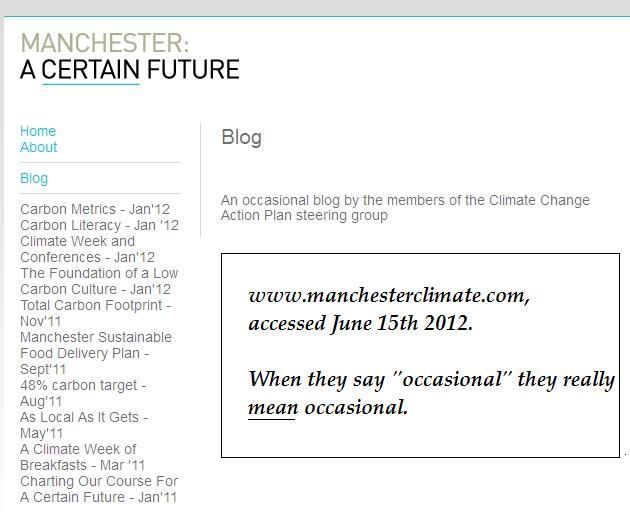
What Steering Group? I see no evidence of a Steering Group. There’s no blog posts, there’s no events, there’s no minutes of their meetings (which are, I’m told “tedious”). There’s no media profile. The only function it serves is as a stab vest for the Council. But I digress…

As ever, what is NOT asked is more important than what is. Surely the right question – the missing question – is this;  “How do you think EAP should relate to other bodies such as the Environmental Strategy Programme Board?” You know, the ESPB that we on the EAP are supposed to have oversight of, so we can be the “critical friend” we were told the Council wanted us to be. You know, the same ESPB whose minutes have not been circulated in ages, or posted on the Council’s website The same ESPB which EAP members are not able to attend. That ESPB.

  • Any other comments?

More than you could possibly imagine. And many of them are useful and constructive, as [the Council] seemed to acknowledge in March, before… ???   But I have – as I am sure you will understand – very little stomach for being a fig-leaf in what is a farcical Potemkin Village of a participatory process. (1)

I look forward to seeing you at the next EAP.

Detailed  feedback will be treated in the strictest confidence and we would welcome any comments you may have.

Yep, we did this one at the outset of this blog post.

Please let me have your comments, if possible, by Friday 15th June.

Not quite “before Easter”, is it?  Still, plenty of time; I mean, it’s not as if Climate Change is any sort of emergency, eh?

Best wishes,

[name redacted]

(1) My apologies for the mixed metaphors. It’s late, and I’d rather be working on the genuinely game-changing idea that four of us came up with in the pub last night.

[EDITORIAL NOTE:  15/6/12, 16:38   I got the pronouns badly wrong in this blog post, and that made the tone wrong (the sarcasm I stand by. The inadvertant personalisation I apologise for to the person this letter goes to). 

I have gone through and removed most “you” with [The Council].  The person who sent the email out was doubtless NOT the person who chose the questions, and who chose not to follow-through on the March 20th “proposal”.  In future – if every I have to write a blog post like this again – I will be much more judicious in my pronouns.  Marc Hudson, who cycled home from work at top speed to try to beat the scheduling of this post, but missed by 6 minutes.]

 

Posted in Democratic deficit, Manchester City Council | Tagged , , , , , , , , | Leave a comment

Something for the Weekend 15 June 2012 #Manchester #Climate

To get your weekend off to a start- a bad joke.

Why do all French people want to hug Obama?
Because President Sarkozy.

In contrast to last weekend we have lots of  events on over the next three days.  First up is the Ending Activism event.

Fri 15, 7.30-9pm, Ending Actvisim. People interested in learning from their mistakes — and other people’s – will gather at the Lass O’Gowrie pub in central Manchester. They will share their experiences and thoughts about climate activism’s past, present and future. “Endng Activism” refers to the ways and reasons people stop “doing” activism. It also refers to our belief that a form of “activism” that has been critiqued repeatedly needs to, well, have people ending it. http://endingactivism.org/

Fri 15, 6 to 7pm Free performance at Royal Exchange Theatre by “Geddes Loom
Geddes Loom fuse spoken word, songwriting, beatbox, story-telling and electronic and acoustic music to create unique and intriguing musical and theatrical performances.
The group currently consists of poet and beatboxer Ben Mellor, singer, writer and cellist Léonie Higgins, and guitarist and all round purveyor of Technology, Dan Steele.

Sat 16, 5–8pm (after Didsbury Festival) Didsbury Dinners is having a vegan-friendly community celebration/BBQ to say “thank you” to all its supporters. “Come and join us to celebrate all that we’ve achieved so far and to find out more about what we’ve been up to. There’ll be free food from our vegan-friendly barbecue, seed planting, face painting and more!” See website here.

Sat 16th, from 7pm Rio+20 Earth Summit Teleconference: Southern Perspectives on Climate Change’ at The Creative Corner Cafe, 14 Milton Grove, Whalley Range, Manchester, M16 0BP Background papers can be found here http://tinyurl.com/bl6f5wk and here http://tinyurl.com/c3lkwj3.

If you know of weekend events that are about “climate” (and that includes food growing, or cycling or whatever), then let us know and we can include them in future “Something for the Weekend”s…

And if you know any jokes of the high standard we’ve used so far, please submit ’em.

Posted in Something for the Weekend | Leave a comment

Event Report: What If… Manchester was as sustainable as Havana?

MCFly co-editor Arwa Aburawa has mixed feelings about  the “What if… Manchester was as sustainable as Havana?”  event at the Manchester Museum on Thursday 14th June.

First to speak was Nadine Andrews of the Transition Network. She started off by looking at the general principles of the transition movement (spiritual fulfilment, social justice and ecologically sustainability) and also mentioned some research she is carrying out which explores the value of the local economy in Manchester. The most interesting point she raised was that, according to the Centre for Cities, Manchester is the most unequal city in the UK and also that if Mancunians spent just 1% more locally in terms of their food shopping they could contribute £22.6 million to the economy annually. With that in mind, Andrews said we need to explore new business models – not in an inward-looking, survivalist mentality but in terms of getting more bang for our Mancunian buck.

Next up was Liz Postlethwaite, who we have interviewed in-depth here, She talked about her experience looking into sub/urban agriculture network in Havana and how it operates. She spoke about the changes that Havana made following the collapse of the Soviet Bloc in the early 1990s which meant they lost huge economic support. In these difficult circumstances, Havana managed to launch an impressive agricultural revolution which was not only lead by the masses but also supported by government policies. People got trained up, communities became self-reliant, cut waste and took ownership of their food production which normally meant organic food on the cheap for all.

Whether this model is replicable is the million dollar question says Postlethwaite, although spending time in Havana and talking to experts there suggests that Manchester needs to come up with its own unique solution to the sustainable food question. Next up to deal with the ‘What if….’ question was Emily Morris of the Institute for the Study of the Americas, and I think her admission that she knew very little about Manchester summed up what wasn’t so great about this event. There was very little said about Manchester – my co-editor may insist that there is very little to say –  but there wasn’t a genuine effort to engage with the question. Given the time constraints and the fact they were trying to get information across about Manchester and Havana, I wonder if it would have been better not to pose such an ambitious questions and then effectively sideline it.

By the time Morris has whizzed through the special set of circumstances that led to sustainable agriculture in Cuba (one of which is that Cubans are more used to participatory politics than the British) there was no time to talk about Manchester. Still, it was interesting to hear how life expectancy rose after the crisis in Cuba and that one minister lost 14 pounds in weight due to food cuts – as she notes, she’d like to see a British politician lose weight due to the economic downturn in the UK and really show that ‘we’re all in this together’. She also hinted that there are tensions in terms of environmentalist championing green strategies in Cuba and those who see the current mode of operation as temporarily necessary and open to change once the right opportunities come along.

The final speaker was Tyndall Centre climate scientist Kevin Anderson. Anderson started off by arguing that although he was supportive of Manchester become more like Havana, he was troubled by concept of a greener, more sustainable ‘city.’ He argued that boundaries are too permeable and things like waste and water are too widely connected to make it possible for a city to be sustainable in isolation. More interestingly, he talked about a tension between the concept of sustainability which he noted is long-term and participatory, and dealing with climate change which he remarked needed coercive action right now.

Anderson said that we are so locked into certain behaviours and our physical infrastructure that we need legislation to start taking our choices away. Not bad legislation that we don’t need but good legislation that sets real, enforceable standards in the way to consume and choose goods. So as well as the bottom-up thinking around sustainability, he argues that as we have abjectly failed to cut our emissions, we need legislation to help us move away from a choice-based society. He added that the ingenuity shown by the Cubans also makes him hopeful that we have the scope for change within us.

Overall, an interesting event. None of the speakers over-ran significantly, however, by the time the floor opened to questions people started slowly making their way to the exit. One way the organisers could have avoided this energy lull would have been to get people talking- either at the start of the event or after the speeches. It was also rather ironic that the top question on their feedback form (for which they should be praised) was about ‘connecting’ people. Still, I think that lots of other people left the event with a lot more questions then when they first came in (not necessarily a bad thing) but not many answers. For example, do we really think that Manchester would ever be willing to learn and embrace radical food growing policies, which forgo economic gain, before a devastating crisis hits the city?

Posted in Event reports | Tagged , , , , , , , | 1 Comment

Event Report: “Business as Usual?” North West Sustainable Business Quarterly

It’s not every day you get to eat free grub while surveying Manchester from 24 floors up. For free! MCFly co-editor Marc Hudson feels the lure of the dark side…

Tonight I attended the latest “North West Sustainable Business Quarterly,” on the theme of “Realising a Green Economy – the social challenges.” These events, organised by the Macclesfield-based M4C, have a pretty straight-forward format. There’s mingling (and some of the aforementioned grub). There’s a brief intro and house-keeping, followed by two talks, followed by a question and answer session. That’s the first hour. Then there’s facilitated round-table discussions, with about 6 to a table, with different themes (you select when you book).

What could go wrong? Well, quite a lot (Murphy was an optimist) ; but tonight not much did. One of the speakers was (more than a) bit overlong and under-structured. Not the end of the world. The food was good, the views from the City Tower (in Bruntwood‘s eyrie, donated for the evening) superb, and the networking dead useful.

Is this “the solution” to climate change? Don’t be ridiculous. Does it claim to be? No. It’s a swapping-of-business cards and mild-expansion-of-intellectual-horizons for people in the field. It’s well-organised, welcoming (even to semi-feral journalists with axes to grind) and well-worth the time of anyone who runs a small business or social enterprise.

The next one is on Thursday September 13th and is on “Why Business should be taking climate change seriously” If you are in business or social enterprise, then hold the date…

Additional points

Table rules were simple: Chatham House rule (you can report what was said, but not who said it), no selling and let everyone have a say. Every event should have these rules!

In the Q and A session I asked “what went wrong with the Rio process [between 1992 and 2012]?” Came the answer-

“Failure of political will… we all got greedy – for the first 15 years life was getting better and better, and we understand now the basis on the which it did that… unfettered corporate power… mechanistic production… mechanistic organisational structure…”

That’s a pretty good summation, imho. “Human stupidity” would be one addition. Others, gentle readers? (Don’t all say “capitalism” at the same time!)

There was a detailed but not insanely-long feedback form, which I suspect they actually learn from.  They’re slick without being intimidating about it…

Posted in Business, Event reports | Tagged , | 3 Comments

Complaint Against Manchester Solar Company Upheld

The Advertising Standards Agency has found an advert circulated by Manchester-based “Beech Solar” to be in breach of ad rules and declared it ‘misleading.”  Beech Solar have so far declined to comment.

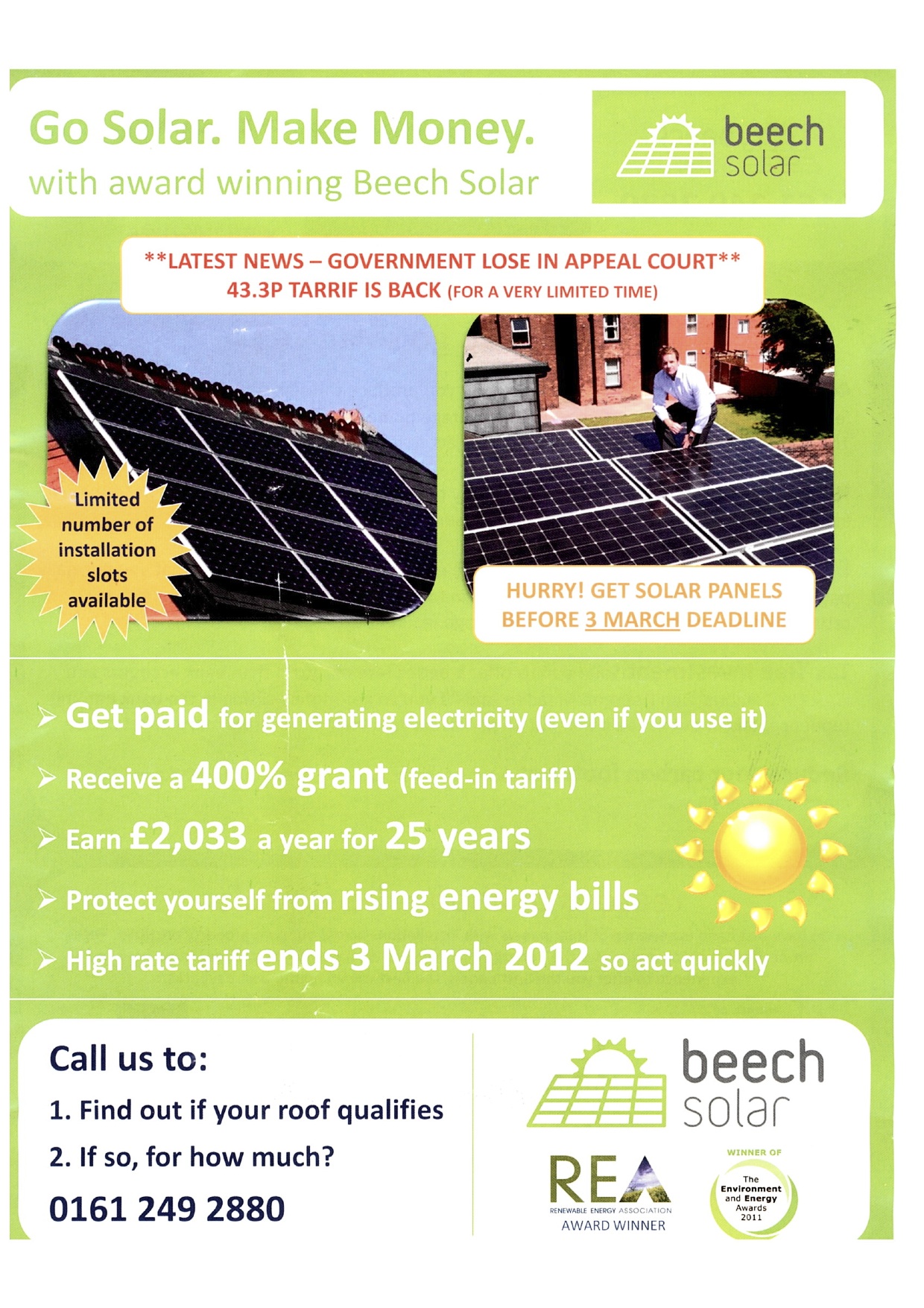
In February 2012, a Manchester Climate Monthly (MCFly) reader got in touch about a puzzling flyer that had landed on their doormat. It was an advert by local solar provider Beech Solar.  The flyer read **LATEST NEWS – GOVERNMENT LOSE IN APPEAL COURT** 43.3P TARRIF IS BACK (FOR A VERY LIMITED TIME). It seems, however, that in their rush to get the flyer out Beech Solar not only misspelt the word tariff, but also misled customers.

A little background is necessary. At the time, campaigners such as Friends of the Earth and SolarCentury had challenged the government’s decision to cut solar subsidies in half (11 days before the end of consultation) and won the support of the high court. However, the Department for Energy and Climate Change appealed against that decision in January 2012 and so the original 43.3p tariff rate was not in fact guaranteed until the final decision had been made. This final decision came in March. Luckily, the government failed to get permission to appeal the High Court decision and so the lower tariff rate only applied for solar installation from April. The crucial point, however, is that when the flyer was published, Beech Solar didn’t know that.

The High Court could have allowed the government’s appeal. In this case, the rate Beech Solar promised their customers would not have applied. Despite this, Beech Solar advertised the 43.3p rate almost as a dead cert. Although they explained on the flyer that the government was appealing, the Advertising Standards Agency (ASA) found that this “contradicted the impression given by the headline claim that the 43.3p tariff would definitely be available for installation before 3 March and therefore conclude[d] that it was misleading.”

The ASA added: “We understood from advice issued by the Energy Saving Trust that the tariff of 43.3p/kWh, for installations with an eligibility date between 12th December 2011 and 3rd March 2012, could not be guaranteed and that homeowners should plan on the basis that, at the very least, they would get 21p/kWh.”

The local solar company, which is a member of the Greater Manchester Chamber of Commerce, has won various green awards and accolades. It has been certified as carbon neutral by carbonneutral.com. They were winners at the 2011 Renewable Energy Association and the Environment and Energy Awards. The ASA has asked that the ad not appear again in its current form.

We contacted Beech Solar on several occasions but they failed to provide a comment for this story.

Arwa Aburawa

Posted in Energy | Tagged , , , , | Leave a comment

Getting kids to save energy, or, “Nuclear Power Kills!!”

Getting people to cut their energy usage can be tough.  “Behaviour change” this, “moral exhortation” that, “carbon literacy” up the wazoo.  Well, from now on, we at MCFly are going to use the following technique to convince all the children we have brought into the world to reduce their energy consumption. Simples.

[Saturday Morning Breakfast Cereal rocks!!]

Posted in education, Energy, humour | Tagged , , , | 1 Comment

Newsflash: Council report on Steady State economics published, to be discussed June 20th 9.15am onwards

BREAKING NEWS: Manchester City Council last night pubished a seven page report on steady state economics. This report will be discussed at a meeting that is open to all members of the public on Wednesday June 20th from 9.15am, at Manchester Town Hall.

The Economy Scrutiny committee will hear the report and then quiz its authors . They will then hear from some of the 11 people who offered to work – for free-  with the council on producing the report (this offer was not, in the end, acted upon in any meaningful sense).

This will be followed by three workshops (to contain a mix of officers, members of the committee and members of the public) on “Green Jobs and Skills,” “Green Business,” and “Green Investment.”

The meeting is free, open to the pubic, and does NOT require booking.  [See the agenda here.] More information and analysis of the report will be published in the coming days.

Manchester Climate Monthly urges people to attend. If you need some breakfast to fortify yourself beforehand, come join us in the Wetherspoons’ pub “The Waterhouse” on Princess Street from 8.30am.

UPDATE:  There will be a meeting on the evening of Monday 25th June for people who were at the meeting – and especially for people who were not able to attend – to come together to talk about what we, citizens of Manchester, do next.  All welcome.  The room, at the Friends Meeting House, 6 Mount St, is booked from 6 to 9pm, so you can drop in after work or come from home.  (The idea is to come when you can, not for the whole three hours!!)

Posted in Climate Change Action Plan, Democratic deficit, Manchester City Council, Upcoming Events | Tagged | 1 Comment