Volunteer Opportunity: Auditing MMU

This may not seem so sexy, but think a) of how good it will look on your CV, b) of how much you’ll learn and c) the warm inner glow (insulated) of having helped make Manchester just that tiny smidgin greener…  If you’re not interested, please forward on to people who are. Here’s the advert;

Do you want to……

Take practical action towards creating a sustainable planet?

Learn new skills?

Gain an insight into Manchester Metropolitan University’s national leading behaviour change programme?

MMU is looking for volunteer auditors to visit our Green Impact Teams and conduct environmental assessments of their work.

What is Green Impact?

You will be taking part in our national leading behaviour change programme that encourages staff to take actions to reduce their carbon emissions through competition. We have recruited 67 departments, influencing the behaviour of 2128 staff members, approximately half of MMU’s total employees! This is the largest number of Green Impact Teams active in any participating organisation. For more info click here and here.

What do I have to do?

Each volunteer auditor will be fully trained on the criteria and what they need to audit through a half-day of training session. In pairs auditors will then complete one or more audit. An audit should take between one and two hours to complete depending on the size of the department.

Audits will take place at the following dates, times and locations:

Wednesday 14th March 2012, All Saints Campus (Oxford Road),  John Dalton Room E317, 09:30 – 12:00, lunch from 12:00 – 13:00 audits to start around 14:00 – 16:00

Thursday 15th March 2012, All Saints Campus (Oxford Road), Sandra Burslem Room 3.03,09:30 – 12:00, lunch from 12:00 – 13:00 audits to start around 14:00 – 16:00

Tuesday 20th March 2012, All Saints Campus (Oxford Road), Righton Building Room 115, 9:30 – 12:00, lunch from 12:00 – 13:00 audits to start around 14:00 – 16:00

Wednesday 21st March 2012, All Saints Campus (Oxford Road), John Dalton  E317 9:30 – 12:00, lunch from 12:00 – 13:00 audits to start around 14:00 – 16:00 (Labs criteria)

How do I apply?

Please email laura.williams@mmu.ac.uk with your availability according to the dates specified.

Posted in academia, volunteer opportunity | Tagged , | Leave a comment

Manchester Climate weekly nuggets #2

Hi all,

A busy week ahead (see calendar below). Just a reminder- if you want to start writing or volunteering for MCFly
a) you’ll be joining a growing band of folks
b) all you have to do is email us – mcmonthly@gmail.com

Please encourage your climate-concerned friends to take out a (free!!) subscription to the blog/newsletter – via our subscribe page.
If they need convincing, here’s a 40 second video explaining the top ten reasons folks should subscribe
And follow us on twitter (@mcr_climate).

Coming up this week (see our March 2012 calendar page for more info)

Mon 12th, 6pm Using the “Activist Skills and Knowledge” framework, at the OKasional Cafe (Gamecock Pub)
What is it?  How does it work?  An opportunity to try out an early version of a tool for finding out what you already know and can do, and then sharing those skills and knowledge with other people
Length – 60 to 90 minutes

Mon 12, 6.45 to 8.30Engineering Solutions to the Energy Crisis. Mike Koefman, Lauren Collins and James Woudhuysen will introduce a discussion on how science can help engineer solutions to the looming energy crisis
Manchester Salon. £5/£3. Book here.

Tuesday, 13th, 5pm – 6pm
‘Emissions and Energy Scenarios – A Focus on the UK’ A talk with Maria Sharmina
Room 4, University of Manchester Students’ Union, Oxford Road, Manchester, M13 9PR

Tuesday 13th, 6-8pm Eco Streets: Celebrating South Manchester’s commitment to tackling climate change
ZION Arts Centre, 335 Stretford Road, Manchester, M15 5ZA
This celebration event will showcase the work of the nine successful Eco Streets projects in South Manchester.  Projects include food growing at Fallowfield’s secret garden and education and learning at the new Chorlton Apiary at Scott Avenue Allotments.
For more details please contact Rachael Stoney at Groundwork on 0161 220 1000 or Rachael.stoney@groundwork.org.uk

Tuesday 13th 6-8pm  GreenSpirit Greater Manchester
Friends Meeting House, 6 Mount Street, Manchester, M2 5NS
This year GreenSpirit Greater Manchester will be hosting an event in the week leading up to the Manchester: A Certain Future conference. It will be a chance to feed our ideas and thoughts into the main conference. It will be an informal and fun evening, with a bring-and-share supper held at the Friends Meeting House.
If you would like to come along or find out more, please contact Nicola Percival on 01625 572894 or email Nicola.percival@soulsustainability.co.uk

Tues 13th, 7.00p.m. (refreshments will be available from 6.30p.m.)
Famine and Food Security – does Genetic Modification have a role to play?
Cockroft Lecture Theatre, Manchester Conference Centre
You are invited to join an open discussion and question time on the theme of Famine and Food Security. This discussion will bring together experts to look at this topic and also to examine what role, if any, there is for genetically modified produce in addressing the issues of Famine and Food Security.
This event is a joint venture between the British Council and the British Science Association as part of a series of British Council Dialogue events.
Confirmed speakers are:
Kidist Kibret (University of Nottingham) – an Ethiopian student conducting research into yams as a food diversification strategy
David Hall-Matthews (University of Leeds) – the social and political causes of famine and food security
Christine Foyer (Centre for Plant Sciences, University of Leeds) – biotech approaches to improving crop yields
Booking is not required.
Questions can be submitted on the night or in advance to Addam Merali-Hosiene, Regional Officer for the North of England for the British Science Association on 0161 306 1599 or
addam.merali-hosiene@britishscienceassociation.org

Tues 13 March 6.45 for 7pm til 9pm, The Behavioural Challenge of Climate Change: Where we are at, and where we need to be’. A discussion of the latest climate research and some solutions to address the challenges.
Hosted by Manchester Friends of the Earth. Speakers:Prof Kevin Anderson, Director, Tyndall Centre for Climate Change.- talking about latest research, current understanding and projections for the future to understand the scale of the challenge.
Friends of the Earth national campaigner  Mike Childs- talking about Friends of the Earths current strategy and choice of campaigns to address the challenge.
Dave Coleman, Director, Cooler Projects CIC- talking about how Manchester as a city is responding to the challenge via the Manchester Carbon Literacy Project.
Public Discussion,  Everyone welcome, refreshments provided.
Green Fish Resource Centre, 46-50 Oldham Street, Manchester M4 1LE

Weds 14 March, 10 to 4pm
“Community Rights Made Real Workshop” – Tameside
Free! Book here.

Weds 14 March
cities@manchester Inaugural Lecture
Professor Ash Amin (University of Cambridge): Q&A and Public Lecture
1-2.15pm: Q&A with Ash Amin, Cordingley Lecture Theatre
Kevin Ward (Professor of Human Geography) will lead an informal Q&A session with Prof. Amin about his work, career and publications.

5-6.15pm: ‘Resilient Urbanism’- Lecture by Ash Amin, Chaired by Stephen Milner, Serena Professor of Italian. Cordingley Lecture Theatre. Followed by a wine reception.

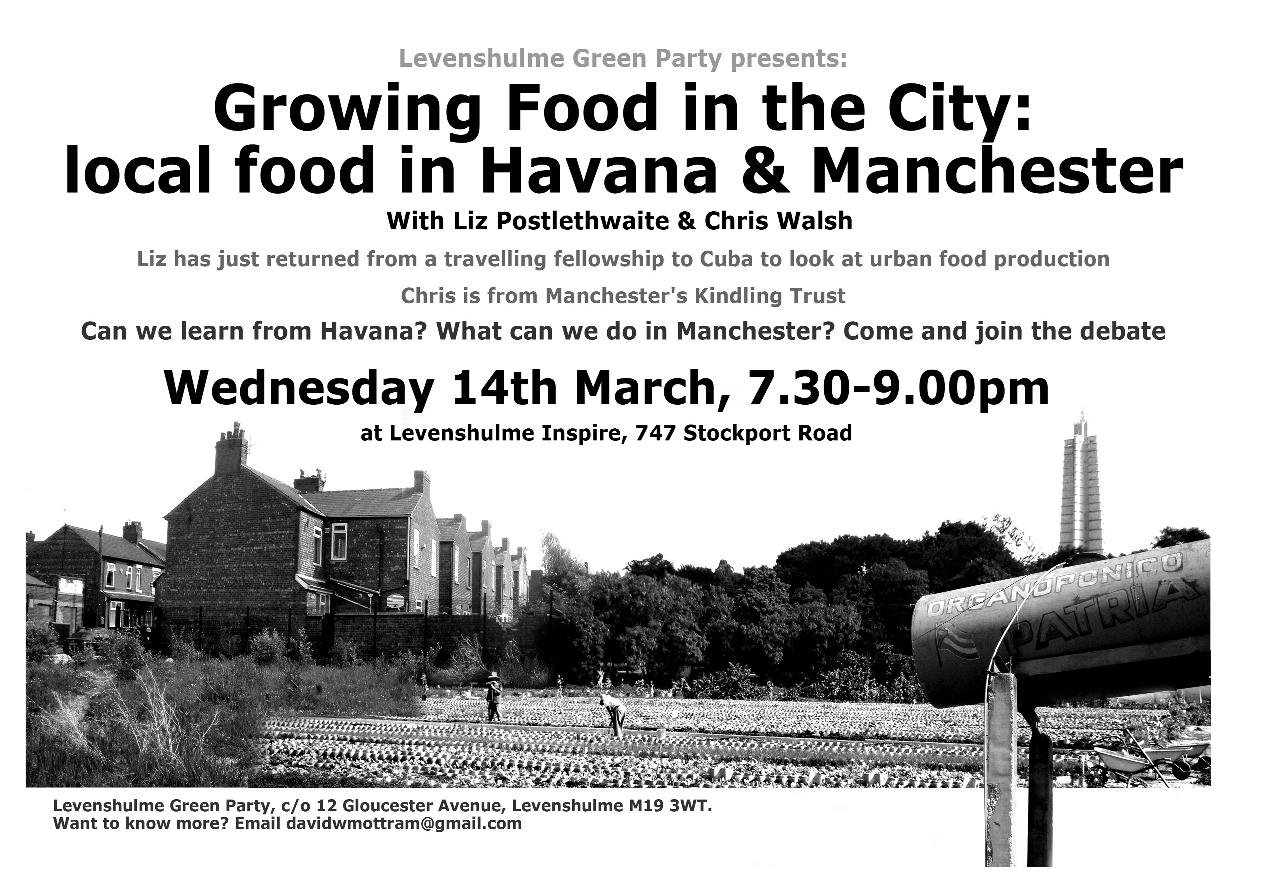
Weds 14 March, 7.30pm to 9pm Growing Food in the City: local food in Havana and Manchester Levenshulme Inspire, 747 Stockport Rd organised by Levenshulme Green Party.
Thurs 15th, 1-2pm cities@manchester brownbag :‘Creating a sustainable Manchester: can the UK’s first industrial city blaze a trail for sustainable living?’ Mike Reardon, former Strategic Director, G.M. Environment Commission, University Place, 5.204.

Thursday 15th, 6.30 to 8.30 Carbon Coop and retrofit options…
Yard Theatre Work for Change, 41 Old Birley Street, Hulme M15 5RF
Free, informal, food provided
Places are limited, RSVP: info@carbon.coop or call 0161 408 6492

Friday 16 March Stakeholder Conference, 12.30 to 5.30 at MMU. Sold out


MCFly stories you may have missed

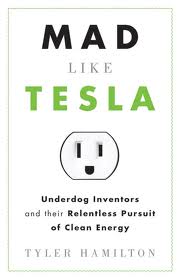
Book Review: Mad Like Tesla; Underdog inventors and their relentless pursuit of clean energy
Event Report: Going Beyond Dangerous Climate Change
Manchester misses out on Green Investment Bank
Interview: Urban Agriculture in Havana… and Manchester?
Interview: Energy and Emissions Scenarios

Lessons we like to believe we’ve learnt this week
Everything takes longer than you think it will.
You cannot porofread your own work.

Grab the money and run
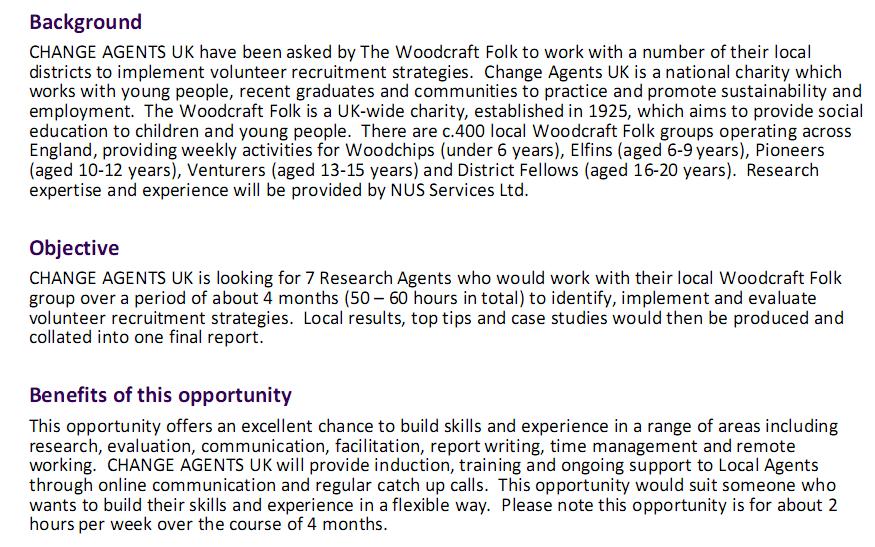
Job Alert: Researching “volunteer recruitment strategies” CLOSES TUESDAY 13th

Jobs that need doing!
Could someone trawl twitter for groups MCFly could follow?
Could someone audit MCFly to see how much we are writing about people who don’t happen to be white males?

Local and Regional News

Mon 5th The Co-operative creates a million quid fund for renewables (MEN story)

and speaking of outfits that support Manchester Airport…
Friday 9th Flybe adds 86 flights a day
Reading and Watching

According to the stats this video starring Richard Leese talking about the climate change action plan, has only had 55 views. Shreuly shome mistake?!

Can Organic Farming Feed the World? asks the Soil Association (hat-tip to obsessive compulsive commenter Patrick Sudlow)

Joe Romm at Climate Progress takes a look work by Ken Caldeira and tech guru Nathan Myhrvold on the impact of switching from coal to natural gas and finds it a bridge to nowhere.

“…a switch to natural gas would have zero effect on global temperatures by the year 2100. “If you take 40 years to switch over entirely to natural gas,” he said, “you won’t see any substantial decrease in global temperatures for up to 250 years. There’s almost no climate value in doing it.”

“The most surprising thing we found,” lead author Nathan Myhrvold told me recently, “is that unless you switch to a form of energy that cuts emissions really drastically” — and he isn’t talking about any piddling 50%, either — “you basically don’t get any real effect.”

Changing Climates, Changing Minds: The Personal – account from Skeptical Science of a geologist’s conversion. Very well worth reading!

If you’ve not seen the Greenland icesheet, you may want to fly up to take a look before it’s all gone (Ok, that’ll take hundreds of years-ish)

Posted in Weekly bulletins | Leave a comment

Book Review: Mad like Tesla, Underdog Inventors and their Relentless Pursuit of Clean Energy

Book Review: Mad like Tesla, Underdog Inventors and their Relentless Pursuit of Clean Energy
Hamilton, T. 2011, ECW Press, Toronto, Canada

Wind turbines, photovoltaic cells, biofuels, tidal power… yes, yes, same old, same old… We know renewables exist, what they look like, how it will happen – albeit rather slowly – tell me something new. Well here it is: “whatever they’ll think of next” is coming to a street near you.

The author of this really interesting book is a Canadian journalist (not the sportsman by the way) with a huge interest in clean technology and renewable energy in general; he has been indulging his interests in his blog Clean Break for the past few year, and decided to expose some of the most varied and promising ideas in a book.

In his view, these driven and visionary researchers, challengers of the “ it cannot be done” mantra, may bring us tomorrow’s essential technology, just like Nikola Tesla who was well ahead of his time (magnetic fields, AC current, wireless communication etc), but was also regarded as mad by some.

Alternating between technical explanations and stories about the entrepreneurs and their difficulties, the concepts are so unusual you cannot help but keep on reading. Here you will find the most eclectic range of energy production, from bizarre to mysterious, to… well, seemingly wacky or unlikely… See for yourself:

  • Believe it or not, someone is thinking about creating huge man-made tornadoes – under very controlled and rigorous circumstances you understand- to run turbines generating electricity.
  • Another company is looking at launching serious mirrors and solar panels into space, converting the electricity generated in situ into microwaves. These would be beamed back to receiving stations on earth 24/7- where they would be turned back into electricity.
  • Efficiency could – and should- also be part of the equation, so someone has managed to copy nature’s perfect spiral shapes to build state-of-the-art, high efficiency propellers and turbines based on fluid dynamics,
  • A new type of incredibly efficient lightweight rechargeable ceramic batteries using ultracapacitor technology is being developed in great secret in Texas. These promise lightweight, clean, safe usage as well as hyper-fast recharge and long-life ….
  • My real favourite though was Algenol’s process from blue-green algae, converting salty water and CO2 into water and ethanol: surely this would be a fabulous development to multi-task in this way and reduce CO2 whilst providing drinking water and greener energy.

There are a few more ideas in this book, all of which with the real potential to change the world forever – because do not be fooled: although these ideas may seem extreme or strange, we are not talking about nutty professors in their garden sheds here. Every one of these technologies is being prototyped, produced and tested as we speak. It is true that funding issues, development and scale are forever mentioned throughout, but these companies are successful, have marketable patented products and carry on with their research because as you would expect their potential is huge despite the mountains to climb.

After all, incredibly novel and unlikely devices, the stuff of science-fiction, ended up in our pockets within a few decades, so why not expect these will too?

Laurence Menhinick


Posted in Book Review | Leave a comment

Event Report: “Going Beyond Dangerous Climate Change”

“Going Beyond Dangerous Climate Change: Exploring the void between rhetoric and reality in reducing carbon emissions” – A talk by Professor Kevin Anderson on Tuesday 6th March 2012

Professor Kevin Anderson gave a very honest talk on ‘dangerous climate change’ hosted by Manchester Environmental Students Society. He highlighted the current situation in regards to climate change and the (very low) likelihood of us staying within the 2°C limit for average global warming. One key point was that we must look at cumulative emissions rather than year by year. He explained how, over a century, we have a carbon budget so the longer we take to reduce our emissions now, future cuts will have to be more rapid and therefore less achievable. He stressed the urgency to reduce our emissions now as it will make it easier to achieve the 90% reduction in emissions by 2030 which would probably restrict warming to below 2°C.

Kevin pointed out that even a change of 2°C would drastically alter our climate including the total disappearance of artic sea ice in the summer. It seems more likely that we may hit a 4°C increase with the current rate of emissions. Although this does not sound like much, it would result in widespread detrimental effects to our environment.

To conclude, Kevin spoke of the potential for mitigation of 4°C change and the need for improvements in efficiency, better regulation and behavioral change away from mass consumerism. Kevin’s talk may not have been as optimistic as other speakers on climate change, but his bare representation of the facts made it clear that we will have to make some very serious changes…very soon.

By Kate Matthews and Rachel Carr

Kevin Anderson is also speaking next Tuesday, 13th March, at “The Behavioural Challenge of Climate Change: Where we are at, and where we need to be” a free event organised by Friends of the Earth.

Posted in academia, Event reports | Tagged , | 1 Comment

Something for the Weekend #4

Two cannibals are eating a clown.
One says to the other “Is it just me, or does this taste funny?”

And in Manchester this weekend, you can pick up litter or you can swap seeds…

Sunday 11th 10:30 am Scrub removal on the Hardy Farm SBI with Friends of Chorlton Meadows. Meet: Jackson’s Boat Bridge Note: Jackson’s Boat pub car park is for pub customers only. Please park either at the Sale Water Park Visitors’ Centre or in the Chorlton Green area and walk from there). If you have any questions, please e-mail Dave Bishop davegbishop@aol.com or phone 0161 881 6276

Sunday 11th, 2pm to 4pm, Transition Moss Side are doing a seed swap at the Cranswick Triangle. See here for more details.

Posted in Something for the Weekend | Leave a comment

Job Alert: Researching “volunteer recruitment strategies”

Change Agents UK tell us that they “have a number of verypart time (but paid) local opportunities around the country working on a research project.  Due to the nature of the roles it would ideally suit someone already living in (or at least very near to) one of the local districts – Manchester [etc…] .  The role will entail approximately 50 hours work spread over 4 months, could be completed alongside your current studies or other work engagements.

The deadline for application is next Tuesday (13th March) so please read through the attachment and if you are interested please fill out this link asap – https://www.surveymonkey.com/s/LocalResearchAgents.”

[Recruiting and retaining volunteers is a topic close to MCFly’s heart, btw. So if you’ve got ideas, send them to us!!]

Posted in Job Alert | Tagged , | Leave a comment

Manchester Loses Green Investment Bank Bid

Edinburgh and London were chosen as the two cities to host the Green Investment Bank and Manchester came in a close third

After a couple of tense weeks (the decision was due end of February), it has been announced today that London and Edinburgh will be jointly hosting the Green Investment Bank. The bank’s headquarters will be based in Edinburgh and the main transaction team will be in London. The Green Investment Bank, which aims to encourage investment in low-carbon technologies such as renewables and recycling, is expected to employ 50-70 people.

We contacted John Ashcroft, chief executive of pro.manchester, who represented Manchester’s bid for the Green Investment Bank for a comment:

“We welcome the commitment of the government to the Green Investment Bank and the ambition to create a world leader in it’s field. Naturally we would have preferred the bank to be located in Manchester but our recent success with the bid for the £50 million Graphene centre offers some consolation.

Edinburgh like Manchester has a thriving green sector and respected expertise in wealth and asset management. London, as the world’s leading financial centre, will ensure that the GIB’s transaction team can hit the ground running.

Unlike some we do not see the decision as a political sop to Scotland to ward off devolution. No more in fact than the decision to repatriate the Stone of Scone.”

Over the next three years, the bank will have £3 billion to lend and should be able to leverage a further £15 billion from April 2015. However the decision not to allow the bank to borrow from the get-go has been criticized.

Friends of the Earth’s economic campaigner David Powell said in a press release:
“Choosing the HQ for the Green Investment Bank has been like arguing about where to put the cherry on a half-baked cake. This is great news for Edinburgh, but George Osborne’s inadequate support means it will start life as a lame duck. The Chancellor’s Budget must free the bank from his vice-like grip by allowing it to borrow and lend from the markets from day one.”

Arwa Aburawa
Mcmonthly@gmail.com

Posted in Business | Tagged , | Leave a comment

Interview: Urban Agriculture in Havana… and Manchester?

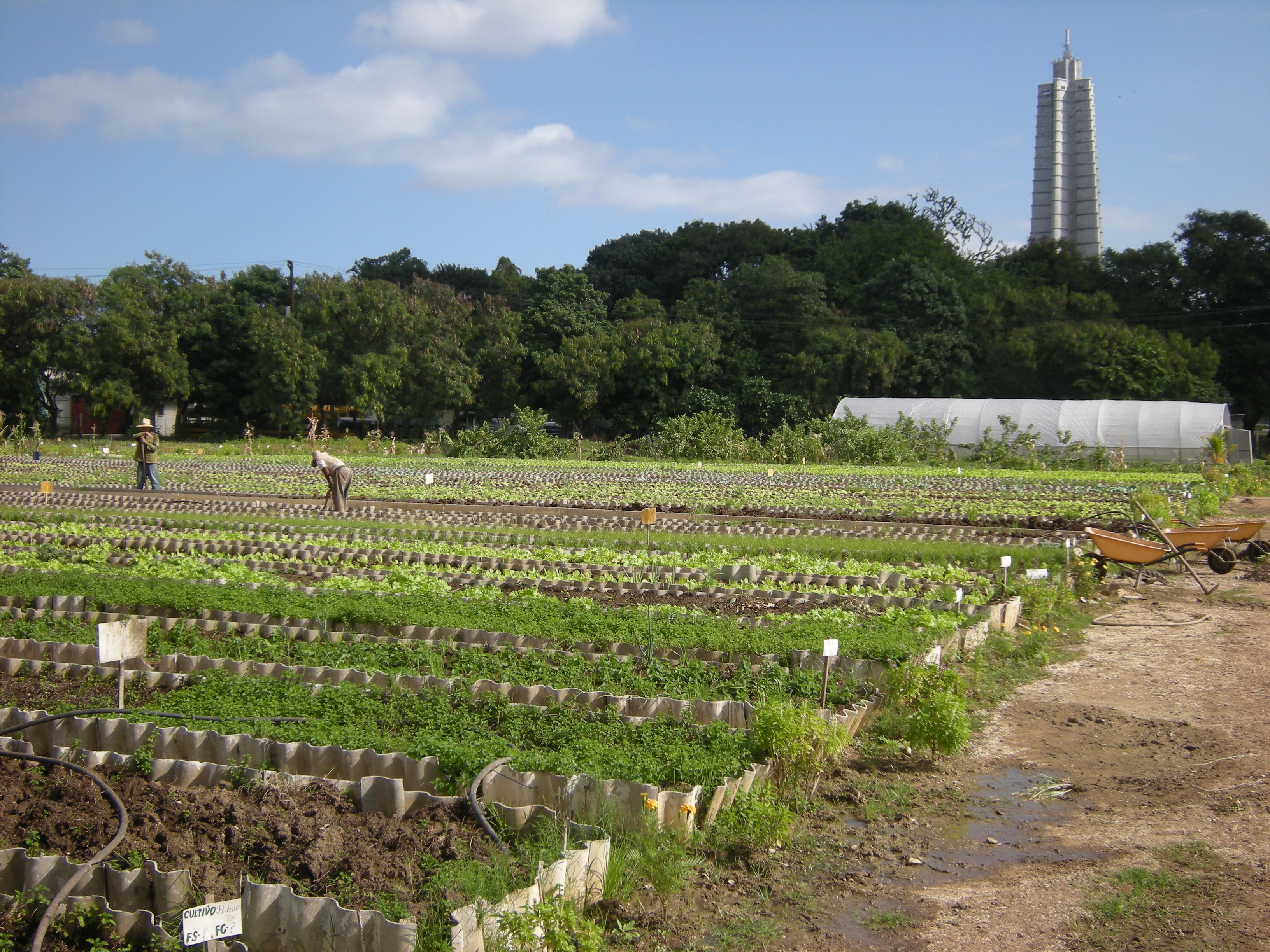
Liz Postlethwaite, who is giving a presentation at Levenshulme’s Inspire Centre on Wednesday 14th March about her trip to Cuba looking at urban food production, answers some questions about the project.

Could you tell us a bit a about why you went to Cuba and what you’d already been doing around food issues in the UK?
Through the kind support of the Winston Churchill Memorial Trust I was lucky enough to spend a month at the end of 2012 in Cuba learning more about their Urban Agriculture systems. This something that they have developed since the early 1990s when their economy and agriculture collapsed meaning they had to design new ways to feed their population. As over 70% of the Cuban population now live in cities Urban Agriculture has been a key part of this development. The urban food systems that the Cubans have developed are world class and now other countries from all over the world are looking to Cuba to learn more about how they may do the same.

Prior to my trip to Cuba my main link to food issues in the UK was growing my own food on my allotment in North Manchester, playing a part on the management committee of my allotments and writing about organic food on my blog. However, working in the cultural sector with predominant focus on creative community development it was becoming increasingly clear to me that food production needed to start to pay a more prominent part in the cultural life within Manchester and other urban communities in the UK. I felt this to be important in terms of improved food security within our communities but also as a crucial cultural activity that has the potential to play a key part in strengthening and reinforcing cultural identity, and increasing connection to nature and natural processes.

In addition to this it is my belief that Urban Agriculture has huge potential as a catalyst in the reinvigoration and reinvention of urban communities, in particular communities within post-industrial cities, many of which have faced significant challenges attempting to fill the social and economic gap left following the end of more traditional industry.

What was unexpected in your visit – what surprised you?
I don’t think I can say that anything about my visit was particularly unexpected or surprising. I had high expectations prior to my trip but trying to secure my visa involved a long and engaging planning process which put me in touch which lots of local people so I feel that my expectations were fairly realistic. Maybe I could say that the biggest surprise was the fact that all of these expectations were far exceeded when I was in Cuba.

The level of knowledge and expertise in urban farming on all levels is exceptional – from the national head of urban agriculture to small food producers working directly in local communities to grow food.  I was also amazed by the kindness, hospitality and openness of the Cubans that I met along my travels. I had so many fascinating conversations with people of all ages on a huge range of subjects from David Cameron and the credit crunch to the BBC World Service and it was some surprise to me that people, many of whom were strangers who came up talking in the street, were willing to be so open and articulate about their thoughts around politics.

If you went again, what else would you want to see, what else would you want to ask?
I certainly hope to go back to Cuba again in the future. I would like to catch up with all the friends that I made and follow up on their projects. I would also like to learn more about Permaculture in Cuba if possible – a subject that I did not get to investigate in that much when I was there but which is a very interesting and active area of work, in particular through organizations like Fundacion Antonio Núñez Jiménez de la Naturaleza y el Hombre which is one of the most active permaculture organizations in Cuba.

I would also like to look at ways to build links with Cuban Urban Agriculturalists to use their expertise to support the development of Urban Agriculture here in the UK. It would also be amazing to look at ways that we could support their work in Cuba. For example, Cuba would be a perfect climate to use solar panels to power water pumps and other simple technology on their urban food sites. However, at present Cuba has no access to this kind of technology due at least in part to the blockade of the island. It would be great to see if there are ways we can support groups to access this kind of simple equipment that would hugely improve the ease of much of the work that they need to do.

What “lessons” are there to be learnt from what is a very different social and economic environment in Cuba?
A couple of different things spring to mind:

  • That infrastructure and support is essential to develop any kind of successful urban food production system.
  • That knowledge and the sharing of knowledge is one of the most important factors in the development of Urban Agriculture.
  • That food producers are essential parts of our communities and should be valued and nurtured accordingly – it does not matter if food is organic or free range if the person that has produced it has not been treated with respect and dignity in doing so.
  • That allowing people to retake a significant control of their local food chain and supply has the potential to make profound positive changes within local communities, and improvement in quality of life in a whole number of different ways.
  • That people all over the world are fussy eaters – for example many Cubans love apples (which won’t grow in their climate!) and would happily swap them for local grown tropical fruit any day. Any Urban Food system has to try and provide a mixture of what people have to eat due to seasonality combined with at least a bit of what they want to eat through personal taste.

What you are doing in Manchester around food? Can people get involved with what you are doing, and if so, what sorts of things would they find themselves doing.
If you want to learn more about my trip to Cuba the trip is being documented on my blog www.organicallotment.typepad.com where you can also learn more about organic food production and permaculture on my allotment. I will also be doing a talk about the trip in Levenshulme on 14th March from 7.30pm – 9pm at Inspire at 747 Stockport Road.

I also run a creative social enterprise called Small Things that is developing a number of different projects around food and cultural identity. You can out more about these projects at our website www.smallthings.org.uk

Finally, I am always looking for new projects to get involved in and support. If you are developing a community food project that you feel could benefit from my support I would be happy to come and speak to you about how I may be able to get involved. My email address if hellosmallthings@gmail.com

Anything else you’d like to say?
If you are interested in learning more about Cuba have a look at:
British Cuba Solidarity Campaign http://www.cuba-solidarity.org/

Manchester Cuba Solidarity Campaign http://cubasolmanchester.blogspot.com/

And if you have an idea for research that you would like to do overseas:
Winston Churchill Memorial Trust http://www.wcmt.org.uk/

Addendum: The event on the 14th is free, and will also include a talk by Chris Walsh of Kindling Trust. For our report of a previous event with the same two speakers, see here.

Further Addendum: A prolific commenter has suddenly developed shyness, and sent this to our email: “I thought I would forward this article to you, in support of your recent article, as some people believe the hype of the giant agrochemical companies.
http://www.rodaleinstitute.org/20100827_drought-tolerance-critical

Posted in Food | Tagged , , , | 2 Comments

Interview: UK emissions and energy scenarios

Maria Sharmina, Doctoral Researcher at the Sustainable Consumption Institute and affiliated to Tyndall Centre Manchester, answers questions from MCFly volunteer Kate Matthews, ahead of her “lecture and a curry” on Tuesday 13th March at the University of Manchester Students Union (all welcome!).”

What are your thoughts on current UK emissions targets?
The UK emissions target is, at the moment, 80% reduction by 2050 compared to the 1990 level and there is a pathway consisting of four carbon budgets to achieve that target. I think the budgets are a really good idea and they were introduced after the Tyndall Centre did research on carbon budgets so it was an incentive. The over-arching targets itself, 80% by 2050, doesn’t seem very informative because it is an end-point target and is based on annual level of emissions compared to the carbon budget. In the talk [on Tuesday 13th] I am going to discuss why it is better to use the carbon budget rather than the end-point target.

Even with even with these targets there is currently a planning application for a new coal-fired power station in Scotland, do you think these targets are achievable?
I think there is a lot of hope put on Carbon Capture and Storage, it is like a technology that sucks out carbon dioxide in coal plants so implicitly this CCS technology is incorporated in many scenario studies that underlie governmental policies so if this technology is developed then yes it is going to work out. But it is unexplored and a lot of investment is being cut in this area so it does not seem very hopeful.

What are your thoughts on the use of alternative fuels such as biofuels?
Biofuels are quite controversial because they have implications for land where you have to grow the product. Taking land to grow crops has implications on land for food.

How much of a role would you say the public plays in helping reduce emissions?
Not so much, scientists mostly who try to push policies based on science rather than the public. The public often does not know what is happening and also because many academic papers are not available to the public, they are not open access, not everyone knows what is happening.

If you could change one thing about how we as a society have responded over the last ten years, what would it be?
I think I would push for open access so that people can access information, there is quite a scandal going on right now. It is about the publishing houses who make lots of profit out of publishing academic research like on subscription to the university libraries but at the same time they do not provide much additional value on what they charge, so now there is a huge petition against those publishers, especially Elsevier and a few others. [see boycott site here.]

What are the consequences of failure to act?
Well climate change obviously; it could be runaway climate change when it becomes out of control I mean there are quite a few projections now about the 2®C that could probably increase up to 4®C by 2050, and if you heard about the 2®C target which is widely accepted everywhere it already seems outdated if you look at those projections. [See Four Degrees conference]

Posted in academia, Energy, Mitigation, Upcoming Events | Tagged , | Leave a comment

Got a climate question? Ask a climate scientist!

You’ve three, count ’em 3, opportunities to ask real live climate scientists your questions in the coming weeks.

The ubiquitous and somewhat dishy (so the wife of one of the editors says) Professor Kevin Anderson, deputy director of the Tyndall Centre is available to answer your queries twice. On Tuesday 6th March, from 5pm he’s ‘Going Beyond Dangerous Climate Change: Exploring the void between rhetoric and reality in reducing carbon emissions’ Room 3, University of Manchester Students’ Union, Oxford Road. On Tuesday 13th from 7pm he’s part of a panel discussion organised by Friends of the Earth, at the Greenfish Resource Centre, Oldham St, City Centre (see MCFly #3 calendar on page 8 for details).

Earlier on Tuesday 13th, from 5 to 6pm, Maria Sharmina, also of the Tyndall, gives a talk with Q and A on ‘Emissions and Enery Scenarios – A Focus on the UK’ Rm 4, University of Manchester Students’ Union, Oxford Rd. All these events are free, and will be blogged by MCFly writers. After attending one or more of them, please ponder the Sven Lindqvist quote from the beginning of his book ‘Exterminate All the Brutes’:

 “You already know enough. So do I. It is not knowledge we lack. What is missing is the courage to understand what we know and to draw conclusions.”

Marc Hudson
Mcmonthly@gmail.com

Posted in Uncategorized | Leave a comment