Newsflash: Stakeholder Conference venue announced

The Climate Change Action Plan Stakeholder Conference date and venue have now been announced. However, you will have to wait another “couple of weeks” to actually book your place – that’s if you have any annual leave (and patience) left…

Constant readers will recall that we have been following the progress around the stakeholder conference for the “Manchester – A certain future” plan for quite a while. In November 2010 the first ‘annual’ conference was held. No follow-up to attendees, nothing on the manchesterclimate.com website. No conference in 2011. So, you can probably understand our frustration at the time it has taken to announce:
a) That the conference is happening, even if it is in the following year
b) That it will be on Friday 16th of March 2012

We can now also announce that it will be taking place at Manchester Metropolitan University’s Pennine Suite in the All Saints Building, on Oxford Road. Capacity is just 150 people so it’s not going to be a mega-conference – Steve Connor who heads the steering committee in charge of organising the conference has said in the past that he wanted to keep the conference small…

Saying that, I was told today that people will have to wait another couple of weeks before they will be able to actually book themselves in for this conference. Although full details of the stakeholder conference will be released on Monday, potential attendees will not be able to book, or get a confirmation until the following week. That means people could end up with just five weeks to try and book their place at the conference and then try and get the time off work.

And all that during the end of March, when most people will have taken all their time off before the new financial year.

On second thoughts, 150 might be a stretch target…

Arwa Aburawa
Freelance Journalist
mcmonthly@gmail.com
 

Posted in Climate Change Action Plan | Tagged , | Leave a comment

Event Report: Waste is a beautiful thing to mind

The chair of the Greater Manchester Waste Disposal Authority today launched a shameless (and successful) bid to grab headlines.

Cllr Neil Swannick (Labour, Bradford ward), a former Executive Member for the Environment for Manchester City Council, was giving a report to the Greater Manchester Combined Authority (or was it the Association of Greater Manchester Authority? We’re just a MCFly drowning in alphabet soup) Executive about the budget for the Waste Authority.

He stated his report was “the same story I’ve been telling every year, to anyone who’ll listen,” namely that the GMWDA is locked into a 25 year Private Financial Initiative contract. Fortunately, said Cllr Swannick,  the construction period of this is almost complete, and Greater Manchester will have “world class facilities for the next 25 years.” Cllr Swannick pointed out that 94% of the money raised via council tax goes to the PFI, with only two percent going to debt charges and the remaining four percent going to the running costs of the GMWDA itself. These running has been reduced by 25% over three years.

Councillor Swannick conceded that several household recycling centres had been shut down, or were due to shut down, but that the GMWDA was on track to reduce the amount of waste sent to landfill. This would mean millions of pounds saved on landfill tax and – here’s the shameless bid – less methane from rotting organic waste and thus a reduced contribution to global warming by Mancunains.

He alluded to a challenge process by the leaders of Bolton and Stockport councils, but said that after consultation they had seemed happy.

Also at the meeting(s) –Councillor Dave Acton, chair of the Greater Manchester Fire and Rescue Authority, gave an overview of the  budget dilemmas, the Fire Authority’s efforts to lobby central government and the stark possibilities (including station closures) if things go badly. In the meantime, they are making successful efforts to reduce the number of fires taking place.

(The best book MCFly ever read about fires/public policy and so on is “A Plague on Your Houses: How New York was Burned Down and National Public Health Crumbled”)

Cllr Paul Murphy (Labour,  Moston Ward), the chair of the Greater Manchester Police Authority presented on the 1 year budget freeze, with hope for a 2.5% precept increase assumed for the next two years, and the £8.6 million grant they have got in the aftermath of the 2011 riots. He said the GMPA still hoped to balance the budget “with prudent use of reserves.”

Earlier, during the GMCA bit, the Leader of Salford Council, John Merry, had presented a report on scheme to get unemployed people into work (see Manchester Evening News piece here).  This is a subject presumably now even closer to the councillor’s heart

Marc Hudson
mcmonthly@gmail.com

UPDATE: For a slightly less glib take on this meeting, see here.

Posted in AGMA, Manchester City Council, recycling | Tagged , , , | 6 Comments

Incredible forest gardens

Manchester Climate Monthly volunteer Roisin Weintraub investigates local food production.

I have heard and been very impressed with Todmorden’s Incredible Edible.  I’ve never been to see what they do, but have watched their progress via the internet and heard awed reports from people I met who have bothered to wander over to see them. For those of you who have not heard of them either, they grow and campaign for local food, with the goal of making Todmorden a self-sustaining town. Look them up they do an awful lot; herbs, vegetables, eggs and fish

As it turns out my local area is one of the places that looked at this project and thought I want one too.  The Prestwich Incredible Edible, (can be found here: http://incredible-edible-prestwich.org.uk/ ) started in 2010 and again was something I was watching from afar. But as its projects got closer and closer to my house, it became harder and harder to ignore. A walled-in beer garden (Rueben, my toddler somewhat trapped) a twenty minute walk from my house became a site in May last spring. So it was with some guilt I agreed to write a piece on a talk I attended put on by the incredible edible “Woodland Gardening” – a talk by permaculture expert Angus Soutar

The argument for forest gardening is this; nature left to its own devices makes forests, so how do we make forests make food?  The father of Forest gardening is a guy called Rob Hart. He created the first forest garden in his home of Shopshire. He traveled, studying the structure of forests.

  1. A ‘canopy’ layer consisting of the original mature fruit trees.
  2. A ‘low-tree’ layer of smaller nut and fruit trees on dwarfing root stocks.
  3. A ‘shrub layer’ of fruit bushes such as currants and berries.
  4. A ‘herbaceous layer’ of perennial vegetables and herbs.
  5. A ‘ground cover’ layer of edible plants that spread horizontally.
  6. A ‘rhizosphere’ or ‘underground’ dimension of plants grown for their roots and tubers.
  7. A vertical ‘layer’ of vines and climbers.

On each of these layers could be food producing plants. In Hart’s words: “Forest gardening offers the potential for all gardeners to grow an important element of their health-creating food; it combines positive gardening and positive health . . . The wealth, abundance and diversity of the forest garden provides for all human needs – physical needs through foods, materials and exercise, as well as medicines and spiritual needs through beauty and the connection with the whole.”

Gardening like this is not high yield, but is low effort too. Instead of fighting the land to force massive crops working with the plants, and making the plants work together, with things like companion planting to combat disease and pests.

As it turns out the purpose of the meeting was to raise awareness of the Prestwich Incredible Edible and one of there a recently started projects the Prestwich Clough Forest Garden, This is the undertaking of some local folks who I met while at a permiculture event at the Middlewood Trust. I’ve offered them some help, or at least come have a look so I will be able to see these ideas in action.

Roisin Weintraub

PS Image is from here;  http://images4.wikia.nocookie.net/__cb20060217001915/permaculture/images/thumb/6/6a/Forgard2.jpeg/445px-Forgard2.jpeg

Posted in Food, volunteer opportunity | Tagged , | 2 Comments

Event Report: Corridor of Power?

Manchester’s “Oxford Road Corridor” came under an academic spotlight today at the University of Manchester (on Oxford Road). “Corridor” is, in its own words, “the first partnership of its kind in the UK. It brings together Manchester City Council, the University of Manchester, Manchester Metropolitan University and the Central Manchester University Hospitals NHS Foundation Trust to build on the partners’ investments in the 243 hectare area running south from St Peter’s Square to Whitworth Park along Oxford Road, Manchester…”(2)

Give it to me straight, Doc
Drs James Evans and Andy Karvonen have been looking at cities that are proclaiming themselves as “laboratories” for generating useful information for climate change action. (1) Speaking at an academic seminar entitled “Transforming Manchester,” Dr Evans (who did the presentation solo) started by pointing out that the 21st century will be urban; as of 2008, more people live in towns and cities than not, with the raw numbers expected to double in 30 years. Cities will be (directly) affected by flooding, disease and heat waves. At the same time, they are also regarded as sites of innovation. (Examples include Baltimore, Phoenix, Songdo in South Korea, Masdar, Zaragoza etc. (No-one speaks of remarkable Dongtan.)

This is where Corridor – pretty much consisting of the Universities, the Hospitals and various cultural outfits, comes in. Apparently it generates approximately 22% of the wealth of Manchester (though these figures are, imho, always rubbery). As part of the Low Carbon Economic Area for the Built Environment, there could/should be loads of moolah (£1.5bn!?) invested in this “key growth pole.”

i-Trees, you Trees, we all must be out of our flaming trees if we think this is calling anyone to action
So, there’s all sorts of schemes for micro-measuring environmental impacts and generating “useful information.” MCFly’s favourite slide in the presentation came in here – a Manchester City Council figure is quoted on the subject of the risk involved; “An awful lot of money has gone down the drain trying to set up pilot schemes that weren’t that successful. It’s the price you pay for chasing an innovation approach? Is Corridor Manchester going to save the world? Not sure.”

So, asked Dr Evans, “is this a novel form of innovation or just another public/private partnership?” Probably a bit of both, he answered. It’s more than just PPP, “because of the formal element of learning built in.” And, as he concluded, what kind of ‘knowledge outputs’ are used by whom to do what are still questions to be answered…

Redemption Song
As are the questions we sent to Corridor Manchester before Christmas that they never got back to us about – questions around what they achieved in 2011, what was challenging and what their plans are for 2012. To the PR flak who is doubtless reading this post at some point in the weeks following publication – it’s not too late to redeem yourself!

Fringe event
There are always fringe benefits at these events – not just the schmoozing and wine and olives – but the scurrilous gossip and unvarnished opinion that no-one dares publish in academic journals. Fr’instance, today MCFly jotted down all the hilarious but sadly unprintable stories (the libel lawyers would have us strung – or stringered – up) about the 1994 Global Forum. This, as older readers may recall, was Manchester’s winning entry, against stiff opposition, in the contest for “the most underfunded and counter-productive international summit of the 1990s.”

Marc Hudson
mcmonthly@gmail.com

Footnotes
(1) See their excellent chapter “Living Laboratories for Sustainability: Exploring the Politics and Epistemology of Urban Transition” in the excellent and soon-to-be-reviewed-in-MCFly Cities and Low Carbon Transitions, ed. Harriet Bulkeley, Vanesa Castán Broto, Mike Hodson, and Simon Marvin, 126-141. London: Routledge, 2011.
(2) The Corridor “about page” continues in similar breathless vein – “the partnership is committed to generating further economic growth and investment in the knowledge economy for the benefit of the city region. Corridor Manchester is home to a wealth of knowledge intensive organisations and businesses. These operate in the areas of health – with particular concentrations of bio-medical, pharmaceuticals, clinical trials, medical devices and oncology related healthcare – education, creative industries, communications technologies, financial services and information communication technologies.”

Concepts worth pursuing

Experimental Governance Matthias Gross
Truth Spots
Public Ecology

Posted in academia, Adaptation, Event reports, Manchester City Council | Tagged , , , , | Leave a comment

Event: Book Club on Mon Feb 6th – “Animal Farm” and climate change

George Orwell’s classic (and short!) book will be up for discussion at the first ever “Manchester Climate Monthly” reading group event. It’s happening on Monday 6th February, from 7pm, in the front room at the Waterhouse Pub, Princess Street (literally in the shadow of Manchester Town Hall…) (map).

Come along and mingle with other people as we discuss how language can be used to shape the perception of reality (heavy!). What would an updated version say? Perhaps – “all low-carbon lifestyles are equal, but some are more equal than others”?

It’s free, of course, We only ask that –
a) you have recently (last year or two) read the book
b) you listen to others’ viewpoints without peddling an ideology
c) you buy some food and/or drink so we don’t look like freeloaders…

Here’s a full-length animated version of the book!

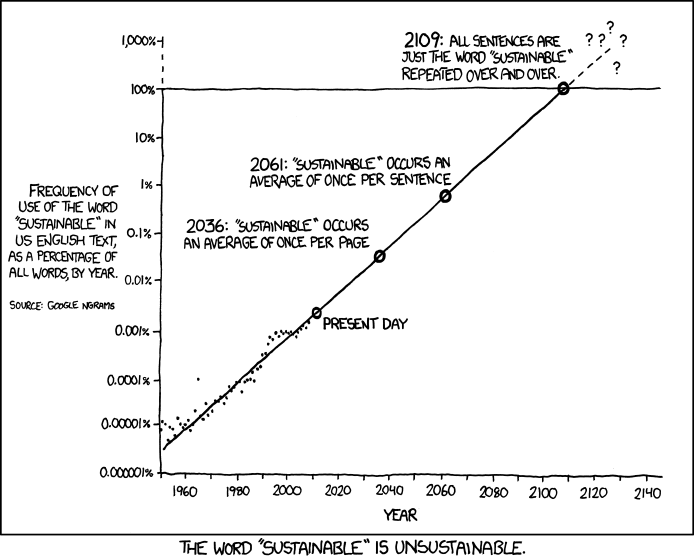
The “sustainable” cartoon is from xkcd.com

Posted in Upcoming Events | Tagged , , | Leave a comment

Food Futures Growing Manchester Programme Opens

We got this email from the “Food Futures” folks a couple of weeks ago, and hope it is useful to our growing [geddit?] band of MCFly readers!

What is the Growing Manchester programme about?
The programme is about supporting community food growing projects to
become more sustainable and ensuring that local people with the enthusiasm to grow food can access support to ensure their projects succeed.

We’ d like to support new and existing projects. Maybe you’re completely new to food growing but think it might be something that would interest your friends and neighbours.
Knowing where to start could be a problem and that’s what’s great about this opportunity, as we’ll take you through every stage!
For those already involved in growing it’s a chance to take your project to the next stage.
Over the last year, we’ve already supported a number of projects, so
there’s lots of support on hand to help new groups to grow!

What support is on offer?
The programme is flexible so your group will be able to access training and support based on the specific needs and goals of your project.
Growing Manchester can provide your groups with training – covering
everything from startup tips to site assessments, and access to additional training courses such as advanced food growing,
container growing or chicken keeping.

How to apply
For more information about the programme, who should apply and how to complete the application form, see the attached guidelines, below.

If you have any queries about the application form or programme contact me on 0161 234 4102, or drop me an email.

Please note the deadline for completing and returning the application form is midday Friday 27th January, 2012.

Completed forms can be posted or emailed to me as follows:
Emma Reid
Public Health Manchester
Manchester City Council
P.O. Box 532,
Manchester
M60 2LA
emma.reid@manchester.gov.uk

We’ll be in touch with all groups by 10th February to let you know if you’ve been successful.

Please feel free to circulate this opportunity to your networks.

Posted in Food, Manchester City Council | Tagged | Leave a comment

Book Review: Climate and Disaster Resilience in Cities

Book Review: Climate and Disaster Resilience in Cities
eds Rajib Shaw and Anshu Sharma
Emerald Books
ISBN 978-0-85724-319-5
287 pages

Resilience is one of those words – like “sustainable” and “green” – that is losing its meaning through constant fudging and smudging. So although I was keen to read this, I was braced for disappointment. Needlessly, so, since this is a very good collection of articles indeed.

Emerald Books’ “Community, Environment and Disaster Risk Management” series “connects academic research to field practice, strengthening the links between the environment, disaster, and community.” This specific book, volume six in the series, sets out to “show how to enhance actions at local levels, and how … plans can be implemented through multi-stakeholder collaboration.”

The fourteen brief chapters (all of which appeared as journal articles) fall into four categories. The first two give an overview of urban development and resilience. The next four look at implementation of the Climate and Disaster Resilience Initiative (CDRI) from nation to city level. The next five chapters look at action planning and – dread phrase – ‘capacity building’, with the final chapters examining at risk communication and future challenges. All focus on the “developing world (largely Asia), but the concepts and implications are, I believe, universal.

The chapters that will be most of interest to people looking to build social networks, and engage critically but constructively with local authorities and the like will be chapter 6 “Climate and Disaster Resilience Mapping at Micro-level of Cities” and Chapter 8 “From Resilience Mapping to Action Planning.” Meanwhile, Eiko Wataya’s “Capacity Development and Training: Blended Learning Program” (Ch 10) is a rich vein of insights and concepts for anyone (like the present reviewer) looking to increase the depth and breadth of relevant skills and knowledge in order to improve a city’s response.

The authors note in their overview, there is an “insidious risk, often ignored, of continuing disaster: of communities maintained in poverty by the constant setback of ongoing disasters.” All surplus resources (time, money, enthusiasm etc) that could be used to nurture communities so they were better able to bounce back from future knocks is instead spent coping with today’s disaster (the contrast they make is between “shocks” and “stresses.”) As a friend says “If you spend all your time fighting the alligators, it’s easy to forget that you came with the intention of draining the swamp.”

Every academic library should, imho, have (at least) one copy of this book. Every serious academic, policy maker or activist who is interested in how societies might become clever and “tough” enough to cope with the firestorms this species seems determined to bring down itself should read with care. That care will be rewarded..

Marc Hudson
mcmonthly@gmail.com

Posted in academia, Adaptation, Book Review | Tagged , | 3 Comments

Readers’ opinions sought – is Tesco’s “low-carbon” store a little help?

An academic at Durham University is going to be doing interviews in Manchester next week (Monday 30th Jan onwards). Cheetham Hill-area residents are especially sought. If you know anyone in that neck of the woods who would be interested, please pass this on.

Dr Sara Fuller is part of a team “undertaking some research in and around the low carbon Tesco store in Cheetham Hill, north Manchester. The aim of the research is to explore if people are aware of the low carbon store, and how the presence of a low carbon store influences how people engage with and understand issues of climate change. “

If you yourself shop there, get in touch with her directly, here – s.k.fuller@durham.ac.uk

Marc Hudson
mcmonthly@gmail.com

BTW: As a general rule, MCFly has a “study the rich” policy on academics.

Posted in academia | Tagged , | Leave a comment

Open letter to Steering Group 2.0

The Steering Group
An Open Letter from the editors of Manchester Climate Monthly

Dear members of the Steering Group old and new,

We wish you good luck in your new endeavour. Manchester desperately needs your energy and unique position in the “eco-system” of organisations, businesses and the like.
We know how little time you have. We know how little money there is. We have some suggestions, for which money is not needed. Here they are;

1) Ask tenants and residents associations, mosques, churches, trades unions etc if you can come and talk with (not “to”, not “at”)  them about the Action Plan, the Conference, and hear their ideas and questions. Do Chorlton last.  Keep a public log of these meetings, including the questions people raise. Reflect on how to make the meetings more inspiring and “sticky”.  Avoid “sage on the stage” and “death by powerpoint.”  They are not sticky, they do not inspire.

2) Undertake training, as members of Steering Group, in how to be part of interactive forums (ok “fora”) and discussions, rather than the traditional “death-by-powerpoint followed by Q and A” that are mis-sold as “workshops.”

3) Hold  quarterly meetings (in public!) with the Environmental Advisory Panel (on which some of you sit), the Environmental Strategy Programme Board and other “key stakeholders” where members of the public are able to ask questions.  Record these. Tweet them. Et cetera.

4) Hold. Elections.  It’s not difficult, and it will do your credibility no end of a favour.

5) Call your arty friends at the Cornerhouse and organise a film festival.  What films? See our suggestions here.  It’d be a good excuse to have a couple of public discussion events too.

6) Call your arty friends at the Royal Exchange, or the Library Theatre, or the Contact or the Lowry, and get them to stage a run of  Henrik Ibsen’s “An Enemy of the People.” It’s all about a beloved doctor loses his beloved status when he accurately reports that the economically essential asset everyone loves is actually really unhealthy.  Who knows, maybe Manchester Airport Group will sponsor it. Organise a couple of post-performance discussions

7) Call your friends at the Manchester Evening News and get a monthly (or even weekly?!) column about climate change, its local impacts, local actions being proposed/taken, difficulties encountered etc. The journos at the MEN already seem to be not entirely opposed to printing good news from Castle Grayskull and her outposts, so it shouldn’t be a big ask.

8) Create a quarterly “question time” style event, with panelists such as the Exec Member for the Environment, the Council Leader, MAG, MEN, members of the Manchester Board (other than your good selves) and maybe a token business person or activist-type.  Some sort of gender and race balance would be good.  The Town Hall would probably give you a good discount on a room.

9) Make loads of youtubes and other multimedia explaining what the plan is, what progress is being made. (Probably want to avoid talking about how many Implementation Plans have been written though, at least in the short-term…)

10)  Set up a short story contest, or film contest (or both) for people who live, work or study in Manchester, about how the city could and should look in the year 2020, or 2030, or whenever.

Once you’ve done all these, feel free come back to us – we’ve got loads more suggestions, many of them which appeared in an April 2009 document a few of you may recall.  To real action!

Arwa Aburawa and Marc Hudson

co-editors of Manchester Climate Monthly

mcmonthly@gmail.com

Posted in Climate Change Action Plan, Democratic deficit, Manchester City Council | 2 Comments

MCFly Climate bulletin #11, Jan 23 2012

Hi all,

don’t forget to book your annual leave/child-minder etc for Friday 16th March, for the second “Stakeholder Conference” on the Climate Change Action Plan. Apparently the venue and booking arrangements will be announced imminently.
Other dates for your diary -Mon  February 6th – MCFly’s first book club (Animal Farm). Tues Feb 14th – Green Valentines, from 8pm at the Sandbar. And International Women’s Day event at Manchester Town Hall on Sunday March 4th, around the themes of “recognize, represent and resolve.” More details to follow…

Please encourage your climate-concerned friends to take out a (free!!) subscription to the Manchester Climate Monthly blog/newsletter – via our subscribe page.
If they need convincing, here’s a 40 second video explaining the top ten reasons folks should subscribe
And follow us on twitter (@mcr_climate).

Coming up this week

Weds 25 Jan, 8 till 11 “A Reasonable Cause,” in the Kraak Gallery Northern Quarter. A night of music, short film, a talk about something green, and a lot of fun.”The editors of Manchester Climate Monthly will be along to give brief talks and answer questions.

Thurs 26 Jan, 6pm FuellingManchester – a networking & socialising opportunity for community renewables projects across Greater Manchester
Bulls Head Pub (M1 2PN)

Thurs 26, 6.30pm Manchester Friends of the Earth Campaigns Meeting.  On the last Thursday of each month, come along to the Green Fish Resource Centre on Oldham Street (next to Mint Lounge) to get stuck into doing actions on each of FoE’s campaign areas.

Thurs 26, 8pm Greenpeace monthly meeting, upstairs at Ape and Apple pub, John Dalton St, City Centre

MCFly stories you may have missed
Climate adaptation and information technology
Manchester law firm cuts its own environmental footprint
News Flash: Christie car park turned down
The Land Army digs in
Airport City, against and for…

Grab the money and run
London-based “Network Development Officer” for Stop Climate Chaos.  See here.

Local and Regional News
Action for Sustainable Living in partnership with Ecospheric secured Chorltonville funding from the Local Energy Assessment Fund (LEAF) to help promote energy efficiency in all its 262 households. LEAF is a government grant for communities to help them understand the potential for improvements in their homes and prepare for new opportunities in sustainable energy and climate change arising from the Green Deal, Renewable Heat Incentive and Feed in Tariffs. Other North West projects also got money

Jan 19 The Planning and Highways Committee of Manchester City Council decides it is “minded to refuse” the Christie application to build a multi-storey car park. A £20m research centre also got turned down, because it was “bundled” with the car park… Watch this space.

Jan 22 The Manchester Green Party held its Annual General Meeting.  A committee of eight was elected. Brian Candeland moves to the new role of Speaker responsible principally for representing the party to external audiences, whilst Chris Gibbins replaces him as Chair with the focus on managing internal party business; David Mottram remains as Secretary.

National News
Jan 19 An open letter by various worthies warns the Bank of England that fossil fuel reserves will soon be “sub-prime assets.”

Scary Science
Jan 22 A river doesn’t run through it. An Environment Agency report says England’s rivers will be toast ‘unless something is done.’  Toast, then…

And finally…
The BBC reports that “UK wildlife charities are asking for people’s help in examining if hedgehogs are being affected by climate change. Retired hedgehog expert Dr Pat Morris performed a study 40 years ago showing that temperature affects when the animals emerge from hibernation. With the British Hedgehog Preservation Society and People’s Trust for Endangered Species, he wants to see if warming since then has changed things.”

Posted in Weekly bulletins | Leave a comment