Event Report: Climate Violence

Climate Violence, History and Resistance (exploring a bigger picture) workshop. Saturday 21st January. Hosted by Southern Voices who are running a series of five workshops, of which this was the first.

The first thing to mention is the demographic which was remarkably unusual for a climate change event. Out of 24 attendees only eight were white and 15 were male (the Crèche room may have helped with the gender balance).

The speaker was Kooj Chuhan (Creative & Cultural Producer, Researcher, Filmmaker/ Digital Artist and Co-Director of Virtual Migrants). The talk was very late starting, lasted over an hour, and was of the “Sage on The Stage” type. This meant there was very little time left for group discussion or feedback.

Despite asking whether some people wanted an introduction to the subject (a few nods) and saying anyone could chip in during the talk, Mr. Chuhan did the vast majority of the talking. He began with a couple of recent events (disaster in Mozambique, last year’s floods in Thailand), and a lengthy ‘introduction’ to climate change with graphs and pie charts (= death by PowerPoint). There was then a request from a member of the audience to hear where everyone was from. One of the organisers suggested we do it at the first break (incidentally the results were: India, UK, Sudan x 10, Uganda, Egypt, Zambia, Jamaica, Poland, Chile and Australia).

We then got onto the topics which had been advertised: race displacement, a critique of the Western framework, immigration and Diasporas. This part came at the issue of climate change from a unique perspective, but unfortunately whilst the analysis was refreshingly radical in content, the points could (and should) have been made in a fraction of the time.

There were some interesting stats e.g. server farms overtook the aviation industry last year for amounts of emissions (Google has 300,000 server farms in Oregon alone! [UPDATE – see comment beneath this post for correction]), along with some good quotes e.g. Dr Atik Rahman on the situation in Bangladesh: If the global citizenry and global nation states fail to take action it will be “climate genocide”.

Hurricane Katrina was used to show how racism and poverty interplay with climate-related disaster. After posing the question to audience of whether climate change is a cause, a process or a symptom, there followed an interesting and lively discussion on; consumer society, economic growth, colonialism, exploitation, marginalisation, power, racism, models of so-called development.

Then the speaker continued about the dangers of the dominance of the climate science perspective in narratives on. Science, he argued, has become the focus for all discussion, which has lead to it being talked about purely in terms of numbers, which is a diversion from real issues underneath it.

There were some statements made from the front that you don’t often hear outside of radical left-wing circles:

  • “capitalism is unsustainable in a number of fundamental ways”
  • “we need to re-think violence as predominantly enacted by corporations, governments and political processes” (with a nod to Slavoj Zižek)
  • “the U.S. deciding to keep emitting is a violent act”

Along with a blunt assessment of some of the solutions currently on the table:

  • “techno fixes have been discredited”
  • “carbon trading is corrupt and lucrative, avoids any of the issues and makes them worse”

Some of the possible consequences of climate change were then listed: unstable climate conditions, sea level rises, desertification, conflict and displacement, resource wars, ecosystems and wildlife degradation, effects on agriculture and water scarcity.

Eventually we got on to the small group discussion and we were given a comparison of the Anchorage Declaration vs. the outcome of the Durban COP17 climate negotiations as a possible topic for discussion. A friend of mine remarked afterwards “it was nice to be the only white person at the table for once”. Almost out of time, Dr. Chucan then spoke some more, before a few minutes of questions and feedback from the audience.

The event made some important and thought-provoking points, and could have played host to exactly the sort of conversations that need to be happening right now. Unfortunately in this regard, it was a badly missed opportunity. Let’s hope their next event seeks to rectify this.

Mark Haworth

Posted in Event reports | Tagged , , | 5 Comments

Airport City – against and for…

Attention Conservation Notice: The following article contains entirely predictable statements from various organisations about the virtue/vice of “Airport City.”

Last week, accompanied by a certain amount of civic boosterism (always in short supply in Manchester), the £659 million “Airport City” project got the go-ahead.  It will, in essence, be a whole wodge of offices, call centres, logistics centres and the like around t’Airport.  Will it suck money and businesses from elsewhere in a beggar-thy-neighbour manner, or generate ‘new revenue streams’? That’s for the economists to discuss.  We at Manchester Climate Monthly were more interested in what various “green” groups thought of it – and, crucially – what they wanted their members and supporters to do about it.  And, for the sake of some new-fangled thing called “journalistic balance,” we’ve also asked the Liberal Democrats, the Airport and Manchester City Council (55% owners thereof) for statements on how a whopping big business park predicated on flying is consistent with a ‘low-carbon Manchester’.  Read on!!

First, we asked various green groups “Is the proposed development of “Airport City” consistent with a low carbon Manchester?”  You will be shocked, shocked to find that they thought “no.”  Stop Expansion at Manchester Airport (the clue is in the name) told us “the scheme plans to attract businesses that will ‘serve the growing demand at the Airport’ – thus coupling economic growth with rising carbon emissions from flights.  It is mistake to tie prosperity creation to high carbon industries like aviation.
Secondly,  80% of trips to the Airport today are made by car – so creating more activity at the Airport will lead to an increase in car emissions.  The major transport addition in the plans is the controversial SEMMMS road link (South East Manchester Multi Modal Study) – which will cause a rise in road emissions.
Thirdly, the Airport City scheme plans to build on Green Belt areas – which is not consistent with a low carbon, green vision of Manchester.”

The Manchester Green Party told us “Anything which increases the role of the Airport and which encourages air travel will make it much harder for Manchester council to achieve its carbon reduction target” and pointed us to their website article posted after we contacted them.

Second up, we asked them, if they didn’t think it was consistent, then “what actions is your organisation taking/encouraging its members to take?”

SEMA said “The Airport City scheme has already been approved from on-high by the Chancellor George Osbourne.  Within this scenario we need to limit the damage the scheme will cause as it goes ahead.  Along with other groups, we have urged the Council that the scheme is carried forward in a way that doesn’t compete with other economic areas in the Manchester region – and that the SEMMMS road is not given planning permission.  People should voice their disapproval of the SEMMMS road to the Manchester and Stockport Councils directly. “

The Green Party said “I think it’s safe to say that Manchester Green Party will never support this Zone by opening an office there, in spite of the low taxes.  More seriously we will campaign against this and similar proposals in our role as a political Party within and alongside electoral politics.”

The Manchester Liberal Demcrats favour the project. Councillor Marc Ramsbottom, leader of the Opposition stated that his party “fully welcomed Airport City and are delighted that the Coalition Government have made the project possible. Airport City could create 13,000 jobs and help the regeneration of Wythenshawe; making Wythenshawe and Manchester more economically sustainable. The project is aiming to attract global businesses, and particularly those connected with the Aviation industry.”
He continued “I hope that this will encourage R&D to make aviation more environmentally friendly and Manchester Airport more sustainable. I also believe that the project is consistent with Manchester Airports objectives to cut down on Domestic flights, which I believe are unnecessary and one the major reasons the aviation industry can be so damaging.”

And here’s where their opponents will doubtless say they are wanting to have their cake and eat it: “Whilst Manchester Liberal Democrats support Manchester Airport as a key player in employment and growth in the North West, we believe it’s expansion (which Airport City is a part of) must be sustainable. We believe that there is an inconsistency between the government’s policy on CO2 emissions, and the government’s policy of airport expansion. These inconsistencies need resolving. We believe that the Council and Airport should set Carbon Reduction Targets based on 2005 levels. We believe a full cost benefit analysis should be done before any significant infrastructure development at the Airport.”

So, what do they think should be done?
* local people to benefit from the jobs created at Airport City.
* Council and developers to encourage R and D investment.
* Manchester Airport to continue to reduce the number of Domestic Flights.
* the Council to invest revenue generated from Airport City into schemes to reduce carbon and promote sustainability.
* The Council to include Airport City and Manchester Airport in the City Council’s Climate Change Action Plan so they can be part of a low carbon Manchester.
* the Council and Airport to set Carbon Reduction Targets based on 2005 levels.
* a full cost benefit analysis to be carried out.
* Airport City and Manchester Airport to be included in the City Council’s Biodiversity Action Plan

And now for the organisations who are usually quoted at the top of these sorts of opinion-scanning pieces.

Manchester City Council supplied the following;
Councillor Nigel Murphy, Manchester City Council’s executive member for the environment, said: “Airport City, which will create an estimated 20,000 jobs in a wide variety of sectors, will be designed to the highest environmental standards possible and will be built with a series of green bridges ensuring that every part of its northern zone is within an eight minute walk from the airport’s bus and rail hub.
“Airport City will also be one of the best connected sites for public transport anywhere in the country, with a new Metrolink line currently being built to complement existing rail connections and planned and committed improvements to the road system.”

and the Airport press office gave us this;
John Atkins, Airport City Director for the Manchester Airports Group, said: “Airport City will be a central project for the Group over the next ten years and we will look to construct buildings that are low carbon in design. It’s a project that will have social cohesion and the local community of Wythenshawe at its heart. Alongside existing community initiatives, we will continue to support schemes that improve levels of skills, education and attainment while reducing unemployment locally and equipping local people to compete for new jobs on-site. The new Metrolink extension to the airport will also assist in the delivery of that objective.”

Other groups we asked
Manchester Campaign against Climate Change didn’t reply to two email requests.
Manchester Friends of the Earth were unable to provide a statement by our deadline.

Editorial: Who wants to be an Enemy of the People?
To understand what’s going on here, we need to turn to a 19th century Norwegian playwright [Ed: er is this right?] Henrik Ibsen wrote a play called “An Enemy of the People.”  Its main character is a beloved town doctor who has brought people into the world, treated their illnesses, reduced their pain as they die. Everyone loves him. Then he makes a mistake: he analyses the actual quality of the water at the town’s famous spa, which earns huge revenues from visitors coming from all over Europe. Worse, he lacks the common sense and decency to keep schtum about the fact that the water is quite the opposite of healthy…

For over 100 years Manchester was about export and innovation. After the decline of the 70s and 80s, a ‘renaissance’ has taken place (for some) around inward investment, of which the Airport is perceived to be a crucial component. And woe betide anyone who says the waters aren’t healthy. But then again, also woe betide anyone who grumps about the waters without doing work on what else people are going to drink

Posted in Aviation, Climate Change Action Plan, Manchester Airport, Manchester City Council | Tagged , , , | 2 Comments

The Land Army digs in

Poster for national service in the Women's Lan...

Image via Wikipedia

In 2011, the Kindling Trust received £5,000 from Making Local Food Work to launch the Land Army project. The aim of the project was to recruit volunteers to help local cooperative and organic farms with their daily jobs such as weeding, harvesting and collecting produce. One part-time worker was employed costing £3,000 and the rest of the money was spent on refreshments, insurance, travel and other costs. According to Chris Walsh from Kindling, the project also received a donation from Unicorn Grocery of £1,000 to “establish a low-carbon field kitchen, which will allow us to offer volunteers better facilities and shelter during bad weather, and personal protective equipment for volunteers.”

Previous Events
Several outings and events were organised in 2011  as part of the Land Army’s effort to publicise the project and explore ways to make the project add up financially. As well as taking a youth exchange group of twelve young adults to Glebelands farm for the day,   social enterprise Reason Digital were invited out to harvest numerous crops. “This was to test the concept of offering ‘corporate days’ out on the farm, which would generate a possible income,” says Walsh of Kindling. You can read one volunteer’s experience planting garlic here.

Type of Work
Previous events have included weeding at various farms, harvesting potatoes, planting garlic and collecting eggs. There has also been a hedge-laying day and a tree-planting event at Moss Brook Growers where 500 trees were planted. Half of the growers the Land Army scheme supports are workers co-operatives and the others are third-generation organic farmers . All the growers are members of Manchester Veg People.

Awareness Raising
The volunteers get a verbal explanation from Kindling about the role the Land Army is playing in supporting farmers who are poorly paid. “This is a first step of introducing people to sustainable food growing at a commercial scale,” says Walsh. “ And to encourage more people to go into this field and therefore have more farmers and more sustainable food available locally.” As such, it should be clear that volunteers are helping farmers who sell their produce and not a charitable/not-for-profit organisation that is giving food away for free.

The Land Army’s support is focused on reducing waste (e.g. surplus crops that would otherwise not be harvested as it would make it too expensive to sell) and increasing yield by making more sustainable food available to a wider range of people. We were also informed by Kindling that after each outing, they seek feedback from volunteers via a feedback form and they collectively review any improvements that could be made.

Risks
A first aid kit is taken to events and a qualified first aiders is always present. According to Kindling, all the tasks have been risk-assessed and have been defined as low-risk, simply requiring an appointed person to be present. The farms have also been visited beforehand and a survey of facilities was carried out to make sure there are toilets nearby etc. “Our appointed person is always on hand and we have not had any incidents,” says Chris Walsh. “We must point out tasks involve, for example, walking up and down rows hoeing so very little risk exists.”

Safety
Volunteers receive verbal health & safety instructions and are supervised within reason. Before joining the day, volunteers complete a next of kin form and provide information about any medical conditions or medication requirements or tasks they would feel uncomfortable doing. Kindling has a Health & Safety policy and accidents are recorded and the appropriate authorities informed of incidents. Kindling also has insurance cover from BTCV for these activities with cover up to £10 million. As Walsh explains, “a significant part of the workers time has been spent on ensuring a safe and enjoyable experience for the volunteer which effectively and efficiently supports the farmer.”

Arwa Aburawa
mcmonthly@gmail.com

MCFly’s Verdict
Working with volunteers is difficult, and the legal and administrative obstacles daunting. A mass media story with the headline “volunteer injured in accident: clueless greens at fault” would be immensely damaging to the getting and keeping of volunteers. MCFly is delighted that the Land Army is so tightly run. If people are told where their labour is going, and the duty of care to them is taken seriously, then everyone (including desk-jockey editors) needs to think about donating some time and energy.

Upcoming Events

What to be a Farmer?
The Greater Manchester Land Army is to receive 4 days of horticulture training from Jenny Griggs of Climate Friendly Foods. The training, which will run on four consecutive Wednesdays in March, will be a mixture of practical work and theory, and will include visits to Glebelands City Growers and Fir Tree Community Growers. Anyone interested in becoming an organic grower for Greater Manchester, who can commit to a number of week day outings with the Land Army in this growing season, can apply for a place on the course – email chloe@kindling.org.uk

Apple Grafting Marathon
The Greater Manchester Land Army will be having a weekend of apple tree  grafting on 24th and 25th of March 2012. It has funding from Making Local Food Work to create 500 new trees and Adam Davies, an orchard manager from Herefordshire, will be there to show how it’s done. Places are limited but anyone wishing to apply can email chloe@kindling.org.uk saying which day (the Saturday or Sunday) would suit them best.

Posted in education, Food, Fun, inspire, volunteer opportunity | Tagged , | 1 Comment

News flash: Christie car park turned down

Christie Hospital has been refused permission to build a multi-storey car park in Withington (previous MCFly story on this). The Planning and Highways Committee of Manchester City Council met at 2pm today. After representations for and against from interested parties, one of the comittee members, Cllr Andrew Fender (Labour, Old Moat), a former chair of the committee, moved that the committee was “minded to refuse” the application. This was seconded and passed.

Cllr Chris Paul (Labour, Withington) has been actively involved in the campaign against the car park. He told Manchester Climate Monthly “There was a site visit this morning and around 200 people turned up for that. Senior representatives from all the schools. Lots of residents. Planning Committee members got a proper feel for the size of the site and, through helium filled balloons, a bit of an indication of the height. That was critically important I think. No one at all wanted the proposed car park. And the committee listened intently to a wide range of views.

“There is of course an enormous groundswell of support for The Christie, and everyone who spoke expressed that support. It is very important for Manchester that highest quality scientific and clinical research goes on in our city. We hope that The Christie come back with proposals that work better for the neighbourhood and which show them in a good light as institutional neighbours who listen and who respond well…. Residents want to help and residents would be pleased to provide Focus Groups, a Community Conference, even a Planning Mediation to help The Christie get it right.”

A Christie Hospital spokesperson supplied the following statement: “Director of the Manchester Cancer Research Centre (MCRC) Professor Nic Jones said: “The Manchester Cancer Research Centre partners remain committed to working with the City Council and stakeholders to enable us to provide the vital facilities needed to continue our world-renowned cancer research. The MCRC has a clear vision for the expansion of research that will be crucial to underpinning advances in the treatment of cancer patients, both here in Manchester and across the globe. We are committed to ensuring that the benefits of the resources secured for the provision of these world-class facilities are delivered as soon as possible in a region where cancer rates continue to be well above the national average.”

More to follow.

Marc Hudson
mcmonthly@gmail.com

Posted in Manchester City Council, Mitigation, Transport | Tagged , , | Leave a comment

The Big Cs: Christie, carparks and carbon dioxide

Christie Hospital will find out today if they can build a new multi-storey car park in Withington. The Planning and Highways Committee of Manchester City Council meets at 2pm today (Thurs 19th January) at the Town Hall to decide on the controversial application. Members of the public are welcome to attend. Here’s directions

The Christie wants to build a new research facility. Given its international reputation, and its mission – tackling cancer – this is a stunningly uncontroversial application. The problem rests with a multi-storey carpark application that is bundled with it. Local residents say that this car park would be too tall, that it is unnecessarily large and that there are viable alternatives (see letters to the Manchester Evening News on Monday 16th January).

Questions we don’t have answers to yet
On Tuesday afternoon MCFly contacted the Christie’s press department, explained we were running a pre-decision as well as a post-decision story, and that we’d really like answers to the following questions as soon as possible. When we get the answers, we will let you know.

1) Who will be the users of the new car-parking space?  What proportion staff, what proportion patients/families/carers.
2) What new measures have been implemented in the last 3 years to more encourage staff to travel to work on public transport or by bicycle and how successful have these been? (i.e. is the multi-storey car park a last resort, all other reasonable avenues being exhausted?)
3) Have projections been made about the Metrolink, which will pass relatively close to the Christie, been factored in to the Green Travel Plan?
4) Has the alternative design for a car park by George Mills (mentioned in letter by Daniel Gillard in the MEN) been considered?
a) If not, why has it not been considered.
b) If it has been considered, for what reasons has it been decided to proceed with the original design.
UPDATE: See addendum for more information.
5) What will the Christie do if the planning application is rejected?

What will happen next?
A site visit takes place this morning, before the Committee meeting this afternoon. The committee is not, MCFLy is told, able to say “you can have the research centre, but not the whopping big car park” – it’s a ‘take it or leave it’ bundle, with only minor changes being allowed.
If the application is turned down, Christie can appeal. If it is approved, the opponents’ options are somewhat limited. Judicial Reviews do not come cheap!

Watch this space.

Marc Hudson
mcmonthly@gmail.com

Re: Question 4 – after sending the questions, we found this on a December 12 Manchester Evening News article.

“A spokeswoman for the Christie said hospital representatives had met Mr Mills three times, but that at the third meeting ‘it was acknowledged that his proposals did not meet the requirements of the brief’.

She added: “The capacity for the car park has been calculated to re-provide the existing car parking and provide extra car parking required for future needs. We are taking a two-pronged approach: provision of a realistic level of car parking allied with initiatives to reduce demand.”

Posted in Manchester City Council, Mitigation, Transport | Tagged , | Leave a comment

Manchester legal firm cuts own carbon footprint

Leading legal firm Pannone has been working on its internal environmental footprint [see their press release here] It has established an environment/sustainability policy, conducted a firm-wide internal environmental audit and in the last 12 months reduced energy consumption by 40%. Manchester Climate Monthly contacted Tim Hayes, who heads Pannone’s Environmental and Sustainability Group, for more information. [Links added by MCFly]

What was the impetus to take action on your environmental footprint? Save money? Impending government regulation? Responsible corporate citizenship? Mix of these? Others?
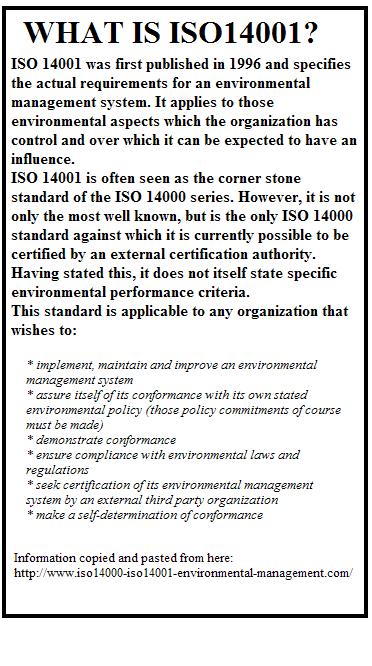
We were awarded ISO 14001 in November 2011. The impetus for pursuing the award was a mix of reasons; environmental footprint, carbon audit, CSR, cost implications, to assist in tender process and because it the right thing to do.

What did it cost? (roughly!) and when is it expected that this suite of actions will have paid for itself?
We are unable to put an overall cost on the whole process that took over 18 months and involved a number of staff.  We were assisted by some free consultancy support from Groundwork under the Enworks funding programme. The firm’s investment in environmental improvement makes clear commercial sense e.g. saving paper, reducing energy costs and winning new work. We are often asked about it when submitting tenders. Of course, our waste minimising and recycling efforts did not simply commence on the day we were given the award, we have been recycling for some considerable time now.

Were there any unexpected obstacles, and if so how were they overcome?
In very general terms the vast majority of staff embraced our environmental approach. This is evidenced by the take up of the recycling facilities and the enthusiasm of our ‘green champions.’

What, if any, action, has Pannone taken to reduce the amount of flying its staff/partners do? (Teleconferencing etc)
We have our own bespoke in-house teleconferencing suite and in addition many partners hold conferences via Skype.
What actions are Pannone planning next?
Our aim is to continue to meet the requirements/standards  of ISO 14001.

What are other similar firms doing?
A number of other national law firms had already achieved ISO 14001. Further information can be obtained from websites and the Legal Sector Alliance.

Marc Hudson
mcmonthly@gmail.com

[PS If readers have further questions, please add them to the comments box, and we’ll ask Pannone to respond!]

Disclaimer: MCFly may have unconsciously “soft-pedalled” on this story, given that the current writer did claim (inadvertantly falsely) in our January 2012 print edition that we had contacted Pannone for answers and that they had not got back to us – see our unsolicited apology to them here.

Posted in Business, Mitigation | Tagged , , | Leave a comment

Digging for Victory with the Land Army

MCFly badgered Ben Cashell, organiser of “A Reasonable Cause“, into writing about his conscription into a “Land Army.”  The views expressed are his own, not those of MCFly.

Last month I went and planted some Garlic with the Kindling Trust’s, Land Army. This is a venture that they have set up to counter two needs. The first being the difficulty and loneliness of being an organic farmer, long hours , lots of weeding and not much if any profit. Who knows why you would do it?

The second , allowing people like myself to have the opportunity to view and learn something about the growing process and to get a chance to tip our little toes into this wonderful cycle that feeds us.

For me this was particularly needed as I had spent the last few days doing a wee tour playing with a chap called Jake Mattison who was supporting Emeli Sande a very talented lady who happened to be number 1 at the time. Before you gag at my name dropping , my biggest contribution to the tour was a brown note( sonic boom) that I would reliably provide at some point during our sound check.
Playing the cello, (my pick-up), and big monitors are not a winning combination, unless you work for Huggies.

Anyway, back to the garlic. On a beautiful November morning we (the land army) headed off to Moss Brook farm which is somewhere in the vicinity of Warrington. When we got there we arrived at the few fields, compost toilet and a stunning hawthorn bush that make up Moss Brook farm. We met Tom/Rob, (could never remember his name) one of the main growers at Moss Brook who settled an ongoing argument over whether hectares or acres were bigger by very handily informing us it was acres.

He proceeded to give us a tour of Moss Brook which is the only vegetable grower in the area, a serious crime. This area is perfect for growing vegetables and feeding Manchester with produce from its own doorstep. Instead it is used for maggot farming, horses, chickens etc. and you really can’t blame the farmers as there is no point trying to grow vegetables unless you can produce vast quantities to produce any kind of a profit.

If the Council are any way serious about their pledge to reduce the city of Manchester’s emissions of CO² by 41% by 2020 from 2005 levels, this might be a good place to start. Instead of vast tax cuts and grants given to big business, give some money to the farmers to make it a more inviting prospect to grow Veg. Instead of subsidies currently given for pesticides which drain the last bit of productivity from the soil, why not use 20 per cent of that to get people who are out of work to work on a farm? That might also help the council with their second aim to engage all individuals, neighbourhoods and organisations in Manchester in a process of cultural change that embeds ‘low-carbon thinking’ into the lifestyles and operations of the city.

But I digress; back to the tour. He started off by showing us some of the fields. We began with a type of spinach that I had never seen before that is less energy intensive to grow and very tasty.

A terrible crime for an Irish person to admit, but I had never seen potato plants and I was amazed at how pretty the plants are that produce the humble spud. We walked past a field that was not growing produce but was sown with clover and vetch to put the nutrients back into the soil – a staple practice of farming before the overuse of fertilizers.

Our job was to plant a load of garlic which is to be harvested next year. Apparently garlic is planted during Winter as the frost benefits the growing process, I am not sure how that works but it sounds good. We had boxes of the Isle of Wight’s finest, which is where the good stuff comes from.

So to be a garlic planter, what you need to be able to do is:

break up a bulb of garlic
whack the cloves in a bowl
find a stick for measuring ( very important the stick)
then hopefully plant them in a straight line so that the tractor can come along and harvest them
get cracking

Part of the joys of The Land Army are the people you meet and the conversations you have. I discussed Swiss Immigration policies, Scottish masonry and whether or not men should make cakes. (Craig, we are still waiting for your Victoria Sponge…)

Our wonderful grower Rob was on hand to answer any question you could think of about organic growing, or garlic. For example; why they hadn’t used their own crop from last year to sow the garlic instead of the Isle of Wight variety? Apparently it is for prevention of disease as it is better to use a different variety as it stops any disease that might have been in the previous batch from becoming too prevalent.

It felt good after worrying about audiences, getting to places on time and feedback, just to have to worry about pushing the next clove of garlic into the ground. There is an appealing rhythm to it that is very relaxing. It is perhaps not the best for your back and I imagine my waxing lyrical might have been different if it had been pissing it down but those things aside it was good craic.

After a spot of soup and a wee test of the aforementioned compost toilet, we got back to the garlic.
There was a different variety to plant after lunch which was a real bugger to prise open and left your hands red raw, but we finished our containers and planted 5,000 cloves of Garlic.

We set off back to Manchester a little bit more informed, sore and excited to see the garlic at some point next year. For anyone reading this, I would highly recommend volunteering with The Kindling Trust, going out and weeding, planting or whatever they have in store for you. It is a grand experience which will take you out of your comfort zone and you will pick up a story or two.

Ben Cashell

[At the next Reasonable Cause night, on Wednesday January 25th 2012, you can have the dubious pleasure of super-brief discussions facilitated by Arwa Aburawa (on “The Middle East and Climate Change”) and Marc Hudson (on “how to get involved in climate action in Manchester”). And the actual pleasure of music from Riognach Connolly – Honeyfeet, Sarah Louise Higham and Ben Cashell.
£4/£3 at Kraak Gallery, 11 Stevenson Square.]

Posted in Food, volunteer opportunity | Tagged , , | Leave a comment

Information technology and climate adaptation

MCFly volunteer Dama Kudoja interviewed Manchester University’s Professor Richard Heeks about the “Nexus for ICTs, Climate Change and Development” (NICCD). NICCD is a practical academic project looking at the use of information and communication technologies to help people who didn’t cause climate change cope with its effects.

How was NICCD created and who are your partners?
NICCD (www.niccd.org) is a project that brings together both knowledge and practitioners relating to ICTs (information and communication technologies), climate change and development. The coordinator is the University of Manchester’s Centre for Development Informatics (CDI), a research centre specialising in work on ICTs and developing countries.
The two main partners are Canada’s International Development Research Centre (IDRC), which funds the project; and the Association for Progressive Communications (APC), which is helping with project dissemination.

The project was created from the perception of staff working in CDI that ICTs have an important role to play in climate change in developing countries, but that role was under-recognised, and almost completely un-researched.

How has the project worked and which are your most successful case studies of ICT for climate change adaptation?
The project is producing three main outputs. First, a set of papers which review and analyse what is already known in various thematic areas: ICTs and mitigation, ICTs and strategic actions, ICTs and
adaptation, etc. Second, a series of case studies of projects which – again – touch various different aspects of climate change: mitigation, monitoring, but particularly adaptation. Third, some strategy briefings on the roles that ICTs can play.

I wouldn’t pick out an individual case study since we have more than 20. But I would highlight two cross-cutting lessons. ICTs are best used tactically where they empower those who are on the frontline of climate change – the poor farmers, fishers, inhabitants of low-lying areas; helping them to get advice, information, early warnings, etc.
And ICTs are best used strategically where they help to bridge gaps; most particularly between science and politics – between those who understand climate science and those who make the political decisions about climate change.

When choosing countries to cover, how is the selection administered?
We didn’t pre-select any particular developing countries, but asked for case study proposals and chose those of highest quality. This has led us to have cases from all continents of the global South though, as more broadly with use of ICTs in development, there is a particular strength of activity in South Asia.

How can NICCD be effective in countries where electricity is an issue and how do you overcome this?
Electricity is an issue for many developing countries and their use of ICTs but it is not a “deal-breaker”. Backup generators, battery power, solar chargers are all widely used to keep desktops and laptops running. And the icon of ICTs in developing countries – the mobile phone and its related infrastructure – are highly resilient in locations with poor electricity supply.

UPDATE: NICCD have just released new a Strategy Brief titled “ICT-Enabled Responses to Climate Change in Rural Agricultural Communities”.

They say: “This Strategy Brief identifies the role of ICTs (Information and Communication Technologies) within the climate change responses of rural agricultural communities in developing countries. It argues that ICTs can become strategic enablers of action to create awareness about, mitigate, monitor and adapt to climate change within these communities. Despite their differences, rural agricultural contexts share similar attributes and challenges (geographical, economic and social) that are exacerbated by climate change impacts, and that require the adoption of innovative strategies based on emerging and traditional knowledge and information tools.

The analysis identifies different types of ICT interventions, key enablers and constraints to the use of these tools within rural
agricultural settings impacted by climate change. It suggests the
importance of adopting an ‘Information-plus’ approach that targets the improvement of local livelihoods through a variety of content and
tools, while tackling climatic impacts as part of a broader set of development vulnerabilities.

You can access the Brief at:

http://www.niccd.org/ICTs_and_Climate_Change_in_Rural_Agric_Communities_Strategy_Brief.pdf

Posted in Adaptation | Tagged , , | Leave a comment

MCFly Climate bulletin #10, Jan 16 2012

Hi all,

time to get out your diaries/book your annual leave.  On Friday 16th March (afternoon) the second “Stakeholder Conference” about the Manchester Climate Change Action Plan will take place.  More details about venue, booking as we get them.

Before that though, come mingle (especially if you’re single) at MCFly’s green valentine’s day event “Carbon Dating” – it’s at the Sandbar, on Grosvenor St, from 8pm

And before that you can come talk about George Orwell’s “Animal Farm” on Mon Feb 6th from 7pm at the Waterhouse on Princess St. And if you’re even more desperate to meet the MCFly editors, we are at the next “Reasonable Cause” event, on Weds Jan 25th (see the January 2012 page), with Arwa talking about “the Middle East and Climate Change.”

Please encourage your climate-concerned friends to take out a (free!!) subscription to the blog/newsletter – via our subscribe page.
If they need convincing, here’s a 40 second video explaining the top ten reasons folks should subscribe
And follow us on twitter (@mcr_climate).

MCFly stories you may have missed
Interview with John Ashcroft about Manchester’s bid to be home to the Green Investment Bank
“Food and the City”
Noise, airports and farms.

Coming up this week – Pannone’s green actions.  a Land Army volunteer. Airport City – what do ‘green’ campaigning groups think?

Jobs that need doing!
See our “help mcm” tab – we’ve lots of jobs, simple and quick to complex and lengthy…

Paid jobs to apply for (not with MCFly!)
Freelance Domestic Energy Officers

Local and Regional News
Weds 11 Business Insider reports that “Warrington-headquartered Energos Holdings has acquired waste-to-energy business BioGen Power through a share swap arrangement. Energos, part of the Salford-based ENER-G Group, already had a 28 per cent stake in the business and was its gasification technology partner. The company has now released shares to the former BioGen Power owners as part of the reciprocal agreement [cont]”

Thurs 12  Insider reports that “Biomass Engineering, a manufacturer of renewable energy biomass plants, has received a €6m (£4.95m) equity investment from a US-based investor. The company, based in Newton-le-Willows, designs, produces and installs biomass gasification combined heat and power systems. It secured the funding from Excelestar Ventures of Massachusetts…. [cont]

Thurs 12 Insider reports that “Warrington-headquartered United Utilities has been given the go-ahead to build a £200m extension to its waste treatment plant on the banks of the River Mersey. The move could create up to 350 jobs. The existing works at Sandon Dock, Liverpool, will be extended into the redundant Wellington Dock. That will result in a plant able to cope with 11,000 litres of waste a second, serving one million people in Liverpool, the utilities giant said…. “[cont]

Thurs 12  And everyone’s dead chuffed about Airport City.

National News
No news is, well, no news about the Solar Feed-in-Tariff…
“The court will wrap up the decision on permission for an appeal and a possible judgment if an appeal is allowed in the next few weeks,” the DECC said in a statement. “Once the outcome is known, we will consider our options and make an announcement on the way forward to provide clarity to consumers and industry.” (source: solar industry mag)

Global News
Jan 12 Danish wind turbine maker Vestas is cutting 10 per cent of its workforce, to save 150m euros per year. Order delays, production problems and over-optimistic forecasts about Chinese demand, it seems.

Reading and Watching
Sarah Parkin asks if we’re going back to a non-resilient future.
Matthew Spencer, director of the achingly-corporate Green Alliance in Mystic Meg mode – Three trends that will shape environmental politics in 2012.
The Guardian reports on leaked Rio 20 plus goals.
Report says global climate deal hinges on Obama reelection “Prospects for striking a binding global climate deal by 2015 are probably toast if President Obama loses in November. That’s among the conclusions in a wide-ranging, new climate and green energy outlook from banking giant HSBC’s research branch. A major outcome from the United Nations climate talks in December was a plan to craft a deal by 2015 — one that would include big, developing nations such as China — and have it come into force by 2020.”

Scary Science
Near-future carbon dioxide levels alter fish behaviour by interfering with neurotransmitter function
Nature Climate Change , 15012012 doi: 10.1038/nclimate1352
Göran E. Nilsson Danielle L. Dixson Paolo Domenici Mark I. McCormick Christina Sørensen Sue-Ann Watson Philip L. Munday
A study of two species of coral reef fish demonstrates that the anticipated increase in atmospheric carbon dioxide directly interferes with neurotransmitter function in their larvae, a hitherto unrecognized problem for marine fishes.

Posted in Weekly bulletins | Leave a comment

Event Report: “Air pressure” symposium (ain’t just noise pollution)

Manchester Climate Monthly’s prolific volunteer Laurence Menhinick attended a recent symposium. Here’s her report.

Symposium: Japan Society for the Promotion of Science (JSPS), Air Pressure
Thursday 5 January 2012, Whitworth Gallery
The symposium, organized by the Japan Society for the Promotion of Science, followed on from the Air Pressure exhibition (on at the Whitworth until 12 February 2012). Three distinguished guests took part: Professor Kozo Hiramatsu, Japan’s foremost acoustic scientist and UK president of the JSPS, Professor Rupert Cox, from the Department of Social Anthropology at the University of Manchester, and Angus Carlyle, sound artist and Reader at the University of the Arts, London.( who unfortunately arrived late as trains had been disrupted by track damage due to the winds).

[I must add at this point that having registered through the gallery’s website for the event, where no mention whatsoever was made of the second day (6th January) hosted by the School of Social Sciences at the University of Manchester, I completely missed the rest of this very comprehensive and relevant event because by then it was too late for me, which means that I was *mighty* annoyed!!]

Anyway, the presentation at the gallery’s theatre was attended by a mixed crowd, which included delegates from Japan who had travelled to Manchester specifically for the symposium. Professor Rupert Cox started the proceedings with an introduction to the artistic Air Pressure project and its unusual format – observing that other environmental events in Japan (Hiroshima, the Minamata mercury poisoning) have also been depicted in a similarly artistic and cinematographic fashion. In the case of the Narita Airport, two working (organic!) farms operate on the airport in the line of runway B (with only access trough underground tunnels) in what was the village of Toho. The exhibition lets us experience the different sounds and levels of noises on the premises. One of the targets of the exhibition was to turn very comprehensive and scientific data relating to sound levels and health effects into something the general public could understand and relate to. The usual unit measuring aircraft noise levels per day at a given location is the WECPNL ( Weighted Equivalent Continuous Perceived Noise Level) – this has a complicated formula based on acoustic measurements, but Professor Cox related the acronym to the interaction between human life and location such as for instance:

Weight – from the violent protests to the heavy concrete walls surrounding the farm
Equivalent– 104 sound monitoring stations but the levels experience by the local farmers has no equivalence anywhere.
Continuous –perpetual aircraft noises, but also the rhythm of seasons
Noise: the loudest events take place when taxiing occurs – and descending planes pass only 80m over the farm.

Professor Kozo Hiramatsu carried on with an introduction to what aircraft noise means. Drawing from the WHO “Burden of Disease from Environmental noise” publication, and studies by Professor Matsui et al. in Japan and Europe, he listed the known effects of noise pollution: cardiovascular diseases, cognitive problems especially in children, sleep disturbance, tinnitus, hypertension, “annoyance” (stress to you and me- effects vary from one individual to another) and low birth weight, with a noticeable increase in births under 2.5kg. According to data from the studies in Japan, road traffic noise presents a higher death risk than asbestos and even HIV!

One of the problems of the current statistical measurements is that the noise level is averaged over 24hrs – in other words, averaging noise level + number of events over a day is not good enough to show the impact of single events at the time they happen.[ think of sleep disturbance: it is not so much the fact that only 10 planes go past your window in 8 hrs that counts but the impact on your sleep of 10 disturbances!]

Professor Hiramatsu also explained that there is a historical angle to aircraft noise on some Japanese localities – on Okinawa for instance, airfields and plane noises have a direct link with WWII, especially relating to US bases, which adds to the individual perception of aircraft noise for the locals. However, the farmers in Toho are staying because of the links they have with their land – two generations have worked on this farm, creating it from scratch after being relocated after the war and it is now part of their family history: they do not want to be relocated again.

Finally Angus Carlyle took to the chair to give a sound and vision tour of Toho, and its contrasts: steel fences and concrete walls, metal grids and watchtowers but also 50 types of crops, poly-tunnels, chickens and trees. Sounds on the farm, although dominated by airplanes landing and taxiing are surprisingly varied: insects, birds, secateurs, ploughing, packing, rain and wind. The recording and rendition of these sounds were a challenge especially when it came to isolating them and balancing them in the Air Pressure installation – the goal being to provide an experience of the farm, not make a documentary, but this too has its limits since relentless regular aircraft noise cannot be experienced fully on a 10 minutes film. The installation is not the only work the team has produced– there are also an artbook with CD and research papers already, but further work may follow such as a feature length film.

Altogether this event was very interesting ( although I couldn’t stay to the concert that followed) – having listened to the explanations I (and several attendees) couldn’t help re-visiting the installation immediately to take better notice of the details of the film, and found the jet engines even more deafening than at my first visit. Transcribing scientific research into art is an interesting exercise, and I do believe noise pollution is particularly suited to a transposition into art form – and because it is a lesser “popular” pollution in the media despite its links to other types of pollution, and because of the very real and serious health implications, it is high time the issue was brought to the public’s attention.

Laurence Menhinick

Further reading:
The researchers involved in the project are Professor Kozo Hiramatsu, Professor Toshihito Matsui, Dr. Rupert Cox and Angus Carlyle.

Angus Carlyle’s blog about Air Pressure

Map of Toho site (Google map)

The research was funded by a Wellcome Trust Arts Award


Posted in Aviation, Event reports | Tagged , , | 1 Comment