Of #Manchester, #climate and solidarity. Interview with Prof Julia Steinberger

Last week Professor Julia Steinberger (@JKSteinberger) released a video in support of the students going on strike about climate inaction.

She kindly answered the following questions from Manchester Climate Monthly.


1.  According to your video, Nicola Sturgeon said she was both shamed and inspired to take action by the strikers. How do we (all) make sure that that inspiration lasts and turns into real action?

I think we have to keep learning much more about social movements and struggles, and what makes them enduring, inventive and eventually successful. I believe I’m speaking for most of us when I say that this part of our education is sorely lacking, and that we don’t have enough reference points of practical knowledge regarding past examples, their tactics, challenges, victories and failures. Many social movements have had periods of apparently massive failures and adversity (the “then they fight you” part of Gandhi‘s trajectory of social justice movements) before becoming resurgent and eventually victorious. Specifically, I believe that we need to turn mobilisation into organisation, i.e. large spectacular demonstrations must also become catalysts for a range of on-the-ground efforts and durable groups of advocacy and action which are both geographical and topically focused.

I am very encouraged by the efforts to get city councils to declare climate emergencies, [see climateemergencymanchester.net]  because these are explicitly seen as a tool for longer term engagement. Nothing will be solved overnight by a city council declaring climate emergency, but these declarations are brilliant tools for highlighting inconsistencies: between the policies supported by city councils and the long term health and existence of their inhabitants under climate change.
Climate emergency is incompatible with motorway and airport expansions, inefficient building plans with no renewable energy generation, private parking, wasteful car-based developments etc: it should be used to stop these and roll them back. Climate emergency declarations give the people mobilised by the climate protests a voice and a place to stand in concrete local debates, and hopefully to join up with specific efforts (making cities car-free and good for bikes/public transit, deploying renewables and energy democracy throughout their area, collective efforts for energy-efficient housing, vegan food production/consumption, climate conscious education, entertainment and workplaces, etc etc etc).

2. What would a responsible Council do in respect to climate striking? What is Manchester City Council not doing that it should be doing?

That’s a really interesting question. I think a responsible Council would set up communications with the striking students to make sure that their demands are met, and to ensure good common processes moving forward. The students have legitimate, vital and urgent demands, and simply saying “stay at school, debate these topics in class or school assemblies, and don’t bother us grown-ups any more, or at least until you become of voting age or get elected yourselves” is completely unacceptable from the perspective of democracy and responsible governance, as well as from the perspective of the necessity of radical urgent action on climate change. Unfortunately, the stance of Manchester City Council has been mixed so far: they should be encouraged to change, and in fact must be persuaded to change to take the climate striking students extremely seriously indeed.

A responsible Council would build on the momentum of the student strikes, and the wide social engagement they represent, to set up working groups on large challenges we face (effectively mini-citizens assemblies). It would harness the energy and local engagement of the students to build support and face the challenge of becoming climate-compatible cities: car-free, energy efficient, plant-based food supplies, renewably-energized, supporting virtual and low-carbon technologies. This can (and must) be done, but it requires facing and fundamentally changing existing ways of doing government business, including the existing dominance of car-based culture. A responsible Council would work with the students and its population to educate, debate, and face the immense challenge that becoming consistent with future survival in an age of climate change implies.

I have great hopes for Manchester, because its councillors and MPs have shown a willingness to learn and be educated, including by the students and climate researchers, and because it’s a city with a scrappy “can-do, must-do” attitude, with an unparalleled history of social justice struggles (voting, worker’s rights, women’s rights & suffrage, LGBT rights, immigrant rights …). I believe that once our population, students and politicians understand that climate change is the next (and possibly most daunting) chapter of the social justice struggle, they will develop a large appetite for leading the immense and necessary transformation. But perhaps I’m being over-optimistic. In any case, those of us who are climate-aware, starting with the students, must keep pushing hard, so that the politicians – either leading or following – have no choice but to come along for the ride.

3. What practical support do you think adults in general and academics in particular should be doing to support/alongside the youth climate strikers?

I think we need to see ourselves as being at the service of climate-striking students, so start from their perspective (of needing to loudly communicate and spur the world to urgent action so they can survive in the coming decades). What do they want or need from us? Communication, debate, tools for arguments, structures for organising, initiatives for local engagement, resources for loud mobilisation? Do they want to build awareness and activism for the need for green jobs and a sustainable future that they can participate in, like the extraordinarily successful youth-led Sunrise Movement in the USA? Do they want to lobby politicians, gain voices in the media, change the school curriculum, influence business and private sector? All of the above? Then our job has to be to help them in any way possible, with expertise, contacts, reflection on past and ongoing efforts. And we should avoid any impulse to water down their enthusiasm or message – I’ve heard of parent groups who asked fossil-fuel supporting politicians to come speak to climate strike events.
I’ve also heard of some groups trying to co-opt or divert the direction of the student’s activism, by trying to focus the students on green consumerism, or small-scale interventions (like recycling or using less plastic, rather than the types of changes required to really reduce emissions at scale). That kind of thing should be completely unacceptable.

Academics in particular should:
(a) work with students, going into schools to teach and discuss climate issues, not once or twice, but on an ongoing basis;
(b) work with teachers and parents who are concerned and want to move things forward as well;
(c) provide public support, communication materials, put our networks at the disposal of the students;
(d) give them realistic historical guidance on the kinds of social movements which have achieved success in the past – on the great promise but also great sacrifices of non-violent civil disobedience, for example;
(e) and generally I wish that academics would see themselves as having a new boss: Greta Thunberg and her millions of friends. We will do our best work not for the Research Councils or the University Vice Chancellors or the Research Excellence Framework or any of these established and fossilized ways of directing research: we will do our best work for the students, by answering their questions and helping their actions and goals.

4. What are the root causes, in your opinion, for the 30 years of failure by so-called “adults” on climate change?

Another good question! I ask myself that one every day, and hope that the layers of answers help us accelerate towards a next 30 years of incredibly successful action. I think the answer has many dimensions, and plays out differently according to the spheres of “grown-up” activities (academia, politics, business, living daily life), but have common root causes. For a more comprehensive discussion of this, I would recommend your readers look at “The Collapse of Western Civilization – A View From the Future” by Naomi Oreskes and Eric Conway.

The root causes of failure, in my view, are first of all a complete misunderstanding of corruption, and how thoroughly fossil-fuelled industries had corrupted our various spheres of work and influence. Scientists thought they could simply inform policy-makers of the dangerous reality of climate change for commensurate action to be taken: nothing could have been more deluded. Scientists really believed that scientific information would be enough to stop the fossil fuel industries from their deadly business model, but of course those industries, in many cases, already understood the scientific reality, and had decided to fight tooth & nail to preserve their profits. The resulting unequal war of corruption, disinformation, climate denial and so on is still playing out, and the fossil fuel industry has been overwhelmingly victorious so far.

The second root cause of failure is that we did not understand the scope of our own ignorance in terms of social movements and social change. The scale and rate of change demanded from our industrial societies is immense: almost overnight, in a few short years, we have to go cold turkey on coal, gas, oil (and also most animal products). That requires more than technological change and a few economic incentives: it implies profound social change as well.

This means a huge effort should be directed at communication, mobilisation, organisation, building a new consensus and new determination for a large social movement for survival. The fact that this was not understood by scientists and others who saw the climate challenge clearly is a fatal failure of our technocratic culture. Decades were lost trying to convince a small number of timid politicians to implement taxes on carbon emissions, when those decades would have been much better spent (and to be fair were in fact spent in this way by many enlightened activists and advocates) in taking the cause of climate change straight to the general public: mobilising against extraction of fossil fuels, like fracking in Lancashire and coal mining in Cumbria, and transforming every aspect of our society to allow our children to grow up in a livable world.

5. Anything else you’d like to say.
Thanks but I think I’ve already gone on for far too long! As Mark Twain said, if I’d had more time, I’d have written a shorter letter. Thanks for your questions and I hope the answers are at least thought provoking, and help us all, students, parents, teachers, politicians, researchers, advance in our own thinking on this in these desperate times.


Biography

Prof. Julia Steinberger researches and teaches in the  interdisciplinary areas of Ecological Economics and Industrial  Ecology. Her research examines the connections between resource use  (energy and materials, greenhouse gas emissions) and societal  performance (economic activity and human well-being). She is interested  in quantifying the current and historical linkages between resource use and socioeconomic parameters, and identifying alternative development pathways to guide the necessary transition to a low carbon  society. She is the recipient of a Leverhulme Research Leadership Award for her research project ‘Living Well Within Limits’  <http://lili.leeds.ac.uk/>investigating how universal human well-being  might be achieved within planetary boundaries. She is Lead Author for  the IPCC’s 6th Assessment Report with Working Group 3.

Before coming to the University of Leeds in 2011, Prof. Steinberger was a Senior Researcher at the Institute of Social Ecology in Vienna (SEC), where she investigated sustainable cities and the links between  material use and economic performance. She has held postdoctoral  positions at the Universities of Lausanne and Zurich, and obtained her  PhD from the Massachusetts Institute of Technology. She has published  over 40 internationally peer-reviewed articles since 2009 in journals  including Nature Climate Change, Nature Sustainability, WIRES-Climate  Change, Environmental Science & Technology, PLOS ONE and Environmental  Research Letters.

Posted in Interview, School Strikes | Tagged | 5 Comments

Weekly Digest #001 #Manchester #Climate stuff

Here’s an experiment – for the next 8 weeks there will be a weekly one page digest published on this site. Will be a jpg and also a pdf. Please do share,send in info and also critique. Will review after 8 weeks to see if its a good use of time/bandwidth.

weekly digest 2019 04 08

Coming up this week in Manchester
Monday 8 , 6pm. Extinction Rebellion meeting, the Sandbar, Grosvenor St
Tues 9, 3-4pm  The Australian Energy Transition, U of Mcr
Weds 10, 6pm Shell Out meeting, 10 Little Lever St, Manchester
Friday 12, 12-2  Fridays for the Future protest, St Peter’s Square @YouthStrikemcr Also details here</>
Friday 12, 7pm Takeback Theatre: Letters to the Earth. Royal Exchange.  Free, but
need to book

For other/non-climate events, see Manchester Friends of the Earth’s events calendar.

Coming up in the next weeks/months
Thurs April 18  BBC documentary on climate change, narrated by David Attenborough
Sat May 25, 1-7pm Envirolution festival. Platt Fields Park
Sat June 1  Groundswell – Manchester Friends of the Earth

Stories in the last week on MCFly
Event report: Shell’s “dialogue” at MOSI more of a capture and store kinda thing  …
Declare a #Climate Emergency in #Manchester: 1st petition signer interview

Campaign updates from environmental groups
Carbon Coop AGM Fri 26 April, Friends Meeting House.
Climate Emergency Manchester – website launched. First 100ish signatures gathered.  #climateemergencymcr
Five Minute Friday #001 – For the #YouthStrike4Climate
Fossil Free Greater Manchester – Next meeting Mon April 15, 7-8.30 Green Fish Resource Centre, 46-50 Oldham St, Manchester M4 1LE
Kindling Job Alert: Admin/Finance person for Veg Box People    Manchester Climate Monthly – site makeover. Still meh…
Shell Out –  Meeting on Weds 10, 6pm, 10 Little Lever Street, Manchester, M1 1DB. Details.
Steady State Manchester –  AGM last week.

Latest hilarity from/about Manchester City Council/GMCA

Other things to read

Posted in Uncategorized, Weekly Digest | Tagged | Leave a comment

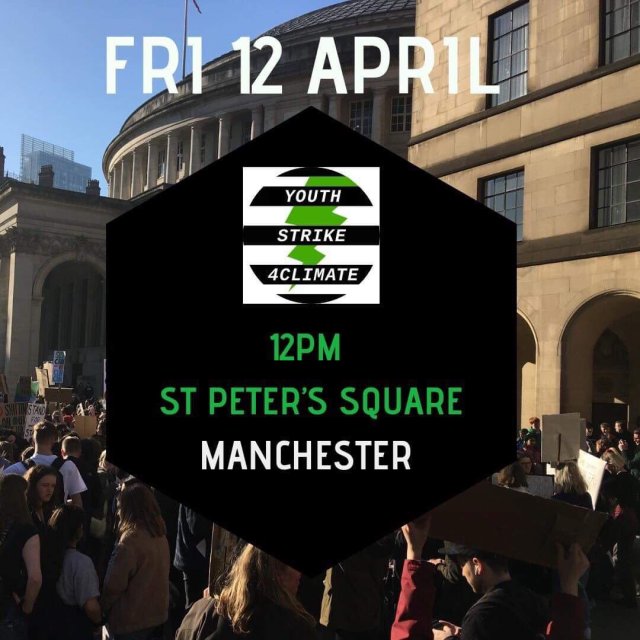
Next YouthStrike4Climate – Friday 12th April #Manchester

So, it’s that time again – the next strike is Friday 12th April, convening in St Peter’s Square at 12noon. If you’re on Twitter, follow @Youthstrikemcr

youthstrike12april

And there’s this cartoon from the wonderful Marc Roberts. The cartoon appears in the latest issue of the New Internationalist.

only planet marc roberts

Posted in School Strikes, Uncategorized | Leave a comment

Job Alert: Admin/Finance person for Veg Box People #Manchester

All details below lifted from here.

Change the food system for the better, work with us at our veg scheme co-operative

Date:
Thu, 03/28/2019
Come and work with Veg Box People

Veg Box People and Manchester Veg People are two co-operative organisations that work closely together to deliver a model of a more sustainable and fairer food system for Greater Manchester.

We need someone who shares our passion to create better food systems to help us consolidate both businesses. You will need to be an all-rounder as we also share much of the work we do, but we are particularly looking for someone to join the team who has strong administrative skills with experience and confidence of working with spread sheets and quickbooks (or similar software).

Your typical week would include collating orders (both from restaurants and for our weekly veg and fruit bags), placing orders with our suppliers, general administration of the business (including managing stock, invoicing and emailing customers and suppliers) and packing our lovely veg, which will give you the hands on experience to help you explain why our products are so much better than anyone else’s. While it may not be one of your regular tasks, you will need to be able to drive the delivery vehicle and know the delivery routes, to be able to provide cover for other members of the team.

Veg Box People is an equal opportunity employer. We celebrate diversity and are committed to creating an inclusive environment for all employees. We welcome applications from individuals across a diverse range of cultures, genders, ethnicities and lifestyles.

Further details are included in the job description and application form which are available to download below. Please send completed application forms to mail@kindling.org.uk by 19th April 2019.

Posted in Job Alert, Uncategorized | Leave a comment

The complete uselessness of #Manchester #Climate Change Agency, example #1532 or so

Or thereabouts. I’ve lost count.

The Manchester Climate Change “Agency” (actually a community-interest company, established by Manchester City Council and its hangers-on as a non-FoIAable stbvest).

  • So, shiny website, tick.
  • Glib presentations at “stakeholder events”, tick.
  • Snouts in trough and warm fuzzy feelings for certain people, tick.

And their “events” page.  Here it is, screengrabbed just now.

mcca events page 6 April
Never mind the fact that there is a huge upsurge in activism and things happening, not least the “Letters to the Earth” event happening at the Royal Exchange Theatre next Friday, 12th April – which happens to be where the MCC”A” holds its wretched annual meetings.

I wonder how all the members of the so-called  “Manchester Arts Sustainability Team” sleep at night – which includes the Royal Exchange itself – knowing their reputations bolster this shitshow of incompetence?

Posted in Manchester City Council | Leave a comment

Upcoming Event: “Letters to the Earth” #Manchester 12 April

Take Back and the Royal Exchange Theatre invite you to Letters to the Earth.

BOOK HERE

takebackletters to the earth..

A group of professional actors and climate activists will read out a selection of letters in a specially curated event, written by members of the British public, young and old, as a response to the climate and ecological emergency the world is now facing.

Inspired by the work of Extinction Rebellion and the global School Strike For Climate, we will be joining The Royal Court Theatre, Shakespeare’s Globe, National Theatre Wales and theatres across the country presenting Letters to the Earth on Friday 12 April.

This free event will last about an hour and will be followed by an informal discussion.

Find out more about Take Back and Letters to the Earth.

Posted in Upcoming Events | Leave a comment

Five Minute Friday #001 – For the #YouthStrike4Climate

There’s a new online campaign a-foot.  Every Friday citizens of Manchester will be encouraged to contact their elected officials/other important figures about a pressing environmental/social justice concern.  Manchester Climate Monthly will reposts these calls every Friday, and a link back to the originators (website pending!)
Take action – be heard 

Take five minutes every Friday to take action on important issues to make a difference. By adding our voices together we will amplify our impact and make sure that we are heard on important issues. Our initial focus will be changes at local level – Manchester Council, Greater Manchester, the airport, schools, clean air. Let’s get our councillors and MPs acting on our behalf and listening to our concerns.

Every Friday we will share an email and a message to be shared on social media.

You will need to know who your local councillors are and their email addresses. https://www.manchester.gov.uk/site/scripts/councillors.php?viewBy=name

You can also find your MP’s details at https://www.writetothem.com

Let’s make this happen. Share the event with friends, tag people.

5th April
Thanks for taking action on this. Keeping up pressure on the council over their lack of support for climate strikers is really important. (Not quite sure why? Watch the video below) Please personalise as much as you feel comfortable with.

Personalise the email – change the email as much or as little as you want. It is important to add your own personal intro message. If you are happy to build a relationship with your councillor it is helpful to ask their thoughts, say that you know they are probably worried too, request that they respond to your email. If you don’t feel confident to do this then say that you don’t expect a reply but that you want them to be aware of your thoughts on this topic.

Thanks!

To: Your councillors (Find yours at https://www.manchester.gov.uk/manchestercouncillors)
Cllr Angeliki Stogia (Lead Executive for Environment) cllr.a.stogia@manchester.gov.uk
Richard Leese (Leader of the Council) r.leese@manchester.gov.uk

Subject: Please support climate strikers

Dear Cllr Stogia/Angeliki
Please reconsider your position on climate strikers.

Dear Cllr
I am writing to you to get your support in asking Manchester City Council to reconsider its position on the climate strikers.

This week parents at Chorlton High received a letter detailing fines and potentially prosecution should students take unauthorised absence. This is a very difficult position for parents of climate strikers and is inevitably going to impact upon numbers able to attend the strikes.

Climate scientist Professor Julia Steinberger took time out of the IPCC conference to make a personal video appeal to Manchester City Council to support the strikers. I understand that you’re busy but of course, so is she. I really hope that you will watch this very short video, just 5min 14 seconds.

It is hugely important that we support the climate strikers. Climate breakdown is an existential threat to our survival, to the futures of our children and to all life on Earth. As Professor Steinberger says in the video, the actions of the strikers have supported and influenced numerous politicians to take stronger action on climate breakdown. This is invaluable.

I would love to hear back from you on your thoughts on this, and on how you could help persuade the council to support the climate strikers.

Best wishes

Partial transcript
“I’ve been encouraged and inspired by striking students. I want to give my personal and professional appreciation of what your children have started. Congratulations on raising them well. They have really started a seismic shift and when I talk to colleagues at the opening ceremony here at the IPCC the fact that striking students are there demanding significant powerful change, that we take their futures seriously, that we take their engagement seriously is carrying a lot of us forward.

Nicola Sturgeon said that they influence her in her work as well, she said that she was both shamed and inspired by the striking students and encouraged to move forward on significant action on climate change. And I think this is true for many politicians. The students are helping them move forward, demand urgency, demand climate emergencies and take much stronger and more proactive action than they would otherwise.

“I was quite disappointed that Manchester City Council are not having the same kind of statement. That Manchester City Council in particular are threatening to fine the parents of striking students which I think is completely unacceptable. And also raising questions about the safety of students at the strikes. I understand the safety concerns.”

“It is the responsibility of the security, the police and of the city council and the authorities to make sure that these protests happen in the best way possible.”

“We are not raising our children in a safe environment. Full stop. Because of climate change, and that is the reason they are striking, because we have failed in our duty as parents, in our duty as grown-ups, as the generation that should have allowed all future generations to live safely. That is something that we are failing to do across the board and that is why they are striking.”

“A really important aspect of the safety debate is that we need to remember is that safety is not just the safety of the children who are striking while they are striking we are talking about the safety of their entire future.”

FOR TWITTER
Climate scientist @JKSteinberger makes a personal plea for @ManCityCouncil to support #ClimateStrike

youtu.be/Vu4fzsRaMEY

@angelikiStg @XR_MCR @familiesrising
#ParentsForFuture #GMGreenCity #ActNOWforFuture #FridaysForFuture


Posted in 5 Minute Fridays | Leave a comment

Event report: Shell’s “dialogue” at MOSI more of a capture and store kinda thing… #Manchester #climate #greenwash

This is a guest post from the “Shell Out” campaign

It’s good to talk?

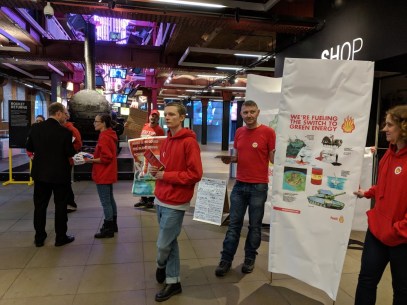
feueling the switchConcerned Mancunians were barred from the Shell Energy Dialogue at Museum of Science and Industry last night.
Since August 2018, Shell Out! have been campaigning against the oil company’s sponsorship of the Manchester Science and Industry Museum with one of our objectives to talk to those involved to explain our concerns. So when we heard Shell were running an ‘Energy Dialogue’ at the museum we thought we were in luck! Inexplicably our invitation failed to arrive, so in the spirit of communication, we went along anyway.

In eagerness we arrived two hours early whilst the museum was still open, to set out our arguments to present at the dialogue. These included raising concerns about the Shell’s Nigerian corruption case  currently taking place in Italy (we did wonder who was behind all those spam emails), the historic damages Shell owe having been responsible for 2% of global carbon emissions since 1860 and recent Greenwash efforts to mask their 95%+ involvement in hydrocarbons.

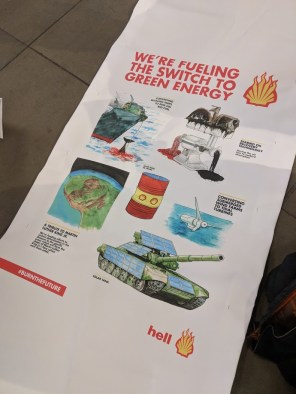
close up fueling the switchNot everyone can take in all these facts and figures so we also brought along some excellent displays  courtesy of visual artist Darren Cullen, just to drive our message home.
As delegates came in to the museum we engaged them in ‘dialogue’, discussing their awareness of Shell’s track record and hearing their views on Shell’s dubious legal, ethical and environmental record. The vast majority, including museum staff, were happy to talk, many had previously been unaware of the company’s history and activities.

Less keen to talk were Shell with no one from the company wanting to talk to us or even make an appearance in the foyer. To add insult to injury, we were barred from the dialogue session itself, prevented from engaging in a wider discussion on the issues at hand – fairly ironic given the nature of the event.

We may not have been present but our friends on the inside who did make it in to the session report the information we shared was widely discussed during the evening, so at least the point was made.

Another disappointment was the attendance, only around a quarter of the 120 odd name badges set out at the start of the event had been collected when the proceedings began. Perhaps it was the poor weather or perhaps, as some attendees acknowledged, the expectation that concerned Mancunians such as ourselves might make an appearance to put forward their views.

We’d like to thank the museum staff who were helpful, polite and courteous and all the attendees who engaged in discussions. We’d also like to thank the many delegates who passed on details of the event to us in advance when Shell or the museum had failed to.

We’d very much like to discuss our concerns directly with Shell UK and the Museum’s senior staff and would welcome their contact. But for now the campaign continues and we will return to the museum in the next few weeks and months. To get involved in the campaign email

shelloutpublicscience@gmail.com

or contact our social media accounts to attend a campaign planning meeting

https://twitter.com/shelloutofsci

We are just one of many similar campaigns around the world campaigning to kick oil out of public cultural institutions, some of which have scored recent notable successes

[A note from the editor  of Manchester Climate Monthly- Journalistic practice would be that we invite Shell the right of reply. Even though they couldn’t be bothered to engage in dialogue with the people trying to raise concerns, then yeah, whatever; if one of Shell’s PR flaks cares to respond to the above,  (#notholdingbreathe) it will get published.  The comments section might get quite entertaining…]

[Oh, another note from the editor – I did some blogs of some Shell innovation, adverts etc a while back. They still stand –

Dec 2014 – PRELUDE IN LNG MAJOR: OF SHELL, #CLIMATE CHANGE AND INNOVATION

October 2015- SIMIANS CYBORGS AND SHELL: ON CORPORATE PROPAGANDA AND FALLBACK POSITIONS

October 2015 – OH, BTW, SHELL, WE HAVE THAT ‘HYBRID WORLD’ – THANKS IN PART TO YOU…

December 2015- ON EXISTENTIALISM, GUILT, GODARD AND … SHELL’S CORPORATE FRAMING STRATEGY

Posted in Campaign Update, Energy, Event reports | Leave a comment

Upcoming event: The Australian Energy Transition #Manchester Tuesday 9 April 3 to 4pm

What can we learn from the grotesque horrorshow that is Australian energy (failure of) Transition?  An informal seminar.  Note the access issues!! If you do not have a student or staff card allowing you access to the Alliance Manchester Business School, please email marc.hudson@manchester.ac.uk and he will add your name to the guest list at the reception desk.


Seminar: The Australian Energy Transition:  Big, small or somewhere in the middle?

morrison and coal

Tuesday 9th April 2019, 3- 4pm

Venue: G.021, Alliance Manchester Business School (map)

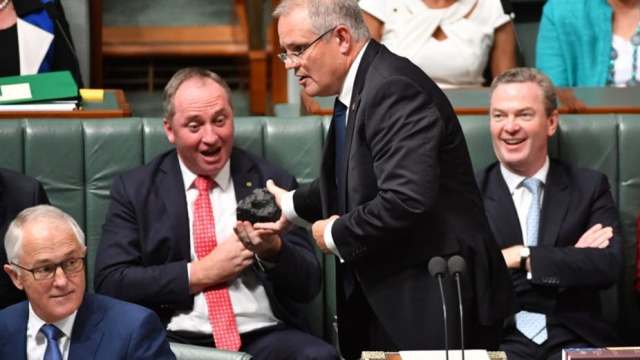
The Australian Energy system is in flux.  Aging coal-fired power stations need to be replaced.  Renewables are going gangbusters. Three visions all have powerful interests behind them looking for subsidies: “High Efificiency- Low Emissions” coal plants, a gas future and renewable energy zones in the desert. People power is keeping rooftop solar for everyone in the picture. How could a mixture of small and large scale renewable energy – principally wind and solar, with grid and domestic storage – prevail?

This will be an informal seminar, with introductory remarks from Heather Smith, followed by discussion.


Biography

Heather Smith is an electrical engineer, a policy maker and a Churchill Fellow. In her third career she is focused on community energy and our energy transition. Heather volunteers with Citizens Own Renewable Energy Network Australia,(CORENA) and the Coalition for Community Energy, two of the organisations in the emerging community energy sector. Heather has recently commenced a PhD with UniSA looking at what it takes to redesign our electricity system. Microgrids and the growing independence of local energy systems will be the focus of her research.

changingweatherblog.wordpress.com


Posted in University of Manchester | Leave a comment

Help the #YouthStrike4Climate protests – meeting Sat 6th April, 2-3pm, #Manchester #climate #SchoolStrike4climate

UPDATE: MEETING IS FROM 2 to 3pm, not 3 to 4.

The next Climate Strike happens on Friday 12th April.

This Saturday, 6th April, there will be a meeting at the Manchester Art Gallery (just off St Peters’ Square – map) from 3 to 4pm with many of the organisers of the strike present.

Anyone of any age who wants to support the Youth Climate Strike is welcome to attend.  No need to book, just turn up.

See interviews with youth climate strikers

(with more to come)

Please share the above details with anyone who would like to know.

Posted in Upcoming Events | Leave a comment