The Mayor’s Green Summit – another point of view.

Hannah Knox reflects on the latest example of promising-to-act in Manchester, the Mayor’s Green Summit of March 25th.

Last Monday’s Mayor’s Green Summit was the second round of what looks to become an annual ritual of green networking, target setting and back patting. It was my first Green Summit as I wasn’t one of the chosen ones to get a ticket the first time round, but this time it was bigger (with a new venue at The Lowry), meaning lots of people who like me didn’t get selected for a ticket last year were able to come.

The green summit was initiated by Andy Burnham’s team last year to establish a collective agenda on climate change for Greater Manchester. This year’s event revolved around the launch of the ‘first’ five year plan  for climate change in Greater Manchester.

There were some new appearances at this years conference. A group of Manchester’s youth climate strikers headed up by Bury Youth MP Emma Greenwood opened the conference with personal and political messages about why climate change needs to be tackled. The bottom up then segued into the top down with a personalised message from HRH Prince of Wales about the importance of cities like Greater Manchester doing their bit, and a video of Chris Packham about how important the conference was. Later in the day celebrities Bez from the Happy Mondays and Peter Gunn from Coronation street did a daytime TV style sofa-set with Andy Burnham which at moments teetered awkwardly between denialism and climate action, and Manchester poet Lemn Sissay was also on stage, turning environmental policy into policy poetry with a musical rendition of his inspiring beat poem What If.

This festival tone was the backdrop for the launch of Greater Manchester’s Five Year Plan to tackle climate change. Anyone who follows Manchester Climate Monthly might be forgiven for a sense of déjà vu. Have we not been here before, in 2011 to be exact, when Greater Manchester launched its 2011-2020 climate strategy? No mention of how the city region had done against that plan however, but no matter. Instead this was all about ‘embracing the future’, about fresh new plans and pledges towards achieving these new goals. Political smugosphere, Marc? Rather like climate change itself, it was the future that framed the present, whilst the power of the past to teach us lessons about what was done well or what to do now was ignored.

One thing about the future framing the present was that it allowed for the appearance of a term that was new to me in policy-speak – THE GAP. THE GAP is the difference between the strategic commitments being made by GM (net-zero carbon by 2038) and the projections provided by the Tyndall Centre Scatter Analysis of what Greater Manchester needs to do to tackle climate change to keep within 2 degrees of warming. Ironically for all the talk of ‘opportunity’ rather than ‘burden’, THE GAP is a policy acknowledgement, that the 5 year strategy is failing, in climatological terms, before it has even begun.

Now tackling global climate change at a city level is clearly difficult, and working with little budget under a Tory government is going to restrict what can be done by a group of policy makers, so THE GAP is probably inevitable, but there did seem some big missed opportunities here. A pledge was made to bring in a zero carbon housing code by 2028 – 9 years to create a local policy instrument: really – 9 years? And what happened to last year’s talk of a GM energy company? Different ownership models for energy provision? Fuel poverty?

More worryingly, though, was that THE GAP also seemed to weirdly legitimise failure as a form of success. When Extinction Rebellion stormed the conference at the end of the day, shouting out to the now depleted audience, ‘do more, faster, now’, and ‘we demand more’ their critique had already been dampened by THE GAP that already anticipated this call to action. Unfazed, Burnham muted their urgent cries by giving them the microphone and inviting them to put their views across, telling us he couldn’t agree with them more. I don’t doubt his sincerity, but perhaps it is important to do more now than just acknowledge, with policy makers, a gap between strategies and projections. The suffragettes and the civil rights movement didn’t call for a % increase in rights by a certain date. They called for absolute changes now. As Lemn Sissay puts it ‘a lost number in the equation, a simple understandable miscalculation – and what if on the basis of that the world as we knew it changed its matter of fact – let me get it right – what if we got it wrong?’ If we are going to rise to the challenge Andy Burnham posed to hold GM to account and to ask them to do more, perhaps what we need is a different calculation to that of the policy makers, one that demands not that we gradually try to close THE GAP – but that we challenge city regions like GM to confront absolutes. We have had Manchester Nuclear Free City – what if we were to aim not for a ‘net-zero carbon Manchester by 2038’, but dared to demand an absolute change, something like ‘Fossil Free GM’. Perhaps now the time has come to replace indicators with infrastructures, pledges with planning legislation, and ever receding futures with a now measured only against itself.

Hannah Knox is Associate Professor of Anthropology at UCL. Since 2011 Hannah has been researching how climate models come to matter in political life with a focus on the everyday work of climate mitigation in Manchester. She is author of Roads: An Anthropology of Infrastructure and Expertise (2015) and Ethnography in a Data Saturated world (2018). Her forthcoming book about her research in Manchester Thinking Like a Climate: Governing a City in Times of Environmental Change should be out next year.

Posted in Event reports, Guest post | Tagged | Leave a comment

Declare a #Climate Emergency in #Manchester: 1st petition signer interview

There’s a petition on Manchester City Council’s website calling on the council to declare a climate emergency. If you live, work or study in Manchester, please a) sign it and b) ask your friends, family and work colleagues to do the same. More details on things you could do here.

Every time the signature reaches a significant milestone (double figures, triple figures, 1000, 2000 etc) MCFly will invite that signatory to answer some questions. First up, as signatory 10, is Jonathan Atkinson.

Who are you, what do you do, why did you sign the petition?
My name is Jonathan, I am a staff member at Carbon Co-op and I signed the petition because I believe this kind of action reflects the scope and the scale of the climate change challenge we are facing and the kind of action required to tackle it.

Have you tried to get other folks to sign yet? If so, how, and how did
 that go?
No, I only signed it last night, but I will be circulating it to colleagues and friends via social media and talking to them.
I will also ask whether Carbon Co-op can officially endorse the petition.

What suggestions do you have for those trying to get more people to sign
 the petition
I think it would be useful to get prominent people and organisations to adopt the call. Also, I believe some councillors and Labour Party branches might also sign up to it if approached.

If Manchester City Council DOES declare a climate emergency, what should its first actions afterwards be?
To appoint a Cabinet member with sole responsibility for Climate Change action, to carry out climate change assessments and audits on all current and future council-related spending, to appoint a scrutiny committee to the oversight of climate change action with a requirement to publish an annual report on performance and present the report to the public via a meeting.

How do you think citizens could/should act to make sure that such a declaration is followed up with actual actions? What skills and  knowledge are needed for that?
Through the above mechanisms but with an emphasis on the report and the public meeting. Where possible, citizens should be involved in the creation of climate change related policy eg through citizen juries and on spending of money related to climate action through participatory budgeting mechanisms.

Anything else you’d like to say?
Thanks you for starting this petition. Will you be bearing your bottom at the next Council Scrutiny meeting? (I’m begging you – please no!)

Posted in Manchester City Council, petitions | Leave a comment

Petition: #Manchester City Council must declare a #climate emergency

Want Manchester City Council to declare a climate emergency? There is a new petition on Manchester City Council’s website that you can sign if you live, work or study in Manchester (registration required, but takes about 1 minute: see here).


We the undersigned petition the Council to declare a climate emergency, with a target to be “zero carbon” by the year 2030, with a proportionate share of Manchester Airports emissions (35.5 percent owned by the Council) included in the carbon budget it sets.

Other councils around the United Kingdom have declared a climate emergency. While Manchester has set a target of being zero-carbon by 2038 (based on production-based emissions), this is not ambitious enough. Moreover, it excludes a fair share of the overall emissions from Manchester Airport. Declaring a climate emergency, and then taking the relevant actions, will show true leadership on the crucial issue facing young people today.

You can sign the petition here.  PLEASE encourage your friends, family and acquaintances to sign it too, and to share it as you have.  Here below are some other things you could do


declare cliamte emergency

  • Create a pinned tweet on your twitter feed with text along the lines of this below I’ve signed the petition calling for #Manchester City Council to declare a #climate emergency. If you live, work or study in Manchester, you can (should!) too.  https://bit.ly/2uBnnFS And tag people into it who you think will sign it/give it a signal boost.
  • Repost it on facebook
  • Change your twitter/facebook photo to something like this.
  • ivesignedsquare4
  • Having an email signature that says, well – I’ve signed the petition calling for Manchester City Council to declare a climate emergency. If you live, work or study in Manchester, you can (should!) too.  https://bit.ly/2uBnnFS
  • Encourage your friends, family and acquaintances to do so
  • Make a short video (use your phone) explaining why you signed, why it’s important to you, encouraging your friends to do the same, and then posting online
  • Encouraging any groups you are part of to include the existence of the petition in every newsletter/digest they send out
  • Encourage other people to make videos
  • Other suggestions welcome!


Posted in Manchester City Council | Tagged | Leave a comment

First reflections on the Mayor’s Green Summit – #Manchester always has done a good conference #GMGreenCity

By our middle aged guest-columnist from Stockport

I’ve been to quite a few climate conferences in Manchester over the years. Remember the send-off we all gave Ed Miliband before he went off to fight the good fight in Copenhagen at the GMEX in 2009? What about the launch of the report into ‘the economic opportunities presented by low carbon technologies’ at the Town Hall in 2011? We’ve had the all the fringe events at the different party conferences over the years (I’m sure I saw Nick Clegg commit the Lib Dems to phasing out nuclear power to a bemused carbon savvy audience; David Miliband grapple with the existential threat of climate change, just before walking out of politics and various Tories who also ‘got it’ and at least seemed to enjoy their conferences much more than their opposite numbers).

This isn’t a recent phenomenon. Who else was at the launch of the North West’s Climate Change Impacts and Adaption Strategy launched by the North West Regional Assembly back in 1998 at Manchester Airport (yes really, and no the demise of the NWRA hasn’t affected my life adversely either)? That last one at least didn’t promise to change anything, rather it had the honesty of saying ‘this is what we face’ albeit the picture was much less bleak back then.

Many of the more recent ones have, of course, told us how Manchester will lead the way in tackling the greatest threat we face, launching a new strategy, pledge scheme, study or whatever. Casting my mind back is it fair to say that ‘Manchester is my Planet’ was the worst of the lot? [Probably: ed].

I didn’t make it along to the bash last week. This wasn’t actually intentional (honestly, I’m not trying to be cool), rather I don’t work in the city any more, I’m not connected to the public infrastructure that does these things and I didn’t know it was going on. I just live here.  I genuinely hope that the latest effort delivers more than the others, I wish everyone involved well, and I don’t have a problem with conferences per se (you can always go for a drink after).  The worry I have is that when I drive ‘round Manchester, fly out Manchester Airport or shop at the Trafford Centre I’m struggling to see what this great city has actually done to claim any leadership credentials. The UK has made great strides on carbon reduction in the last two decades driven by renewables and energy efficiency (the latter being a fortuitous accident centred around LED lighting and industrial decline but never mind).

But, I have to ask, what has Manchester done to stick its neck out? We turned down the opportunity of a congestion charge a decade ago; anyone trying to develop renewables faces a hostile local authority and while talking a good talk on climate we continue to build things like Airport City. Nothing like an Amazon Fulfilment Centre on a greenfield site is there? We can talk as much as we like about the potential of green technologies but this really is where it’s at right now if you’re one of the big boys in the Town Hall.

I’m not saying that there aren’t any good people working hard to make a difference right now – GM Community Renewables actually do things, Emerge Recycling brings people back into employment, tackles food waste and feeds the needy, Peel Holdings (funny bed fellow with the other two I admit) builds wind farms. The worries I have are: will these people even have noticed Andy Burnham’s sudden interest in climate change and what ‘bad stuff’ are we actually going to stop doing under the new plan?

Posted in Uncategorized | Tagged | Leave a comment

Interview with youth #climate striker Alex Davies #SchoolStrike4Climate #YouthStrike4Climate

Following on from interviews with Emma Greenwood, George Hassall and Ishaa Asim, Alex Davies, a Stockport Member of Youth Parliament 

alexdaviesWas today (the March 15th strike) bigger than you thought? What was your favourite thing about it? 
Whilst I was not at the strike in person, it was fantastic seeing how substantially bigger the turnout was than originally anticipated. In my opinion, the best aspect was the sheer number of young people who turned up in support of their futures; something I think is hard to do nowadays – it is great to see so many people take an interest in politics and their future.
When did you first start learning about climate change – was it in school, from your parents? Did Greta Thunberg have a part to play? 
I had learned parts in school, but have only recently gotten involved myself once I realised the potential catastrophic effect this could have on my future – and how those calling the shots will be the people living with the consequences of it. Greta Thunberg also fuelled this – I watched her speech and was enthralled by her knowledge and passion in changing her future. As a Member of Youth Parliament, it led me to think that I could be doing more as climate change will affect not just me, but my constituents and everyone. Climate change is the biggest threat to society; yet for the most part, politicians are sitting on their hands, leaving us to suffer with the consequences in years to come.
This is the tricky one – what sort of help/advice/support would you like from your parents, existing activists, adults? How is that best offered (I call it the POG problem – “Piss Off Grandpa/Grandma”) 
 It can understand that it may be hard to ascertain what we do that contributes to pollution, and it is completely understandable that trying to have a low impact on the carbon footprint is difficult; but this is why we need to start now – before it is too late to even have this decision. We need unity in our effort to secure a safer future; we need you to stand by us in our aim to improve our lives.
Anything else you’d like to say? 
I would like to thank anyone who attended – unfortunately, I could not make it due to illness, but I hope to be at the next strike! I implore Members of Parliament, Members of Youth Parliament, young people, councillors, mayors and everyone to support these strikes. We’re trying to ensure a safe future for us all.
Posted in Interview, Uncategorized | Tagged | Leave a comment

2020 – How we started winning in #Manchester

[The text below is an attempt to think through how, a year from now, “we” might be in a far better place than we are now.  Please share it, comment on it, share it, write your own versions. This is a crucial discussion.  Although I take responsibility for it, I also must acknowledge the many excellent suggestions and supportive critiques of Rose Arnold and Calum.]

“What a difference a year makes” said Alex to Cameron (names have  been changed to protect the innocent), as they surveyed the final format of the People’s Green Summit, now, in March 2020, only a week away.  It was a day packed with skill-share, facilitated discussions, information sessions and barely a keynote to be seen. People who attended would be participating, not sat in rows listening to presentation after presentation after presentation from the stage. Everyone would leave with new contacts, new ideas, having been able to share their thoughts and experiences on a vast variety of topics.

Last year at this time activists had been out in force at the farce that was the second “Mayor’s Green Summit.”  It had been another depressing debilitating spectacle, full of people being talked at by the great and the good. The last minute cynical insertion of a youth climate activist and a “listening” panel had not been able to disguise the fact that neither Greater Manchester nor Manchester “leaders” had a clue what to do. Instead they had just recycled the same old greenwash, the same old promises-soon-to-be-broken.  It had convinced those who wanted to be convinced, who needed to believe that the last ten years hadn’t been wasted and that business as usual would provide the radical transformation required. But it had not convinced those who wanted to see real action, despite Andy Burnham handing the microphone to the Extinction Rebellion ‘invaders’ at the end.

Despite its many shortcomings it was in a way the beginning of everything changing. People picked themselves up after the period of disillusionment and depression. Many who had perhaps harboured hopes that it would be better now knew that it wouldn’t be. Knew that there was no plan being worked on which would take us anywhere good. There was agreement that More. Faster was indeed urgently needed, and although of course there wasn’t agreement as to exactly how much more and how much faster they were all working on pushing in that direction.

There would be no more willingness to sit and rows and be told by economic and political elites that a survivable future could be achieved without any real disruption of those elites.  There would be no more silence when soothing blandishments about “Paris-compatible” and “science-led” were bandied about. There would be no more looking the other way as “leaders” flew around Europe talking about carbon dioxide.

Spelling out how we get from here to there
The councillors who thought seriously about climate change were emboldened by the growing numbers of people contacting them, demanding more. Members of the groups took time to talk to their councillors, to support local actions, to push them on the issues and the detail. Groups started talking to their members about how to talk to people about climate breakdown, and asking that they look for ways to include it in different activities they took part in, to talk to the groups they attended about what they could do. And it worked…
The council, under pressure, backed down on fining parents of children who attended the climate strikes. There was embarrassment about the fact that footage of the climate strikers was used in the yay making change video (you know the one I mean) while at the same time councils were trying to stop the young people from attending.

People started realising that supporting young people in the strikes was not enough. They started their own strikes, low numbers at first but growing ever larger.

A dense and growing network of organisations – youth groups, sports clubs, mosques, churches, unions, small businesses  and the like, were learning how to communicate and co-ordinate with each other to not merely shame green-washing leaders but to deliver real leadership, by example. That meant that every single councillor had been “adopted” by activists who lived in that ward, or nearby, who were educating, pressuring and praising-where-due.  It meant that when people met to break bread, to worship, to play sport, they thought about what is unfolding on this planet, and how they could minimise the damage by changing their behaviours and pressuring not just politicians, but corporations and organisations. It meant that there was relentless radical explanations of the causes and consequences of climate change at cultural events. It meant that people struck up conversations with friends, family and acquaintances whenever they felt it would be helpful (and even, sometimes, when it might not).

[see acknowledgement of greenhouse gases, modelled on “welcome to country”]

The People’s Green Summit – basically the  day-long “stakeholder conference” that the Manchester City Council-controlled “Steering Group” had failed to implement between 2011-14, before giving up altogether – was not the focus of Greater Manchester’s climate activity, nor its culmination. It was, however, a handy measuring point, a chance to take stock and look honestly at what had succeeded and what had failed in the last year.

Everybody knew the risks of seeing it as the peak of an emotional journey, and everyone knew that the day after the Summit, more work would be required, onward and onward. People knew that they could not – should not- try to be involved at maximum intensity, for risk of burn-out. They also knew that the organisations the were part of had it covered – there were few bottlenecks and single-points of failure. Everyone was wanted, but nobody was indispensable.  If there were skills and knowledge that were in only a few hands, those were carefully shared, increasing resilience.

People were encouraged to not over-commit and then under-deliver.  Status was not to be gained through intense busy-ness but through being a steady and reliable member of a group/multiple groups.

It had all kicked off back in April 2019 when a bunch of activists – some affiliated, some not, some old/experienced, some new, had gathered for a meeting to figure out what was to be done, and how, and by who. Normally these meetings were full of different groups each wanting to be the “lead” group (whether they would admit that –  even to themselves – or not). Normally the meetings would also be bloody arenas for (undeclared) ego-battles. This meeting, however, was different. Instead, the agenda, format and facilitation was skilfully done, for once. Attendees were asked to do some pre-thinking, that was then shared with the wider group. There were mechanisms by which anonymous appraisal of past efforts could be made.  Everything was up for grabs – the lack of decent social media skills among groups, the appalling ways that meetings were held (all info-deficit smugosphere), the lack of media training, the lack of any strategic approach, the willingness of groups to stay stuck in stale repertoires that made them feel good, the inability to conduct meaningful research and investigation into the failures of official climate policy and – above all – the staggering inability to make use of all the new energy and skills that was available  the absorptive capacity problem.

[see also 2019: How we blew it again]

From the meeting came a commitment that the activist groups themselves should do what they had forever been demanding governments and corporations do –  “Do More. Faster!”


So they

  • spotted their lacks and they looked around to share their skills and knowledge.

  • innovated in the format of their meetings, both public and “business,” to makes sure that they were genuinely welcoming to new people and allowed everyone -old and new- to get involved in doing things BETWEEN meetings

  • focused more on having dialogues with other concerned (and unconcerned) citizens than in stroking the egos of politicians, while still doing the necessary lobbying and pressuring

  • realised that the traditional success metrics (of bums on seats at meetings or marches) were totally inadequate, and that long-term involvement, even if it was at a relatively “low” level, between meetings and away from meetings (most people would only come occasionally) was the only way forward


The adults ruefully realised that the tendency in February and March, of “stepping aside” for young people to lead the climate revolution had been a symptom of their shame and guilt, and that if they wanted to be actual allies, they had to up their game,and sort out their own activist practices. Waiting for Greta Thunberg and her Manchester equivalents to save us was not going to work.

It wasn’t easy, and there was a steep learning curve around project management, time management and the like – all things that were anathema to the “usual” culture” of activism in most groups.  Those who met – who stayed in touch and gradually invited more people to be part of their broader “unofficial” network, were well aware that they were up against ingrained habits by which – in a kind of Gresham’s Law – ineffective (predictable, self-indulgent, co-opted) activism could drive out the good (sustainable, innovative, resilient, inclusive), and that there would be mis-steps.

They made sure that they supported each others’ efforts but were also willing to critique (in private, primarily) efforts that smacked of slipping back into old comfortable and futile ways of behaving.

The activists made sure that when they were invited to attend a mosque, a cricket club, a union meeting that they were well-prepared with stories, analogies and metaphors that “made sense”. They made sure that they went in a a spirit of dialogue rather than “filling a deficit” talking at people and telling them things .

They realised that they needed help – they did call outs for storytellers, artists, facilitators, people skilled in delivering workshops. They tried to find insiders to represent, people involved in the community who understood the particular challenges and had relationships with those they were meeting with.

They realised that Rome was not built in a day, and that organisations would need support and encouragement for the journey. Activists made sure that rather than trying to be at the centre of a web of influence, that groups were connected with each other, knew how to get specific help from other relevant organisations, be they local authorities, central government (everything was totally fine now that Saint Jeremy was in Downing Street) or a charity. If they showed a film, they made sure there was a proper discussion. If they held a panel discussion, they made sure the Q and A was not dominated by the ‘usual suspects’.  Simple things, but they made a surprising difference over time.

Some thought this emphasis on building networks of communication and co-ordination were a distraction from the more urgent work of blocking roads and getting media attention.  But the activists who wanted the networks to be built were able to convince enough people that mobilisation for the long-haul depended on social movements, and movements in turn depended on wider networks.  Those networks meant that when an activist group needed skills, or knowledge, or support, it could draw on far wider resources than just the activist ghetto. There was not just good will, but also a willingness to support the more radical and confrontational actions.  [Those with a military bent pointed out that only one tenth of an army is involved in active combat with the enemy. The rest are making sure the frontline troops are fed, watered, clothed, paid.]

But beyond the practical reason were moral and philosophical reasons.  Part of the problem of Western society was the creation of aching, gnawing loneliness (and its cousins, despair and hopelessness), the holes that people try to plug with high-carbon consumerism (disposable clothes, cheap holidays in someone else’s misery).  And beyond that, the problem of distrust and disconnect, of hollowed out democracy. Unless activists tried to combat that, to “prefigure” a different world through creating webs of support, affection and trust, then nobody else would, and the so-called “zero carbon” future would be just as depressing as the current high-carbon abomination.

The decision to even hold a People’s Green Summit had been fiercely debated. Some warned that it was just another part of the  “emotacycle”, where a big orgasmic event is promised, with feeder events beforehand.. Others saw the danger of that, and proposed that there would be a programme of events and actions planned for AFTER the PGS too, and that the feeder events would not just about the PGS.  This view prevailed, and everyone had worked hard to make all of this a reality. The feeder events had not, thankfully, all been in the city centre and South Manchester. All ten boroughs had had events, and different formats had been deployed. Similarly, real efforts had been made to engage with – and learn from – the “unusual suspects” – refugee communities, BME, LGBTQI and other groups beyond the usual bubble of white, tertiary-educated middle-class people.

Efforts were made to make sure the day was planned with consideration to all the groups now involved in the movement. The venue was accessible, there was childcare, it wasn’t held in a place which sells alcohol nor on a religious holiday. There were NO talks, instead there were activities which were designed to get people interacting with others they didn’t know, scribbling ideas on joint challenges – groups then brought together to flesh these out.  

It helped that a bunch of academics, disgusted with the emptiness of the leaders’ rhetoric had gone beyond merely saying they supported Youth Climate strikes, but actually thrown their brain power and institutional power into the service of civil society organisations. Sure, there had been tensions, but nothing unmanageable

[ see also this short story about an activist and academic handcuffed to each other, fleeing a public order situation – The Defiant Ones ]

Not all plain sailing

It wasn’t all plain sailing of course.  The Council and GMCA, after a period of ignoring the activists, made a concerted effort to co-opt the rhetoric and some of the activists, before giving up.  The exposure in September of the undercover cop in one prominent organisation – after an exhaustive and secret investigation lasting several months – was relatively well-handled.  A few people were left emotionally bruised, betrayed by someone they had thought was a friend – but no lasting harm was done. That was in part because there was now a strong awareness that the “management” of emotions in social movement organisations was a crucial and skilled task, that all could and should contribute to, especially when facing such an overwhelming and overwhelmingly terrifying prospect as abrupt climate change.

Victories were small, but they did exist.

  • There was a network of play streets and chemical free allotments,
  • The campaign for better buses had won some serious victories, and decent and cheap public transport was – slowly- becoming a reality.
  • Under enormous political pressure Manchester City Council had been forced to sell some shares in the airport to invest in local energy company,
  • They also agreed to change their procurement process giving a boost to green businesses across Greater Manchester.
  • The chief executive finally did her carbon literacy training, and the Executive Member for the Environment even gave a speech one time about climate change- albeit at one of the climate strikes which she had tried to prevent. Small victories.
More importantly the movement was clearly growing, things were changing and happening, it was starting to swell and felt like we were almost at that tipping point where everything could change. There were burgeoning projects springing up all over the city, banners hung from windows. 

Real hope had been and still  was a problem – there was a constant battle to find straws of hope, reasons to be cheerful in the midst of unfolding chaos.   While ‘hope’ as such was still scarce, while it felt scary, there was an energy and a feeling of connection, of community and of working together which carried people through. People read Joanna Macy and Chris Johnstone’s Active Hope and discussed how they could make it real in their lives. Meanwhile, those who didn’t need hope to keep going – or felt that as per climate scientist Kate Marvel that we need courage not hope – learnt to shut up, so long as the hope-efforts were not distracting from the overall goal of building networks (nay, movements) of people who were taking action in their daily lives and effectively demanding action from politicians and other so-called leaders.

Cameron turned to Alex, as they finalised the preparations for the post-People’s Green Summit action plan.  “Yeah, I didn’t use to think we could do this. But this last year… we just gotta keep bringing in new people, new ideas, new energy.  We can turn this around.”


Posted in capacity building, inspire | 3 Comments

Chief Exec of #Manchester City Council- Still. Not. “Carbon. Literate.” #climate

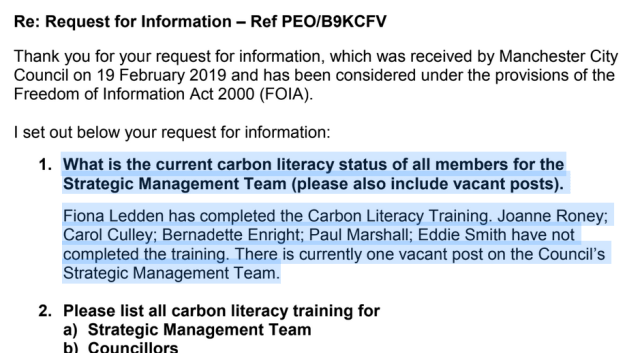
For the last two years the Chief Executive of Manchester City Council has been saying she would soon undertake “carbon literacy” training.  A recent Freedom of Information Act request that she… still hasn’t.

The chief exec, Joanne Roney, spoke recently at an event at Manchester Business School.  The topic?  The future of Manchester: and the mentions of climate change were notable in their…. complete absence.

In the Q&A Roney said that she would indeed be completing the carbon literacy training, with her Senior Management Team (of well-paid bureaucrats) as soon as it was “stable.”

(This was perhaps an allusion to the fact that the ONLY member of that team to have done the carbon literacy training was … leaving.  Sara Todd is now at Trafford, as its CEO (Perhaps someone would like to FoIA Trafford about their carbon literacy?))

Manchester Climate Monthly submitted yet another FoIA about Roney’s carbon literacy status (at least the fourth – we’ve kind of lost count over the years).

Here’s an excerpt of the reply.

foia roney


“Carbon literacy” is a one-day training package, mentioned in the now forgotten second goal of the 2009 Climate Change Action Plan.  The idea is that once people have “the facts” they will change their behaviour.  The 2009 Plan said that by the end of 2013, everyone who lived, worked or studied in Manchester (about a million people) would have done the training.  Today, in 2019 the number is somewhere around. ..  5000.

And the training is enormously effective, oh yes. The best indication is that people like local MP Jeff Smith take the training, get the certificate and then… vote for the expansion of Heathrow Airport. NO, I am not making this up.

So why do I bang on about it?  Because it’s like the “no brown M&Ms” rule that the band Van Halen have in their contract – it’s an easy way of seeing if an organisation has ANY competence, any plan. If they can’t even get the “small” stuff right, why should they expect any one to have any faith in their fine words?

It. Is. Ten. Years. Since. Manchester. City. Council. Started. Promising. To. Do. Stuff.

They’ve done nothing but spin, spin, cancel quarterly carbon reports and take credit for carbon reductions that came from a national level. In this grotesque parody of leadership they have been helped by a bunch of “well-intentioned” self-described “environmentalists” who are basically a shiver looking for a spine to run up, who colluded and enabled endless Groundhog-Day relaunches of the same tired soon-to-be-broken commitments. Because, you know, “change the system from within”.

Posted in Manchester City Council | Leave a comment

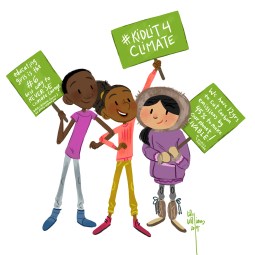
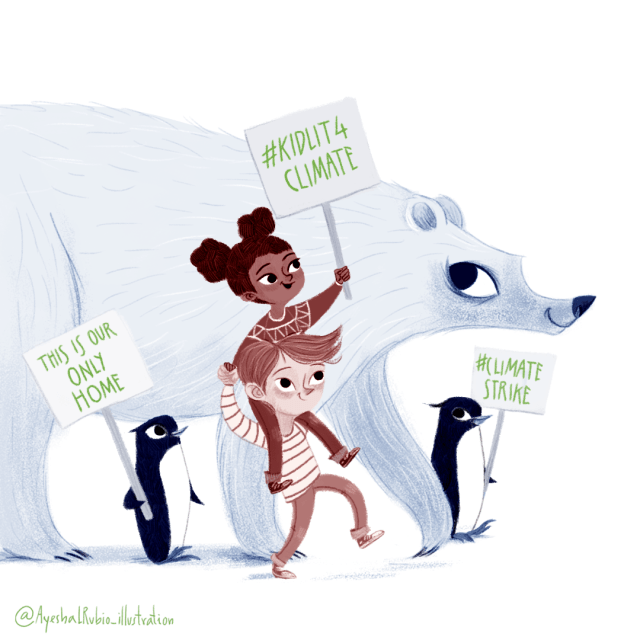
@kidlit4climate – who, what, how you can get involved #YouthStrike4Climate #climate

Emma Reynolds, the brains behind @kidlit4climate kindly answered Manchester Climate Monthly’s questions.

Tell us a little about yourself – who are you, how did you get into the children’s illustrator/author job, what have been some of your books/projects?

Hi! My name’s Emma Reynolds, I’m a children’s illustrator and author based in Manchester. I have a background in children’s animation as a character designer, and I’ve also taught at Stockport College on the illustration degree. I am now a full time freelancer working on my first illustrated children’s book out in 2020 with Simon and Schuster. My books are inspired by nature, adventure and animals.

When did you first become aware of the seriousness of climate change (when did it emerge from the “background noise”). What other things have you been involved in?
I’ve always been keenly aware of endangered animals since I was a child, and in the 90s when my friend and I were 9 we organised a craft fundraiser to sponsor a rhino at our local zoo. I’ve known climate change was an issue for a long time, but ‘the big fear’ I would say hit me around ‘Blue Planet 2’ time in 2017 when the impact humans were having was driven home. Boiling point for me was three weeks ago (very recent!) on an unusually hot February day, and that’s when I decided I wanted to do more, and started the #KidLit4Climate campaign.

What are your favourite kids’/young adult books that engage with climate change?

Lily Williams makes brilliant accessible books about climate change. In her series ‘If Sharks Disappeared’ and ‘If Polar Bears Disappeared‘, they explain how one animal’s role in the ecosystem affects others around them, and of course eventually humans too. The books end with lots of things we can do to help as individuals, which I think is important as climate change is overwhelming, and tangible steps are important.


Tell us about how long the #KidLit4Climate campaign has been going. What was the initial impetus? What have been the successes so far, what have been the difficulties/challenges?

It is very new! Three weeks ago I was walking through Manchester on a February morning in temperatures we normally only experience in summer, and I thought ‘When am I going to do something? I don’t want to look back and wish I’d done something sooner.’ I don’t claim to be a climate expert, but I knew that this campaign was something I could amplify within my field of work, so I decided to go for it and start there.

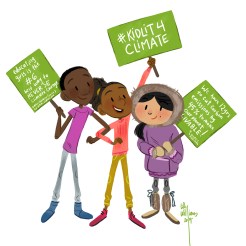
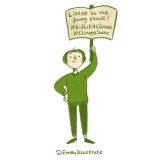
#KidLit4Climate is a campaign for authors, illustrators, publishers and bookshops to stand in solidarity with the young people we make our books for. I invited people to share the logo and voice their support, and to create an illustrated protestor to form a ‘Virtual Protest’ to coincide with the global climate strike on March 15th.

I was honestly expecting to receive about 20-30 illustrations over two weeks from people I knew. By the end of the first week I had been sent over 1,000 illustrated protestors from 45 countries worldwide from every continent, even Antarctica! Three weeks in and there are over 2,000 illustrated protestors, which is incredible. The campaign is ongoing!


What it shows me is how people are desperate to show their support for the youth climate strikes and the young people we make our books for, and this gives them an outlet for that. It has been wonderful feeling a sense of community and hope from so many countries, with many world renowned authors and illustrators showing their support.
I hope that lots of young people see that we are listening and stand with them, and that we can continue to amplify their message as the strikes and campaign continues.
You can see all the illustrated protestors on the instagram hashtag #KidLit4Climate


What kind of ways can people be involved?

The campaign is ongoing, and all of the ways to get involved are here on the website –
emmareynoldsillustration.com/kidlit4climate
Follow us on Twitter KidLit4Climate 
And on Instagram KidLit4Climate
Watch the video here
to see what we’ve been up to so far!

Anything else you’d like to say.

KitLit4Climate exploded in a way I wasn’t expecting, and as such it is evolving all the time. I’d like to thank each and every person that has sent words of support for the young people striking, and created an illustration to stand with them for our planet.
I would love to directly amplify young people’s messages – So if you’re a campaigner reading this, please email me at kidlit4climate@gmail.com I’d love to hear from you and make this a key feature across our social media. Thank you so much for all that you’re doing. We stand with you.

Posted in Campaign Update, Interview | Leave a comment

Things to know about Angeliki Stogia #GMGreenCity

You’ll hear a lot from/about Angeliki Stogia, the Executive Member for the Environment today.  But perhaps not this.

“Cancelling quarterly #climate reports the right decision, sends the right message” says #Manchester Environment boss.

Councillor Angeliki Stogia, the Executive Member for the Environment of Manchester City Council, has stated baldly that cancelling the quarterly climate reports was the right decision. It sends, she says, the right message about how seriously Manchester City Council takes climate change.  No, you read that right. It’s not a typo, or a misrepresentation.  And we’ve got the tweet (screengrabbed below) to prove it.


and this, in response to a FOIA.

foia about speeches


Posted in Uncategorized | Leave a comment

Things to know about Andy Burnham #GMGreenCity

You’ll hear a lot about and from Andy Burnham today. But possibly not this.

Andy Burnham says we all will have to reduce our #carbon footprints. Flies to/from Paris. Twice. #climate #Manchester

That was last year.  Recently, the Good Mayor was in Cannes, talking about how important climate action is.  So I tweeted to ask how he got there. No reply, of course, so had to resort to a Freedom of Information Act request.

Sent: 19 March 2019 09:33
To: Enquiries <enquiries@greatermanchester-ca.gov.uk>
Subject: FoIA re flights

Dear Sir/Madam

last November you kindly provided information about the flights of Andy Burnham and the lack of a policy about not flying.

Recently I saw that the Mayor had given a barnstorming and inspiring speech about the importance of climate action. In Cannes.  It’s great to see he has a Cannes-do attitude.

I asked Mr Burnham on Twitter how he got there and back, but for reasons that escape me, he declined to acknowledge the request for such basic information.

Therefore, using the far more time-consuming route, I am writing to you.

1) Please provide a list of all flights taken by the Mayor and by Alex Ganotis on GMCA business since the 22nd September 2018.

2) Please provide copies of correspondence where Mr Burnham asked his staff to investigate the lowest carbon dioxide means of international travel, and the replies he received, if such correspondence exists.

3) Is it still the case that no policy/protocol/guidance etc that is in place about their travel and the minimisation of carbon, and that it is all down to price/convenience?

Please provide me with a reference number for this request and the date by which I can expect a reply.

Please consider this a request under the Freedom of Information Act 2000

Marc Hudson

Posted in Uncategorized | Leave a comment