“Do More Faster!” says #Climate “Action” “Network” re #GMGreenCity

Manchester and Greater Manchester bureaucrats and poltiicians have been making shiny promises about climate change for more than ten years.  After a couple of years, when it becomes clear that the old promises haven’t been kept they

a) blame someone else (usually the Tories, with some justification) and

b) make some new shiny promises.

Activists either don’t know this because they are new, or do know it but don’t talk about it because a) they’ve been colluding in the old promises or b) it’s too terrifying to realise that there are no adults, just a bunch of men (and a sprinkling of women) in suits spouting gibberish with nice powerpoints.

And so we come to the latest iteration, the latest shiny bullshit. As the stark realities of what faces us become too big to ignore, the incentive from the politicians and bureaucrats to double-down is irresistible.  And people will want to believe that matters are in hand.

Recently Steady State Manchester hosted an excellent analysis of the latest Five Year Plan” . You can read it here. The tl:dr is this –

Looking back at my earlier comments on the GM Springboard Report in August 2018, I find that most of the criticisms made there apply equally to this plan, namely:

1) There is insufficient information about the main sources of GHG emissions in GM;
2) There is no substantive information about what has been achieved in GM so far in reducing GHG emissions (reference to earlier strategies or plans is lacking);
3) Key responsibilities for taking the various actions proposed are not assigned;
4) The plan does not recognise the crucial role of putting an end to the extraction and combustion of fossil fuels, irrespective of whether this occurs in GM or not;
5) Priorities for action seem to be identified on an ad hoc basis rather than on a strategic basis such as in terms of how much a proposed action is likely to contribute to reducing GHG emissions.

Peter Somerville, 12.3.19


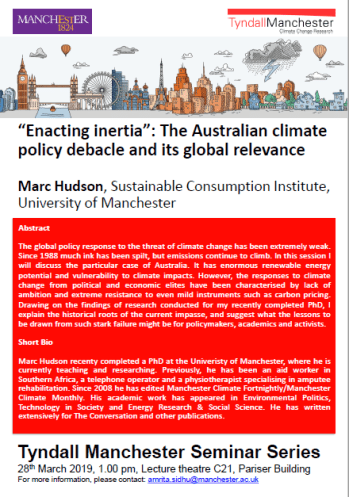
Okay, so now Steady State and other groups have announced a grandly named “Climate Action Network”.  No website (but to be fair, it’s only been three months, and it’s not like websites are easy, or the issue matters at all, is it?).  No jpg or pdf of the leaflet.  No hashtags for their call out for action.  No meeting scheduled for the week after the summit.  What could possibly go wrong?  Thank god the activists are “on it”, and innovating where business and government is not, or else I’d begin to worry…


Do More, Faster!

Our Response to the GMCA 5 Year Environment Plan

We’re facing a climate emergency.

The science tells us how much carbon we can afford to emit to keep the climate safe.  We need to live within this carbon budget.

But the GMCA 5 Year Plan fails to deliver, using up the budget twice over.

We have to do more, faster.  We therefore call on Andy Burnham and the 10 council leaders to:

In the next 3 months:

  • Declare a Climate Emergency and appoint a Climate Emergency Commissioner with the responsibility and resources to deliver rapid carbon reductions.
  • Accelerate the actions in the 5-year plan to deliver in line with the Tyndall carbon budget, and act now to deliver a 15% reduction this year.
  • Instruct the GM Pension Fund to sell all holdings in companies involved in the exploration, extraction, refining and distribution of fossil fuels within 2 years, starting with the most polluting (coal, tar sands and fracking).
  • Call on the Government to:
    • Make carbon reduction a statutory duty for local authorities and provide the powers and funding to deliver rapid action.
    • Accelerate grid decarbonisation by rapidly scaling up the deployment of renewable power.
    • Introduce an immediate ban on coal and unconventional oil and gas extraction (including fracking and coal bed methane), and end all direct and indirect subsidies for fossil fuel extraction
    • Reintroduce a zero carbon new build standard, and make retrofit of existing buildings an infrastructure investment priority.
    • Bring forward the date for phasing out the sale of petrol and diesel cars and vans from 2040 to 2030, and introduce a scrappage scheme for the most polluting vehicles.
    • Scrap HS2 and the national road-building programme, and invest instead in walking, cycling, buses, trams and local rail services.
    • Announce an immediate moratorium on airport expansion, update aviation policy in line with the Tyndall Centre carbon budget, and introduce a Frequent Flyer Levy.


In the next 6 months:

  • In each local authority area:
    • Run a series of Carbon Literacy workshops to inform and inspire people to act on climate change, starting with all councillors and council staff
    • Collaborate with the public sector, businesses and community members (making particular effort to involve women and BAME communities) to develop local action plans
  • Set up the GM Environment Fund and provide initial funding to give communities the financial support they need to deliver their local action plan.
  • Accelerate delivery of high-quality walking and cycling infrastructure across the region.


In the next 12 months:

  • Re-regulate our buses to deliver a cleaner, simpler, more frequent and affordable bus network.
  • Implement a low-carbon Clean Air Zone as soon as possible, which covers all types of polluting vehicles including private cars.
  • Set a cap on flight emissions at Manchester Airport, supported by the introduction of a Climate Emergency Levy for departing passengers to contribute to the GM Environment Fund
  • Set up a Climate Emergency Capital Fund, funded by investments from the public, businesses and the GM Pension Fund, to finance a GM-wide programme of retrofit, renewables and energy efficiency measures.
  • Work with employers and education partners to deliver a Climate Emergency Skills Programme to enable the rapid roll-out of retrofit, renewables and energy efficiency measures.


This response has been drawn up by the Greater Manchester Climate Action Network (GM-CAN), a coalition of local climate activist groups.

Let us know your views by tweeting us @GMCAN3 or emailing gmclimateactionnetwork@gmail.com.  If you or your organisation would like to endorse our response, visit: bit.ly/gmcan-endorse


Fine, great. And if I were Burnham, or Leese, or Stogia, or Atherton reading that I’d say “Or else you’re gonna do what?”

Posted in Uncategorized | Leave a comment

Interview with Ishaa Asim, #climate activist. #YouthStrike4Climate #SchoolStrike4Climate

Ishaa Asim, a member of the Manchester Youth Council, kindly answered some questions about her activities. See here for an interview with Emma Greenwood, and here for one with George Hassall.

Was the March 15th event bigger than you thought? What was your favourite thing about it?ishaa amin
The event was bigger than I thought, as there were so many people and posters everywhere! I loved seeing people speak, so many shy people took to the stage to pour their hearts in to the cause, which they believed in. I loved encouraging others to find their voice in the march.

When did you first start learning about climate change – was it in school, from your parents? Did Greta Thunberg have a part to play?
Climate change – as a member of the Manchester Youth Council, I’ve been involved with the issue for some time. I take inspiration from my Year 8 Geography lessons, where we learnt about key aspects of the world and how it is so damaged. It made me want to help and do something to protect it!

What next after the 15th March strike?
The next strike for Manchester is Friday 12th April, like last time I will be assisting and organising people to make sure they all get a chance to speak and be heard. This time there will be a protest in main roads to attract attention, which is controversial. I will hope to work with my team to make sure there are two aspects; one direct and one non direct action. Students will be able to choose whether they want to peacefully protest or do something direct but still legal.

This is the tricky one – what sort of help/advice/support would you like from your parents, existing activists, adults? How is that best offered (I call it the POG problem – “Piss Off Grandpa/Grandma”)
Young people need all the help they can get, as we can only do so much! We need adults to understand our perspective and think of the future, be selfless and think of what will happen.

Posted in Interview | Tagged | Leave a comment

#Manchester councillors asked to explain position on #SchoolStrike4Climate #climate

Following up from this morning’s story about Manchester City Council failing to meet a deadline to respond to a request for information about its cstance on the climate strikes, comes this:  Parents of children who are taking part in these strikes are asking their councillors their position.  Whether you are a parent or not, I urge you to contact your councillors. You can find out who they are here.

After the two (excellent!) letters, both published with the permission of their authors., I publish the text of a Freedom of Information Act request sent this morning to Chorlton High School.

Birgitte Johnson  letter to Councillors

We are getting in touch as we would like Manchester Council to follow Edinburgh Councils lead in supporting our children to strike school this friday by authorising their absence and not threatening to penalise parents if their children wish to strike. See here the article demonstrating how Edinburgh is supporting the school strikes .

We have been told by my daughters’ school, Chorlton High that they are not able to authorise her absence this Friday for the strike and that any potential further unauthorised absences (strikes) will result in a penalty fine.

We are facing a climate emergency and as Cllr Mary Campbell from Edinburgh stated ‘the future will depend on how willing we all are to listen to children and young people whose futures are most at risk, versus some politicians or vested interests who want to delay or do nothing.’

As a city that prides itself on revolutionary change and having recently witnessed the celebrations and tributes to Emmeline Pankhurst and the suffragette movement I believe the city council needs to show our city’s children that we truly respect and honour their voice and support their right to demonstrate in the face of a climate emergency.

We are urging Manchester City Council to authorise absence if children wish to strike and leave school premises if the parents will be responsible for the child or young person for safe guarding purposes. Furthermore promise not to penalise the parents of children who strike school in protest at our governments lack of action on climate change.

Our government needs to be reminded that these young peoples futures are at stake.

Adults have let them down. They should not need to take this course of action but this is the only way our children can collectively make their feelings known.

Around the world children and young people feel they must and we should be proud of our city’s children who want to be part of this protest.

From Rose Arnold
Hello,
I am writing to ask you as my councillors what your position(s) are on the climate strikes?
Manchester Council has taken an aggressive approach by contacting all the schools to tell them not to authorise absence for attending the climate strike. Now Chorlton High is following your lead by threatening parents with fines.
Today the news includes the story that in 25 years Britain might well run out of water. It is morally wrong to stand in the way of these children and young people fighting for their futures. They face destruction, death and horror. They need to know that we were all fighting too, not standing in their way.
I would very much appreciate a response as to your views on this matter and ideas about what could be done to move to a supportive position such as Edinburgh have.
Regards
Rose Arnold
Text of FoIA sent this morning.
Dear Sir/Madam,
I am writing to request the following information
  • Copies of all correspondence between Chorlton High School and Manchester City Council concerning the “School Strikes” that took place on February 15th and March 15th, up to March 18th 2019.
  • The responses sent to parents who enquired about the school strike (obviously with any specific information  that would identify either parent or student redacted!!)
  • Copies of all memos/emails sent to teachers who enquired to the Head/Management Team  (obviously with anything that would identify individual teachers or students redacted)
  • Copies of all advice sent ‘in general’ to parents about the school strikes, up to and  including March 18th 2019
Please consider this a request under the Freedom of Information Act 2000
Posted in Climate Strikes, Manchester City Council | Tagged | 1 Comment

#Manchester City Council breaks law on #climate FoIA about #SchoolsStrike4Climate

Manchester City Council has not disclosed its stance on the Climate Strikes, while simultaneously talking up just “how much it is doing” on climate change.

On February 13th, before the first School Strike, the following request for information was sent-

Dear Sir/Madam,
I have heard a rumour that the City Council has instructed schools that they cannot give leave to students/parents for children to take part in the February 15 “climate strike”.
I am writing to request

  • all legal advice sought/received by the Council around this issue (including internal deliberations/discussions within the City Solicitor’s office, or whoever is responsible)
  • copies of all correspondence between schools and the City Council pertaining to the February 15 2019 “Climate Strike”.
  • copies of minutes of internal deliberations held by Council officers and elected members on the Executive about the stance of the City Council.

Given that the City Council has the goal to create a “low carbon culture” I am particularly interested to know if any officer or elected member suggested at any point that the City Council SUPPORT the strike.

Many thanks and Please consider this a request under the Freedom of Information Act 2000

An automated reply was received on the 14th.

Dear Mr. Hudson,
Re: Request for Information – Reference No: CHS / B9DLBD
Thank you for your request for information received by Manchester City Council on 13 February 2019
Please note that it may take up to 20 working days ( 13 March 2019) for the Council to consider your request and to provide a formal response.
If this timescale needs to be extended to consider an exemption you will be notified and kept informed.
If you have any queries, please do not hesitate to contact me.
Yours sincerely
[redacted name]
Democratic Services
PO Box 532
Town Hall
Manchester
M60 2LA

And since then, as of March 19th… nothing.

This from a council that is going out of its way to tell people how concerned it is about climate change, from a council that that recently congratulated itself on putting up a statue of an activist now safely dead almost a hundred years.

They have utter contempt for us all, and they will continue to spout nonsense for as long as they can, aided by their pet fig leaf “activists.”
Posted in Manchester City Council | Leave a comment

What might allyship with young #climate activists look like? #YouthStrike4Climate #oldfartclimateadvice

What does it mean to stand in solidarity with youth who are on strike for their futures? How do old farts who have been failing (or doing nothing) on climate change behave usefully in the coming months and years? What to do about the POG problem? I don’t exactly know (or rather, I don’t know AT ALL). But this essay, drawing on how white people can be allies in BLM struggles or, men in feminist struggles might be a useful starting point for some people, besides the author. If you disagree with what is below, or you have something to add, your constructive criticisms will be very welcome (pure ad hominem will get deleted because signal-to-noise ratio).

I’ve recently written two pieces, one on this website, one on the Conversation. In both I tried to get existing/ex-activists to reflect on how we might usefully support new-to-climate change activists. The silence was relatively deafening. Perhaps because folks don’t think I’m the right person to kick this off (though I’ve not seen/been told about useful conversations anywhere else), or perhaps – worse, because people feel they have nothing to say? (That’s a fairly damning indictment of their ability to reflect, to make sure we come back and do it better next time. But reflexivity is hard, and not rewarded within activism (or, frankly, any society).

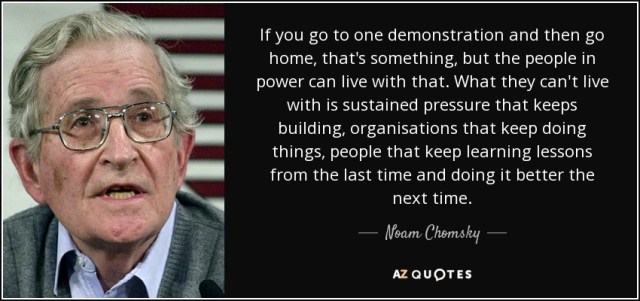
quote-if-you-go-to-one-demonstration-and-then-go-home-that-s-something-but-the-people-in-power-noam-chomsky-55-98-82

So, first question to ask is “is this a New Thing, or are there similar situations we can draw provisional lessons from?” I think we can learn from the enormous amount of hard work that people of colour (poc) have done trying to get white people to understand what solidarity means (there are other people – e.g. those living under the Soviet Union – who did the same [e.g. Vaclav Havel] but fwiw, the poc writing is newer, and imo smarter.
There are heaps of great writing on this.

See here – Kristina Wong 2018. Six ways to be a better ally. New Internationalist, 15 March.
Paul Kivel – Guidelines for Being Strong White Allies Adapted from Uprooting Racism: How White People Can Work for Social Justice
Kesieno Boom. 2018. 100 Ways White People Can Make Life Less Frustrating For People of Color. Broadly, 19 April.
Anon. White Anti-Racism: Living the Legacy
[Let me know your favourites, I’ll add them to the list]

I’m going to draw on five key (for me) pieces of advice.
a) Put aside any notions of being a white saviour.
b) Sort your own subcultures shit out
c) Signal boost poc thinkers
d) Make sure you’re not centering yourselves
e) Actually use the privileges you have

So, what does that mean in practice, for interacting with young people?

a) Put aside any notions of being an “adult” saviour.
If we had been behaving like adults, the kids wouldn’t have to be going on strike to sort this out, as many of the placards have noted. I call this the “Piss Off Grandad/Gramdma” problem – what credibility do we ‘established’ activists actually have? What successes, victories can we point to? That’s not to say we disappear into convenient self-recrimination (see b and e below.) If we have experience about how the youth movement is being gaslighted, we should say it.

This, from @bridgetmck is good –

I’ll add another bit of #oldfartclimateadvice to new activists: Find out what others know before taking up a lot of conversation time lecturing with new-found knowledge. Climate is complex and can take up hours of talk time. Find codes to simplify shared understanding.

b) Sort your own subculture’s shit out
When it comes to being a white ally, that means that white people are in a better position to confront each other’s unconscious/casual/actually meant racism (everything from asides to ‘jokes’ to advocated bigotry) than black people. Ditto for men and sexism. I think it’s a slightly different thing for climate activism. I think it means that one of the best ways older climate activists can support the youth is by having actual functioning groups, not little desperate cliques of rusted on activists who haven’t innovated in years (decades), who run dreadful dreary meetings and ‘campaigns’, who can’t even, after several months, sort out having their own websites, for example (I can think of two outfits here in Manchester that are guilty of that of late). Older people, with experience, ought to be demonstrating better ways of doing things, not repeating egregious half-assed ‘activism’ (of not even being able to book a room in the building of their own organisation, of perpetrating endless sage-on-the-stage ego-foddering and emotacycles and so on).

c) Signal boost young climate thinkers
We don’t do this enough. And so we stay trapped inside extremely Northern, technocratic thinking that imagines the climate catastrophe isn’t already here (pro-tip it is).

So, some PoC thinkers I like on climate and signal boost.
Mary Annaise Heglar  see her blistering Climate Change Ain’t the First Existential Threat
Jerome Foster
see also here and here.
[Let me know your favourites, I’ll add them to the list]

In terms of young people. When they put speeches online, publicise them. Ask them if they are up for interviews. If they are gracious enough to say yes, ask them questions, then publicise their answers. I’ve done that with Emma Greenwood and Green-fingered George, but could/should have done it more.

d) Make sure you’re not centering yourselves
That’s kinda obvious I guess? But can be tricky in the moment. Sometimes, if people are doing something that could have serious consequences for themselves, then well, there are circumstances in which the whole loco parentis thing might kick in.

e) Actually use the privileges you have
So, for example, if you’re a student at a university, you have access to information (stuff behind paywalls, your lecturers’ time and expertise), the training to do research. So do research that young people tell you would be useful, and then deliver it in a timely fashion, in formats that are digestible and transmissible (videos, graphics, animations etc). That’s a research collective right there (even if it only lasts a couple of years).
If you have experience of stuff that young people feel might be useful, flag that, and make yourself available (that might be getting arrested/charged, it might be experience of previous rounds of co-optation by our lords and masters, it might be of being a media darling. Whatever).
Here are some additional things that I think, then, that

So ultimately, the things that I think we old farts need to do

  • we need to share what we “know” freely, while not pretending that our experiences are the same as what will happen in the future, in our home countries or in others
  • we need to do this in formats likely to be shared
    and most of all,
  • we need to admit that our complicity in the system, by taking the elite bullshit seriously, is actually awful. We need to admit that we have been either willing fig-leaves or unwitting fig-leaves. Spatial Framework this, Green Summit that. It’s all frankly worse than delusional, it is complicity with fatal delay, in exchange for feeling good or important. It’s at best contemptible, at worst criminal.

Fwiw, I think I have something useful to say about the UN climate process’ history (will get help to make a video) and also about social movement dynamics.  So things I am going to do today
Write and post about ego-fodder and its consequences
Write and post about the emotacycle

UPDATE- these comments from Twitter

Signal boost, yes & we need to bridge worlds – I need to know what’s happening in insta so my insights are put through a teen filter to become useful. I need to have a discussion about what adults need to know and help with the messaging that might work with the over 40s crowd.

Teach at the Parliament House weekly climate strikes? R-12 carbon maths, climate science, critical thinking, whatever strikers think would be worth learning. I don’t know if that’s useful but there’s a heap of knowledge and skills- including activism done well- that might help.

Posted in Unsolicited advice | Tagged | 3 Comments

Upcoming event: Australia’s #climate policy debacle & wider lessons. #Manchester Thurs 28 March #Tyndall

Another Tyndall Centre seminar!

2019 03 28 enact inertTyndall Manchester invite you to attend the next talk in our seminar series “Enacting inertia”: The Australian climate policy debacle and its global relevance by Marc Hudson, on Thursday 28th March (room C21, Pariser Building, Sackville Street) at 1.00pm.
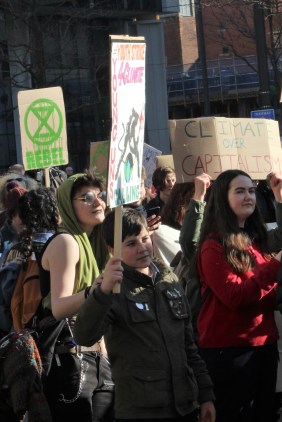
“Enacting inertia”: The Australian climate policy debacle and its global relevance

Marc Hudson, Sustainable Consumption Institute, University of Manchester


The global policy response to the threat of climate change has been extremely weak.  Since 1988 much ink has been spilt, but emissions continue to climb.  In this session I will discuss the particular case of Australia. It has enormous renewable energy potential and vulnerability to climate impacts. However, the responses to climate change from political and economic elites have been characterised by lack of ambition and extreme resistance to even mild instruments such as carbon pricing. Drawing on the findings of research conducted for my recently completed PhD, I explain the historical roots of the current impasse, and suggest what the lessons to be drawn from such stark failure might be for policymakers, academics and activists.

Speaker bio

Marc Hudson recently completed a PhD at the University of Manchester, where he is currently teaching and researching.  He has been an aid worker in Southern Africa, a telephone operator and a physiotherapist specialising in amputee rehabilitation.  Since 2008 he has edited Manchester Climate Fortnightly/Manchester Climate Monthly.  His academic work has appeared in Environmental Politics, Technology in Society and Energy Research & Social Science. He has written extensively for The Conversation and other publications.

The seminar will take place in room C21, in the Pariser Building on Sackville Street– number 12 on the map herehttp://www.manchester.ac.uk/discover/maps/interactive-map/?id=9

Posted in academia, Fun, University of Manchester, Unsolicited advice | Leave a comment

£5k “projects that matter” crowd funding campaign launched

From email:

To celebrate the Mayor’s Green Summit, Crowdfunder has teamed up with M&S Energy to award £5,000 to two crowdfunding projects in Greater Manchester.

The ‘Projects that matter: Greater Manchester’ campaign is being launched to find meaningful projects across the region making a difference to the areas carbon footprint… And, based on the campaign criteria, I thought it may be of interest to Manchester Climate Monthly!?

The competition opened for entries on Monday but closes midday this Friday 15th March.

For more information and to apply head to www.crowdfunder.co.uk/projects-that-matter-greater-manchester


Posted in Campaign Update | Leave a comment

“The best support us kids could have from adults is to be taken seriously.” George Hassall on #YouthStrike4Climate #climate #Manchester

Thirteen year old George Hassall kindly agreed to an email interview about the February 15th Climate Strike, the upcoming (bigger) strike on March 15th, and what support adults could give. (See here for answers to the same questions from Emma Greenwood).

hassall1JPGWas today bigger than you thought? What was your favourite thing about it?
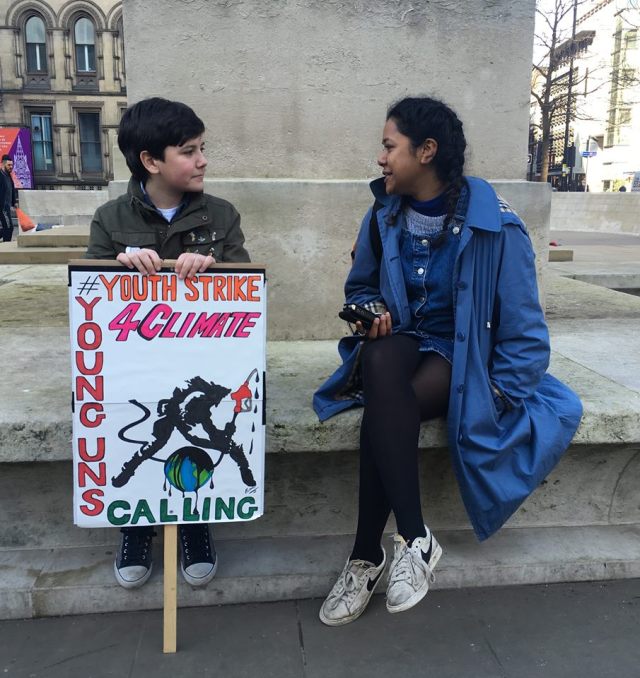
The event was defo bigger than I expected; having watched the event build momentum on social media, I thought at best we would get a couple of hundred kids striking, but I think the reality was probably 1000+, which was incredible. I was there from early on and I really enjoyed that sense of anticipation as more and more people arrived. I described the Uni protesters as like The Cavalry arriving, when they marched in to St Peter’s Sq. There was this amazing atmosphere and when they led the crowd in chanting, what do we want, climate justice, when do we want it, now”, I just thought WOW, this is brilliant!

My favourite thing about the protest, was just being with other like-minded young people, who were all as passionate as me about saving our precious planet. I felt like I was part of something monumental, that I could look back and think, ‘I was there!’

When did you first start learning about climate change – was it in school, from your parents? Did Greta Thunberg have a part to play?
I think we touched on climate change at Primary School, which was where I joined a gardening group; here we learnt how to be resourceful in the garden. Now I’m in Year 9 at High School we’ve studied it in science and geography and I’m part of the eco-group there. I was also lucky to attend an RHS Science Lecture about ‘Gardening in a changing climate’, where the lecturer, Professor David Wolfe, said, Climate change will forever alter the fabric of our gardens, farms and natural landscapes with implications for our eco-systems  – I blogged about it at the time – you can read it here

I’ve loved nature and wildlife all my life and that’s definitely come from my mum & dad; we grow a lot of fruit, vegetables and herbs in our wildlife inspired garden and that’s one of the small steps we could all do, to lead a greener life. I was inspired to strike by the climate activist, Greta Thunberg. My Mum showed me a clip of her speech on the news and I was blown away; I was like, ‘I want to be a part of that’ and strike in solidarity with other young people.

hassall2What next – there’s the next Climate Strike on March 15, and then…?

Whilst there’s the Global Strike on 15th March, for me, it’s about how we can all make small changes to our lifestyles. I want to keep on raising awareness about growing your own food, wasting less food, and planting more trees for example. This contributes to a greener lifestyle, helps wildlife and makes you feel happy and healthy.

What sort of help/advice/support would you like from your parents, existing activists, adults? How is that best offered (I call it the POG problem – “Piss Off Grandpa/Grandma”).
The best support us kids could have from adults is to be taken seriously. There was a lot of negative comments on social media about kids striking so they could blag a day off school, that many of the kids who attended arrived in their parent’s SUV or that we wouldn’t swap our Ariana Grande gig for a climate change protest, well that couldn’t be further from the truth. There are kids who care, kids with compassion and kids who want to do something to protect our planet

Anything else you’d like to say?
I’d like to thank the organisers for doing such a great job of bringing such a monumental event together – it was totally epic and one I’ll never forget.


Mini bio 

In May 2014, aged 8, George was crowned RHS Young School Gardener of the Year, a year later he was made the first RHS Young Ambassador in order to inspire other children to share his love of gardening and the natural world. Late December 2018George became an RSPB Nature Star in the RSPB’s Big Garden BirdWatch campaign.

George keeps a regularly updated blog visit greenfingeredgeorge.com

Twitter – @GreenFGeorge Facebook – greenfingeredgeorge Instagram – @greenfingeredgeorge

Posted in Interview | Tagged | Leave a comment

When is a boycott not a boycott? Renewables Conference to happen at Shell-sponsored MOSI… #Manchester #climate

shelloutLast September the Manchester Museum of Science and Industry took sponsorship money from the oil giant Shell, and got accused of hypocrisy for its troubles.  Partners in its “science festival withdrew in protest.  Manchester’s Carbon Coop has set up a “Shell Out” campaign.

Meanwhile Community Energy UK is having its next big meeting, on March 1st, on the important subject  Community Energy in Greater Manchester: The Next 5 Years  at… MOSI.  Oops, “awkward” as the young people used to say.

We reached out to Shell Out for a comment. Here is their statement in full

The Shell Out campaign continues to pressure the Manchester Science Museum to end its association with Shell and the Electricity exhibition – funding from fossil fuel companies has no place in modern science communication, in particular exhibitions in which young people are invited to learn about the current and future energy system.

However, we have always been supportive of the Science Museum as an institution and whilst the museum is free of institutional funding from  Shell, we welcome the involvement of Community Energy groups at events  at the museum – these are exactly the sorts of groups pioneering a new,  decarbonsised and localised energy system that MSI should be associated  with, rather than dinosaurs of the past like Shell.

We would encourage all the Community Energy groups participating in the  event to sign up Oil Sponsorship Free  pledge(http://oilsponsorshipfree.org) and make their views on Shell’s  sponsorship of the Electricity exhibition clear to MSI whilst in the  building.

Posted in Campaign Update | Leave a comment

Interview with Rebecca Willis about politicians and #climate change

On Thursday 28 February, Dr Rebecca Willis of Lancaster University is presenting her recent research at a Tyndall Manchester seminar. (details here). She has kindly agreed to an email interview – here it is, unedited.

1. In a nutshell, please recap the research you’ve done, including
what was the initial impetus for the research (from Lancaster? Green
Alliance?) and what was novel in both the methodology and the
presentation (e.g. the synthesised interviews, but other stuff).

My research investigates how politicians, as individuals, understand and respond to climate change. Back in 2009, I set up Green Alliance’s Climate Leadership Programme, a personalised programme for politicians, where they learned from climate scientists and policy experts, and thought through how climate change affects their work as a politician. We worked with over 100 MPs, and the response was enthusiastic – but the programme left me with a big question. What do the politicians do with the knowledge once they walk out the door, and back into their working lives? I had a look at the research out there, and discovered that there is lots of work about climate politics, in the abstract; and lots of work on public attitudes to climate, but almost nothing about how politicians, as important individuals within the system, handle climate change. So I thought I should do the work myself.

The research uses different methods to reach a fine-grained, qualitative picture of how politicians understand a complex issue like climate change, in the context of their life and work. I used an academic technique called corpus analysis to analyse public speeches on climate in the House of Commons; then I did a focus group with NGO representatives who lobby politicians; and finally, a set of 23 interviews with current and former MPs. This was the first study of its kind, to my knowledge (which surprised me).

2. What reception has the research had so far (where have you
presented it etc) and what impact do you hope it might have?  (Which
audiences would it be good to reach/engage with).

Everyone’s interested in how politicians think – and so lots of people have wanted to hear about my work, which is a nice change for me, especially compared to my rather arcane work on energy governance which tends to send people to sleep. I have done talks and workshops for young climate activists in Scotland, Royal Society scientists, local residents in my home town of Kendal, and many others. It’s had so much interest that I have been persuaded to write it up as a simple, chatty book, due out early next year – watch this space. Many people are frustrated by politicians’ lack of action on climate, and while I am careful not to make excuses for them, my work does help to explain why it isn’t currently the political priority it should be. I hope that it also points the way to a better sort of climate politics – like the Green New Deal that is hitting the headlines in the US, for example. I would love to repeat the work over there.

3. Has anyone done this kind of work – about politicians’ awareness
of/concerns/action about climate change
a) in other countries
b) on local government politicians?

There have been a few studies, using standard quantitative interview techniques, with other politicians – particularly in Australia and the US, both known for complex and confrontational climate politics. But nothing like the detailed understanding that I have developed, setting politicians’ understandings of climate change within the framework of their lives, identities and careers. Since I started, I’ve had quite a few conversations with people wanting to do similar work, particularly with local councillors, so I’m hoping those results will be published soon, which will give us a more rounded account.

4.  You mention a series of things that could happen (feel free to
recap them)!  My question is – who do you see making this so – what
constellation(s) of actors (trades unions, community groups,
environment groups etc etc)

The difficult thing about my research is that it sends a clear message that the science alone is not enough to compel politicians to act. The hopeful thing is that it does open up a whole range of ways in which we can engage politicians in climate action, and that things can happen quickly. The incredible success of the Green New Deal in the US in bringing climate change to the centre of the political agenda is a case in point. I would particularly like to see broad alliances working together and putting their case to politicians – so Trade Unions, Churches, health alliances, and so on. Politicians don’t feel under much pressure to act on climate change – yet – but there’s lots that can be done to change that. And lastly, every time I talk about this work, I ask people to go and see their own Member of Parliament – it’s easy enough to go along to a surgery, and it sends a really clear signal that people want to see change. If you don’t know how to do this, have a look at the brilliant resources on Hope For The Future’s website.

5. Anything else you’d like to say

My research is summarised in this briefing for Green Alliance.

Posted in academia, Interview, University of Manchester | Leave a comment