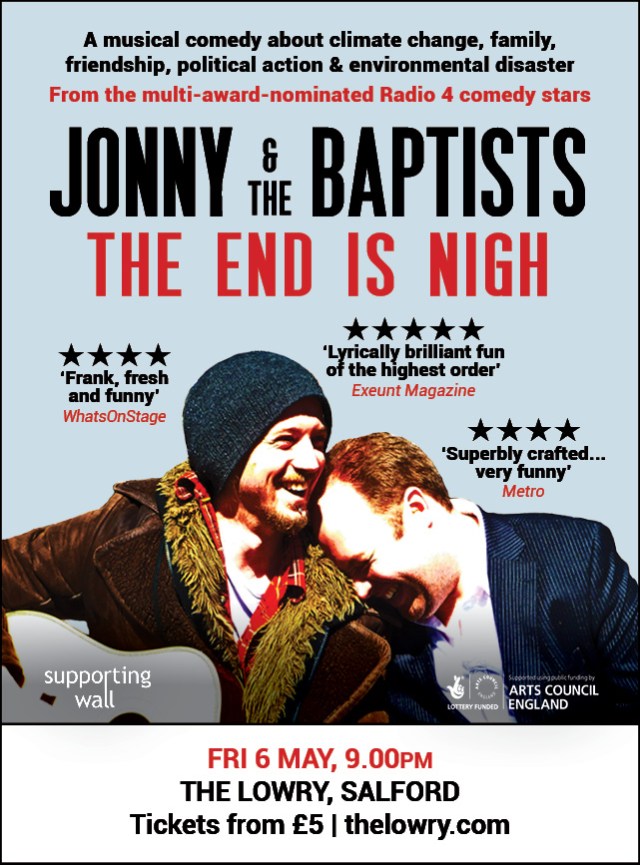
Fri 6 May | The Lowry, Salford
Info & booking:
http://www.thelowry.com/event/jonny-and-the-baptists-the-end-is-nigh
Fri 6 May | The Lowry, Salford
http://www.thelowry.com/event/jonny-and-the-baptists-the-end-is-nigh
1. What is the purpose of your group? (three or four sentences)
Fossil Free Greater Manchester is asking Greater Manchester Pension Fund (GMPF) to divest £1.3bn of members’ pension money from fossil fuels. We are specifically requesting that they divest within 5 years and are calling on GMPF to immediately freeze any new investments in fossil fuels. We’re also encouraging GMPF to work with the Greater Manchester combined authority to come up with a mechanism for achieving positive returns and positive social impact. The excellent Community Reinvest report “Reinvesting Pensions” identifies mechanisms and past examples of pension funds doing just that.
2. How do you find out what skills and knowledge the people who get involved have?
On an ad hoc basis – we put a call out to people interested in the campaign as to if they have a skill and would like to use it to help us out.
3. How do you find out what skills and knowledge the people who get involved want to develop?
Ad hoc – we are happy to let anyone try any of the tasks to learn through doing and those with more skills will help them and give feedback.
4. If people get involved in your group, what sorts of things will they end up doing? (stuffing envelopes, selling newspapers, knocking on doors, getting arrested etc etc)
Engaging with the general public through petitioning and leafleting, helping to engage with councillors and the councils of each of the local authorities in Greater Manchester re the campaign, engaging with unions, attending events where influential members of the councils can be engaged. We are open to any creative ideas and new angles that people want to work on. Our group works wherever possible within the law to achieve our aims and objectives, looking to make long-term, lasting change.
Successes and “opportunities for improvement”* in 2015.
5. What have been your group’s main Manchester-based successes in the past year? (i.e. nothing that took place outside the ring road counts)
Our launch at the GMPF office in Droylsden was a great success with media in attendance (BBC NW, BBC Radio Manchester, local papers). GMPF have changed the wording of their policy on investment stating they can now consider divesting on moral grounds – a reaction to the replies to their consultation on their policies, a process initiated by the request of campaigners from Fossil Free Greater Manchester.
More recently we have worked alongside members of UNISON North West to see them pass a motion in favour of divestment which they look to debate at the national UNISON conference. With such a large trade union supporting our movement we look to put the pressure on GMPF further.
6. What were the things you hoped to achieve but didn’t.
See GMPF commit to divest in the future. Expand the group to increase our capacity on what we can work on
The coming year
7. What do you hope to achieve in 2016? What are your success metrics for December 31st 2016.
See GMPF commit to divestment and draw up a plan on how they hope to achieve this. Spread the word of the campaign to as many people as possible – especially members of the fund
8. What (up to 3) things would you like to see done in Manchester to make the city less crap on climate action
a) by the City Council
Support the call for GMPF to divest.
b) by the “climate movement”
Have better communication between groups on actions and campaigns
9. What is the stupidest thing the “climate movement” could do this year?
Lose the momentum of the movement from Paris, the floods, etc this winter – the movement feels stronger than ever and we need to try and keep that up
10. How can people get involved?
Come along to one of our actions across the boroughs (see our Facebook Page or Twitter handle for updates on this) If you want to help us plan our strategies then feel free to attend our meetings
11. Anything else you’d like to say.
Our group is very young (around 6 months) – we are still a small group and would be extremely happy to welcome anyone on to the group with any help they can provide. We want to get ourselves out there and make this a big issue for all of the Greater Manchester boroughs. This is one of the strongest ways to combat fossil fuel companies – if high profile investors pull out this will tarnish their financial reputation. And if we can get GMPF to commit to investing this in the industries that will benefit GM (renewables, infrastructure, etc) we could see the healthier, more sustainable city we want sooner than we might have thought.
Thursday 14th April
Sign up to attend (free) here.
Presentations by:
‘Alison’: deceived by undercover police officer
Harriet Wistrich: solicitor
Eveline Lubbers: Undercover Research Group
The Undercover Policing Inquiry was appointed following revelations that undercover police officers kept lawful political campaigns under surveillance, assumed the identities of deceased children and deceived women into having sexual relationships.
‘Alison’ is a member of Police Spies Out of Lives and gave evidence to the Home Affairs Committee on her experience of having been deceived by undercover police officer Mark Jenner into having a long term relationship. Harriet Wistrich represents several women, including Alison, who have successfully pursued civil claims and obtained an apology from the Metropolitan Police Service, and others that will be giving evidence to the Undercover Policing Inquiry. Dr Eveline Lubbers is a member of the Undercover Research Group and has published research on the activities of undercover police officers. Core issues that will be raised before the Undercover Policing Inquiry, relating to lawful police surveillance, the right to privacy and family life, freedom of expression and the law on sexual offences, will also be discussed at the seminar.
When Thursday, 14 April 2016 from 17:00 to 19:00 (BST) – Add to Calendar Where Lecture Theatre A, Roscoe Building, University of Manchester Oxford Road, Manchester M13 9PL, United Kingdom
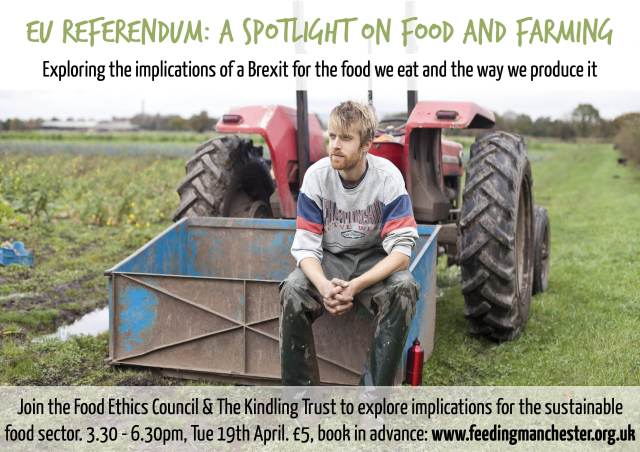
EU Referendum: a spotlight on food & farming
Tuesday 19th April, 3.30-6.30pmVenue: Bridge 5 Mill, M4 7HROrganised by The Kindling Trust and The Food Ethics CouncilThe EU influences every aspect of the UK’s food and farming systems; subsiding farming to the tune of billions and regulating everything from worker and consumer protection to rural development, biodiversity and river water quality.
The result of the impending referendum will have profound implications for the future of our food and farming sectors. As we prepare to go to the polls, join us as we bring together industry experts and those working in the sustainable food sector to get clued up about the implications of staying in or leaving the EU.
Hear from Nourish Scotland’s Pete Ritchie, agricultural economist Steve Webster, Lancashire Wildlife Trust‘s Anne Selby and Associate Lecturer at Manchester Metropolitan University Charlie Clutterbuck and discuss the issues with others working for a more sustainable food system in our city and beyond. The event will be chaired by Dan Crossley of the Food Ethics Council.
We’ll be exploring the social, economic, cultural, environmental and ethical implications of the ‘stay’ or ‘leave’ outcomes, covering issues including
Food and farming has barely featured in referendum debates so far. Let’s put it back on the agenda! We hope you will be able to join us for this event and contribute to what promises to be a fascinating and informative discussion. It will also be a great opportunity to network with others working in, and with an interest in, food and farming.
There was a time when Manchester Climate Monthly was edited by a white guy and a BME woman. But then she (Arwa Aburawa) accepted a demotion to go and work for Al Jazeera…
On a serious note, journalism in this country is crushingly crushingly white. Red Pepper is trying to do something about this. They would like some of your money…
|
|||||||
|
Volunteers needed for new Climate Control exhibition at Manchester Museum. Please email museumvolunteers@manchester.ac.uk for more info
Volunteer Opportunity: Climate Control, Manchester Museum
This summer, Manchester Museum will be staging a series of exhibitions and events that explore the causes of climate change and, most importantly, what we can do about it. Central to this is Climate Control, a thought-provoking exhibition which will tell stories of snowflakes, Peppered Moths and the Arctic, opening on May 11.
We are looking for passionate volunteers who are knowledgeable and care about nature and the environment to encourage curiosity, creative thinking and change. We want to empower visitors to play a part in creating better future and making a difference through the experiences they have and the objects they encounter. As a volunteer, there will be opportunities to facilitate object handling sessions, take part in participatory programmes and lead daily Climate Exchange conversations.
Please email Kate Glynn for an application form and further informationKate.Glynn@manchester.ac.uk / 0161 275 2473
Closing date: 10 April
In a bold move, Council leader Richard Leese and Executive Member for the Environment Kate Chappell are publicly announcing this morning that they have “CLAP”. But don’t worry, it’s not what it sounds like. Instead, today, the two prominent Council figures will today unveil the Council’s new “Carbon Literacy Action Plan”.
The ambitious plan sets a target to have all 96 councillors ‘carbon literate’ by the end of 2016, with an additional bold goal of having 100,000 of Manchester citizens trained up. Although far short of the original goal of all 1,000,000 people who live work or study in Manchester receiving carbon literacy training by the end of 2013, both Leese and Chappell are at pains to call it an encouraging start.
Speaking exclusively to Manchester Climate Monthly, Richard Leese said. “As I said when the last Liberal Democrats councillors were kicked out of the Town Hall by the voters of Manchester, ‘we have to ensure we hold ourselves to account within this chamber and we also need to ensure that citizens – and people that have voted for us – are able to hold us to account on an ongoing basis.’
“And, to be honest, carbon literacy training has fallen off the to do list. Although I launched it back in 2012 or so, between the trip to Shanghai and preparing my run for the GM Mayor, it fell through the cracks. But I’ll lead by example now.”
Sir Richard conceded that his response to questioning on carbon literacy at the recent launch of the latest ‘Community Strategy’ had been less than precise, and had in fact been an impetus for ‘CLAP’. “I’m grateful to Manchester Climate Monthly for keeping this issue on the agenda – it’s the sort of engaged and non-sycophantic citizen action that Manchester Labour party welcomes, and in fact cultivates.”
Councillor Kate Chappell, the Executive Member for the Environment echoed her Leader’s comments, and added. “I’ll soon be putting up a post on my blog detailing the tough but achievable schedule for the coming months. We’ve given £13k to MMU to help us with this again. This time there is a contract though.“
“Carbon-literate councillors will be leading on this issue in their own wards. They’ll be making sure that ward plans include not just adaptation and disaster-management plans, but also opportunities for people to learn more about climate change locally, in their community centres, mosques and churches. We’re even in talks with the ‘Antwerp Mansions’ venue – which I’ve personally supported for years – about “Carbon Literacy Inspired Music – Awesome Team Event”, (CLIMATE) which we think will show young people how cool and ‘with it’ the Council is.”
Speaking on condition of anonymity, a senior council official conceded the acronym for the scheme was unfortunate. “We spent £5k from the ‘Clean City Fund’ on some branding consultancy advice. It came down to ‘CLAP’ or ‘Carbon Literacy Information Taskforce.’ And we felt that many of the male councillors wouldn’t be able to find it, and if they did somehow stumble across it they wouldn’t know what to do. Or wouldn’t care.”
Other climate-concerned bodies are less impressed. Gavin Elliott, with the “Manchester A Certain Future” Community Interest Company told MCFly. “It’s good that the Town Hall is finally acting, but we’ve been setting them a good example for a long time now on carbon literacy“
Friends of the Earth told MCFly. “The plans are probably quite good, but would have been strengthened if there were more extensive community consultation – something at which the Council excels.”
A backbench councillor, up for re-election and therefore unwilling to be named on the record, told MCFly “Carbon Literacy? The course could be passed by a monkey repeatedly slamming his fists on the keyboard during the multiple choice tests. That monkey could then go on to high office in the North or East of the city. Possibly Central too in some seats. Definitely Wythenshawe as well…”
New Green Party co-leader Matt Schreibke [interviewed here] dismissed this scheme as just more cynical and fear-driven greenwash from Labour. “They’ve obviously looked at the polling and realised that they’re vulnerable in marginal wards like Whalley Range, Cheetham and Bradford. Perhaps even Ancoats & Clayton. By this time next year – April 1st 2017 – what with our showing in May and possible by-election victories, we will have a strong presence on Manchester City Council, alongside the resurgent Liberal Democrats. Then, and only then, we will be able to engage in forensic scrutiny of the council’s dismal record.”

Dear Councillor Craig, [cllr.b.craig@manchester.gov.uk, @bevcraig]
I know you care about climate change (you are one of the councillors who has completed the face-to-face carbon literacy training, but not the online component).
I know that the agenda of the Health Scrutiny Committee, which you chair, is packed. The City Council is trying to cope not just with the awful health consequences of ‘austerity’ but the changes emerging around responsibility for public health, and the uncertainties around Devo Manc. The cuts to mental health funding are not a good sign either, clearly.
However, yesterday the newly formed UK Health Alliance on Climate Change warned that more frequent extreme weather events like flooding and heat-waves pose direct risks to health and systemic threats to hospitals and health services. The recent flooding in Greater Manchester is a mere taste of this.
I know that to get any traction in this city, a problem has to be framed as a (business) opportunity, so I will add that the Alliance also highlights that “Responding to climate change will have real benefits for health and would put the UK at the centre of the “greatest global health opportunity of the 21st century”.
So, I have two simple questions.
Firstly, will you commit to completing your carbon literacy training, and using your influence to encourage all other members of the Health Scrutiny Committee to do likewise. This could be done by holding a face-to-face session immediately after a meeting of the HSC, and trying to untie the Gordian Knot that is the Council’s IT provision around CL training.
Secondly, and more significantly, assuming you are still chair of HSC in May* will you hold hearings/call for reports about the health impacts of climate change locally? Does Manchester have the infrastructure to cope? Are its plans realistic, updated regularly, and tested ‘in practice’?
According to the Work Programme of the HSC (which doesn’t mention climate change, btw), at its next meeting, on Thursday 26th May, “The meeting will close for the annual work programming session where members determine the work programme for the forthcoming year. To follow an oral presentation from the Director on upcoming issues and challenges within the Committee’s remit.”
Will you work with officers and Executive members to ensure that climate change impacts ARE part of the Health Scrutiny Committee’s agenda for 2016/7?
Yours sincerely
Marc Hudson
editor Manchester Climate Monthly
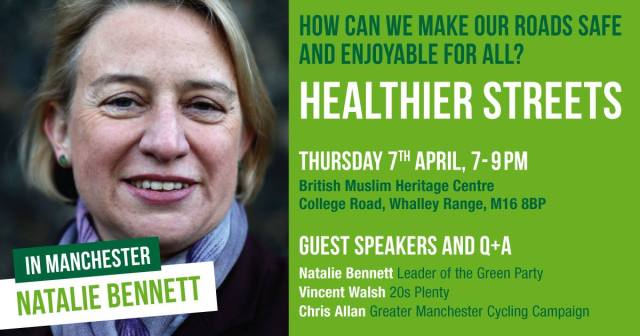
Manchester City Council can’t even listen to the cyclists it ‘consults’ with about cycle lanes. What hope is there for making them competent on the much bigger question of “Healthier Streets”? Maybe someone would like to ask this question on MCFly’s behalf at this event;

The Greater Manchester Low Carbon Hub (LCH) is a partnership of local government, businesses and the third sector in Greater Manchester aiming to reduce Greater Manchester’s carbon footprint.
It’s slightly pale, and very carbon illiterate.
Its next meeting is on April 1st 10am-noon at the scrutiny room of Manchester Town Hall (go to the side entrance, then up the stone spiral stair case and across the walkway). The meeting is open for any Greater Manchester resident to attend – you don’t need to book, you don’t need permission. However, it is a meeting in public, not a public meeting – i.e., you can watch but not speak.
All the papers for the meeting are available here:
https://www.greatermanchester-ca.gov.uk/…/237/low_carbon_hub
Here are some details a MCFly reader picked out from the documents that will be discussed.
*The reports contain, at their very core, a 1.68 million tonnes of CO2 gap between the targeted reduction by 2020 across GM and what LCH expect will actually be emitted. This gap has been known about for months and it seems LCH has done nothing to address this.
*5.Air-Quality consultation. This consultation acknowledges the 1.68 million tonnes of CO2 overshoot mentioned above. The consultation, worryingly, states that reduction in NO2 will be the short term focus of TfGM, with CO2 being more of a longer-term focus (paragraph 4.12).
*7. Climate Change. Has at the end some interesting post-2020 potential targets which go further than the current targets, in light of Paris’ 1.5 C warming target. Now is the time for activists in the area to demand the more stricter targets are set and met.
*7.a Climate Change Annex. Continues the fantasy narrative of “Green Growth”