Exec Member for Environment has not attended last 6 Steering Group main meetings

Manchester City Council’s Executive Member for the Environment, Kate Chappell, has not attended a meeting of the City’s climate change ‘Steering Group’ since July last year.

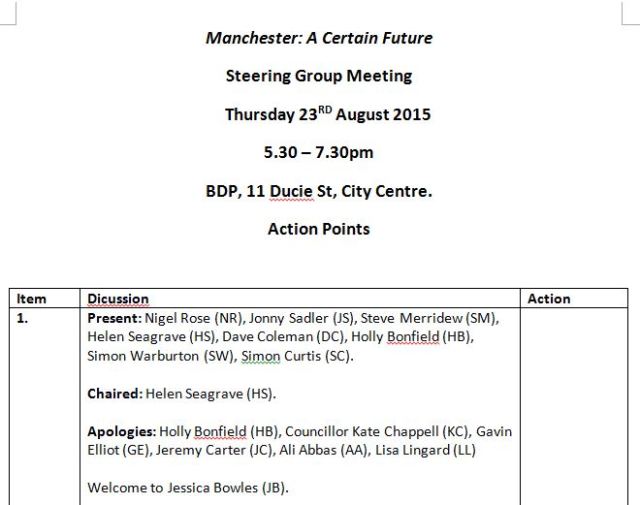
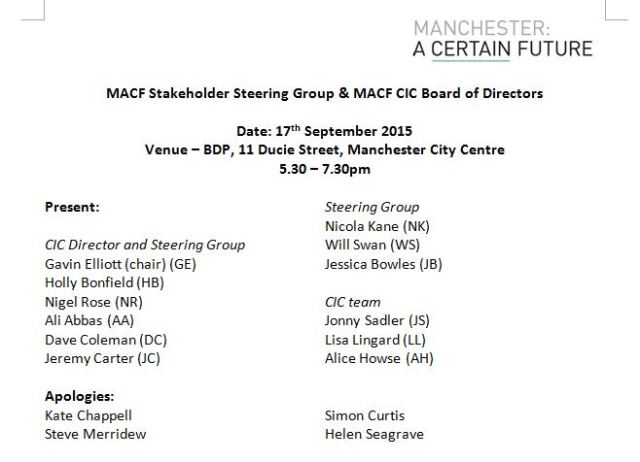
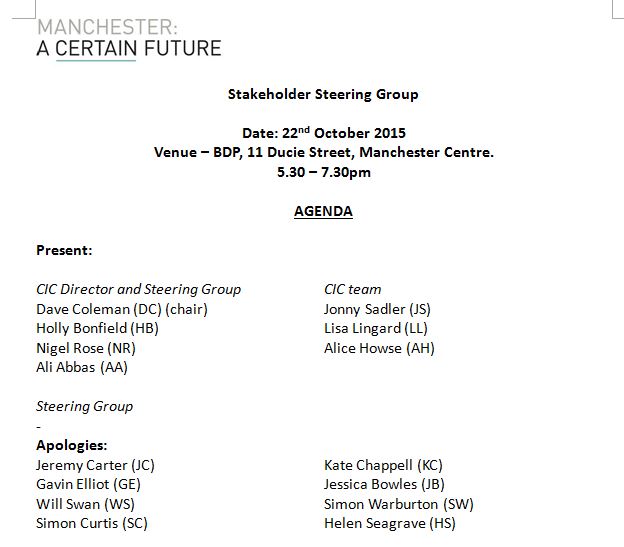
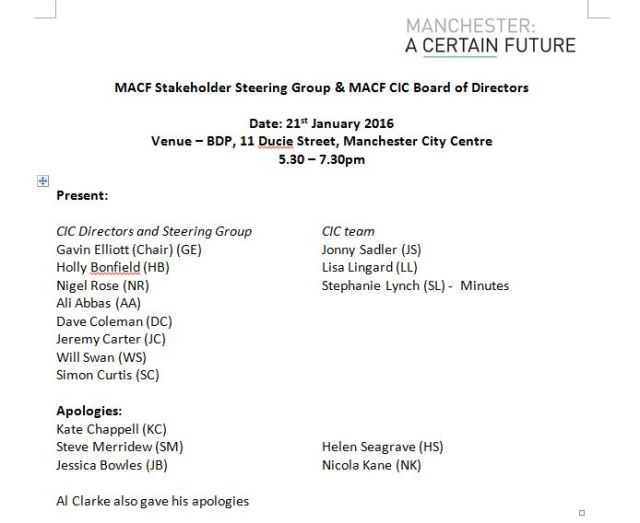
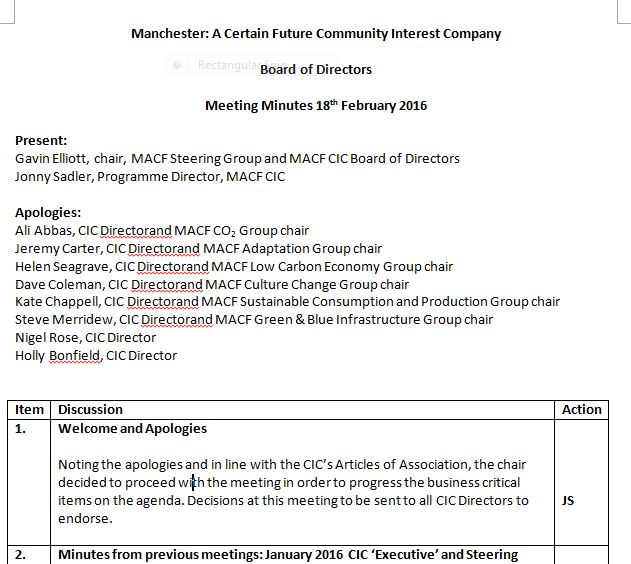
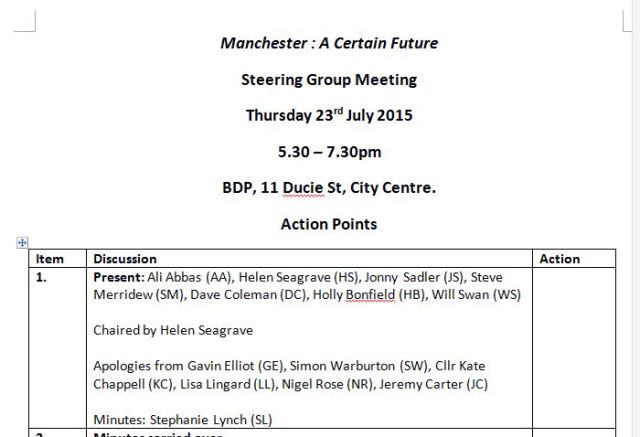
An analysis of the official minutes of the meetings by Manchester Climate Monthly shows that Councillor Chappell attended the June 2015 meeting, which preceded the Annual General Meeting (a sage-on-the-stage talkfest that was also attended by Richard Leese and other committed climate activists).  Since then she has sent her apologies to meetings in July, August, September, October, January and February (see screengrabs of the minutes at the foot of this post for proof)

The Steering Group, which was supposed to be a body of elected representatives, and was also supposed to help stage an annual conference, is an unelected body that can’t even keep its promise to produce newsletters. Members of the public are not able to attend the group’s meetings. At one recent meeting there were two people in attendance and eight apologies (including Cllr Chappell).  Despite its non-performance, the Group continues to receive funding from the council.

There is no evidence in the minutes that anyone has raised Councillor Chappell’s repeated non-attendance at the main meetings.. Nor has anyone suggested that meetings be shifted occasionally from the evenings to suit the needs of women with young and growing families.

Councillor Chappell is chair of the “Sustainable Consumption and Production” sub-committee of the Steering Group.  However, minutes of that sub-committee- and the other sub-committees – have not been posted on the website.

The chair of the Steering Group has not replied to several emails from  Manchester Climate Monthly for information on other aspects of the Steering Group’s ‘performance.’  The Executive Member told the editor of MCFly, face-to-face,  a month ago that she would write an email for publication explaining why -despite a firm promise to do so – she had not established a blog.  That email has not been received by MCFly.

So, given their lack of responsiveness, they were NOT approached for comment before the publication of this story.  If they choose to respond, their comments will be published.

sg july 2015sg aug 2015sg sept 2015sg oct 2015sg jan 201618 feb boad of directors

Posted in Democratic deficit, Manchester City Council, Steering Group | Leave a comment

Victory? #Manchester Health Scrutiny Committee to (maybe) look at #climate impacts

The Health Scrutiny Committee of Manchester City Council may look at the health consequences of climate change on Manchester’s people. This comes (only) after an open letter from Manchester Climate Monthly to the chair of that committee, Councillor Bev Craig (Burnage).

The letter was written and sent at the end of March because newly formed UK Health Alliance on Climate Change warned that more frequent extreme weather events like flooding and heat-waves pose direct risks to health and systemic threats to hospitals and health services. (Between the open letter and the reply Obama’s White House released a report stating that “climate change is a significant threat to the health of Americans, creating unprecedented health problems in areas where they might not have previously occurred.”)

In her reply, Councillor Craig has committed to pushing for increased carbon literacy among councillors, and also stated that she is  “happy to suggest to the committee this be considered in our work programme either as a standalone, or joint committee piece of work.”.  The full letter is below, and is followed by further analysis.

For now, the take home is this – at the first meeting of the Health Scrutiny Committee after the May elections, the work programme for the following year is worked out.  Councillor Craig, who is up for re-election in her ward, and also up for re-election as chair of the HSC – will, according to the letter, ask her fellow committee members to add a climate report to the work they request from bureaucrats.  Watch this space.

Here is the full text of the reply from Councillor Craig The numbers in square brackets refer to MCFly’s comments, listed below.

Dear Marc

Thank you for your open letter, I wanted to give you a substantial response to your letter which undoubtedly raises important issues.

The impact of climate change can’t be overstated, and it will be the most disadvantaged that suffer most. Manchester as a growing and truly global city, has demonstrated its commitment to becoming a leading low carbon city. [1]

I care deeply about climate change, as do a great number of my colleagues in the city [2], and it is important that we use this leadership in our local communities to engage partners and the citizens. As you highlighted, I have completed the face to face training, and have received my carbon literacy training certificate. The issue with completing the online component will be rectified imminently.[3]

I will be raising the issue of what can be done to ensure all councillors have completed both components with the Executive Member Kate Chappell. One of your suggestions is having face to face training after health scrutiny committee; this could be an option however as the committee can last from 1.30 to 4.30, it may not be the best time – however I do note your broad point.

In terms of the substantive issue, that of looking at how the City understands the impact of climate change on health and takes action to best mitigate this; this is undoubtedly a key area and one with growing academic evidence.

The Health Scrutiny Committee remit covers adult social care, public health and reducing health inequalities, in addition to scrutinising wider NHS changes and developments. Over the last year we can covered a breadth of issues around public health, drugs and alcohol, adult social care, health and social care devolution, GP access, A&E performance and a detailed exploration of improving mental health services in the city. [4]

Manchester experiences extreme health inequalities, and I believe that a key component of some of these health outcomes is linked to both the drivers and impacts of climate change. It’s no surprise that improving healthy lifestyles in terms of diet and activity levels benefit individual health outcomes, alongside featuring in a low-carbon city.

In general terms issues relating to climate change have been closely monitored [5] in the scrutiny process through both the Neighbourhoods and Economy Committees (such as the MACF and supplementary annual plans). [6]  As Chair of Health, I am happy to suggest to the committee this be considered in our work programme either as a standalone, or joint committee piece of work to look at the specific challenge facing Manchester to ensure that we are doing our best to mitigate it.

If you have any specific suggestions around health related issues and climate change, I’d welcome your feedback cllr.b.craig@manchester.gov.uk

Best Wishes,
Bev
Cllr Bev Craig
Labour Councillor for Burnage
Chair, Health Scrutiny Committee

Responses from MCFly

[1] “Manchester has demonstrated its commitment to becoming a leading low carbon city.”  Eh?  Really?  I must have missed the bit where they kept even a few of their promises.  I am old enough to remember the promises from 2007 to about 2009 that Manchester would be the ‘greenest city in the UK by 2010’.  I remember all the promises about elections to the Steering Group for the Climate Change Action Plan, and how 60 councillors would be carbon literate by the end of 2014 [actual number was 23], about how Kate Chappell would start a blog. Etc etc.

[2] Lots of people in this city care, but the claim that lots of your colleagues (presumably you mean councillors?) care is harder to sustain.  At last (perhaps inaccurate?) count, only 25 councillors had completed their carbon literacy training.  I never see, from councillors, specific and sustained challenges to the Executive and the Senior Management Team about inaction on climate change from backbench councillors.

[3] So, I had to not only FoIA but also go to the Information Commissioner to get information about which councillors were carbon literate.  And it now seems that the  information finally released is not reliable.  What an omnishambles – the Council can’t even keep records about which of 96 people have received a specific bit of training?!

[4] “detailed exploration of improving mental health services in the city.”  This must be some new meaning of the word ‘improving’ that I am not familiar with.  As someone said two weeks ago “It’s extremely disappointing to see valuable support services for vulnerable people are still being cut, especially at a time when remaining mental health services are over-subscribed and under strain. The priority should undoubtedly be supporting the people using these services to make sure no one suffers as a result.” [you recognise that quote, yes?  It’s you, after all]

[5]  Neighbourhoods Scrutiny Committee basically rubber-stamps whatever nonsense they are told once a year.  The promised quarterly reports are usually late, and largely content free.  Economy Scrutiny has punted the issue ever since the laughable ‘Environmental Sustainability Subgroup’ made its recommendations (largely ignored – for example, where are the ‘environmental factors’ observations that are supposed to be on all reports going to Executive. That’s an idea first proposed four years ago. Still waiting.

[6]  Ah yes. The MACF. Recipient of about £75k in cash, plus paid staff.  The same MACF which holds meetings in secret, cancelled elections, cancelled the annual conference, didn’t produce promised newsletters, held a meeting with two people present and eight apologies etc etc.  That  MACF…

 And now to be churlish about getting (perhaps!) the very thing we’ve campaigned for #howtoalienateeveryone

Ultimately, this;  activists have had previous experience of lobbying the Council Scrutiny Committees in order to get them to produce reports.  The reports, when they do eventually appear, are often complete rubbish.  The Steady-State Manchester group was in fact borne out of the total uselessness of one such report  [see also here].

So, even if Councillor Craig is re-elected, and if she is is still chair of the HSC, and if she puts forward a call for a report/reports, and if this is agreed by her fellow committee members, and  if the report then gets written [items get kicked into the long grass all the time], then it will very likely be not very good (to put it mildly).

What is needed in its stead, is for civil society to co-ordinate its own independent report on the health impacts of climate change, collaboratively, and present it to the HSC members and other interested parties.  This is not actually that difficult, and if MCFly would be very happy to help put folks who wanted to do this in touch with each other, and suggest some useful short-cuts to the production of a civil society report. mcmonthly@gmail.com if you’re interested.

Posted in Health Scrutiny Committee, Manchester City Council | Tagged , | Leave a comment

Low Carbon Hub moves tree planting goal by 15 years.

In Macbeth the witches give the main man a prophecy that he will be fine until “Burnam Wood move to Dunsinane”.  He thinks that means he’s safe.  He isn’t, because his enemies chop down the trees and use them as camouflage.  The doom here in Manchester is more prosaic, as MCFly’s star reporter, Ann Onymous describes, in another bad day for the “Greater Manchester Low Carbon Hub”, the unelected group of worthies that is supposed to be guiding the city to a future that is, well, low carbon…

In the Low Carbon Hub’s draft climate change and low emissions  implementation plan, the Hub planned to prioritise planting 3 million trees in Greater Manchester by 2020. For context, that was an ambitious target to plant one tree for every person living in the region over the next several years. The draft report stated that this would be “part of the Manchester City of Trees initiative”. The Manchester City of Trees initiative, however, has a target of planting 3 million trees across greater Manchester by 2035. If the LCH were to oversee 3 million trees planted by 2020, this would actually supersede the Manchester City of Trees Initiative. After being contacted by a member of the public about this, the LCH decided to change their target of planting 3 million trees from  2020  to 2035. 

In the report, the LCH states that it will work with Red Rose Forest and Manchester Airport to deliver the planting of these trees. Red Rose Forest has consistently, over the past decade, missed their targets of planting new areas of woodland in Greater Manchester. As recently as 2013/14 they were only planting 8% of their target of planting new woodland areas. This therefore doesn’t offer much hope for the LCh to meet its 2035 target of planting 3 million trees. By 2035, this target will be completely forgotten by us all, so there will be no consequences if the target is met or not. It is therefore disappointing that the LCH does not appear to be setting any interim targets for the number of trees planted by 2020. Doing this would make it easier for people to be held accountable if the target wasn’t met.

Posted in Greater Manchester, Low Carbon Hub | 6 Comments

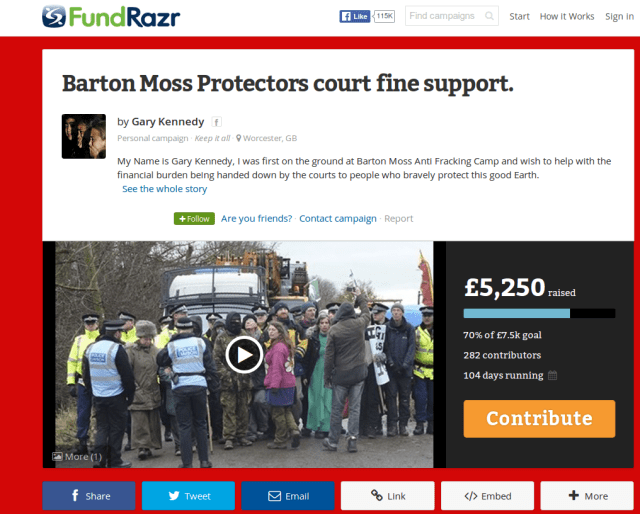
Got spare cash? Barton Moss protectors court fines…

There’s a fundraising site around the court costs for  the people who protested (long and hard) at Barton Moss.

barton moss protectors court.png

Posted in Campaign Update, Fracking | Leave a comment

Not #Manchester; PhD Scholarship in Climate Change Fiction

Do pass this on to anyone who might be interested

PhD Scholarship in Climate Change Fiction

Ghent University – Department of Literary Studies

Applications are invited for a fully-funded PhD scholarship in the Department of Literary Studies at Ghent University, Belgium, tenable for a period of up to four years. The successful candidate will participate in the research project “Imagining Climate Change: Fiction, Memory, and the Anthropocene,” sponsored by a grant from the Research Foundation Flanders (FWO-Vlaanderen) and directed by Prof. Stef Craps. S/he will research Anglophone climate change fiction within the context of the project’s three interrelated strands. The first, formalist strand explores the literary innovations demanded by climate change, a phenomenon whose magnitude and complexity challenge conventional modes of representation. The second, historicist strand links climate change fiction to literary responses to earlier crises that radically altered humanity’s relationship to the past, present, and future: the discovery of geological time in the early nineteenth century and the Cold War threat of nuclear annihilation. The third, postcolonial strand investigates to what extent and in what ways climate change fiction addresses inequalities in the global distribution of responsibility for and vulnerability to climate change, which the developing Anthropocene narrative risks obscuring.

Candidates should have:

  • a Master’s degree or equivalent qualification in a relevant field, such as English, Comparative Literature, or Environmental Humanities (candidates near to completion may also submit applications, indicating the expected date of the degree);
  • an outstanding academic record;
  • excellent writing and speaking skills in English;
  • an aptitude for original, independent, and creative work. 

Conditions of employment:

  • The position begins 1 October 2016 or as soon as possible thereafter but no later than 31 December 2016.
  • The scholarship is initially offered for a period of two years and can be renewed for another two-year period upon positive evaluation.
  • The net amount of the scholarship will be approximately 1900 EUR per month, gradually rising to approximately 2100 EUR per month in the fourth year. The PhD student will also receive a holiday allowance and an end-of-year bonus, and enjoy full social security coverage. Additional financial support is available for conference and workshop attendance.
  • The PhD student will be based at Ghent University.
  • The PhD student will complete the doctoral training programme offered by the Doctoral School of Arts, Humanities, and Law. 

Applications should include:

  • a cover letter, in which you specify why you are interested in this position and why you consider yourself a suitable candidate;
  • a current CV;
  • transcripts of your qualifications to date (degrees and grade lists);
  • a writing sample (excerpt from your Master’s thesis, article, etc.);
  • names and full contact details of two referees.

The application deadline is 20 May 2016 or until a suitable candidate is found.

Further information about the position can be obtained from Prof. Stef Craps (stef.craps@ugent.be).

Applications should be submitted as a single PDF file via email to stef.craps@ugent.be.

Posted in academia | Leave a comment

#Manchester Council throws cash at #climate group which breaks newsletter promise

Manchester City Council has given 70k in cash, and sent two staff to work full-time to a group that promised to produce newsletters and has not done so. Council Leader Richard Leese and Executive Member for the Environment Kate Chappell both spoke at the 2015 Annual General Meeting of the “Manchester A Certain Future” group. In the annual report presented at the meeting one of the commitments that council-funded group made was that

“a new bi-monthly newsletter will start in summer 2015” (page 9)

And despite all that money (your money, if you pay council tax) and the presence of those two full-time council staff… you guessed it, no newsletter.

Why? MCFly asked the chair of the group, Mr, Gavin Elliott, who recently presided over a meeting where there were two attendees and eight apologies to confirm. He told us

You are indeed correct. We are not publishing a newsletter.

Post-Annual Report / and with the CIC up and running, we spent a bit of time looking at how we would distribute tasks between the SG & the CIC, and also whether anything we aspired to do was already being done by other agencies/groups of people within the City/GM with the same agenda (like the LCH for instance) so as to avoid duplication of effort/inefficiency.

To this end Platform already publish a calendar of events, news stories & have a newsletter which is mailed out to subscribers – so it seemed pointless to duplicate this. Particularly when the MACF website is already hosted on Platform ie. there is a close relationship between us/them in terms of provision of news/content/events etc.

So we took the view it would be better to focus our efforts elsewhere.

Trust this helps.

That sounds very reasonable, doesn’t it? Even responsible. There’s just one thing…

All those reasons were true BEFORE the promise was made.

So we have a situation where this group – that gets all this money, and has all this ‘talent’ – can’t even think through which promises to make. It just spits out shiny-sounding feel-good stuff and hopes that nobody notices when it doesn’t deliver. The firm commitments it gives, on paper, are worth nothing. A true son of the Council itself, then.

There are many questions to ask about this. The main one right now is why on earth is Manchester City Council, when cutting essential services to the bone and beyond, throwing good money after bad at this group? Why? Readers of MCFly might like to ponder this, and take it up with their local councillors, especially if any of these councillors are Executive Members, or sit on the Neighbourhoods Scrutiny Committee, which is supposed to monitor the council’s spending on environmental matters.

Posted in Manchester City Council, Steering Group, Uncategorized | 2 Comments

Upcoming Event: “Three Acres and A Cow” #Mancheser Sat 16th April

Saturday 16th April, 7pm, at Nexus Art Cafe, 2 Dale St.

man-digging-potatoes-no-border

‘Three Acres And A Cow’ connects the Norman Conquest and Peasants’ Revolt with current issues like fracking, the housing crisis and land reform movement via the Enclosures, English Civil War, Highland Clearances, Irish Land League and Industrial Revolution, drawing a compelling narrative through the radical people’s history of Britain in folk song, stories and poems.

Part TED talk, part history lecture, part folk club sing-a-long, part poetry slam, part storytelling session… Come and share in these tales as they have been shared for generations.

Featuring Robin Grey, Tim Ralphs and Naomi Wilkins, see http://threeacresandacow.co.uk/ for more information.

Tickets are £10 (£5 concessions) and can be purchased fromwww.threeacresandacow.co.uk/manchester which will incur a £1 booking fee, or in person from the lovely folks at Nexus.

Doors at 7pm, show starts at 7:30pm.

The photo above depicts a wood engraving by Claire Leighton, courtesy of the artist’s estate – http://threeacresandacow.co.uk/wp-content/uploads/2013/10/man-digging-potatoes-no-border.jpg

Posted in Upcoming Events | Leave a comment

Steering Group holds meeting with 2 present, 8 apologies!! #Manchester #climate debacle

This is not an April Fools.  Repeat, this is NOT an April Fools.

On 18th February 2016, the Manchester A Certain Future  Community Interest Group held a meeting of its board of directors (members of the public are NOT able to attend).

Clock the attendance.  #wordsfailme  #notsatire

Here is a screengrab and here is a link to the document page itself.

18 feb boad of directors

Posted in Steering Group | 2 Comments

#Manchester Council gives useless #climate group another £27k. Why?

[UPDATE – The minutes of the Steering Group’s meetings have been found.  And they reveal that for the meeting on 18th February 2016  there were 8 apologies, and only 2 people present.  The meeting went ahead anyway.]

Manchester City Council is throwing another 27 thousand pound at a hopeless and undemocratic climate group. This is on top of a previous 70 thousand that the council has already wasted on the “Manchester A Certain Future” group.  As for what specifically the council expects to get, well, vague (non) answers abound.

The MACF  Group was set up in 2010 to be a critical friend to the Council and to mobilise Manchester’s citizenry in pursuit of emissions reductions and a ‘low carbon culture’.  It was supposed to be a democratically elected body, but this idea was disposed of after a couple of years. It has not been able to organise its own website, submit grant applications  and will not allow councillors attend its meetings.   Despite generous funding from the Council, it seems not to have held any public meetings since last June.

In response to a Freedom of Information request by Manchester Climate Monthly that asked what support the group was getting, this reply was received.

Manchester City Council will be providing dedicated resources to support Manchester A  Certain Future priorities during 2016/17. This includes 2 staff (representing 1.8 full time equivalents) seconded to the Community Interest Company (CIC). The cost of  secretariat support, £20k, will continue to be covered during 2016/17. A budget of up to £7k has been set aside within Manchester City Council that the seconded staff can draw  on for day to day costs such as meeting venues, communications material and travel  and subsistence costs. This will be spent within normal Manchester City Council  financial regulations.

In response to a very specific question –  “what ‘service level agreements’ etc there are for this money.  i.e. what is the Council expecting to get in return,” a typically vague reply was given.

The intention is that the combined resource supports the MACF  priority to become priority to become established as a self-sustaining organisation that progress MACF objectives. The CIC and seconded staff report to the CIC directors and undertake work consistent  with the CIC articles of association. Details of the CIC’s work are available in the CIC  Board of Directors’ meeting minutes available from http://www.manchesterclimate.com.

So, let’s have a look at the latest events on the MACF groups website under the tab “Events Happenings and Conferences.”

macfjunelastyearOh dear, it’s from June of last year.  Not so busy, then?


And those minutes that we are supposed to be able to find?   Here’s a screenshot of the relevant page, taken just now.

18 feb minutes

If you click on the bold link “here” for 14th December, you get this.

minutes not found

So, the last minutes you can access are from November last year.  And the person who sent the reply to the FoIA clearly didn’t check what they were talking about.   [See below for update, 12 April, 12pm] When is the next meeting of the Steering Group? Has it in fact already passed?  Of course, members of the public are not able to attend these meetings. And when the chair of the Neighbourhoods Scrutiny Committee, a democratically elected politician who leads the group that is supposed to keep tabs on what is being done with Council resources around environmental issues asked if HE could attend, he got no meaningful answer (which is basically a ‘please don’t embarrass us by forcing us to say ‘no’ out loud’.)

So, the Council has wasted well over 100 thousand pounds of our money on a group that was supposed to hold elections – never did – was supposed to hold annual stakeholder conferences-  but couldn’t get its act together-  and seems not to have held a public event (or at least, been able to blog about it) since last June.

And will a single councillor hold the Executive Member for the Environment (Kate Chappell) to account for this pathetic decision?  Of course not.


[Update: 12 April 2016, 12pm:  An eagle-eyed eagle scout of a MCFly reader has found the minutes elsewhere on the site. ]


Posted in Manchester City Council, Steering Group | 1 Comment

Repost: Carbon Co-op AGM event report #Manchester

Congrats to Carbon Co-op for hosting an interesting AGM, and for getting an informative post about it (see below) up asap for those who could not be there. This should be standard operating procedure of course, but too rarely is…

Carbon Co-op AGM event report: The role of early adopters in catalysing broader, deeper action on climate change

This year’s AGM event, which took place on 7th April 2016 at Bridge 5 Mill, featured an illuminating set of presentations outlining the role of Carbon Co-op’s energy efficient retrofit projects in the context of increasingly challenging global climate change targets with the Q&A discussion featuring debate on the role community energy organisations like us can play in catalysing wider societal action.

Professor Kevin Anderson of Tyndall Centre began, contextualising the UN climate agreement made in Paris last year and outlining the task ahead for the UK and other countries in achieving what might be considered ‘safe’ levels of global warming. In summary, he felt we have an outside bet of meeting a 2 degree temperature increase!

Though a daunting prospect, Kevin highlighted the role Carbon Co-op’s members might play in providing concrete examples of the large scale, achievable and replicable energy efficient retrofits which deliver significant carbon savings commensurable with the 2050 targets. In his opinion, case studies such as these can initiate quick and effective changes in policy at a government level and references to Carbon Co-op retrofits in recent presentations he has made to high level politicians and civil servants have already brought up questions on how the programme can be replicated elsewhere.

Marianne Heaslip of URBED, lead architect on Carbon Co-op’s Community Green Deal programme, presented on the potential for the wider role out of whole house, low carbon retrofit in the UK. Though technical challenges were highlighted, she argued these were relatively solvable and that the real barriers were social, political and economic. For example, home owners have no problem investing tens of thousands on a loft conversion but simultaneously expect energy efficiency improvements to be free of charge.

Marianne also highlighted the role of early adopters such as those within the Carbon Co-op’s membership, and the challenge of bridging the metaphorical ‘chasm’ to the wider majority.

For the subsequent Q&A session the presenters were joined by Rob Jones, a Carbon Co-op committee member. The discussion was wide ranging and touched on a number of themes including the role of small numbers of pioneers in influencing government and the wider population, the sometimes confused association between carbon reduction and fuel poverty alleviation (many in fuel poverty probably need to emit more carbon!) and the relative merits (or otherwise) of biomass in general and wood burning stoves in particular.

The evening finished with a discussion on the responsibility a very small number of wealthy Westerners (Leonardo Di Caprio for example!) ultimately bear for a significant share of carbon emissions (the richest 1% emitting many thousands of times more than the poorest 1%), with the ultimate conclusion that we need to communicate with other people in our communities and peer groups to spread the carbon-saving message in ways relevant to them (rather than seek out meetings with film stars).

A set of online videos documenting the presentations and the discussion will be available in the next month.

Presentations

Photos from the event can be viewed here.

Posted in Event reports | Leave a comment