Why scrutiny (of #Manchester #climate inaction) is so weak, and so ineffectual

Why does Manchester City Council get away with breaking quite so many of its climate promises, including the simple one where the Executive Member for the Environment promised to set up a blog?

This rant lists structural reasons, personal/personnel reasons and for the failure of scrutiny, before turning to ‘what is to be done’.  Please feel free to comment, or send an email to mcmonthly@gmail.com

Structural reasons (Long-term and global)

a) Neoliberalism gets blamed for everything, so let’s start with that. At a national level, since the 1970s, the ‘market’  has become the measure of all things.  And climate change, as a ‘market failure’ (TM Nick Stern) is not something economists and their ideological slaves, the bureaucrats and politicians, like to think about

b) The hollowing out of the local state.  Thatcher gets blamed (rightly) for that, so let’s continue with that. Local government has become a shell, basically a delivery mechanism for national policies and a shield dented into virtual oblivion.  Manchester City Council ran the white flag up in the second half of the 80s, and it’s been fluttering above Albert Square ever since.

c) The collapse of the media that was supposed to perform a ‘watch-dog’ role.  When was the last time the Manchester Evening News, or BBC North West, ‘broke’ a significant story about Manchester City Council.  Anyone?  They don’t send anyone to scrutiny meetings (no money to do so) and they rely on press releases and ‘leaks’ (yeah, right).  It’s churnalism, basically.

d) The coming of the One Party State – the collapse of a local political opposition
As recently as 2010 the Liberal Democrats had a third of the Council seats.  I am not saying this was necessarily a Good Thing, but at least there was some sort of criticism.  Yes, often misplaced or ill-informed, but it was there.  The Greens, a long long time ago, had a councillor.  Nowt since. So you have 96 Labour councillors. A 9 member Executive that rules them all, and jostling for preferment among the rest, whose future rests in making the right noises and not embarrassing The Party.

e) The lack of social movement organisations that monitor or challenge. Manchester’s environmental scene has basically imploded.  It looked busy a few years ago (e.g. in 2007-2010) but most of those groups are now inactive, and the few that are left basically don’t say boo to the goose or get their acts together (and yes, that includes the ones the author tried to set up).   The focus is always on some event in London, or further afield, and mobilising is usually a substitute for movement-building. There’s currently a very small ‘buzz’ (or drone?’) around Paris, but unless a miracle happens, that will dissipate, because the same mistakes are being made.

Westminster-style  democracy is supposed to work like this: you have an executive made up of big beasts from the party that has the most seats.  They work with the permanent bureaucracy to deliver what they want (which may or may not match what they promised). Hubris and incompetence are kept in check by the close surveillance not just of their own back-benchers, but by the official opposition, by the media, and by civil society groups (unions, thinktanks, charities, etc) from without.  So a rough sort of ‘wisdom of crowds’ keeps from anything TOO stupid from happening.  Yes, there is the occasional outbreak of crude hegemony or group think, but overall, this is the best of all possible worlds.

But Manchester has no opposition party, no media, no civil society.

f) The nature of Manchester City Council; When did the powerful ever welcome long-term and detailed scrutiny?  When did the ‘confident’ ever welcome people who said ‘you’re not keeping your promises, your plans are unrealistic, your bureaucracies clumsy at best’?   It may have happened, somewhere, somewhen.  But in Manchester?  Really?

Personal/personnel reasons 

People become councillors for different reasons.  Basically they fall into three categories

  1. The ambitious who see it as a stepping stone to Bigger Things. Well, they might occasionally bang on the table, but they’re never going to undertake sustained campaigns of questioning the Executive and the bureaucracy.  That would be a Career Limiting Move.  And the ambitious are not into CLMs
  2. The “I can change the system from withins.”  They do exist.  It can take them a while to learn better.
  3. The rest. People who are doing it for the money (£16,000 isn’t much, but it isn’t nothing), for the status (not nothing) or for the business contacts.  Or just want to make the world a better place, be part of the dented shield.

(People shift between these categories of course!)

There are two crucial things for our purposes, in terms of sustained, detailed and brave scrutiny of Manchester’s climate debacles.

Firstly,  very few of the people who are currently engaged in council “climate politics” (for want of a better phrase) were actively engaged in 2009.  Some weren’t councillors back then, or were councillors but had no interest in or involvement in the issues.   It’s hard for them to understand just how wide the (widening) gap is between rhetoric and reality

Secondly, climate change is but one issue among MANY.  Thanks to the Tories trying (successfully) to roll back the welfare state, councillors spend huge amounts of limited time and energy try to help people that David Cameron, Ian Duncan Smith and the rest are trying to stuff down the cracks.
Is the issue the issue?
Some say that climate change is too complex for our pretty little heads, too complex for the current structure of scrutiny.

Hmm.

  1. I don’t see a lot of decent scrutiny being done on OTHER issues. It’s not like climate change is an outlier, the only thing that isn’t getting attention.
  2. Also, it’s actually NOT very complex.  Manchester City Council made a lot of concrete promises in 2009 and 2010, and some more since then.  And it is evidently breaking them.  Yes, the bureaucrats and the executive spin and wiggle and wriggle, and shift baselines where and when they can, and promise reports and not deliver.  But so what, that’s normal.  That’s not hard to spot.  In the words of Sven Lindqvist  “You already know enough. So do I. It is not knowledge we lack. What is missing is the courage to understand what we know and to draw conclusions.”

What is to be done?
So, it’s easy enough to make a list of What Manchester City Council COULD Do.  I did it last year, in  a report that went out last year under the catchy title “The Scrutiny Mutiny.

The point is, Manchester City Council will NOT do these things.  Or rather, they won’t do them soon, and they won’t do them without a fight so fierce that it will probably leave us exhausted and demoralised (and therefore defeated.)

So, “we” (1) have to do these things(2).

  • Who is we? You dear reader, and whoever else you and I can rope in.
  • Or at least, those items that we think a) we can do fairly easily and b) will increase OUR power.

We could start by

  1. Figuring out what items really really matter to us. My personal vote is for ‘resilience rightly understood-  class-race-gender-age-aware disaster preparedness and the (lack of) ward plans around climate change.  We should be starting to take actions ourselves BEFORE hassling the Council to help us (because they won’t, not quickly anyway).
  2. Building teams of people who know what skills each other have, what skills and knowledge each other WANT, and going from there. That would be novice lines etc.
  3. Attending scrutiny committees (especially Neighbourhoods) and writing/filming/tweeting about them with verve, clarity, accuracy and all necessary cynicism (plus a bit more).

We need to be thinking

  1. How can we do this without dying of boredom or wanting to kill ourselves in despair?
  2. In what ways can people too busy or just-plain-sensible to set foot in Castle Greyskull to get involved (and how can we learn from their skills and knowledge) and stay involved (how can we share our skills and knowledge, and maybe even score some wins).

Meanwhile, the Green Party could actually put the sterling work of those brave enough to attend the horrorshows in the Town Hall not on a basically hidden page of their website, but front and centre. If folks are doing the hard work, they should be rewarded.

Posted in Uncategorized | 1 Comment

Upcoming Event: Carbon Co-op Social, October 16th #Madlab #Manchester

Carbon Co-op header

Carbon Co-op Social – Thurs 15th October 2015

Meet other members, socialise, discuss

At October’s Social we will be launching of a series of video profiles of members, funded by the Green Open Homes network to showcase homes that have been benefitted from energy efficient improvements. Each film is 4-5 minutes long and highlights a different aspect of retrofit such as triple glazed windows or internal wall insulation.

Also, Matt will be introducing the latest collaboration with OpenEnergyMonitor on the a Community Smart Grids project we will be piloting in 2016.

As always there will be complimentary snacks and drinks and lots of opportunities to chat and mingle.

Please RSVP to let us know if you will be attending (the event is open to non-members).

Routes to Retrofit seminars – November 2015


Planning and Delivering Energy Efficiency Retrofit works for householders

We’re running another series of seminars on planning and procuring retrofit works. These sessions always sell out, so do book early to reserve a space!

WHAT: Planning on an eco-home make over to reduce energy bills and do your bit for the environment? Confused about what to prioritise, which professionals to appoint and how to approach contractors?

Carbon Co-op are hosting two specialist seminars run by industry professionals on the practicalities of commissioning eco-retrofit works.

Attendees also receive supporting materials and access to an online webinar.

FOR: householders planning an eco-refurbishment or retrofit project who already know the kinds of measures their home requires and are seeking to take forward works. Householders who have had an energy assessment carried and want to commission some of the recommended measures.

For more detailed information on course content view this webpage: http://carbon.coop/news/2015-09-22/routes-retrofit-seminars-autumn-2015

Posted in Upcoming Events | Tagged | Leave a comment

#Manchester Literature Festival – #climate events, inc George Monbiot

http://www.manchesterliteraturefestival.co.uk/categories/literature-and-landscape-2015-36816

Literature and Landscape

From nature writing and memoir to psychogeography and climate change, authors and non-fiction writers reflect on our relationship with the earth and the landscapes around us.

Simon Armitage
Thursday 22nd October, 6.30pm
Central Library

Granta Presents: What Have We Done?
Sunday 25th October, 12.00pm
Whitworth Art Gallery

Sarah Hall & George Monbiot
Sunday 25th October, 2.00pm
Whitworth Art Gallery

Oliver Morton
Sunday 25th October, 4.00pm
Whitworth Art Gallery

Box Office: 0843 208 0500
MLF Office: +44(0)161 832 5502
office@manchesterliteraturefestival.co.uk

Posted in Uncategorized | Leave a comment

More pathetic spin from #Manchester City Council about its carbon emissions. #climate

Back in 2013 Manchester City Council tried to spin an increase in its emissions as a decrease. They were laughed at then. They have, of course, learnt nothing, and they’re claiming decreases that are basically illusory and not what was actually promised anyway. Ann Onymouse reports…

The council has put a news article on their website which begins “Figures show carbon emissions down over last five years. New figures show Manchester City Council’s carbon emissions have decreased by 13 per cent over the last five years. “

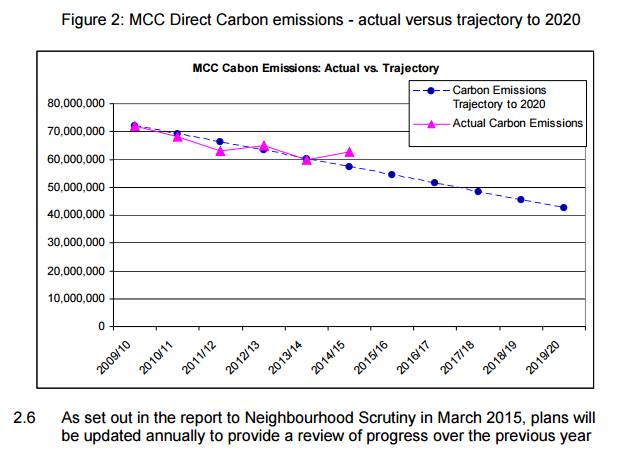
It is interesting that the council have chosen to lead with those headline figures, rather than the headline figure of the carbon emissions going UP 4.8% over the past year. The news post mentions that the target is for a 41% reduction between 2009 and 2020. In order to make that target, the council should have reduced its carbon emissions by over 20% by this point [actually, by 2014!]. Another appropriate title would be “Figures show that carbon emissions haven’t gone down enough over the past 5 years.”

The news article mentions that “more work is being planned to make the council’s building more efficient. This includes undertaking a huge building by building survey of all council buildings”. The report to the council, however, states that “15 buildings have been identified (11 in our top 25 carbon intensive buildings) that will be subject to energy audits… This work is subject to the approval of a business case which is currently being taken through internal sign off processes.” So will only 15 council buildings receive an energy audit, or will all buildings receive this after these 15 have been completed?

In the scrutiny meeting where the report was discussed, it was mentioned that 203 tonnes of CO2 were emitted by the council that were not contained in the report. This means that the emissions have actually gone down by only 12.7% over the past 5 years and up by 5% over the past year.

Posted in Manchester City Council | 1 Comment

Will someone not kill off this undemocratic and worse-than-useless “Stakeholder” “Steering” “Group”? #manchester #climate

What do you call an organisation that promises and then cancels elections to its board?
What do you call an organisation that unilaterally cancels day-long community-focused conferences and replaces it with a 90 minute talkfest by three old white men?
What do you call an organisation that couldn’t even run its own website and sighs with relief when instead it gets swallowed by a joke of North Korean -style ‘everything is awesome‘ s(h)ite?
What do you call an organisation so inept and obviously pointless that can’t even get funding from the City Council’s “Clean City Fund”, even though it has long been the Council’s climate change stabvest?
What do you call an organisation that won’t even allow elected members of Manchester City Council – let alone members of the public – attend its meetings?

I am sure you can think of plenty of names. But “Stakeholder Steering Group” (SSG) is unlikely to be among them, now, is it?

Gavin Elliott, the second (and hopefully last) chair of the SSG, finally appeared before a group of councillors today (the Neighbourhoods Scrutiny Committee, one of six scrutiny committees that is supposed to keep tabs on the Council’s elected and unelected bosses.). He had been due to appear two years ago to the “Environmental Sustainability Subgroup”, but Council officers never quite seemed to be able to coordinate diaries for him.

Elliott started by claiming that the Stakeholder Steering Group’s very existence was down to discussions between Council Leader (since 1996) Richard Leese, the first (and last) ‘Director of Environmental Strategy’ (Richard Sharland) and Steve Connor (first SSG chair). Most everyone who was actually engaged in climate politics in this city at that time – 2008 to 2010 (Elliott was not)- would raise an ironic eyebrow at the characterisation.

Elliott then did NOT to mention that the Climate Change Action Plan that the Steering Group is supposed to be steering on had two headline goals – a standard emissions reduction target (which he conceded we are missing) and – well, let’s quote it in full

“To engage all individuals, neighbourhoods and organisations in Manchester in a process of cultural change that embeds ‘low carbon thinking’ into the lifestyles and operations of the city. To create a ‘low carbon culture’ we need to build a common understanding of the causes and implications of climate change, and to develop programmes of ‘carbon literacy’ and ‘carbon accounting’ so that new culture can become part of the daily lives of all individuals and organisations. Every one of the actions in our plan will contribute in some way to the development of ‘carbon literacy’ in the city. However, achieving a new low carbon culture – where thinking about counting carbon is embedded and routine – can only be delivered as a result of all the actions together, in an overall co-ordinated manner. Enabling a low carbon culture in the city will be particularly important if the challenge of meeting even more demanding carbon reduction targets between 2020 and 2050 is to be met.”

And since he didn’t mention it, he also didn’t mention that that goal was continually characterised by Sharland, in 2010-2 (i.e. before he got involved) as MORE important than the first goal, since only with a low carbon culture could we hope to make the much much deeper cuts needed AFTER 2020.

“Low carbon culture” came up – for literally a minute – later in his presentation. The only metric that has been developed, apparently, is per capita emissions. Seriously. Elliott did not mention that last year the Steering Group actually had a presentation from the authors of a report on Manchester and a “Total Carbon Footprint” approach. (The Climate Change Action Plan, as well as committing to everyone in Manchester having received a day’s carbon literacy training by 2013, also said the Council would move to ‘consumption-based metrics’ by 2013. Neither happened). Elliott also didn’t mention that a report was produced (by this author) about “What is a Low Carbon Culture?” Wonderful stuff.

There was more, but the key bit (and if you need a reason to kill yourself, you can watch the whole thing here), but the gist of it was that Manchester’s emissions have been tracking the other ‘core cities‘ (Liverpool, Leeds, Birmingham etc), albeit at a slightly higher per capita level. And a chunk of the reduction to date may well be down to the recession, so as growth returns, so might emissions growth.)”

None of the councillors (and there’s a separate blog post to be written about the structural as well as personal/personnel reasons why scrutiny in this city is QUITE so useless) asked the very obvious question.

“If all the other core cities have carbon footprints that have matched Manchester’s (at a slightly lower level) and yet most of these cities don’t have ‘Stakeholder Steering Groups’, then isn’t it the case that your group has probably had NO IMPACT on carbon emissions?” (The obvious next question, given the answer is ‘yes’ – And so, at present, are you are not wasting your time and ours?)

None of the councillors asked about the cancelled elections, the cancelled stakeholder conference (replaced with an ‘AGM’), the lack of a website, the lack of events, the feeble social media presence (No youtube account, no facebook – 442 twitter followers? Really?)

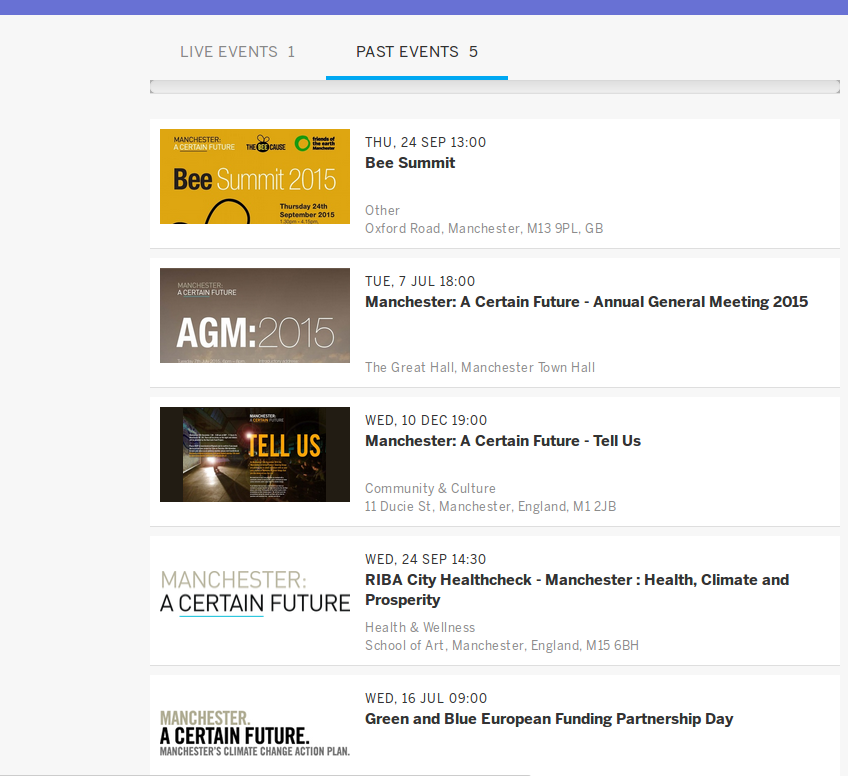
We are more than half way to the 2020 target date, and yet Elliott is still talking about ‘early steps’. After two years in the role,he neglects to mention his abolition of the stakeholder conference, holding two short AGMs and claiming that there are four meetings a year (they actually managed 3 in 2014. I haven’t bothered to count this year; according to the MACF’s eventbrite page there was nothing between last December and the AGM in July 2015-

macf events

Apparently being a community interest company and being able to get European funding (in theory) is progress. In 2015. Seriously.

Elliott was then asked a straight-foward question by the chair of the Neighbourhoods Scrutiny Committee – are meetings of the Stakeholder Steering Group open for members of the public – and indeed elected councillors – to come and observe (a meeting in public, as opposed to a public meeting)?

Elliott twisted and turned on the hook, resorting to the feeble ‘I’m sure the meetings are too dry and boring‘ line (i.e. ignoring the fact that in a democracy it’s up to adults to decide how and when they will be bored, and that a group that calls itself a Stakeholder Steering Group that forbids stakeholders from attending its meetings is, well, um…)
Gillard pointed to the fact that five of us had turned up at the NSC meeting and were still mostly alive.
Elliott twisted and wriggled on the hook some more, and refused to give a ‘yes’ or a ‘no’. So, that would be a…..?
Elliott quickly moved to Gillard’s other question, which was about the obsession with economic growth to the exclusion of all else.

Readers of MCFly may remember that in 2010 the Council committed to looking at Steady State economics (after the current author spoke at a scrutiny committee). And that process ended in farce, when the bureaucrat who volunteered to write it delivered a useless page and a half and then failed to consult, as later asked to, by a croup of Economy Scrutiny Committee councillors, and this then led to an alternative report that…

Oh, look. If you believe that our elected representatives, or the bureaucrats at the Town Hall, are acting at the scale and speed required to prepare Manchester for the challenges it will face around climate, then you clearly have not been paying attention for the last 7 years or so. We’re toast. Carpe the diems.

As for what you’d call the Steering Group – One of the names I can think of for it is “joke”. But it’s not a funny one, and when Manchester finally (and too late) comes to take climate change seriously, if we ARE serious we will
a) learn from the multiple multiple failures of the Steering Group
b) not let any of the people who committed those failures, over and over and OVER again, anywhere near the levers of power.

Posted in Manchester City Council, Steering Group | 5 Comments

#Manchester Airport misses #climate target, comically inept spin ensues. Write to your councillor #democracy

Back in the heady Big Promise days of 2009/2010, some bright spark came up with the idea that the ground operations of Manchester Airport (lighting, power for the x-ray machines etc but not the actions of the big metal birds that are its raison d’etre) could made ‘carbon neutral’ by 2015.  And so a promise was made.  Manchester City Council (which owned 55% of Manchester Airports Group, now owns 35%) was VERY good at making climate promises back then. Keeping them? Not so much.

It is 2015.  The Manchester Airport Group bods were at full Council last week.  There was a blink-and-yer-miss-it reference, ambiguous, to carbon neutrality as an aspiration.

MCFly wrote to the Airport’s Press Office

Dear Sir/Madam,
I was surprised that there was not a proper announcement at today’s Council of just where Manchester Airport is with its much vaunted “carbon neutrality” in its ground operations by 2015 promise.

We will be running a story on Manchester Climate Monthly about this, and would appreciate a statement from you that covers
a) the Airport’s current carbon footprint
b) the progress (or lack of it) over the last 5 years towards carbon neutrality
c) the new date by which the Airport plans to be carbon neutral
d) why the lack of progress was not flagged at the Council meeting today.
Many thanks

We were promised an answer in 24 hours. And, unlike on another occasion, an answer did in fact come.

A Manchester Airport spokesperson said:
“At Manchester Airport we are proud of our environmental record with regards to noise, energy efficiency and carbon reduction and remain committed to being one of the leading airports in Europe on environmental management.
“In our 2015/16 CSR highlights we committed to reducing energy use by 16,000 MWh, by 2020 and to deliver an updated renewable energy strategy, whilst maintaining a carbon neutral operation at Manchester Airport. As our transformation programme progresses, maintaining this neutrality will be a key objective for all involved in the project.”

Kind Regards

Manchester Airport Press Office
Part of the Manchester Airports Group (MAG)

So, what do we learn from this?

a) that the spin is feeble.
b) that they are claiming to have achieved ‘carbon neutrality’, but there is NO reference to when and how they did this. A search of the internet finds no such announcement.

So if they DID achieve it, they want to keep very very quiet about it.

Why would that be? Manchester is a city addicted to (empty) boosterism. Could it be because they don’t want to anyone asking awkward questions like

a) did you achieve this neutrality simply by buying loads of (cheap and meaningless) carbon offsets?
b) how much carbon is generated by the expansion of your numbers of flights
c) will “Airport City” ever be carbon neutral?
d) how are you getting on with the nothing-to-landfill promise?

Look, it’ almost certainly too late to avoid 4 degrees of warming. The species is headed for a horrorshow, and will wipe out a vast percentage of the other species by its actions and inactions. The future of civilisation is really in the balance. If you are under about age 40, you are going to see this unfold – or rather, unravel.. If we are to pull through (big if), then we are going to need to have justified trust our institutions and to strengthen our democratic habits.

The actions of Manchester City Council, and the Press Office of Manchester Airports Group are exactly the kinds of behaviour that we, who still (for now) have freedom of assembly/speech/information have to challenge.

So, what to do? You could write to your local councillors (you can find them here).
Ask that they raise the Airport’s obfuscation – both to the Council and to citizens- with the Executive. Ask them to raise it in their Scrutiny Committees.

Posted in Aviation, Low Carbon Culture, Manchester Airport, Manchester City Council | Leave a comment

Upcoming: Oct 27th, “Where should our energy come from?” in #Manchester

As part of Manchester Science Festival

Where should our energy come from?

Let’s talk about energy. How can it be secure, affordable and sustainable? What’s the long-term outlook and how will it progress? Join the debate surrounding the technologies, strategies and systems that may provide answers for the UK.

Posted in Energy, Upcoming Events | Leave a comment

Upcoming Events: Policy Week stuff on #climate, #Manchester

University of Manchester “Policy Week” events

Cut and paste below. It will, I suspect, mostly be chalk and talk/sage-on-the-stage/ego-foddering/preening-and-attacking.  That’s just the way the species has chosen to roll.  Pity, but what are you going to do?


Policy Week 2015 (2-6 November)

Science, Technology and Public Policy

Stretching across five packed days and featuring discussion, lectures, workshops, simulations and even films, Policy Week brings together leading thinkers, academics, students and policy influencers to debate and progress key policy issues.

This year’s theme is Science, Technology and Public Policy, and the event programme is part of European City of Science Manchester 2016.

Academics from right across the University will be leading or contributing to this year’s programme, alongside expert representatives from numerous external organisations. It will make for fascinating debate, discussion and progression of key issues.

Policy Week will take place at the Manchester Museum at the University, but also at venues across campus and the city. Follow us on Twitter via @UoMPolicy or sign up to our mailing list, to be the first to hear news about Policy Week and updates on the schedule.


How to book

The vast majority of events in Policy Week are free but booking is essential. Please click on the event titles below to be taken to the booking page and order tickets from there.

Date Event Time
Monday 2 November The Pros and Cons of Fracking 10:00 – 11:15
Monday 2 November Can Researchers Speak Truth Unto Power? 13:15 – 14:45
Monday 2 November Film: The Age of Stupid 15:15 – 16:45
Monday 2 November Climate Negotiations Simulation 16:00 – 18:00
Monday 2 November Disruptive influence: How will emerging technology impact Higher Education? Keynote address by David Willetts 19:00 – 20:30
Tuesday 3 November How Much Evidence is ‘Enough’ Prior to Policy Implementation? 08:30 – 21:45
Tuesday 3 November Using digital technology to assess quality in the arts 11.00 – 14.00
Tuesday 3 November Time to Use Technology for a Better Picture of People’s Exposure to Pollutants 10:15 – 11:45
Tuesday 3 November The Manchester Experience: Science, Technology and Engineering Education Enrichment in Greater Manchester 12:00 – 17:00
Tuesday 3 November Film: Disruption 12:00 – 13:00
Tuesday 3 November The Future of Science and Innovation Policy 13:00 – 15:00
Tuesday 3 November Powering the Northern Powerhouse 13:15 – 14:45
Tuesday 3 November Hot in the City – Urban Resilience and Cooling 15:15 – 16:45
Tuesday 3 November The Inaugural Sammy Finer Lecture on Government with Will Hutton 19:00 – 20:30
Wednesday 4 November Falling through the gaps Improving health outcomes for adolescents and young adults in Greater Manchester 08:30 – 09:45
Wednesday 4 November Rethinking UK Research Funding

To request a place at this event, please email your name, job title and organisation to rethinkingresearch@gmail.com

https://rethinkingukresearch.wordpress.com/

09:00 – 16:30
Wednesday 4 November Digital Boom or Tech Time Bomb? The Impact of New Technology on Northern Lives 10:15 – 11:45
Wednesday 4 November Synthetic Biology: Reshaping the future? 13:00 – 16:00
Wednesday 4 November Film: FrackNation 13:15 – 14:45
Wednesday 4 November What is citizen social science, and how can it help make policy? 15:15 – 16:45
Wednesday 4 November Notes on a Drugs Scandal : In Conversation with Prof David Nutt 18:30 – 20:00
Thursday 5 November Technology & Healthcare – Empowering the patient; influencing policy 08:30 – 09:45
Thursday 5 November Greater Manchester Devolution: Update on the Dementia Pilot 10:15 – 11.45
Thursday 5 November Is that a big number? And does it matter? 13:15 – 14:45
Thursday 5 November Climate, Crises and Policy 15:15 – 16:45
Thursday 5 November On the Home Front: The Challenges of Reducing Household Energy Use 16:00 – 21:00
Friday 6 November Seeking Promotion to the Premier League – How can the Greater Manchester and Cheshire life science cluster compete in the global arena? 08:30 – 09:45
Friday 6 November Meet the Government Office for Science 10:15 – 11:45
Friday 6 November Engagement between Scientists and Politicians: Communication of Evidence and Ideas 13:15 – 14:45
Friday 6 November Film: Man in the White Suit 15:15 – 16:45
Posted in University of Manchester, Upcoming Events | Leave a comment

#Manchester City Council emissions UP by 4.8% in last year

For the umpteenth time, Manchester City Council is making excuses for its poor-to-the-point-of-criminal performance on climate change.  MCFly reporter Ann Onymous reports. (As for involving everyone in the creation of a low carbon culture.  They won’t even define what they mean, let alone do anything).

Manchester City Council have this week released their delayed report on their carbon emissions. The headline figures are that between 2013/2014 and 2014/2015 carbon emission have increased by 4.8%, and have decreased by only 13% since 2009. This means that the council is not only behind in reducing its carbon emissions if it is to achieve the goal of reducing CO2 emissions by 41% by 2020, but it is also currently behind where it needed to be a whole year ago.

actualcuts
The report claims that “this is largely due to Government changes to emissions factors which are used to convert the Council’s energy use.” There are many things, however, that the council could be doing to reduce its CO2 emissions, such as delivering the conversion of street lights to LEDs which it had planned to do and hasn’t yet.

The report notes that the scale of the challenge is that the energy emissions from buildings will now have to reduce by 26% over the next 5 years (or just under 6% reduction per year). The report also notes that the council is  working with the contracted operators of Manchester leisure sites (2 of which rank in the top 3 largest CO2 emitting Manchester City Council buildings) to reduce CO2 emissions by only 3% each year, which is approximately only a 14% reduction by 2019/2020 from these buildings.

One welcome development mentioned in the report is that the council is now producing quarterly reports on most of its CO2 emissions, and releasing them quarterly.  The report for the first quarter of this year notes that of the 26% reduction in CO2 from buildings that is required, the council has so far made a 0.1% reduction compared with the same quarter of 2014/2015 (although this figure is subject to change).

Overall, at the current rate of progress it looks unlikely that the Council will reach its target of a 41% reduction in CO2 emissions by 2020. The only way it looks feasible that the Council could achieve this is by circumstances that are beyond its control and not related to how much energy it is consuming; namely if the Government’s emissions factors are reduced or  (ironically) if 2020 is a particularly warm year in which less heat is needed in the Council buildings over winter.

Meanwhile, the council will be discussing on Wednesday if it should install 1,400 solar panels in council houses in North Manchester by Christmas, and to increase the budget by £5.5 million to pay for this. This is twice the number of renewable installations that were registered for the Feed-in Tariff (FiT) across Manchester in the two years of 2013 and 2014.  This would be a fantastic project, which would reduce Manchester CO2 emissions, help alleviate fuel poverty for some of Manchester’s poorest people, provide employment for people and provide profit to the council. The reason why the council wants to conduct this relatively large project in a short space of time is the government’s announcement that it will severely reduce FiT for solar panels build after this year. It’s disappointing that this terrible national policy was required to spur the local council into action and to reap the rewards. Furthermore, after the FiT has been reduced the council will presumably not see projects like this to be economically viable, so will less keen to undertake them despite all the benefits.

Posted in Manchester City Council | 3 Comments

Video: Brief History of Global Warming #bloomberg #slick, #climate #Manchester

This is just over 3 minutes, and very nicely done. If you have some denialist uncles (and don’t we all),then the fact that is by the business outfit Bloomberg (him what was mayor of New York) may make it harder for the standard ‘leftist hoax’ dismissal…

Posted in youtubes | 1 Comment