Periodical Review: Peace News Dec 2012/Jan 2013

Every-so-often we at MCFly will review magazines/journals/newspapers that climate/social justice activists may want to keep an eye on which are not, themselves, climate-related. The first of these is of Peace News, a UK-based publication that has been going over 75 years and comes out every month (with I think July-August and Dec-Jan issues).

2522-front-coverThe latest one has a few things of specific interest to climate activists
Zombie roads rise again in Hastings (page 2)
“Occupying West Burton gas power station” (page 5)

On page 8, in an article about Spanish social movements and housing justice comes this;
“In his book Protest and Opportunities, the German activist-researcher Felix Kolb lists five political mechanisms through which social movements succeed in bringing about policy change; disruption, public preference, political access, judicial mechanisms and international opinion.” [I’ve since had a look at Kolb’s work. It may well be useful, but there are thickets of jargon to be cut through…]

On page 15, in “Liverpool Diary” Jennifer Verson writes
“And at the end of week one, my biggest epiphany is that decisions don’t matter as long as the process is prefigurative. You may be wondering what prefigurative means, to quote Stuart Field of Radical Routes “It means creating working examples of the alternative society that you wish to see. It’s tied to the idea that an inch of praxis is worth a mile of theory”

A very interesting sounding book “Fanfare for the Future Volume 1: Occupy Theory” is reviewed. [I have since skimmed the volume – it’s long on banality, short on insight…]
There is, in the review, a killer quote –

‘Ideas are like rabbits. You get a couple and learn how to handle them, and pretty soon you have a dozen.’

In “Activism and… Desperation” a man compares the sense of willingness to act on the Cuban Missile Crisis with today’s stunned inaction –

…. [w]ith climate change, it is almost certainly going to kill huge numbers of people, and devastate large parts of the planet, but it is a slow-motion disaster. They say, ‘We have only so many months to reduce greenhouse gas emissions’, and it is desperate, but it doesn’t feel like imminent death in the same way.
It is weird because at the same time there is a growing fatalism in the general public, even Hollywood is putting films out that involve the end of the world, where the hero doesn’t save the world, the world dies and a tiny number of people survive. It’s as if the popular culture is gradually preparing itself for the destruction of the human race and we believe that we deserve it, that the human race has had its chance and we’ve messed it up, we’ve been stupid and greedy and immoral and we don’t deserve to survive.

Of course, quite rightly given its name and remit, most articles are not climate-related at all, and focus instead on the UK weapons industry, the aftermath of Iraq, events in Syria. All in all, Peace News (despite a general lack of critical analysis of social movement defeats and failures and intermittent avuncularitis) is well worth the time and the money. You can subscribe via this link.

Marc Hudson
mcmonthly@gmail.com

Posted in Publication Review | Tagged | Leave a comment

Video: Staggering animation of Man’s “relationship” with Nature. Think “Wall-E” mashed up by William Burroughs…

Three and a half minutes of awe-inspiringness, from Steve Cutts*.

* “Steve is a London based freelance artist, ‘specializing’ in animation, illustration and fine art. After studying fine art at Farnham University, he progressed to the position of in-house illustrator for glue Isobar in London, where he worked for four years before entering the world of freelance. He has produced work for clients such as Coca-Cola, Bacardi, Toyota, Reebok, Sony PSP, The Guardian, Kelloggs, Philips, Three and Jamesons amongst others.”

Hat-tip to Sana Aburawa

Posted in education, video review, youtubes | Tagged | 1 Comment

Upcoming Event: TfGM’s habit of announcing consultations at last minute – can we Budge It?

On Christmas Eve the public were informed (as in, a press release went out) that they can come and be all democraticky and oversighty about Transport for Greater Manchester’s public spending plans. When is this? About ten days time. This, apparently, counts as fair advance warning for an event. A cynic might almost wonder if TfGM would not be heart-broken if only the hard-core transport activists were abel to attend… Maybe we need to have a consultation about the way Greater Manchester Local Authorities organise their consultations?
Anyhow’s here’s the press release

Greater Manchester residents are invited to a briefing on public transport spending plans.

TfGM_LogoThe Transport for Greater Manchester Committee (TfGMC) is holding its annual Budget Briefing for 2013/14 in the Banqueting Room of Manchester Town Hall on Thursday 3 January, from 10.30am – 1pm.

Following the briefing, leading councillors and directors from TfGM will be available for a question and answer session.

The briefing will be hosted by Councillor Andrew Fender, Chair of the TfGM Committee. He said: “These are exciting times for public transport in Greater Manchester. We are heading into the third financial year of a massive £1.5 billion investment to revolutionise public transport services and facilities.

“Whilst that ring-fenced funding is a major boost for transport, these are difficult financial times and there is more pressure than ever on our discretionary spending. In recent years we have delivered significant efficiency savings, and we will continue to do so.

“That said, it is widely recognised across Greater Manchester that getting transport right will help us get the local economy moving.

“Everyone with an interest in public transport is welcome to attend our budget briefing and I’d encourage people to come along and find out more about what we are doing.”

The £1.5 billion Greater Manchester Transport Fund was established in May 2009 to pay for 15 major transport schemes, including the Metrolink expansion programme, bus priority projects, park and ride and new transport interchanges.

In addition, transport spending in Greater Manchester focuses on supporting national and local concessionary travel schemes, funding the provision of socially necessary bus services, and providing improved passenger services and facilities.

The transport budget will be considered for approval by the Greater Manchester Combined Authority at the end of January.

To reserve a place at the briefing, please email budgetupdate@tfgm.com or telephone 0161 244 1000.

Posted in AGMA, Democratic deficit, Transport, Upcoming Events | Tagged | 4 Comments

MCFly to academics – “On your bike.” No, wait….

Hot on the pedals of yesterday’s academic atrocity comes this unspokesable example of, well, words fail us…
polarbearonyourbike
The senses act as the interface between self and environment, but in a western context powerful multisensory stimulation is increasingly constructed as marginal, deviant or in need of management/commodification. This paper brings together work on the sensory with ideas around affective intensity to explore the regulation of the individual through the senses. The notion of sensory discipline is developed through an examination of everyday commuter cycling. Based on innovative, mobile audio diaries, the intensities of sensory stimulation for the cycling body are explored. The paper concludes that commuter cycling enacts a minor resistance towards efforts to reduce the intensities of everyday affective landscapes. In turn, this resistance suggests just how pervasive sensory discipline has now become.

Sensory indiscipline and affect: a study of commuter cycling
Social & Cultural Geography
Volume 13, Issue 6, 2012

Thanks to the anonymous MCFly reader who ferreted this out…

Posted in academia, humour, Transport | Tagged , , | 1 Comment

Not-news flash: Academics in “laughable jargon” shocker

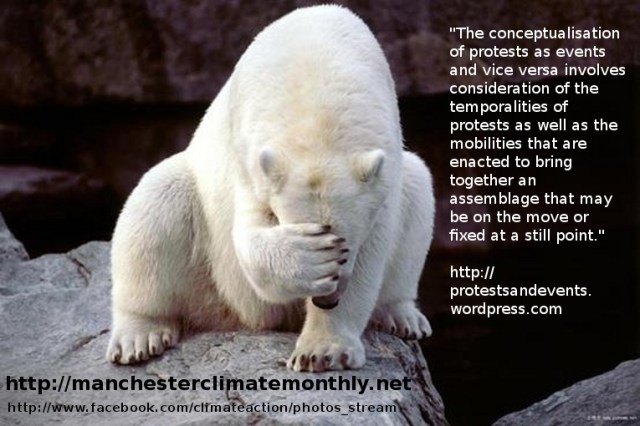
The polar bear is despairing again, thanks the quote from  here, for an event whose organisers “propose an innovative coming together of activists and academics to build bridges, initiate debate and develop future research agendas….”  Yeah, well, good luck with that…

polarbearjuvenilejargon

MCFly sez: There is a culturally-determined and deterministic propensity for individuals with extensive tertiary education and post-doctoral qualifications to devise and implement the strategic placements of multi-polysyllabic terminology in their intramural communications – and by extension their extramural efforts at constructive dialogue with wider communities of stakeholders – which reveals a quasi-Foucauldian and post-Bulterian* desire to reify pseudo-contra-hegemonic discourse(s). The Bataille/battle around these contested and contestable deployments of obfuscatory and onanistic onamastics that ensues thus ensures the overcoming of claims for demotic (Gricean) phraseology that might otherwise lead to destabilising conceptual imbrications and interpolations with other concerned cognitive actors.

* It doesn’t really, but what abstract is complete without a reference to Micky and Judy?

Approximate translation: (Some) academics use long words to hide their lack of ideas, and so hope to protect themselves from public ridicule.

Marc Hudson
mcmonthly@gmail.com

Disclaimer: We at MCFly are not anti-intellectuals. We are not even anti-academics (some of our best friends are academics). There are two posts coming up that will show this. One is a review (that is going to be beyond gushing) for an TOTALLY AMAZING book by a US-based sociologist called Kathleen Blee. The book is called “Democracy in the Making.”  The other is a summary (and possible video?) of an article by a Scottish academic and an American one on the important difference between “resilience” and “resourcefulness”. It IS possible to have useful ideas, and to write clearly.

It may be that the “protests and events” people have good ideas, and will bring together people with good ideas that are useful to social movements – time will tell . What is clear at the moment though, is that they lack either (or both?) the willingness and the ability to communicate their ideas to people who don’t have their cultural capital.

Posted in academia, humour, Upcoming Events | Tagged , , | 1 Comment

Comment is useful – Guardian readers on south west UK flooding

Newspaper writes story about extreme weather events. Commenter says “it’s to do with climate change”. Someone (in this case someone who is “@SoAnnoyed”) says “natural cycles/normal variation” or some such theoretically plausible tosh. Other commenters pile in with supplementary information, pwning him. Happens all the time. Happening now on the Grauniad around the flooding. Thought I’d share a couple of the comments wi’y’all…

Marc Hudson
mcmonthly@gmail.com

http://discussion.guardian.co.uk/comment-permalink/20236920

@SoAnnoyed –
How can heavy rain in England be considered climate ‘change’, pray tell?

If you are genuinely interested there are several excellent climate related websites that are currently discussing the causes of the extraordinary recent weather in various parts of the world.
There is mounting evidence that the loss of 70% of Arctic Ice volume since the 80’s and the shocking record decline of last year has led to a southern-ward shift in the weather patterns.
There has been an increasing tendency for high pressure areas to form over Greenland when they used to form over the (now melted) Arctic Ice.
This is turn is directing deep depressions, that would normally pass nearer to The Shetland Isles, a thousand miles south of their previous normal route.
It can also be clearly seen that the ‘Gulf Stream’ is now continuing much farther north than it used to just a couple of decades ago.

Of course it could all be just a fantastic coincidence that the increases in extremes of drought and then floods that the climate scientists have been projecting for decades are happening right here, right now.

and this

“If I had to pick one particular issue, I think the flooding issue is the most dominant,” Professor Sir Bob Watson, chief scientific adviser at Defra, told reporters.

“The climate projections show, especially in winter, significantly more precipitation but also more heavy precipitation and less light precipitation. And over the very long term you would also get sea level rise for coastal flooding. Flooding is something that we believe will become increasingly more severe almost immediately.”

Posted in Arctic | Tagged , | 1 Comment