Upcoming Event: Didsbury Dinners Community Celebration Sat 16th

Konstantina Evtimova, a volunteer with Didsbury Dinners, writes about a vegan-friendly BBQ this weekend…

Didsbury Dinners Community Celebration

Saturday 16 June, 5–8pm (after Didsbury Festival)

Didsbury Dinners is hosting a community celebration to say a big thank you to all of its supporters!

There will be free food and drinks for at least the first 50 people, including a vegan-friendly BBQ and a tasty cake or two. There’ll also be seed planting –  plant a seed, take it home and grow your own; face painting; and music to entertain you.
The celebration is a chance for newly interested people to find out more about what Didsbury Dinners does and how to get involved. It’s also a good chance to network with like- minded people.
The event will be held at Stenner Lane Community Orchard, Fletcher Moss Gardens , Stenner Lane, Didsbury M20 2RQ on Saturday 16th June from 5.00 to 8.00pm.
The main objective of the Didsbury Dinners project is to raise awareness that one of the most effective ways of cutting greenhouse gas emissions is by considering the food on our plates. The site of the event, Stenner Lane Community Orchard, was the first project to be supported by sales proceeds from Didsbury Dinners: The Low-Carbon Community Cookbook.
For more information, or to let Didsbury Dinners know you’re coming, please email community.growing@yahoo.co.uk. For more information about the project as a whole, please visit the website: http://didsburydinners.wordpress.com/
This event has been supported by a grant from Manchester City Council.
Visit our new video channel | Follow us on Twitter | Follow us on Facebook | For exclusive recipes, join our Yahoo! Group | Sign up to our mailing list


Posted in Food, Fun, inspire, Upcoming Events, volunteer opportunity | Tagged | Leave a comment

A tale of two ironies – a “forum” about #Manchester and its sustainability

Attention Conservation Notice: First the two ironies, then some barely-controlled vitriol, about the cities@manchester event held tonight. Of interest primarily to people who were there, or who like to watch bridges burn to their foundations and then watch the foundations get covered in gasoline and lit up all over again.

Irony the first: For an event during which the speakers said again and again (to the point of parody) that we need “innovation and experimentation,” the format and execution were staggeringly, stultifyingly stale. If it had been in a race about innovation, this event would have made an arthritic snail look like Usain Bolt.

 Irony the second: the speaker who lamented the lack of social movement debate about Airport City heads up an organisation that has done the following about Airport City

Press releases… 0
Briefing papers… 0
Events staged…. 0

The event “Towards a Sustainable Manchester?“ is part of a laudable attempt for academics to escape the confines of the Ivory Tower (and probably not unrelated to the new need for them to show research relevance – peer-review articles aren’t enough no more).

After the intro by a white middle-class male (WMCM), and the chair, Andy Karvonen (WMCM and member of the Steering Group – of which more later) introduced the four panelists.
Charlie Baker (WMCM), James Evans (WMCM) Todd Holden (WMCM) and Neil McInroy (WMCM). (1)

Baker, of Urbed, rattled through his presentation. What are we trying to adapt to (there are limits to how much you can do). Is adaptation an excuse not to mitigate. Change is possible. Don’t panic, but we need a plan.

Urban food growing. Billions spent in local economy.. Local R and D supply chain. Disseminate the idea to the right people (Roger’s dissemination curve), the enlightened consumer etc.

James Evans, of University of Manchester talked, as befits a man who has written a text book about Environmental Governance, about governance, or getting things changed.
He pointed out we now have a consensus that we’ve missed the 2 degree guard rail and will hit 4 degrees. We know the solutions (renewable energy, sustainable buildings, sustainable transport) but still we do nothing. He looked at two examples of cities that have actually done something (about cycling), rather than in the Anglo-states in which the state has abdicated responsibility for change and spouts on about partnership and facilitation.
Copenhagen, scene of the 2009 debacle, has sent cycling rates through the roof. They reduced parking spaces 3 per cent per year, and this stimulated innovation (cargo bikes). “Simple policy change opens up a space for people to innovate – the “duality of structure” – allows for change from bottom up.

Amsterdam is a city Evans has visited countless times. He used to just think cycling was “innate, because Holland’s flat, or they are tall, or they invented it in the twelfth century’. But as recently as the early 1970s cycling rates were higher in the UK. Then strict liability laws for motorists made vehicle insurers automatically responsible for any collision with a cyclist. Change came quick… (“utility bikes” etc)

Evans basically finished with a plea for soft paternalism and that this would make Manchester the kind of place policy tourists come to look at how it was done (as happens in Vauban and a corner of Stockholm today.)

Todd Holden, Low Carbon Policy and Programmes, Greater Manchester Chamber of Commerce was perhaps the most interesting, though he barely spoke of Manchester. He started with the very important point that it is the absolute amount of carbon dioxide in the atmosphere that matters, not x percentage reduction by year y…

He quickly outlined the drivers of the global ecological crisis, around population (he cited 12-15bn by the end of the century. The present reporter hopes and expects not to be around to see it, but doubts we will get anywhere near that number). These people will expect a decent quality of life, and currently it takes 763 grammes of carbon dioxide for each dollar of GDP

“There is an ideology of ‘growth is good’ – like any drug it has its downside. If the economy doesn’t grow, it stalls… we are driving a car towards a cliff faster and faster, it’s foggy and we can’t see the edge. We’re hoping we can swerve… We used to think we could buy our way out of all this, but it won’t work like that. China is no longer exporting raw earth metals. Bolivia is sitting on its lithium (MCFly’s co-editor needs to start taking his lithium again, but that’s another story).

“Cities like Manchester are not really competing with world cities (London, Tokyo, Beijing) but with each other, and it’s a tragedy of the commons.”
Fundamental problem is how we measure wealth/prosperity. GDP is the measure we use because it’s easy to measure – what about value, what about social infrastructure. “The regime is sick, the medicine is killing it.”

In the coming century “you won’t want to be anywhere south of Lisbon” [as in, large chunks of Africa will be uninhabitable].

Lastly Neil McInroy of the “Centre for Local Economic Strategies” spoke, asserting that CLES was polygamous – married to GDP growth but in love with sustainability. (2)

Manchester has always rolled with punches from Cottonopolis onwards, but here comes peak oil, peak water, peak soil, peak everything.. It’s a “perfect storm, “not singular and linear” but “complex and unpredictable.” Everyone should be “arsey and pro-active.” “Policy-makers need to face up to [the problems] of growth.” “Steady state economics…” “DNA of Manchester.” And more in this vain.

So, after 50 minutes of this, the audience got a chance to talk among themselves and introduce themselves to … nah, just kidding. Straight into the question and answer session. After initial tumbleweeds someone asked “Is carbon coop an experiment?”
Yes.
And the panellists all then talked about how wonderful experimentation is. Hmmm. Experimentation and innovation are motherhood and apple-pie words. Nobody is against them. What everyone is against is failure. And none of the panellists raised this point. If you are going to have genuine experimentation, you are going to have lots of failure. And bureaucracies – public and private – are very risk-averse. And no politician wants to be able to hand his enemies ammunition. And journalists WILL make hay with failure. And the public is scornful of “waste.” So, what would real experimentation, real tolerance of failure look like? Does Manchester do it? Can it? No panellists raised this. If you are interested in failure, innovation etc, then check out this blog (I’ve deliberately linked to one post in it – the links are worth following).

Most of the q and a consisted of several of the panellists pitching in, answering each others’ points etc. Basically, the audience at this “forum” was like people with their noses pressed up against the shop window, watching other people have the fun, watching a private conversation. Fewer than 15% of the audience said a word. Forum? Really?

“What are the points of leverage?”, asked a man, especially for business. “Risk,” and “risk analysis” said Todd Holden. “But it’s not about what the customer wants – where was the clamour for barcodes, containerisation or long supply chains to China – but we have them all.”

Neil McInroy made the good point that capital flows are different from business, and that business and growth are not the same thing.

James Evans advocated local referenda, something he admitted Whitehall would never allow.

Todd Holden pointed to the Greater Manchester Combined Authority as having potential. [He may not have been following the Environment Commission quite as closely as we have.]

And after an intemperate intervention by the present reporter (mea culpa, but I had heard quite enough about how no-one had tried to get any debate going about Airport City [oh yeah??] from someone who admitted his organisation had released nary a press release on the matter), we were into a very useful question indeed. “What are the focal points, where can people put their energy?” The questioner was looking for three points, or ten, or one. Admirably flexible
This question was not, frankly, answered. Interesting; the four panellists can tell us what the problems are, with verve and clarity. One can point to other cities, one can point to his own house and a few other houses But on specific local actions that people can take… tumbleweed. See below in “top ten things you can do in Manchester” for our answers.

Predictably enough some people left straight away, and others clumped into groups of people they knew. I shovelled some grub into my gob and left before I did something I’d really regret.

Aside from an extremely cursory attempt to find out “who” was in the room, no effort had made to engage in genuine interaction, or to get attention diverted even momentarily from the front of the room, to build the networks that will be needed, to help encourage the sort of new networking that we will need as a society to innovate and experiment and “do governance” in the face of contempt and incompetence from Town Halls. Another wasted opportunity, in other words.

Marc Hudson
mcmonthly@gmail.com

Disclaimer
Manchester is small and getting smaller. I know a bunch of the panellists. I don’t think I have pulled any punches, but then that’s the introspection illusion for you, isn’t it?

Footnotes
(1) Class-baiting? Maybe I am, but if someone wants to explain to me how complete lack of race class and gender balance makes for urbanity, I’m all ears. [Update: I should have made clear that I myself am a MCWM. There’s nothing inherently wrong with MCWMs (well…). They can’t change their MCWMness. It’s just that the media is full of them, government is full of them, and so when staging events, organisers should, imho, make ‘pro-active’ efforts to get some representation from the other 70% to 80% of the population.]

(2) Well, we’re not qualified to say if CLES has consumated that love affair, but Mr McInroy’s advocacy of steady-state sat, for him, neatly alongside a belief that Airport City was a necessary thing for Manchester, because it’s going to alleviate poverty. Building big carbon intensive infrastructure is the way forward. I am sure that this truth to power will have ’em quaking in their boots.

What is to be done?
Event organisers
Don’t call your event a forum when it is clearly a “panel debate” during which the vast majority of time and all the attention is going to be on what four “worthies” think.

Panellists
You don’t have to comply with the format.  If you REALLY believe that social movements are important, and that is important to overcome atomisation, perhaps occasionally forego the pleasures of a captive audience and say “OK, you can read my speech online/I made a youtube. I want to use the time differently.  I want to ask you all, as participants in this room rather than fodder for individual and organisational egos,  some questions.Difficult questions.

How many of you try to engage people in discussions about climate change and sustainability? What tips do you have for other people?

How many of you know what your local authority is doing on climate change? How many of you have engaged your local councillors? How many of you are engaging your friends and neighbours?”

Chair
Find out who is in the audience. Be specific and challenging in your questions.
Announce the gender balance in the room (tonight was about 2 to 1, I think. Why?)
Ask – “how many people under 25?” “how many people over 45. How many people in the room don’t have a university degree? (it will be very few – best to ask who does, then those who don’t aren’t singled out.)
How many people here tonight live in fuel poverty?
How many people cycled here? How many drove?
How many people flew in the last year?
How many have given up flying because of climate change?
How many people have contacted either their MP or their local councillor about climate change in the last year?

A random question about the steering group (that will of course be ignored)
Is there any obligation, expectation that Steering Group members will identify themselves as such when, say, chairing events? There were 40 people in the room tonight, many of whom had never heard of the Steering Group. And they STILL haven’t. Is this how the group intends to galvanise, encourage, connect – by making sure people don’t even know it exists? Good luck with that.

Top ten things you can do in Manchester
1) Talk to your friends, neighbours, work colleagues. Find out what action they are taking. Do what they are doing. Tell other people about it.
2) Grow some of your own food. It will make you feel happy.
3) Talk to your friends, neighbours, work colleagues etc. Find out what their uncertainties are, their excuses and reasons for not taking action are. Research these, and work with people who are willing to take action on individual and community carbon footprints.
4) Find out the difference between carbon literacy and carbon capability. The latter beats the former hands down, imho..
5) Find out who your local councillors are. Phone them up/go to their surgeries. Ask why the council isn’t fulfilling its promises on climate change. If they tell you it is, they at best sadly misinformed.
6) Are your favourite shops doing anything about climate change? Have they endorsed the Manchester Climate Change Action Plan? Have they got an implementation plan (hint, the answer to the second question is “no”)
7) Campaign for more cycling, safer cycling. There are loads of groups, loads of leverage points.
8) If you are a member of a group, challenge the way it holds meetings, encouraging it to hold them better. We’ve published some ideas at the our meetings charter page. There are surely other and far superior ones. Dream them up, try them out, tell us how you get on.
9) Become a reporter for Manchester Climate Monthly. Or a critic of it. Distribute it. Challenge its stances.
10) Campaign against the senseless consumerism that is devouring other species, devouring our societies and devouring our future.

What our provocation would have been (for reasons that escape us we never get invited onto panels.)
“Everyone please turn to someone they don’t know – that will usually mean turning to someone behind you – and ask each other the following questions. What the hell are you waiting for? Who do you think is going to save you?
Governments? At best sclerotic and clumsy in a bad way, at worst incompetent, corrupt and violent. Businesses? Private tyrannies legally obliged to make profits?* Really? The existing social movement organisations, hopelessly outnumbered out-gunned and captured by ecological modernisation? Have you not been paying attention since about 1990?”

[Update 13/6/2012: * We don’t advocate nationalising everything, we really don’t. But business needs “long loud legal” signals, and regulation to stop dirty businesses free-riding. They need politicians to do what they should. And the politicians need to be made to do it.  Simples.]

Posted in academia, AGMA, Democratic deficit, Event reports, Manchester City Council | Tagged , , , , , , | 11 Comments

“Steady State Economy” report to be published today by #Manchester City Council

An important report about economics and climate change is published today by Manchester City Council. It will be discussed by a committee of councillors at Manchester Town Hall next Wednesday, June 20th. We should be able to tell you roughly what is in it. We should be able to, but we can’t.

Why? Well, although the Economy Scrutiny committee accepted the offer made by eleven people (including one of Manchester Climate Monthly’s editors) to work collaboratively on the production of a report about Steady State economics, this hasn’t happened. Instead, the report is being produced, without collaboration, by Council officers.

A little background
The offer was made in November 2011. The minutes of the committee meeting at which the offer was accepted were published in December 2011, and a commitment made to contact the signatories of the letter. In January 2012 the email addresses of the signatories were offered to the Council.

In late May, an email was sent to some of the signatories, requesting the email addresses of the other signatories. These were supplied (by MCFly). An email then went out on a Tuesday afternoon, inviting signatories to attend a meeting that Thursday afternoon. Two of the eleven signatories were able to attend, and see a draft of the report. MCFly was not among those two.

Future blog posts about this report will be about what it does – and does not – say, and where it leads. By the time many people read this, the report will have been posted, and commentary written, and linked to from this post.

But it is important, right now, to remember the context; Manchester City Council was offered the free use of the expertise and enthusiasm of eleven people, including academics, business people and activists.  That would in turn have drawn in other people willing to offer their knowledge and skills, for free.  The Council had six months to work with those people to produce a ground-breaking piece of work.

In the end, it was willing (or able?) to call one meeting on 48 hours’ notice.

In the coming years and decades, local authorities are going to need to be able to work with civil society partners on these issues. We can but hope that lessons are learnt from this particular unfortunate sequence of events.

Marc Hudson
mcmonthly@gmail.com

Further background
The November 2011 report came about because of testimony given in November 2010 by MCFly co-editor Marc Hudson (see contemporaneous reports here and here).  A report was promised, but was delayed (see here).  When the report was finally published in November 2011, its brevity was the inspiration for the offer by the 11 signatories of the open letter.

Posted in Democratic deficit, Manchester City Council | Tagged | 3 Comments

#Manchester #climate nuggets June 11 2012

Hi all,

a date for your diary;  this Friday 15th June from 7.30pm – “Ending Activism” at the Lass O’Gowrie pub, Charles St. An opportunity to meet people, have fun, discuss past, present and future “activism.” It’ll be a fun and “no pressure” event – you get to mingle, chat and reflect and you will not be asked to take on work/campaigns etc.

Best wishes, and, as ever, if you want to volunteer some time and/or energy to MCFly, get in touch with us via mcmonthly@gmail.com…

By the way, the latest issue (number 6) is out now. You can view it here.

Arwa Aburawa and Marc Hudson

Coming up this week

Tues 12 June, 6 to 7.30pm Towards a Sustainable Manchester?
Panel: Charlie Baker (URBED Ltd) James Evans (University of Manchester), Todd Holden (GM Chamber of Commerce), Neil McInroy (Centre for Local Economic Strategies). Chaired by Andy Karvonen (University of Manchester)
VENUE: Anthony Burgess Foundation, Chorlton Mill, 3 Cambridge Street, M1 5BY
TICKETS: Free Registration at www.cities.manchester.ac.uk/events/urban_forums

Tues 12 June, 7pm to 9m Friends of the Earth full group meeting, Greenfish Resource Centre.  Media Training!

Wed 13 June:  George McKay ‘Radical gardening’, Working Class Movement Library, Salford. Radical gardening: politics, idealism & rebellion in the garden, aims to show how notions of utopia, of community, of peace and of activism are worked through in the garden. Working Class Movement Library, 51 The Crescent, Salford, U.K. M5 4WX Ring 0161 736 3601 to book a place

Wednesday 13th June  Climate Survivors meeting   call Pauline on 0777 992 3681 for the address – we often meet in someone’s house so we communicate this privately to those who are attending.

Thu 14 June 12.30pm – 5pm: Tackling Nature Deficit Disorder, Bridge 5 Mill, 22a Beswick Street, Manchester M4 7HR
This conference raises the debate about our how life-style choices and attitudes are changing our relationship to nature. Aimed at educators, the event will explore the impacts on young people, particularly in an urban environment, and focus on what we can do to help young people re-connect with nature. TO BOOK YOUR PLACE: Please register at http://www.eventbrite.com/event/3477809221 (£10 ticket: lunch/dinner/beverages). Spaces are limited.

Thursday, June 14 from 5:30pm – 8:30pm
North West Sustainable Business Quarterly ‘Realising the Green Economy – the social challenges’
Bruntwood, City Tower, Picadilly Plaza, Manchester, M1 4BT
Speakers Luke Wilde, Director, TwentyFifty
John Atherton, Director, The Stable Trading Company

Thurs 14 June from 7 to 9pm What if… Manchester was as Sustainable as Havana.  Manchester Museum. More details and booking here.

Thu 14 June7pm – 8.30pm: MFOE climate subgroup meeting, Green Fish Monthly Friends of the Earth climate subgroup meeting at which we’ll be planning next steps on the Clean British Energy campaign and our local campaign to engage businesses with Manchester’s climate change plan, A Certain Future. If you’d like to join us, please call/text Ali on 07786 090520 so we know to expect you. Green Fish Resource Centre, 46-50 Oldham Street, Manchester M4 1LE

Fri 15, 6 to 7pm Free performance at Royal Exchange Theatre by “Geddes Loom
Geddes Loom fuse spoken word, songwriting, beatbox, story-telling and electronic and acoustic music to create unique and intriguing musical and theatrical performances.
The group currently consists of poet and beatboxer Ben Mellor, singer, writer and cellist Léonie Higgins, and guitarist and all round purveyor of Technology, Dan Steele.

Fri 15, 7.30pm Ending Activism launch event. Lass O’Gowrie Pub, Charles St.
www.endingactivism.org

Stories you may have missed on the MCFly website

Posted in Uncategorized | Leave a comment

Event Report: Manchester Day Parade, or “The Sky Has Limits” #mcrday

MCFly co-editor Marc Hudson searches the Manchester Day Parade for mention of climate change, vainly. And tacks a little gratuitious pop anthropology on the end. Why? For the lulz.

Who today speaks of climate change? Nobody, it seems. I’ve read the 12 page pullout in Friday’s Manchester Evening News. Not a dicky bird, just stuff about metal birds (see below).

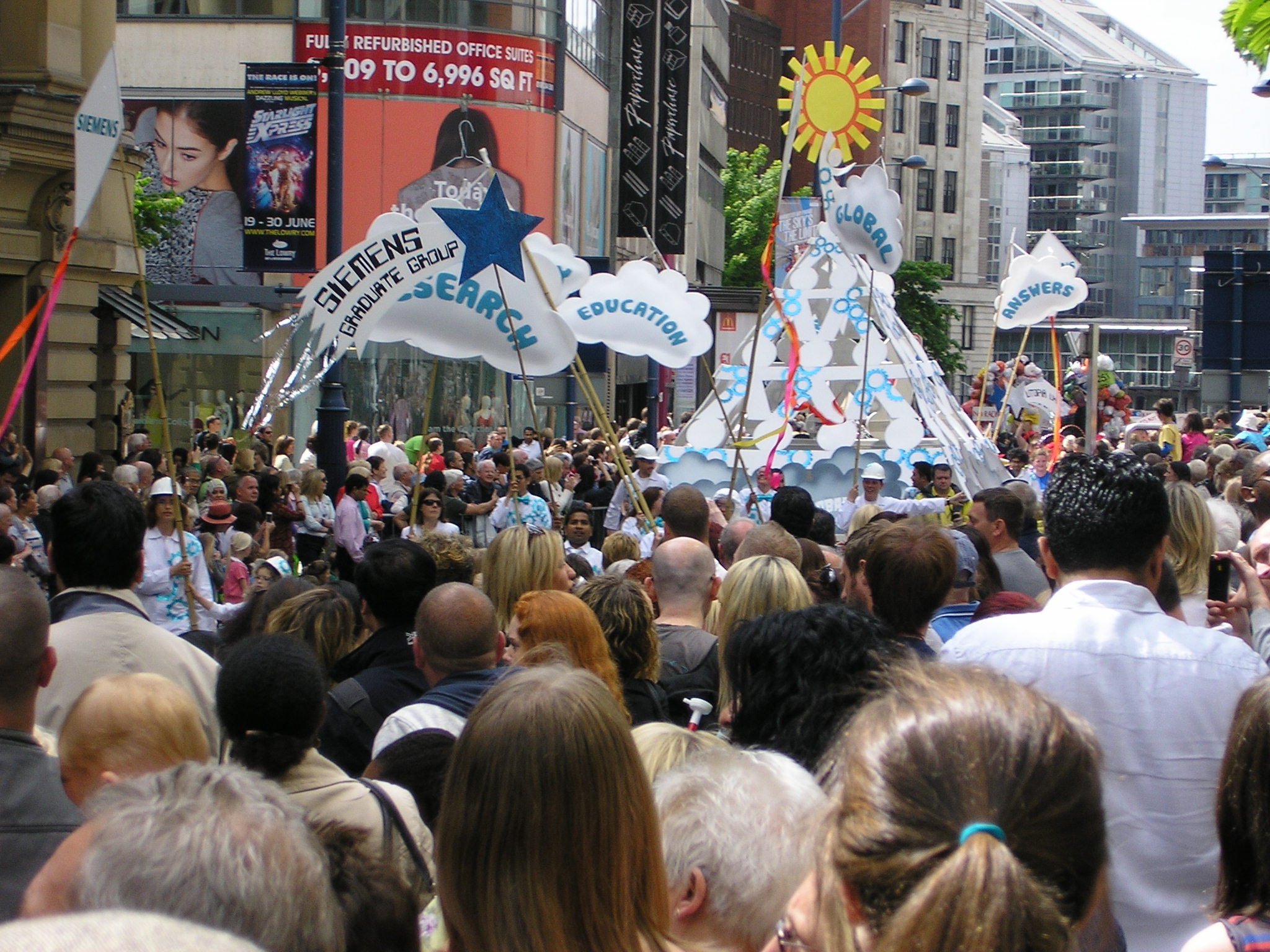
I went to the event itself. The closest we got to an acknowledgement that the species is heading for some very very interesting times is the float of a private engineering company. The MEN pullout says “Siemens’ vision for a better world is embodied in their pyramid of people, reaching for the skies in their efforts to find solutions to some of the most challenging global problems…” And there are lots of nice warm words, but no “climate” or “profit motive” or “Jevons Paradox” or anything that would spoil the mood.

There was also another float on a similar theme – the (unintentionally) semi-nightmarish vision of futuristic skyscrapers sitting atop a mat of greenery and carried along by workers with cogs in their helmets. It’s the work of East Manchester Academy, with support from Lend Lease and Laing O’Rourke. It’s as if it’s been designed James “second contradiction of capitalism” O’Connor after he had watched Fritz Lang’s Metropolis on a continuous loop while tripping on bad acid.

Then there’s the Concorde, and the rather sinister air hostess (see below), but I am beginning to digress…

My point is this; Civic boosterism is what Manchester does very very well. What I want to know is how the complete and utter silence about climate change in this parade contributes towards the second goal of the Manchester Climate Change Action Plan, agreed in November 2009. You know, the second goal that you hear sooo much about these days (1) from the Council and its stab-vest known as “the Steering Group”. This one;

To engage all individuals, neighbourhoods and organisations in Manchester in a process of cultural change that embeds ‘low-carbon thinking’ into the lifestyles and operations of the city.

I’m not being funny, but I really really don’t think we are going to get there if we keep staging events like today’s.

What needs to happen is this; Richard, Pat, Nigel, Steve and some other people will have to sit down together. And Richard will have to scratch his head, clear his throat, and say;

“Hmm. This climate change thing. Putting the Council to one side for a minute, as a city we simply cannot go on pretending that we are on the way to hitting any of those pesky targets we set for ourselves in 2009… We’re gonna have to make it mandatory for all sponsors and participating organisations in next year’s parade to both endorse the Climate Change Action Plan AND produce their own implementation plan. And the two goals of the Action Plan will have to go in all the publicity(2). And we will have to name and shame organisations that don’t sign up.”

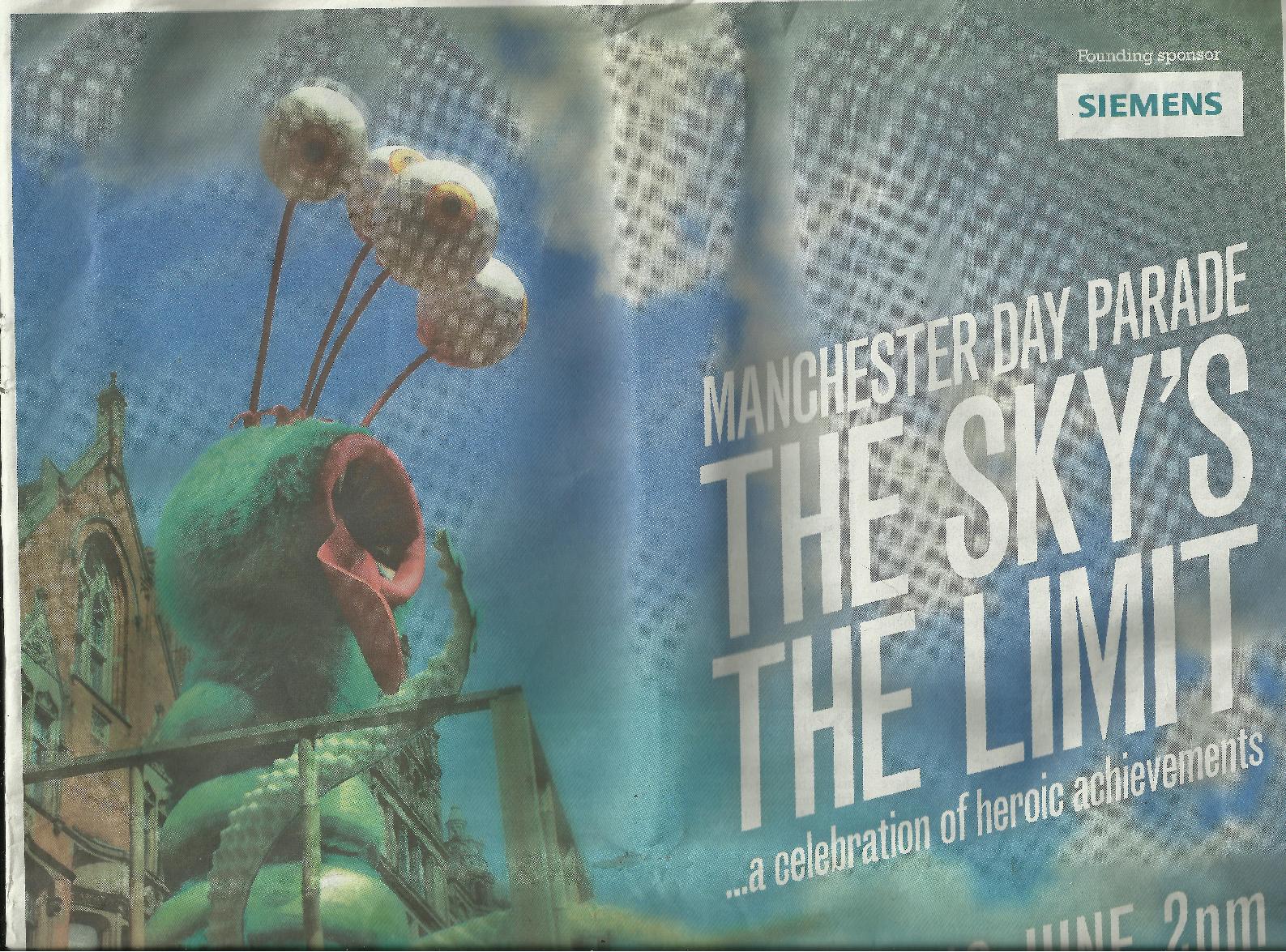
And one of the others could perhaps pitch in with “Great idea, Rich! And maybe we could re-use all the banners from this year, with a little change from “The Sky’s the Limit” to “The sky is limited.” We could dump the ‘heroic achievements’ tagline for ‘from carbon literacy to carbon capability.‘”

Don’t go holding your breath.

Marc Hudson, who understands that talking about climate change is not conducive to the “no limits” sort of mood that the current model of ‘prosperity’ relies on (inward investment, sustainability fix, blah blah blah) but thinks that sooner or later we are going to have to stop pretending that technology will solve all our problems.And who wants to emphasise that he respects the huge amount of work that many people did, especially the volunteers, to make this event happen. 

mcmonthly@gmail.com

(1) The Council has form when it comes to ignoring its own Action Plan.

(2) Oh, and the Manchester Evening News could check its editorials and see if it might want to reprint the one from 2006 “Going Green must be our top priority.”  We’ve totally helpfully scanned it here.

Cargo cult, much?
OK, disclaimers first. I am not beating up on the kids who put the work into the paper-mache Concorde. I’m not even beating up on the people who put voluntary labour into the thing.  But really – we should celebrate a state-run vanity project that kept the aerospace industry going while shaving a few hours of celebrities’ time-budgets and burning gazillions of tonnes of carbon dioxide at 60,000ft?  Really?  The creation of imitations of technological wonders that have gone and won’t come back; isn’t that something we laugh at “primitive savages” for doing?  No, wait…

And while I am busy making friends. What’s with that thing on the publicity for the parade?  It has a green coating, but if you look closely at where it gets its energy, it’s all red and fangy. Big eyes looking everywhere for enemies and snacks, and tentacles reaching out to devour anything it can get hold of. But enough about Manchester City Council – clock the weird shapeless thing!

Posted in Aviation, Business, Climate Change Action Plan, education, Manchester City Council | Tagged , , , | 1 Comment

Danger-ous amounts of cycling to be done!

Lucy Danger, CEO of Emerge Recycling, kindly chaired the pre-election debate MCFly hosted in April.  She’s doing a loooong  bike ride, and one of the Emerge volunteers has written a blog post about where and why. We’re cross-posting it below…


Once upon a time, there was a lady called Lucy.

A social entrepreneur, Lucy pioneered multi-material recycling in Manchester and officially became a superhero in 1996, when she set up the celebrated environmental and waste management enterprise EMERGE (East Manchester Environment and Resources Group). She needed a superhero name, but luckily her full name was Lucy Danger anyway; probably the best superhero name in history. It was just meant to be.

This July, Lucy Danger is using her annual leave (her annual leave) to cycle the length of the country, from Land’s End to John O’Groats – some 900 miles – in aid of FareShare North West.

EMERGE set up FareShare North West in 2008. It’s part of the FareShare national network, which helps people in food poverty by distributing surplus food products that would otherwise be thrown away. Over 4 million people in the UK lack access to adequate meals, while the rest of us chuck out over 8 million tonnes of perfectly good grub every year. It’s just silly. It’s amazingly, horrifyingly silly. And it needs to change. So far, FareShare NW have provided over 2 million meals to 60 local organisations, with around 2000 people depending on their good work. The environment also gets a helping hand: last year they saved about 180 tonnes of food from landfill.

Lucy is a true superhero. But even superheroes need help, and Lucy needs donations to reach her £9000 target. This will help put a new distribution van on the road, meaning next year FareShare NW can double their output!

Help Lucy and we don’t just help the environment, we help those who really need it.

You can learn more and support Lucy by donating here. She’s also looking for corporate sponsors who will benefit from an attractive PR package (contact me – laurence_adams@live.co.uk – or Lucy directly – lucy@emergemanchester.co.uk – to discuss this opportunity). You’ll be able to read about her gruelling journey both here and on EMERGE’s own blog.

Posted in hustings | Tagged , , | Leave a comment

Something for the Weekend 8 June 2012 #Manchester #Climate

To get your weekend off to a start- a bad joke.

What does a clock do when it’s hungry? It goes back four seconds.

And this weekend…

Well, there’s nothing much on that we know about. So if you know of weekend events that are about “climate” (and that includes food growing, or cycling or whatever), then let us know and we can include them in future “Something for the Weekend”s…

And if you know any jokes of the high standard we’ve used so far, please submit ’em.

Posted in Something for the Weekend | Leave a comment

Book Review: Occupy World Street

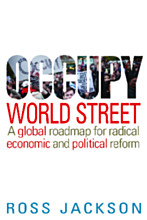
Occupy World Street: A global roadmap for radical economic and political reform
Ross Jackson
Green Books
2012
336 pages

Don’t judge a book by its… title. This book was surely completed before the “Occupy” movement burst onto the world’s television screens and twitter feeds, to incomprehension, consternation, condemnation and condescension from mainstream media. This book is not (and does not claim to be) an assessment of the strengths, weaknesses and trajectories of the Occupy ‘movement.’ Of course, that doesn’t mean the book is useless, just that you should know what you are getting.

So what are you getting? Three fifths of the book is about the mess we are in and how we got here. Then there’s a bit about how it could work, and a final bit – unconvincing to this reviewer – about what a sane global governance system would look like. The author Ross Jackson made a lot of money as a hedge fund manager/currency exchange outfit boss. This money was ploughed into the Gaia Trust, “a Danish-based foundation that supports the Gaia Ecovillage Network and Gaia Education as well as hundreds of sustainability projects in 40 countries..” So when it comes to how finance works, he knows what he is talking about.

In the first section, Jackson outlines “the Assault on Nature” – our species’ growing ecological footprint, overpopulation, global warming, mass extinctions, genetic engineering, antibiotic-resistant bacteria, endocrine disruptors, peak oil etc. He then cites Joseph Tainter’s “The Collapse of Complex Societies” to good effect.

Much of this will be familiar to readers of similar books. Jackson is far fresher in his second section “Drivers of Destruction.” His explanation of where neoliberal economics has come from is masterful, and his third section “The Empire” is downright unusual for its willingness to call US/UK imperialism what it is. The sections on the Iranian coup of 1953 is only several pages, but they are pure dynamite. Other examples of real-existing-capitalism versus democracy – Guatemala 1954, Chile 1973 – follow, and on page 157 there’s an excerpt of a CEO explaining his motivations that will have the hair on your neck standing up.

The penultimate section deals with Lovelock’s Gaia Theory (with a classy shout out to Lynn Margulis too), case studies of businesses that have learnt from natural processes, and an inspiring section to permaculture. Finally, Jackson, in what was for this reviewer the weakest section of the book, tries to re-imagine the Global Economic/Political Governance structures, with a Gaian Trade Organization replacing the WTO, a Gaian Clearing Union, Development Bank, Court of Justice and so on. There’s even, shudder, a Gaian council – a small elected council of ‘Wise elders” with the power to overrule any Congress resolution or law not deemed to be in the long-term interest of the planet, and to mediate conflicts when requested. This from the man who has just written about what happened to Mossadegh and Allende…

The strengths – he writes well, he is very very well-informed, and he has intellectual boldness and clarity. What’s not to like?

The weaknesses – Mr Jackson I think under-estimates the speed and shocks with which climate change will hit us, and the impossibly narrow window we have for reducing carbon dioxide emissions (yesterday would have been too late). A glossary would have been nice.

Though he does it well, he spends far too long spent on outlining the problems (three fifths of the book), and not enough on the nitty-gritty of how his proposed institutions might be brought into existence.

He would doubtless say that it isn’t up to him to be so specific, and would point readers to his www.occupyworldstreet.org which he wants to “serve as a focal point for dialogue, blogs, articles, establishment of working groups, coordination of local initiatives, and all manner of input.

Marc Hudson
mcmonthly@gmail.com

Posted in Book Review | Tagged , , , , , , , | Leave a comment

UniLife, Life on Earth and the priorities of homo sapiens “sapiens”

Best to get the disclaimers in first; I have nothing against UniLife (“the free magazine for The University of Manchester”). It is well-designed, well-written and has lots of useful information in it about what has been going on and what is coming up at the University of Manchester.

But…

The latest issue (Vol 9, no 8) is the usual 24 glossy full colour pages. Stuff about musicians, writers becoming professors etc etc. Listings of upcoming events.

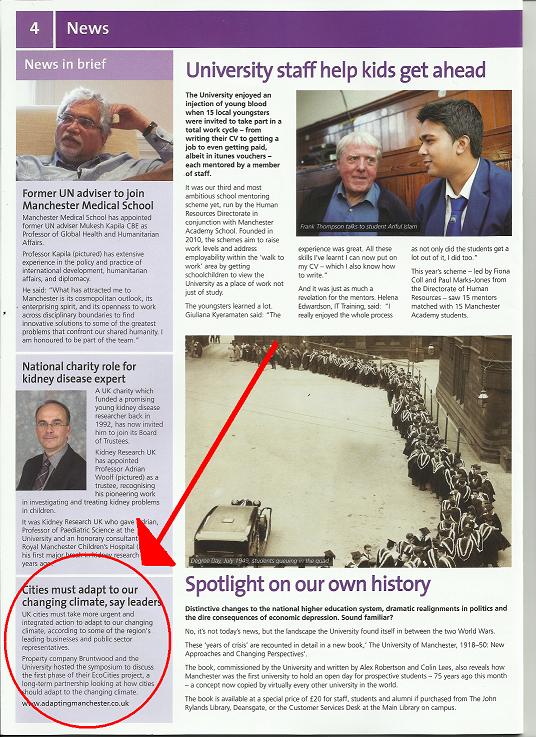
And the recent “Ecocities” event, about adapting Manchester to be ready for the shitstorm heading our way? Bottom of page 4. Two sentences.(1)

Again, nothing against the editors here. They do not, after all, set our societal agenda, but rather follow it, just as much as anyone else. Still and all, it’s revealing (and terrifying) that – even at an elite academic institution like Manchester University – the habitability of planet Earth gets the footer of page four while pretty much everything else – “A right Royal celebration” “’Biggest ever computer conference to honour Alan Turing’ and “Britain’s oldest battlefield?’ – get far more space and attention.

How far climate change has fallen in three short years. The “let’s put all our eggs in the Copenhagen basket” is beginning to look a little silly, no? The question is, what will make us all – academics, journalists, bureaucrats, capitalists and Joe and Jane Punter, wake up and smell the coffee? Answers on a post-card please…

Marc Hudson
mcmonthly@gmail.com

(1) The organisers of the Ecocities conference will no doubt be delighted with the amount of press coverage their event received – two sentences in UniLife, nowt in the Manchester Evening News [Update 7/6/12 – and this, ferretted out by a reader with Google News at his pawtips]. And of course an at-distance kicking by MCFly. On the basis of this overwhelming success, they will be surely be re-hiring the same London-based PR company for future events.

Posted in academia, Adaptation | Leave a comment

Upcoming Event: Tackling “Nature Deficit Disorder”

TACKLING NATURE DEFICIT DISORDER: EXPLORING A FREE-RANGE CHILDHOOD

Thursday14 June, 12.30pm – 5pm, Bridge 5 Mill MANCHESTER
This conference raises the debate about our how life-style choices and attitudes are changing our relationship to nature. Aimed at educators, the event will explore the impacts on young people, particularly in an urban environment, and focus on what we can do to help young people re-connect with nature/.
KEYNOTE SPEAKERS include Tim Gill, the UK’s leading thinker on childhood and author of ‘Sowing the Seeds: Reconnecting Children with Nature’ (London Sustainable Development Commission), and Bernard Spiegal, Principal of PLAYLINK who assists LA’s in the formulation and adoption of play policies and strategies. He developed and runs PLAYLINK’s risk assessment workshops, specifically for play providers.
WHY ATTEND? To explore Nature Deficit Disorder, the freedom of young people and our attitude to risk. To consider how Greater  Manchester schools and local authorities want to respond to the issues. To network school practitioners with organisations who can support the agenda. To experience best practice workshops,  formal/informal curriculum opportunities and local/regional opportunities for getting into the wild.
TO BOOK YOUR PLACE: please register at
http://www.eventbrite.com/event/3477809221_[1[1]] (£10 ticket: lunch/dinner/beverages). Spaces are limited. If you require an invoice, please first register online and then email “office@meen.org.uk <mailto:office@meen.org.uk>” (add “MEEN Summer Conference 2012: Invoice” in the subject line).
TO BOOK A STALL: organisations providing appropriate ‘outdoor’ learning or play opportunities for schools may request a stall (limited spaces). To enquire about availability please email office@meen.co.uk <mailto:office@meen.co.uk> (add “NDD Conference Stall” in subject field).
Posted in Upcoming Events | Tagged , , , , , | Leave a comment