The growing wave of climate protest continued in Manchester on Friday 16 November, when 15 people from across the area gathered in St. Peters Square near Manchester Town Hall. They were inspired by the example of 15 year old Swedish schoolgirl Greta Thornberg, who has been on ‘school strike’ for the past 13 Fridays. She has stood outside the Parliament in Stockholm with signs calling on politicians to take climate change seriously.
People from Salford, Stockport and beyond joined Mancunians at the good-natured protest, from 12 noon until 2pm, with banners, placards and leaflets. They engaged passers-by in conversation about the imminent threat posed by climate change.
One organiser Allan Challenger said. “All over the world these Friday protests are spreading. This has been the biggest one so far in Manchester. Scientists have told us we need to reduce our carbon dioxide emissions drastically, starting now. That will only happen if people come together to force governments and companies to do the right thing.
“We will be here in St Peters Square every Friday from 12 noon. People who care about climate change, or want to learn more, are welcome to join us.”
So, the Greta Thunberg thing is continuing. Thunberg is the 15 year-old Swedish schoolgirl who, every Friday, is on ‘school strike’ for the totally incomprehensible reason that she thinks the “adults” have been screwing up the planet and show no signs of stopping, so why should she study and prepare for a future that might be a lot more nasty brutish and short than she’s been told. I know, crazy, huh?
There are moves to come out in sympathy (replicate the repertoire), and I went to one such thing here in Manchester today. While I am cautious about the whole ‘children will have to save us’ thing, there is surely an opportunity here for climate activists here. Thus I have Fridays on my mind.
However, if we’re not careful and clever, it’s one we will probably screw up or allow to be screwed up for us. Again.
So, this blog of unsolicited advice is about the things that we could (and, to be ‘normative’) should do. I go into as little detail as is sensible about the why and how for each of those as I think. Then I turn to things that could go wrong (and what we could – okay – should do about them, before, during or after they happen). Comments welcome.
The very first thing organisers and dedicated supporters of the organisers need to do is ask “Why are we doing this?” No, seriously. In a detailed way, beyond “why not?” or to answer the infantile “well, what are YOU doing?” question from brittle idiots on Twitter.
To get out of the house on a Friday because there’s nowt on the idiot box?
To meet some new people?
To virtue signal?
To recruit for my tedious vanguardist groupuscule
To keep the gnawing horror of the imminent and probably inevitable collapse of everything you hold dear and the grisly excruciating death of your loved ones at bay.
To build a movement of people that might be able to soften the blows
To sell newspapers
To keep getting paid by your corporate/state paymasters by derailing the process
To identify the ones who can be co-opted, those who will have to be dealt with in, ah, different ways.
To learn new skills
Some/all of the above
Something else?
And of course, these motivations shift over time, as new opportunities/problems show themselves.
Things you could do, what skills you would need, and why you might (not) want to do them
Take photos and put them online
Pros- Gives us permanent record, shows people not there that something is indeed happening. “Raises profile” (and perhaps morale?
Cons – some people don’t want their photo took. We’re doing the state’s work for it. We’re so busy taking self-regarding photos that we don’t engage the people watching, who think it’s a wedding/cult/weird self-regarding thing
Live tweet from the event
Pros – raises profile of event
Cons – might attract trolls, who are not to be fed. Takes you away from ‘the moment’, so perhaps only do it for a few minutes, or have tag team tweeting.
Make video interviews of willing participants and put online
Pros – raises profile, gets people into habit of making films, being interviewed
Cons – can be time consuming. Opportunity for ‘capture’ of the brand of gatherings by trots/randoms (life is too short to worry much about this though).
Have an expectation that people will meet others (build those Granovettian loose connections)
Pros – actually builds those
Cons – can seem weird and culty. Also, some people are introverts, and won’t necessarily appreciate being forced to chat with strangers.
Have an opportunity for people to do (time limited!) public speaking
Pros – great for giving people a ‘toe in the water’ opportunity for public speaking
Cons – can get captured by trots and other de-railers. (ergo have time limit that is crowd-enforced via the clap clinic method)
Writing up a blog post after each protest, by different people
Pros- keeps a permanent record/profile. Gives an experienced blogger/writer a chance to do some brief mentoring/support of a less experienced writer.
Cons- time, availability
Rituals that might work
This is a new social practice, and in the early weeks, it might be possible to create some healthy ‘normal’ things…
Read out messages of support form people who can’t be there
Pros -Will raise morale (esp if small turn out)
Cons- Makes it easier for people to feel they’ve ‘done their bit’ without actually, erm, coming
Read out climate impact from different parts of the world
Pros- Informs people of latest news.
Cons- depressing (and people know – they wouldn’t be coming if they weren’t mildly terrified)
If people staying for a shorter time, have them ‘thanked’ en masse as they leave
Pros- raises morale perhaps?
Cons – can get cult-y (this idea comes from a mass arrest of anti-nuclear activists in California in the 1980s. They were all held for days. Some had to leave (work etc), and the slow diminution of numbers could have lowered morale – the suspicion is that the state was allowing some to leave for precisely this reason. So a ‘leaving’ ritual was invented. Morale was sustained.) Probably not necessary for a short meeting.
Formal close to the event, with something ‘upbeat’ (see peak-end effect)
Pros- Tells people when it’s over and they have “permission” to go
Cons- How to enforce? Capturable/disruptable
Things organisers need to think about in general
How to deal with inevitable plateauing of numbers (it’s a work day, so there is a limited pool of candidates, who won’t come very week.
What are the skills that would go into making this successful, at what level they are needed, and how distributed they are. (See separate blog post about this, coming soon).
Who else would be able to step in to the organiser role if you step down, step in front of a bus, turn out to be a police spy?
Be clear what you’re going to do about Friday December 21 and Friday December 28…
What are the reasons you might call a halt to the Fridays?
Things that could go wrong, and what might be done about them.
(in no particular order of likelihood or severity. Actual circumstances may vary. Always read the label).
Dickheads with megaphones
Have and enforce a no megaphones rule (dickheads can’t, sadly, be legislated against), including the organisers’ mates.
Dickheads with newspapers to sell
See above
Dixon of Dock Green
Police with cameras that have lenses longer than a list of all the undercovers who have abused women, abused trust and undermined democracy, who are at first in the background and if the protests continue and grow will start talking about ‘public order situations’ and ‘need to protect xyz. What is your name’ etc.
Counter-protestors/trolling/doxxing
Unlikely, at present. Most climate denialists are rich geriatric males who won’t be up for coming out to be outnumbered and outthought.
Issue creep/capture
Attempts by various groups to turn the regular meetings into recruitment opportunities for their own specific subsets of the (climate) problem, each of which is likely to be worthy and urgent, but if indulged fully would probably kill the protests.
Yeah, the organisers need to have the moral authority and guts to say ‘no’ to individuals and groups wanting to do this. That authority comes partly from leading by example, by not granting favours to groups they are involved in.
Media smears/hit-jobs
Unlikely in the short term, but you’ll get called rent-a-mob probably (though the Daily Mail is under a new editor who isn’t a complete climate lunatic, so who knows). How to deal with it? Putting out own media etc, I suppose. This one is a hardy perennial.
Boredom
Coming and standing around for two hours every week while the world burns, sorry, turns, eventually loses its novelty value. The way to keep it fresh, I think, is to have explicit opportunities for people to learn new skills, new useful facts, meet new people. You might even therefore have the occasional training session/meet-up after the gathering.
Weather (Winter is coming) On particularly cold, wet and miserable days, have cake and coffee available? An army marches on its stomach.
If it becomes huge and there unwieldy…
Oh, for us to have such problems…
Final thoughts
In a nutshell – and I know it is difficult, it goes against how we’ve been taught, how we’ve been working and perhaps against our brains’ architectures, but we have to try to
Think systems, not individuals (what the people of colour keep telling would-be white allies – stop centering yourselves).
Think processes not one-off events/series of one-off events (beyond the emotathons).
Think dialectically (how things might unfold, what the internal tensions are etc).
Most of all, make a distinction between mobilising and movement building.
How, specifically, is this “building a movement”? What are the metrics? What does success look like after 6 weeks? 6 months? A year?
In these efforts we will surely fail, often. We will need to be compassionate with ourselves and each other, but also insistent on coming back, doing it better next time, or as soon as we can…
Councillor Angeliki Stogia, the Executive Member for the Environment of Manchester City Council, has stated baldly that cancelling the quarterly climate reports was the right decision. It sends, she says, the right message about how seriously Manchester City Council takes climate change. No, you read that right. It’s not a typo, or a misrepresentation. And we’ve got the tweet (screengrabbed below) to prove it.
The quarterly climate reports were started in 2014, after pressure and lobbying from a small group of environmentalists. They were a supplement to the existing annual reports, which often received limited scrutiny and did not enable councillors to see if things were ‘on track’ or not throughout the year. In May this year, Cllr Stogia cancelled the reports, which were being presented to the Neighbourhoods and Environment Scrutiny Committee.
Curiously, there are two competing explanations for the cancellation. Councillor Stogia announced repeatedly that they were cancelled because not all data could be collected in a timely manner.
Manchester Climate Monthly had previously submitted a Freedom of Information Act request to see all the correspondence relating to this. The evidence we were sent had nothing to do with inaccurate/incomplete data, but rather a conversation about how many times the quarterly reports were being downloaded.
The reply, received on 8th November, read in part
The decision to stop producing the quarterly Climate Change Action Plan reports was made on 30 th May 2018. Preceding this, the Executive Member for the Environment was provided with information regarding the number of ‘hits’ the quarterly reports on the Manchester City Council website had received. Email correspondence between David Houliston and the Executive Member is enclosed.
b. Secondly, please provide any evidence that alternatives to abolishing
quarterly plans was considered: e.g. quarterly plans without all the data
or six monthly reports. None applicable. An annual carbon emission report is already produced and published on the council website.
Last Thursday we emailed Councillor Stogia the following three questions.
Dear Councillor Stogia,
I have just received the result of a Freedom of Information Act request about your decision to abolish quarterly climate action plans to the NESC.
I am writing to you for a statement (for publication) about this decision.
1. In light of the recent IPCC report about the need to take radical action to keep global warming below 1.5 degrees, do you think that abolishing the quarterly reports was a good decision?
2. Does it sent the right message about how seriously the council takes the issue?
3. Were alternatives to abolishing quarterly plans was considered: e.g. quarterly plans without all the data or six monthly reports. The FOIA suggests not. Is that accurate?
Many thanks in anticipation of your reply
There was no reply. So that email was screengrabbed and tweeted with Councillor Stogia’s twitter handle. Despite being retweeted by other people, and a further tweet, still no reply.
This morning I sent another tweet (from my personal account). This time, with no explanation or apology for the week’s delay in answering three simply questions, I got this reply
The answer is yes to all the questions you asked Mark
As indicated in the above exchange, a further Freedom of Information Act request has been sent, to try to find ANY documentation relating to this decision. It is now being handled as an “internal review”, with the answers due on 7th December.
Perhaps the Manchester Evening News, in stead of essentially reprinting press releases, might like to follow up on this? Yeah, right.
And the result of a Freedom of Information Act request about the good councillor’s ‘carbon literacy’ status has just come through. ‘Carbon literacy’ is a day (sic) -long program of teaching and reflecting, led by highly Accredited Trainers, that fills the information deficit which is the ONLY thing standing between us and the eco-utopia. So effective is carbon literacy training that one Greater Manchester MP who took it, when faced with the dilemma of voting for Heathrow expansion or not, managed to vote… yes. But I digress.
Here’s some fun facts from the FoIA, followed by the whole reply (which is full, of course, of attempted spin and promises of imminent action (I mean, it’s only 5 years since carbon literacy was launched onto an undeserving world. And it’s not as if climate change is an emergency or anything, or that our lords and masters should be leading by example, is it?)
How many elected members of the current Executive (including Cllr Ganotis) have completed the ‘Carbon Literacy’ Training offered by Cooler Projects.
None of them
How many officers who make up the Senior/Strategic Management team have have completed the ‘Carbon Literacy’ Training offered by Cooler Projects.
None of them
How much money has Stockport Council spent in the last two years on providing the ‘Carbon Literacy’ training to its members and officers (at any level).
Zilch. Nada. Not a penny.
Here, with added attempted spin,, sorry, “facts” is the full response.
How many officers who make up the Senior/Strategic Management team have completed the ‘Carbon Literacy’ Training offered by Cooler Projects.
Senior Stockport Officers are scheduled to attend the current round of Carbon literacy Training `Leading A Carbon Neutral Greater Manchester’ for Leaders. These include Stockport’s Borough Treasurer and the Accountable Officer to NHS Stockport Clinical Commissioning Group.
How many elected members of the current Executive (including Cllr Ganotis) have completed the ‘Carbon Literacy’ Training offered by Cooler Projects.
There are no current Members of the Stockport MBC Executive which have fully completed Carbon Literacy Training courses through Cooler Projects. However, Cllr Ganotis has attended the most recent training course round in the capacity of `Leader listener’ in order to gather feedback created as a result of the first workshop.
Cllr Ganotis has been instrumental in organising, promoting and participating in this series of Carbon Literacy training sessions for senior GM leaders. This includes a central role setting up the current `Leading A Carbon Neutral Greater Manchester’ Carbon Literacy Training for GM Leaders, and encouraging political leads and senior officers from across Greater Manchester to attend.
In consequence, around 50 Council Leaders, Chief Executives, Chief Finance Officers and Executive Directors from across Greater Manchester’s public services have accepted invitations to attend one of three training sessions scheduled over the next few weeks.
How much money has Stockport Council spent in the last two years on providing the ‘Carbon Literacy’ training to its members and officers (at any level).
Stockport Council is not aware of any Council resources used over the last two years in the provision of Carbon Literacy Training to its Members and Officers, through its Member training budget or otherwise.
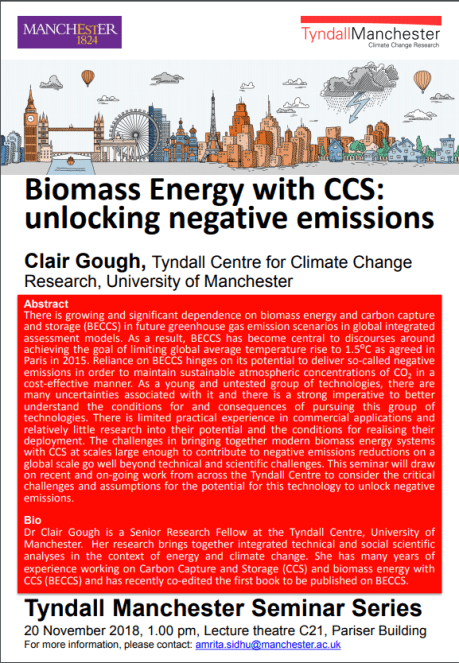
Next Tuesday, 20th November, Dr Clair Gough of the Tyndall Centre Manchester is giving a seminar about Biomass
Energy with CCS: unlocking negative emissions.
It’s free to attend, no need to book. Dr Gough kindly answered some questions about BECCS – see full unedited interview below. Questions in bold.
The basic idea of capturing and ‘storing’ carbon dioxide has been around since the 1970s. Other than a couple of super-expensive ‘demonstration’ projects (Boundary Dam etc), what actual proof is there that it could ‘work’ at scale?
These technologies have been more than an idea since the 70s, the component technologies have been in commercial use for several decades. As you say, there are several (around 20) large scale demonstration projects for CCS in operation, but the only way to “prove” it on a larger scale now is by increasing its use. That would be the same for any technology
In a nutshell, what is BECCS?
BECCS stands for biomass energy with carbon capture and storage.
Biomass (i.e. plants) take up carbon dioxide from the atmosphere via photosynthesis; if the biomass is burnt in an energy conversion facility (such as a power station) that carbon dioxide is released back to atmosphere.
Carbon capture and storage (CCS) was originally designed in the context of fossil fuels – by capturing the carbon dioxide normally released in flue gases during fossil fuel combustion (for example in a power station), then by compressing, transporting and storing that CO2, it can be prevented from being emitted to the atmosphere. The CO2 is stored in geological formations very deep underground; potential storage sites in the UK are all offshore – 100s meters below the seabed.
By combing biomass energy with CCS (BECCS) the CO2 taken up from the atmosphere by the biomass is captured and stored. If the amount captured and stored is greater than any emissions along the supply chain, more CO2 is removed from the atmosphere than is emitted and there is a net removal of CO2 from the atmosphere. This is sometimes called negative emissions.
A lot of people criticise BECCS as an unworkable/fantasy technology that distracts us from the urgent task of immediate mitigation. What’s your take on that?
Technically, there is no reason why BECCS should not work; there is widespread use of biomass energy in large scale facilities (such as Drax power station for example) and CCS is technically well-understood and has been demonstrated to work.
Furthermore, for BECCS to deliver net negative emissions on a global scale, such that atmospheric concentration of CO2 is reduced, would require ambitious mitigation – emissions will only be ‘global net negative’ when the negative emissions from BECCS are greater than all the emissions from other sources. It is not an alternative to mitigation, it can only work with mitigation.
The issue is one of scale.
Firstly, given the current lack of progress in delivering ambitious/radical mitigation (emissions reduction) many scenarios include an extremely large scale contribution from BECCS – the technology may have a role but its potential should not be overestimated.
Secondly, there are very many non-technical challenges to implementing BECCS on a global scale that become more challenging as the scale increases – I will discuss these in my forthcoming seminar at the Tyndall Centre.
So, yes, there are some very optimistic claims made about the potential for BECCS. However, even with the best efforts to reduce emissions elsewhere, there will remain some sectors which are very difficult to decarbonise (aviation, for example) – if BECCS can contribute by effectively removing the emissions from these sectors it could make an important contribution to realising the climate goals agreed in Paris.
Anything else you’d like to say?
Come to the talk and I will explain these issues in more depth!
Facebook event here, if you want to give your details to GCHQ directly rather than indirectly.
From 11.30 to 1.30, Friday 16th November
A peaceful and quiet gathering to protest our ‘leaders’ lack of action or urgency in the face of climate breakdown.
Part of the ‘Fridays for the Future’ movement, supporting and acknowledging school children around the globe who are disrupting their education for their planet.
All very informal as I’ve never organised anything like this before!
MEET ON THE STEPS AT THE REAR OF THE TOWN HALL AT 12PM (OPPOSITE WAR MEMORIAL)
Children welcome and we will make any language used in relation to the protest age appropriate 🙂
1. So, yet another Carbon Coop junket to Europe. What was THIS one about?
Yes, all land based travel of course!
This is mPower, a four year EU Horizon 2020 project facilitating peer
learning between municipalities with energy transition expertise ie
renewable generation, energy efficiency, new financing mechanisms and
smart grids.
But the particular emphasis of the project is on identifying and
promoting projects with citizen and worker involvement.
It’s exciting because cities are the exact scale at which new energy
system innovation can take place and you have a number of municipalities
taking a radical approach to involving citizens such as Barcelona,
Naples, Paris and Grenoble.
The Municipalize Europe event took place at the European Parliament and
was organised by ‘Barcelona en Camu’ and Corporate Observatory Europe
with the aim of sharing expertise between like-minded local authorities.
It also served as an official launch for mPower and we are currently
recruiting municipalities with a short survey that can be completed
here: http://municipalpower.org/get-involved/
2. What happened that surprised you/exceeded expectations? Any top tips on how to organise events that make it easier for ‘lucky’ connections to form?
I think the whole event surprised me as I’ve never attended anything at
the European Parliament and it’s a fascinating place, a hive of activity
with politicians, MEPs, Commission staff, NGOs and lobbyists buzzing
around.
It was also interesting to hear from radical politicians from around the
EU and to hear about their local struggles and how they see working
together as a way to push a more radical agenda on a European scale.
I’m afraid I wasn’t part of the organising and I don’t have much of a
comparison to other EU Parliament events – it was fairly staid, with a
panel and an audience within an auditorium, but I get a sense that
organising anything more participatory in the Parliament might be
challenging due to the constraints of space and security. It was great
that they had translators in the room as it really helped facilitate
dialogue between people from different countries.
3. How will you be taking the things you learnt/relationships you formed/strengthened into your work here in Manchester?
I got a real sense that the issues municipalities face in the UK are the
same as those faced across Europe including housing shortages, the
democratic deficit, corporate capture of procurement, failing services,
transport and air pollution issues and facing the challenge of climate
change.
I feel that there are new, radical models of citizen engagement emerging
around Europe that we can explore here – whether they be
Green/Left/Social Democratic/Community based. And there are also clearly
some really interesting ideas are re-municipalisation of services.
I’m not sure what this means in a Manchester context – my sense is that
we need political and citizen pressure from below to ensure more radical
ideas are translated in to policy and delivery.
4. What are the big challenges for Carbon Coop in the coming year? How and when can people get involved? Why should they?
We have a few projects coming up – watch this space, or more accurately our website and social media channels.
Tuesday 20th November (room C21, Pariser Building, Sackville Street) at 1.00pm.
Biomass Energy with CCS: unlocking negative emissions
Dr Clair Gough, Tyndall Centre, University of Manchester
There is growing and significant dependence on biomass energy and carbon capture and storage (BECCS) in future greenhouse gas emission scenarios in global integrated assessment models. As a result, BECCS has become central to discourses around achieving the goal of limiting global average temperature rise to 1.5⁰C as agreed in Paris in 2015. Reliance on BECCS hinges on its potential to deliver so-called negative emissions in order to maintain sustainable atmospheric concentrations of CO2 in a cost-effective manner. As a young and untested group of technologies, there are many uncertainties associated with it and there is a strong imperative to better understand the conditions for and consequences of pursuing this group of technologies. There is limited practical experience in commercial applications and relatively little research into their potential and the conditions for realising their deployment. The challenges in bringing together modern biomass energy systems with CCS at scales large enough to contribute to negative emissions reductions on a global scale go well beyond technical and scientific challenges. This seminar will draw on recent and on-going work from across the Tyndall Centre to consider the critical challenges and assumptions for the potential for this technology to unlock negative emissions.
It’s groundhog day again. Every two or three years another glossy document full of horseshit is waved through a “scrutiny” committee on its way to Manchester City Council’s Executive. You can (in theory, if you want reasons to kill yourself) read the latest example here, starting page 55.
There was a time I’d have read it, taken it seriously, asked others to take it seriously. There was even a time I’d have lobbied the members of the Neighbourhoods Scrutiny Committee (now renamed ‘Neighbourhoods and Environment “Scrutiny” Committee’, fooling precisely no-one.
There was a time I’d have gone to the meeting itself, encouraged others to come, to ask questions, to try to do the role that almost of the councillors on the committee were unwilling or unable to do.
Those days are gone.
There has been too much drivel, too much glossy horseshit from too many too well-paid people, who know in their hearts that what they are doing is wrong, but do it anyway.
There have been too many outright lies, too many broken promises (that were never meant to be kept). Too much secrecy, too much chicanery, too much flat out incompetence.
This puerile putrid document is not worth anyone’s time.Nowhere in it will you learn that the first body set up to deal with climate change, the so-called ‘Steering Group’ was supposed to hold day long-annual conferences, that it was supposed to have elections. It held one day-long stakeholder conference (in 2010), was too incompetent to do anything in 2011, and had half-day conferences in 2012 and 2013, before unilaterally killing it off. Elections were promised, never held. The people responsible for those failures are still running the shitshow, of course. Failure in Manchester, as long as it doesn’t embarrass a few key people, is rewarded.
Nowhere will you learn that all councillors were supposed to have undergone the (laughable) ‘carbon literacy’ training by 2014, that everyone who lived worked or studied in Manchester was supposed to have had that training by the end of 2013.
Nowhere will you learn that the Council was supposed to have started reporting its carbon emissions on a consumption-based metric by 2013. They didn’t (perhaps because they would destroy the lie about emissions reduction.)
The airport can’t be ignored altogether, but they punt the responsibility for it to central government (I wonder if they’d be so willing to do that if all the profits from the airport went there too? Not so much).
Most of all, the term “low carbon culture” is of course entirely absent. That was goal two of the original plan – it’s worth repeating.
“To engage all individuals, neighbourhoods and organisations in Manchester in a process of cultural change that embeds ‘low carbon thinking’ into the lifestyles and operations of the city.” (There’s more, read the whole thing here).
Instead, it’s the same old interchangeable guff, that’s harmless except it gives the impression that something is being done, when in truth virtually nothing is.
For the fifty-gazillionth time there is going to be a “pledge” proposal… Well, it provides contracts for whoever produces the flyers, and gives scribblers something to write about. That’s about it.
The vast majority of the cuts in emissions claimed – for the City Council – come from the selling off of buildings (though try getting baseline data out of the council, hah!). That the emissions “reductions” at a city level come from partial decarbonisation of the electricty grid and improved energy efficiency in our gadgets. That’s nationwide, but Manchester merrily claims credit for the reduction anyway.
The people who produce this crap should hang their heads in shame (perhaps they do, when they realise what their children would think of them, if they knew the truth). The people who wave it through, giving it the rubberstamp of democracy – and by this I mean the elected councillors and the ‘official’ green figleaf (aka Manchester Friends of the Earth) are too scared of Richard Leese’s displeasure to even cough adversely. Meanwhile, the Green Party – whatever happened to them – and the “activists” are revolting, sorry, “rebelling” in Piccadilly Gardens.
Our problem is not the denialists. This is not Trump’s America. Our problem is that Manchester is a de facto one party state, and the party in charge can mouth a piety or two about climate change if it has to, but has no plan, no clue and no desire to do anything concrete. And it has enough people willing to go along with that, for reasons of career, mortgage or ideology, that nothing ever changes.
Care about improving local democracy, citizen participation, and how decisions are made by local government? Do you have insights into what is already working well, or what the challenges are? Then this event is for you.
We’re looking to pull together people from right across the landscape of local democracy – including citizens, community and voluntary sector organisations, elected representatives, those who work within local authorities, and those who work in democracy and tech – to help inform the beginnings of the Public Square programme and influence the direction we take.
Public Square is a collaboration between The Democratic Society and mySociety, and is funded by Luminate. Over the next two years, we’ll be running a programme of research and action to push forward participation in local government across the UK. We will be working closely with councils, communities and citizens across the country to learn what’s needed to take participation further, and we’ll be prototyping openly available tools, techniques and approaches to fill these needs – building upon what already exists as far as possible.
We know there are already loads of people interested in the broad topic of local democracy, and trying to increase participation in local governments and decision-making in many different ways. We want the work we do to be informed by the expertise and insights already out there – and that’s the purpose of this event. We’ll be asking attendees to share good examples of what’s already going on, and working together explore the challenges that remain and what is needed to make participation easier and more meaningful.
So join us – and lets work together to improve citizen participation in local democracy.
We want this event to accessible to all. We are able to support the costs of a number of individuals and small organisations to attend, so if you need help with the costs involved in order to take part, or if you have accessibility needs that we should be aware of, please contact us at team@thepublicsquare.org.uk.
Our "leaders" are going to keep making empty promises. It makes them feel good. It gets the activists to act like zombie kittens. If you want to have some self-respect and perhaps make a difference (actual facts may vary), then find a functioning group that cares about your skills and knowledge - what you have, what you want.
One useful group might be www.climateemergencymanchester.net - you can email them on contact@climateemergencymanchester.net

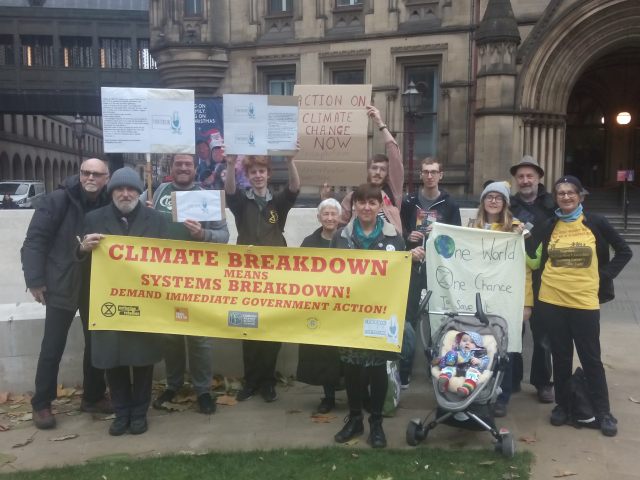 The growing wave of climate protest continued in Manchester on Friday 16 November, when 15 people from across the area gathered in St. Peters Square near Manchester Town Hall. They were inspired by the example of 15 year old Swedish schoolgirl Greta Thornberg, who has been on ‘school strike’ for the past 13 Fridays. She has stood outside the Parliament in Stockholm with signs calling on politicians to take climate change seriously.
 On particularly cold, wet and miserable days, have cake and coffee available? An army marches on its stomach.

 Next Tuesday, 20th November,
  , if you want to give your details to GCHQ directly rather than indirectly.
 Tuesday 20th November (room C21, Pariser Building, Sackville Street) at 1.00pm.
 Care about improving local democracy, citizen participation, and how decisions are made by local government? Do you have insights into what is already working well, or what the challenges are? Then this event is for you.


 manchester climate monthly