“Green Week” events in #Manchester 12-16 February

A few years ago the City Council’s “Green City Team” (since abolished) promised councillors on the relevant scrutiny committee that the Council would organise five events for the following year’s “Green Week”.  It organised…. none, and wouldn’t admit that, so Manchester Climate Monthly put together a Freedom of Information Act request.  This is fairly typical for the incompetents who run the City Council.  Fortunately there are still pockets of competence elsewhere in this city.  One of them, if coming first in a People and Planet league table on more than one occasion is any indication, is Manchester Metropolitan University.  Here’s an email they sent me.

Manchester Metropolitan University has once again been awarded 1st Place in the People & planet University League based on ethical & environmental performance, we are proud to be involved in their national Go Green Week.

SEEG will be supporting various events throughout the week (12th-16th February), Click here to see the full calendar of events, where you book on to numerous sessions through Eventbrite. The activities aim to educate and inspire you to take action on environmental issues such as Climate Change and plastic pollution.

Clicking “here” takes you to this list of events –

lease see activities you can get involved in below. These are open to all staff & students at Manchester Met unless stated otherwise, registeration is via Eventbrite.


CPR Training. Monday 12th February. Hourly (10am, 11am, 1pm, 2pm, 3pm) Business School Room 3.05.

Thanks to Give It, Don’t Bin It!, our student move out campaign raising money for the British Heart Foundation, the BHF are offering free CPR training for staff and students at Manchester Met. Every year 30,000 people in the UK have an out-of-hospital cardiac arrest, but the survival rate is less than 1 in 10. The BHF is on a mission to change that by creating a Nation of Lifesavers where everyone knows how to save a life. Sign up for Free CPR training today. Register for one of the sessions via Eventbrite

Film Screening: Before the Flood. Monday 12th Feb (2- 3.45pm) Business School LT G34.

If you could know the truth about the threat of climate change, would you want to know? Before the Flood, presented by National Geographic, features Leonardo DiCaprio on a journey as a United Nations Messenger of Peace, traveling to five continents and the Arctic to witness climate change first-hand. Free screening, open to all, sign up here.


Recycling Game. Monday 12th Feb (12 – 2pm) Business School.

At Manchester Met, we have committed to recycling 60% of all waste by 2020. To get there, we need your help to reduce contamination and recycle right on campus. During Go Green Week, our Sustainability Ambassadors will be around campus testing staff and students, playing our recycling game. Visit their stall, play the game, test your knowledge and receive a free sustainability –themed gift. No need to register, just visit our stand near the main entrance. 


Film Screening: A Plastic Ocean. Tuesday 13th Feb (12.30 – 1.00pm) Business School LT G34.

In the centre of the Pacific Ocean gyre our researchers found more plastic than plankton. A Plastic Ocean documents the newest science, proving how plastics, once they enter the oceans, break up into small particulates that enter the food chain where they attract toxins like a magnet. These toxins are stored in seafood’s fatty tissue, and eventually are consumed by us. Free screening, open to all, sign up here.


Robert Angus Smith Energy Centre Guided Tour. Tuesday 13th Feb (12.30 – 1.30pm) Meet at Brooks Reception.

Our Energy Centre at Birley uses Combined Heat and Power (CHP), water storage and boiler systems to provide heating and hot water to the campus. Join our guided tour to learn how our innovative technologies help us to generate our own heating, drinking water and electricity reducing costs and our carbon emissions. Open to all, sign up here


Celebration: 1st Place University League. Wednesday 14th Feb (12 – 2pm) Business School North Atrium.

This year we can again celebrate being top of the People & Planet University League. Assessed on a range of environmental and ethical factors, management practices and policies, and performance in carbon reduction, energy sources, waste and recycling, and water reduction, we have climbed from 91st position in 2007 to top of the table in 2013 and back there this year. Join us in celebrating our achievement and all the hard work that goes into being a leading sustainable university, with a locally-sourced lunch and sustainability showcase. Open to all, sign up here.


Basic Bike Maintenance. Wednesday 14th Feb (12.30 – 2.30pm) The Union, Main Hall.

Making sure your bicycle is kept in good working order is as important as your riding skills. The ‘basic’ maintenance course is a practical session led by experts. You’ll be taught how to carry out checks and repairs on your bike, keeping you safe while saving you time and money. Delivered by Transport for Greater Manchester. MMU staff & students only, sign up here


Smart Cities – Presented by Siemens & Triangulum. Wednesday 14th Feb (2 – 3.30pm) Business School G27.

How are cities going to work in the future? How does a city get its energy and reduce emissions? Find out more at this seminar from Siemens’ Global Centre of Competence for Cities & Triangulum the EU Horizon 2020 lighthouse project – looking for solutions for the city of tomorrow, developing smart urban districts. Speaker: Mark Jenkinson, Siemens. Part of the Smart Energy seminar series. Open to all, sign up here. 


Green Drinks. Wednesday 14th Feb (5pm until late) Sand Bar.

Green Drinks Manchester is an informal monthly gathering featuring guest speakers networking and opportunities for collaboration. Aimed at anyone with a passion for environmental issues. Join us for an informal drink just look out for the Green Flag!

As well as the usual informal networking this event will also give the opportunity to give your opinions about what you want from a green, zero carbon city. This will feed into Mayor of Manchester Andy Burnham’s Green Summit for Greater Manchester which aims to inform a new environmental vision for the city region. More details can be found here.


Carbon Literacy Training for Staff. Thursday 15th Feb (1 – 5pm) Business School Room 3.01.

Are you worried about climate change and want to find out ways you can act on it? Want to improve skills to live and work more sustainably? For the first time, we are offering this opportunity to staff as a trial with the hope of offering it to all University staff in the future. This session is for staff only, if you are a student interested in becoming Carbon Literate visit www.mmu.ac.uk/carbonliteracy. Staff members can register here.


Recycling Game. Friday 16th Feb. Brooks.

At Manchester Met we have committed to recycling 60% of all waste by 2020. To get there we need your help to reduce contamination and recycle right on campus. During Go Green Week, our Sustainability Ambassadors will be around campus testing staff and students, playing our recycling game. Visit their stall, play the game, test your knowledge and receive a free sustainability–themed gift. No need to register, just visit our stand near the main entrance.


Film Screening: What the health. Friday 16th Feb (2- 3.45pm) Business School LT G33.

What the Health is the ground-breaking follow-up film from the creators of the award-winning documentary Cowspiracy. The film exposes the collusion and corruption in government and big business that is costing us trillions of healthcare dollar, and keeping us sick. Open to all, register here


Posted in Upcoming Events | 1 Comment

Petition about Gas Storage (not #Manchester)

Here’s the petition

Petition: Debate effect of pumping out brine at Fleetwood on marine life and livelihoods


Here’s the details –

STOP HALITE ENERGY PUMPING OUT TOXIC BRINE AT ROSSALL, FLEETWOOD, &
DESTROYING MARINE LIFE AND LIVELIHOODS IN AND AROUND MORECAMBE BAY

Halite Energy Group has consent to pump out 19,000 tonnes of salt per day, 2.3km off the coast at Rossall, Fleetwood. Pumping will be continuous for several years, so Halite can build up to 19 underground caverns in neighbouring Preesall, to store gas. 19,000 tonnes of salt per day is a huge amount to be absorbed into a small and sensitive marine ecosystem. Local residents with expert knowledge of the sea, fisheries, marine life, and coastline have grave concerns that this will destroy our delicate marine ecology, and impact heavily on local livelihoods. Major concerns include:
Fisheries and conservation: The area is of significant fisheries and conservation interest. The Fylde Coast is a nursery area for demersal fish species such as cod, plaice, and dover sole. Seasonally, thornback ray, brill, turbot dogfish, and tope are found feeding on small shoals of pelagic species such as sprat, herring and mackerel. Shrimps are abundant along the coastal strip, with lobster and whelk found in the northern part of the area. During the summer, seals and dolphin are a common sight, and it is a mecca for bird lovers. It is not known what effect the changes in salinity will have on the Migratory Species (Salmon & Sea Trout) that pass through Morecambe
Bay in passage to our rivers.
The food chain: The toxic brine will not only affect the fish and their young, but also food webs including shrimp, lugworms, and phytoplankton. The saturated brine is very dense and will sit on the seabed if not mixed, in areas such as the Lune Deep, and could result in a ‘benthic desert’.
Fishing industry: The seas off the Fylde Coast are vital for commercial fishermen based at Fleetwood, and are valued by sea anglers both afloat and from the shore. Fisherman have said the toxic brine will be a ‘disaster’ for those who fish for cockles, mussels, bass and shrimp.
Tourism: The wildlife and seaside attract thousands of visitors each year on the Fylde Coast with several beaches used by bathers. It is unclear how far the brine will travel.
Water from Fleetwood fish dock: Water will be pumped from the dock area to wash out
underground caverns to store the gas. There is oil and other pollutants in the water. The dock is currently not dredged to avoid polluting a wider area. The amount of water required is huge, and pumping it out will impact water levels nearby, such as in the Marina – a great asset to the area.
Dispersal modelling versus reality: Dispersal modelling has taken place. As part of the consent order for Halite Energy Group to discharge the brine, certain salinity and other limits have been specified to safeguard the area. Fishermen and other experts have concerns that the surveys being undertaken as a baseline measure are inadequate in terms of timing, duration, season, and weather. Halite Energy Group have admitted that a ‘dead zone’ will be created at the end of the discharge pipe. Local concerns are that this ‘dead zone’ will be significantly bigger than the modelling suggests, and could reach other areas of Morecambe Bay – a major conservation area.
It is also believed that the discharge pipe will be in too shallow water at certain tides, which will affect dispersal. In calm periods, brine will settle in sheltered patches on the sea bed and linger there for long periods. During neap tides, the ambient salinity of the coastal waters along the several areas of the coast will rise above acceptable levels. As salinity increases above acceptable levels, Halite Energy Group will have to cease pumping the brine, but it would be better if it never starts. We need to prevent significant and irreversible environmental damage, and the negative impact on the lives and livelihoods of many thousands of local people.
We are calling for a parliamentary debate on the toxic brine discharge into the sea, and whether this project is really of such national significance that it outbalances the destruction of marine life, pollution of our oceans in a tourist, bathing and fishing area, and the huge negative impact that this will have on livelihoods around the Bay.

Posted in clicktivism, Energy | Leave a comment

Upcoming Event: Circular Economy Club #Manchester 5 February

Register here (free)

NB Venue change – now at the Salutation Pub, same time and date.

The Salutation Pub
12 Higher Chatham St
M15 6ED Manchester
United Kingdom

Description

CEC’s is an international event platform and network of Circular Economy professionals.

The club exists to spur collaboration by connecting professionals, because together we can make a bigger impact. Members are located all over the world and meet periodically through local CEC events, to network, collaborate and share knowledge.

CEC Manchester has the support of the GM Combined Waste and Recycling Authority, it provides an ideal opportunity for you to show case your Circular Economy initiatives and to gain support from other professionals to drive forward further innovation for the City.

CEC – Manchester – CE Mapping Event – Monday 5th February 6-8pm – Hosted by Real Junk Food

This Circular Economy Club event will expand your knowledge around circular initiatives taking place in Manchester. It is also an opportunity to socialise with other Circular Economy professionals and work on future projects.

During the session, you will work in teams to identify circular initiatives happening in Manchester, across different sectors and types of organisations.

At the end of the collaborative session, you will get a clear idea of the state of the Circular Economy in Manchester. You will also have the chance to learn about what other peers are doing worldwide, as CEC will share the outcomes of all sessions happening globally, online for free.

Manchester Workshop Objectives 5th February

  1. Identify all circular initiatives in Manchester by public sector, SME’s and start-ups
  2. Identify their needs (where do they need info or help to be better)
  3. Flag cross industry connection needs

Follow up Mapping Event – CEC Manchester (date tbc)

  1. Workshop the needs of the initiatives identified, and the broader thematic groups, to be more circular
  2. Show case exemplar initiatives at the following CEC Manchester event

We are inviting people to attend this workshop by invitation only and you can register here.

Who is the event for?

  • Any local organisations
  • Architects, Designers, Engineers and Makers
  • Established companies and Start-ups in the energy sector, agriculture, construction, textiles/fashion, electronics, renewable energies, etc
  • Consultants, Business leaders and Strategists
  • Education professionals and Researchers
  • NGOs and professional associations
  • Supporters of the Circular Economy

If you cannot make the event on Monday 5th Feb, then feel free to contact me to let me know what Circular Economy activities you’re involved in. Also look out for the next CEC Manchester Event.

Amanda Reid – Email:a.reid@mmu.ac.uk

https://www.eventbrite.com/e/circular-economy-club-manchester-tickets-42043700841

  • Disabled access is available please enquire for details
Posted in Upcoming Events | Leave a comment

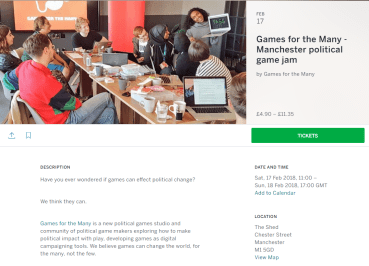
Design games to help make t’planet less uninhabitable in 50 years. Feb 17/18 #Manchester

games for the many“Games for the Many is a new political games studio and community of political game makers exploring how to make political impact with play, developing games as digital campaigning tools. We believe games can change the world, for the many, not the few.”

They’re holding weekend event (17-18 February) here in sunny Manchester. You can book tickets here.

MCFly caught up with them and posed the curliest questions it could think of…

Who should come to the games design event you’re holding in February, and why?

We’re welcoming everyone to our gamejam in Manchester this February. We’re calling on developers, designers and activists to come together and design political games around the issues they care about, or even help put together a game for the 2018 local elections. Participants don’t need to know how to code to take part.

We’re holding game design events across the country to help build a nationwide community of political game makers. Primarily, these events are about creating games, and providing people with the opportunity to access the tools and know-how how to make them. Games produced at the event may be taken forward, if the team agrees, as a game for the 2018 elections or a later snap general election.

This event is also about helping people find a voice through a new medium: games. Games are powerful tools, they are dynamic, immersive, they can tell interactive stories in a way no other medium can, spark debates, educate and agitate. With software like Twine or Game Maker it’s easier than ever to make powerful games without needing to code.

What if you’re skeptical about Jeremy Corbyn/vote Green/Lib Dem/Tory/Monster Raving Loony Party?

The game jam is open to any and all, yes, even Tories. In our previous game jam we had Lib Dem activists as well as Spanish and Swedish activists, who are not necessarily connected with the British Labour Party. We believe a diversity of opinion can bolster the creative process. During the development of CorbynRun we reached out to Conservative activists and voters and invited them to playtest the game. Their input was valuable. We can learn from each other.

What will “success” look like for the organisers at the end of the weekend?

Success at the Manchester Game Jam looks like everyone participating having a good time, learning from one another, developing games to express political ideas and concepts. Some of those games may go on to be invited to take part in further development, but that’s an added bonus for us.

Who ARE the organisers?  Where did the idea come from, where does the money come from?

The two co-founders of Games for the Many, James Moulding and Rosa Carbo-Mascarell, are organising the Manchester Game Jam. James is a political campaigner and project manager. Rosa is a game designer and game jam organiser.

We felt that running game jams should be a crucial part of what Games for the Many is about. We’re not interested in just making games by ourselves, we wanted to foster a movement of political game makers alongside us, working and learning together. From these game jams a range of prototypes will be developed, some of which will then go on to form the basis of Games for the Many’s contribution to future Labour campaigns. There’s also an aspect of wanting to provide an outlet and an opportunity for independent game developers to use their talent to political ends.

The perception, fair or unfair, is that most gamers, or coders are the proverbial 25 year old teenager living in his parents basement, and that the ‘culture’ is difficult for women to be part of.  What steps have you taken/are you taking to a) reach out to women and b) make sure that the stereotypes/expectations are not met ‘on the day’.

Rosa Carbo-Mascarell is a Women in Games ambassador and sits on the Women in Games board. There is a strong community of very talented women in the games industry, breaking the harmful stereotype every day. In her experience of running game jams, she has received messages from women saying they weren’t sure if they should come along because “they didn’t know if their skills would be useful”. Since then she’s made sure that all her events highlight that coding is not necessary to make a game. Everyone can get involved, including those who have never made a game before. With that base, she has spread the event across her networks of female game developers.

What would you say to someone who said “austerity, poverty, sexism and climate change are not things to make games about – it trivialises them”

Games and play are integral in coming to an understanding of how austerity, poverty, sexism and climate change work and how we find solutions to deal with them. We learn, empathise and explore through play. Just look at children, playing is how they learn how the world works and find their place in it. It doesn’t stop when we’re adults, just shifts to more adult forms of play. Talking about zero-hours contracts in Corbyn Run doesn’t trivialise the issue, it makes players aware of it and what Labour is going to do against it.


Posted in Upcoming Events | Leave a comment

URGENT: Help needed Tuesday 23rd Jan to help green printers move, #Manchester

header4MARC the printers, based in the Northern Quarter (28 Edge St)since the year dot, are moving.  Tomorrow (Tues 23rd Jan) they are moving to Salford, near Islington Mill. They urgently need help moving stuff.

If you’ve ever read a Manchester Climate Fortnightly or Manchester Climate Monthly, well, they were printed at MARC. If you’ve ever read any ‘activist’ publication by Manchester community groups etc, there’s a very good chance it’s been printed at MARC.  They’ve taken great effort to be genuinely “eco”, beyond tokenistic stocks of recycled paper to the inks they use and everything else.

If you have two hands or especially a van that can help in the move, your help will be gratefully received.

The MARC phoneline will be working from 10am tomorrow 0161 839 0839

If you need more info about what kind of help is needed, try facebook or reach them on 0161 226 2350 today (answer machine will be on if they’re out)

There will be people at MARC all day and others in Salford all day.

Posted in Upcoming Events | Leave a comment

Upcoming Event: #Levenshulme, Community Energy, #Manchester 27 Jan

reposted from here

Levenshulme takes on energy efficiency retrofit and community energy!

This January Carbon Co-op will be meeting in Levenshulme where the support for community energy and retrofit is growing. We will be joined by Ed Cox (IPPR North) who will host a discussion of the potential for community energy in Levenshulme.

We will also hear from two Levenshulme based members Lorenza and Sarah who have taken a phased approach to whole-house retrofit. Rather than making home improvements in one go, Lorenza & Paul and Sarah & Nicky are taking their retrofits step by step whilst maintaining a whole house approach. Hear about the considerations they made as they planned their retrofits, their decision making of which measures they chose to work on and why, how they managed budgeting, and how they are ensuring a whole house approach.

See a video of Lorenza & Paul’s retrofit.

If you want to make energy efficient home improvements and are a new homeowner, can’t afford the time or money to undertake significant works in one go, this social may be particularly relevant to you.

Families welcome, refreshments will be provided.


DETAILS

WHEN – Sat 27 January 2018, 11:00 – 13:30

WHERE – Levenshulme Inspire, 747 Stockport Road, Levenshulme, Manchester, M19 3AR

COST – Free for members and children, £4 for non-members.

BOOK – social-jan-2018.eventbrite.co.uk

Posted in Energy, Upcoming Events | Leave a comment

Repost: An energy system vision for a community energy-led future?

So, Jonathan Atkinson of Carbon Coop does some Deep Thinking about the future of energy. A good (19ish minute) read…

An energy system vision for a community energy-led future?

The energy transition is happening, what needs to be discussed now is what it looks like on the ground and what role Community Energy plays in it. Is the Community Energy movement’s vision of the transition one in which individual prosumers are liberated to become their own energy trading entities, one in which autonomous communities become self-sufficient energy islands or is it a national (if not international) federation of groups acting in an ever more integrated grid?

(Estimated reading 19 minutes)

In this blog we review energy system business model options for Community Energy groups but also critically examine the values that underpin these different visions and their implications for the performance of the future grid. We welcome responses from the Community Energy sector to this blog and see it as a starting point for debate not the end. Either post comments below or email us at info@carbon.coop

The old business model is dead?

As it becomes clear that…  keep reading here.

Posted in Energy | Leave a comment

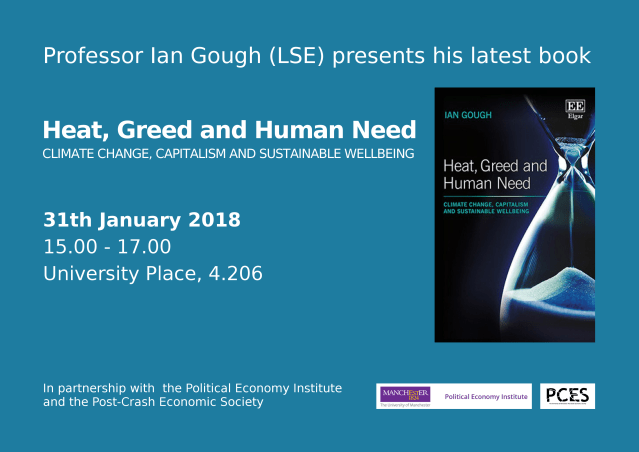
Upcoming Event: Heat, Greed and Human Need, #Manchester 31st January

A seminar coming up – free to attend, no need to book.

Fwiw, I’m most of the way through the book, and it’s good (though more for an academic than popular audience).

IanGough_Flyer_1

Posted in academia, Upcoming Events | Leave a comment

#Climate activist 18-29? Apply for 5 days of inspiration in Austria…

So, this might be good!  It’s being led by someone who knows what he is doing, so probably will be.

salzburgclimatething


P.S. Almost ten years ago, coming back on the train from a climate event in Austria, I had the idea for Manchester Climate Fortnightly (the precursor to Manchester Climate Monthly).    Mind you, I was younger and even more foolish then.

Posted in Upcoming Events | Leave a comment

Derek Wall, Elinor Ostrom and making a different #Manchester (and planet) Mon 19 Feb.

Green Party activist and political thinker Derek Wall will be in Manchester on Monday 19th February.  He’ll be talking about his new book Elinor Ostrom’s Rules for Radicals: Cooperative Alternatives beyond Markets and States (reviewed here).  You can book your tickets here.

eilnorostrommeeting

MCFly caught up with him for an email interview-
1.  So, who was Elinor Olstrom and, in 100 words or so, why should someone concerned about climate change care?

Elinor who sadly died in 2012, was the first woman to win a Nobel Prize in economics.  She was a passionate advocate of climate change action and she won the price for her ecological economics.  Specifically she studied the tragedy of the commons and researched how it could be over come.  To me this is at the heart of climate change question and she provided a scientific (but open) approach to tackling this crisis and other environmental problems.

The tragedy of the commons is the concept that collective ownership leads to catastrophe.  Forests, fisheries and common land it has been argued tend to get destroyed from over use if they are owned collectively.  Elinor won her prize for showing that local people can construct rules and systems for conserving the commons and that far from being tragic commons tend to protect nature,

She scaled her study of the local commons to look at the global commons, coming up with practical ideas of promoting climate change action. She was fascinated by how the right kind of practices could encourage cooperation and protect the environment,. She was practical person and campaigned for climate action, stuck solar panels on her home (which incidentally she and husband Vincent built), saw indigenous people’s protection as a way of tackling this and other ecological problems.

2.  If we took Ostrom’s ideas seriously, how would the Labour Party’s manifesto look different?

It would be less about the state stepping in and more about community control.  It would reject nationalisation as a universal solution and promote commons, cooperatives and other diverse forms of popular ownership as an alternative to neoliberalism.  It would certainly stress ecological policies as well as coproduction. Coproduction is the concept that health care, social services and, in fact, all areas of society should be shaped by users desires not just centralised paternalism.  While Ostrom was not on the traditional left, I think she would have loved the approach of Jeremy Corbyn and John McDonnell when it advocates participation rather than state paternalism.  I have written a brief account of how we might imagine her advising Jeremy Corbyn https://www.plutobooks.com/blog/elinor-ostrom-advice-jeremy-corbyn/

3.  How would the Green Party’s manifesto look different?

There would be less of it for a start.  It would be shorter The Green Party at its two conferences a year has since it was created in the 1970s (originally it was called the Ecology Party and before that People) created a mountain of policies dealing with most aspects of life.  While not all of these get into election manifestos the approach is very much of piling up policies that the state will implement.  An Ostrom approach is not radically anti-state but puts participation and deep democracy at the centre.  Ostrom argued that we have to teach the tools of cooperation and participation at school and change institutions and property rights to promote collective, diverse democratic control.  Obviously in any manifesto she would be looking for us to construct sets of rules that make for ecological sharing.  Making academic publications open source would be big in any Ostrom inspired manifesto.  Community ownership of renewable energy would also be a pillar and famously she argued for looking at all manifesto promises in terms of their long term impact

I am deeply indebted to the indigenous peoples in the US who had an image of seven generationsbeing the appropriate time to think about the future. I think we should all reinstate in our mind the sevengeneration rule. When we make really major decisions, we should ask not only what will it do for me today, but what will it do for my children, my children’s children, and their children’s children into the future.’

4.  How would Green Party praxis (sorry, ‘day to day campaigning’) look different?  How would we know we were in post-Olstrom campaigning mode?

Totally different!  The Green Party doesn’t think enough about method.  Being for good things and against bad things is inadequate.  Strategic thinking about how to achieve change should be at the core of Green Party politics and this would go beyond standing in elections and assuming that at some point in the future a Green government would transform society.  Green Party politics from an Ostrom point of view would be about promoting direct, diverse and deep democracy and understanding how institutions and rules can be changed to do this.  The small things like running meetings, educating members and enjoyment of party activity for Ostrom would be the big things.  If you think carefully about how to promote participation by members the big social change will be easier.  Elinor was sceptical of slogans, her anti-slogan slogan of ‘No panaceas’, is worth repeating, simply electing Greens will not on its own transform top down and anti-ecological power structures.  Its not that the Green Party has the wrong approach to these questions but simply that the Party doesn’t generally discuss them at all.  Its been great seeing the Green Party moving left over recent decades, I would love to see it deepen what it does by taking on Elinor’s insights and inspiration.

5. Why should people come along to the book launch – what will they get out of it.  How will it be structured in congruence with Olstrom’s ideas

Hopefully pleasure and ideas.  At the London launch I brought my homebrew IPA to share and I intend to bring a couple of bottles when I am in Manchester.  I will certainly leave lots of time for questions and participation rather than just, despite my enthusiasm, lecturing.  We can see where people want to take the discussion and how it might hopefully promote both thought and local action in Manchester.  And Ian Parker who kindly has organised it and myself are very open to suggestions for making it the full Ostrom so to speak.

6.  Anything else you’d like to say

I have been provoked and made to think deeply by Elinor Ostrom.  She was an inspired thinker, ecological politics was at the centre of her work and she argued for genuine participation, thought practically about how to achieve this and advocated good natural and social science as alternatives to sloganizing sentiment.

Posted in Upcoming Events | Tagged , , | Leave a comment