Questions to @afsl about its secretariat function for the “Steering” “Group” #MACF

The charity “Action for Sustainable Living” has got the contract to provide secretariat functions to the “Steering Group” (paid for by… Manchester City Council).

Those functions include

  • Clerking Steering Group meetings (5 per year),
  • Producing the 2013/14 Forward Plan of meetings,
  • Providing support to the Governance and Funding, and Communications sub groups,
  • Organising the MACF Annual Conference in March 2014 (including securing funding/sponsorship),
  • Managing the 2013/14 Steering Group election process
  • Maintain and update the MACF website
  • Maintain the events and conferences forward plan
  • Secure funding to support the activities of the Steering Group,
  • Maintain and develop the MACF mailing list.

Let’s start simple with two questions;

a) what do you understand by the bullet point “Managing the 2013/14 Steering Group election process?”  Could you unpack that for us please? When will elections be held? For what roles? How?

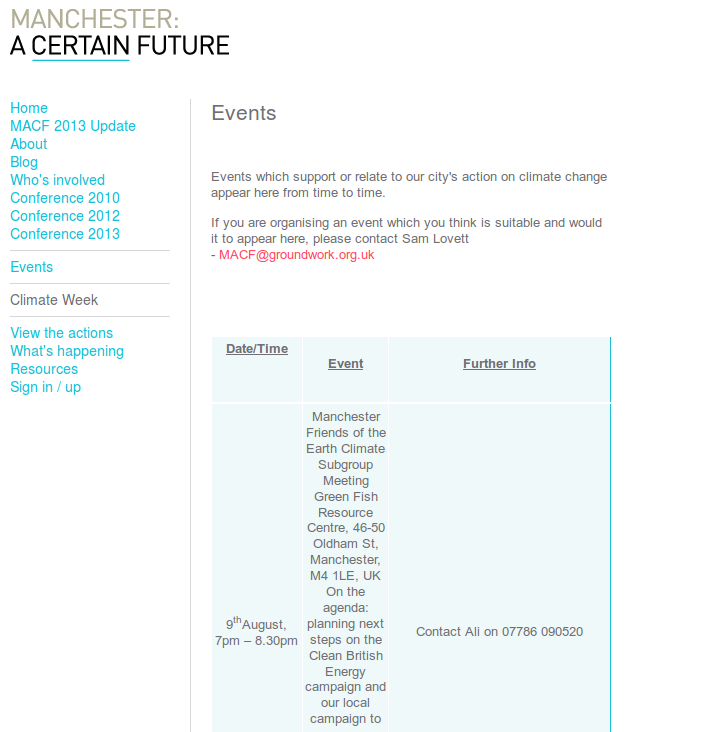
b) what do you think of Groundwork’s legacy with “maintaining and updating the MACF website” – given that as of July 25th 2013 the “events page” refers to upcoming events  in August… 2012.  Will you be doing better?

eventsscreenshot

Posted in Democratic deficit, Manchester City Council | Tagged | 2 Comments

Newsflash: Steering Group NOT dead – has new chair #MACF

Well well well.  The hyper-active and high-profile Steering Group has a new chair.

It’s someone called Gavin Elliot.

How do we know?  Not from the website (one blog post in the last seven months, and that full of demonstrably false claims).  Not from simple replies to straightforward questions put (repeatedly) to Manchester City Council.

gavinelliotNope, via the wonders of … twitter.

It seems they are having a meeting now – on energy – (behind closed doors, no minutes to be circulated – of course. That’s how “stakeholder” “participation” is DONE in this city.)

And they’re wondering “how do you fund a voluntary and unconstituted body like ours? Probably through partnerships with other organisations.”

Gosh, maybe that’s something they could have, you know, sorted out at any point in the last three years or so??

MCFly, will, of course, seek an interview with the new chair.  We’re masochists that way…

Posted in Democratic deficit | Leave a comment

Grassroots (!) report on #biodiversity in #Manchester launched

A report about the state of Manchester’s biodiversity is now available. The report, written by Dave Bishop, chair of “Friends of Chorlton Meadows” was launched last week at the “Beyond the Carbon Budget” event hosted by Manchester Climate Monthly.

biodiversitycoverThe report, which begins with a quote by Jared Diamond –

“Elimination of lots of lousy little species regularly causes big harmful consequences for humans, just as does randomly knocking out many of the lousy little rivets holding together an airplane”

looks at the current state of  biodiversity in Manchester and Greater Manchester and declares it to be “in a poor state and deteriorating annually. The destruction of wildlife, and wildlife rich sites, in this region, over the past few decades, has been shocking and depressing.”

You can read the whole thing here, or you can download the 16-page shortened version here.

A video of Dave’s well-received speech at the event, filmed in WonkyCam, will appear shortly. [Update: here it is!]

Posted in Biodiversity | Leave a comment

#Recycling in Rusholme and Moss Side. Meeting tonight, Thursday 25th July

Residents of Rusholme and Moss Side … a group of residents are planning a major recycling campaign in the “terrace square” (Princess Parkway to Wilmslow Rd, Platt Lane to Moss Lane East). We launch the project ideas so far THIS THURSDAY 25TH JULY either 1-3pm or 7-9pm at the Vets Bowling pavilion, just off Platt Lane between the church and Platt Hall Gallery (it will be well signposted ) If you live in this area, are intrigued and would like to get involved, please come along ….

If you are reading this AFTER Thursday night (and you probably are!), then click through “here” for more information about what is being done and how you can be involved.

Posted in recycling, Upcoming Events | Tagged , | Leave a comment

Airing views on aviation – Tyndall #Manchester chap and that Monbiot geezer…

Following on from the much-read MCFly report on the Airports Commission’s recent jolly in Manchester, here are links to two worth-reading articles about aviation

First up, Michael Traut , who researches on Shipping, Aviation & Climate Change
at the Tyndall Centre for Climate Change Research (University of Manchester). He forwarded his blog to us, making the point that he does not wish to support any cause or views other than the ones expressed in what I’ve written.” In his piece, which is well worth a read, he drily points out

“Both assumptions, on the availability and the carbon efficiency of biofuels for aviation, are on the very optimistic end of the spectrum. These three wedges bring emissions in Sustainable Aviation’s scenario down to 115% of their level in 2010. At this point, carbon trading is invoked to reduce “net emissions” from 115% to 50%. While the first three wedges are optimistic scenario assumptions, the fourth is unreasonable. According to the climate change act, all other sectors have to cut their emissions by more than a factor of 5, and the mainstream opinion is that this is a rather steep challenge. So which sector would reduce its emissions even more, to create allowances for aviation to snap up? The report doesn’t say. Instead, the carbon market looks a bit like Rumpelstiltskin’s crafty brother, spinning emissions to gold.”

and then there’s Mr Monbiot , on form…

Hoisting 180lbs of human flesh 30,000 feet into the air and 4,000 miles across the ocean every time you want to talk to someone: does that sound like 21st Century technology, or a 20th Century throwback?

The lobbying power of well-established industries will always be greater than that of new or emerging businesses. So one of the impacts of lobbying is to keep dragging us back into the past. There is no better example than the demand to build new airports and new runways. Sold to the public with the promise of progress and modernity, their impact is to retard technological change….

Posted in Aviation, Manchester Airport | 1 Comment

Now THAT’S a local economy – Levy TimeBank #levenshulme #cooperation @LevyTimebank

Andrew Dyson of Levenshulme “TimeBank” explains the whats whys and hows of an exciting social innovation.  Given what is coming our way thanks to the unmitigated disaster that is climate change, we will need these – and lots else – in every single ward of the city…

clocks2-200In the last few months, a group of local residents in Levenshulme came together and started a new and unique enterprise in the area – a TimeBank. A time-what, you ask? Is it like a piggy bank? The answer to that is yes…and no. The timebank is a service that allows you to swap an hour of your time for an hour of someone else’s. It’s an alternative economy, where time is the currency instead of cash. If you’ve come across services such as Freecycle or Freegle, where you swap your stuff, then you’re part way to the concept. The difference is, with the timebank you can exchange your time, skills and even ideas with other local people. You post a message with what you can offer, and what you need, contact other users and the timebank lets you keep track of your spending – if you give time to help someone else, you get time credits. If someone else helps you, you give them your credits. Everyone’s skills and labour are valued equally, as time.

So what’s it all for? After all, anyone can do a favour for a friend and get one in return, why keep count? The first answer is simple – timebanking lets you do a favour for one person, and but get help yourself from someone completely different, someone who’s in a better position to help you. So you might give your neighbour a hand with the shopping, but he can’t repair your bike, so the woman three streets away helps you with that. In turn, your neighbour helps her learn to grow vegetables. All this activity can only lead to good neighbourliness, more social contact for the most vulnerable, and improved quality of life for all – the satisfaction of helping, and the advantages of getting help. It’s also a way to mobilise the community – groups or societies can post adverts for help (e.g. a communal litter pick) and find local people who might need their specialist assistance, or want to become members. Finally everyone gains because the timebank lets people make use of assets and resources that are often overlooked or undervalued in traditional economic transactions and services.

Currently Levy Timebank has about 100 members, and we’ve been around for about 3 months, so it’s onwards and upwards from here! All kinds of people from every walk of life have got involved, and they offer and request all kinds of things – cat feeding, maths tuition, photography skills, being a gym buddy, help with shopping, and even kickboxing lessons. The more people who join, the more matches between people we’re likely to get and the more effective we will be.

In other timebanks, people have also offered the use of rooms and other assets, and some encourage businesses, charities and social enterprises to share time and resources, to make themselves more efficient and potentially more environmentally friendly as well, by making better use of buildings and people.

If you want to get involved, and live in or near Levenshulme, then please sign up at www.levytimebank.org.uk, and follow us on Facebook (www.facebook.com/groups/levytimebank/) and Twitter (@LevyTimebank). Although we mostly operate online, there are ways of communicating on paper for those without IT skills or access – email info@levytimebank.org.uk for details.

You can also find out more about timebanking in general at www.timebanking.org. Around Manchester there are existing timebanks in Trafford, Tameside, Harpurhey, Miles Platting, and Ladybarn, and there are about 250 nationwide.

Posted in education, inspire, volunteer opportunity | Leave a comment

Jobs Alert: “Sustrans Smarter Choices Co-ordinator” & “Tameside etc Allotment and Gardening Co-ordinator”

environmentjob.co.uk is dead useful!!

Smarter Choices Co-ordinator, North West

Organisation: Sustrans
Salary: £23,396 – £26,578 pa
Reference: SUS957E
Location: Manchester
Hours: Full Time
Position type: Paid
Contract: Fixed Term Contract
Closing date: Thu 25 July 13
Website: www.sustrans.org.uk

Sustrans, the charity that’s enabling people to travel by foot, bike or public transport for more of the journeys we make every day, is seeking a motivated and organised communicator to join our team in the North West:

Smarter Choices Co-ordinator, North West
£23,396 – £26,578 per annum (Ref: SUS957E)
(depending on relevant skills and experience)
37.5 hours per week – contract to 31 March 2015 – based in Manchester

This exciting new role is to assist the Programme Manager in developing opportunities and managing the effective delivery of active travel projects, in particular those relating to workplaces and communities, in the north west region so that the strategic objectives of Sustrans in the area are achieved.

Ideally educated to degree level or equivalent, you will have experience of project management and delivery, line management and of working with behavioural change/engagement projects, ideally in the workplace or community setting. With excellent written and verbal communications skills and experience of partnership working, you will have good leadership, presentation and report writing skills, the ability to motivate others and experience of working within budgets and to deadlines. Commitment to the promotion of sustainable transport is essential as is an understanding of Sustrans workplace and active travel work.

To apply please download and complete the application form and equal opportunities monitoring form from our website. Alternatively, email jobs@sustrans.org.uk or ring our recruitment line on 0117 915 0325. Please quote reference number. Closing date for the receipt of completed applications is Thursday 25 July 2013. Interviews will take place in Manchester on Wednesday 7 August 2013. Second interviews will take place on Tuesday 13 August 2013.

Working Towards Equal Opportunities

Please mention environmentjob.co.uk when responding to this ad.

*********

Allotment and Gardening Coordinator

Organisation: Tameside, Oldham and Glossop Mind
Salary: £10,994 – 22.5 hours/week
Reference: AGC
Location: Hyde, Tameside
Hours: Part Time
Position type: Paid
Contract: Fixed Term Contract
Closing date: Tue 20 August 13
Website: www.togmind.org
Contact name: Zoe Spensley Wood
Contact telephone: 0161 366 7571
Contact email: zoe@togmind.org

Tameside, Oldham and Glossop Mind’s Kitchen Garden project is an inclusive ecotherapy project run over four allotment sites in Tameside, providing food for our three cafes. In conjunction with the other Allotment and Gardening Coordinators, this job coordinates and oversees all aspects of our Grange Road allotment service within the organisation’s ethos of well being and recovery for all. Kitchen Garden Grange Road currently caters for adults with learning disabilities or additional needs. The role includes aspects of allotment management, people support, particularly for people with learning disabilities, development and coordination of horticultural courses and drop-ins. The role operates within a social care environment, with a focus on ‘learning by doing’, production of a regular and good quality vegetable and fruit supply, volunteer management and site and health and safety management.

Download an application pack from our website.

Please mention environmentjob.co.uk when responding to this ad.

Posted in Job Alert | Tagged | Leave a comment

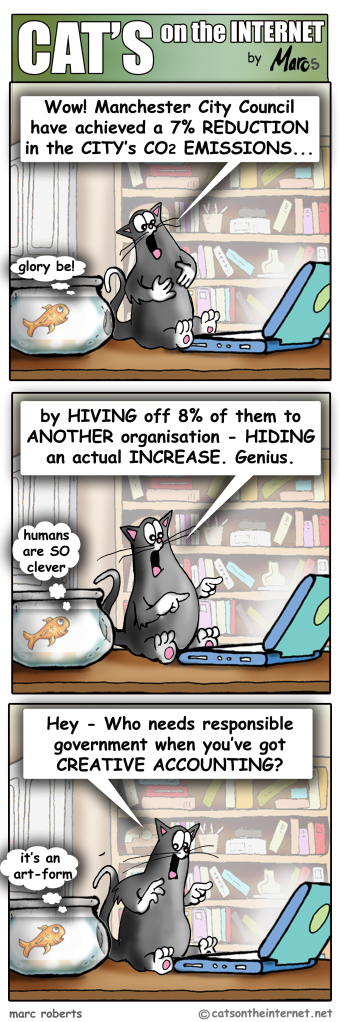
Does 5+7 = 20? Simple questions to #Manchester Council about #climate plan

Dear Councillor Murphy

re: statement on the 2013/14 Annual Carbon Reduction Plan

At last Tuesday’s Neighbourhoods Scrutiny Committee, it was conceded that the Friends of the Earth analysis was correct and that

“there was a 1.8% increase in like-for-like emissions between 2011/2 and 2012/13, and that there has only been a 5.2% reduction in like-for-like emissions against the 2009/10 baseline.”
My primary question is simple: is the 2013/14 Annual Carbon Reduction Plan going to be redrafted to include more ambitious targets, so that the Council meets its “20% by 2014” reduction target?

If so, will an announcement be made to this effect at Executive on Wednesday 24th July?
When would the re-drafted Annual Carbon Reduction Plan be re-submitted to the Scrutiny Committee?

If the plan is not going to be re-drafted, what new target year will be set for the 20% reduction, given that 5.2 plus 7 equals 12.2, not 20?

My secondary question is this: when did 2009/10 become the agreed baseline year for the Council’s emissions? In the Manchester Climate Change Action Plan, agreed by the Executive on November 17th 2009, goal one was a 41% reduction on carbon dioxide emissions by 2020 from a 2005 baseline.

Yours sincerely
Marc Hudson

Posted in Climate Change Action Plan, Manchester City Council | Leave a comment

Help Delilah the cat explain #climate change to #Manchester…

Dear Person-We-Know-Who-Cares-About-Climate-Change (!),

re: a cartoon booklet about climate change and Manchester: what do you think should be in it?

We want the benefit of your experience. It will take a few minutes and will help us immensely!

cats00093manchesterWe are going to produce a friendly* cartoon guide to climate change and Manchester. It will be “narrated” by a cat called Delilah, with helpful comments from bob the goldfish (There’s an example to the right, and you can see more by going to catsontheinternet.net).

Delilah and bob will explain, in “simple English” –

  • the (very very) basics of climate science
  • the impacts climate change is having/will have globally
  • the impacts climate change is having/will have locally (in Manchester and the North West)
  • the history of efforts in Manchester to create and enact policies (from 2007 onwards)
  • the actual policies (the headline goals of the MACF, for example)
  • examples of good stuff that we can be proud of (MEEN, Moss Side Community Allotment etc etc)
  • how is Manchester doing compared to other cities (in UK and around the world)
  • how “resilient” is Manchester (bioregional stuff)
  • the things that individuals and groups can do (around food, transport, housing, personal consumption, political pressure (“from carbon literacy to carbon capability”)
  • an appendix that lists the different extant groups in Manchester (and beyond!) and how to get in touch with them.

We also want to know – what is missing from that list above? What is on there that shouldn’t in your opinion be on there? (Please note, the booklet will be “modular” so that groups can use just the bits that they want to.)

Please do let us know what you think, other thoughts/opportunities/cautions…

Deadline? The sooner the better, but definitely by Friday 2nd August

We plan to launch the booklet in late September, to coincide with the fifth assessment report of IPCC.
All best wishes
Marc Hudson (writer) and Marc Roberts (cartoonist)

* By “friendly” we mean family-friendly (“Beano” rather than “Viz”)

Posted in Upcoming Events, volunteer opportunity | Tagged , , | 2 Comments

Book Review: “What’s Wrong with Climate Politics and How to Fix It” reposted from #lse

From the London School of Economics blog…

Paul G. Harris prescribes several remedies for the failed politics of climate change, including a new kind of climate diplomacy with people at its centre, national policies that put the common but differentiated responsibilities of individuals alongside those of nations, and a campaign for simultaneously enhancing human wellbeing and environmental sustainability. Ultimately, Harris’s book offers some very sensible reasons for reducing consumption amongst the most wealthy, but the book repeats the same mistakes of the majority of texts arguing for changes in patterns of consumption, writes Christopher Shaw.

What’s Wrong with Climate Politics and How to Fix It. Paul Harris. Polity. June 2013.

In this analysis of our dysfunctional climate politics, Paul Harris identifies three barriers to reducing greenhouse gas emissions: self interest of nation states in general, the self interest of US and China in particular, and the self interested behaviour of individuals. For a student or interested citizen wishing to delve deeper into some of the issues behind the current climate policy impasse, this well researched book offers an accessible and engaging read. However, the book does not quite live up to the promise of telling us how to fix it. This is because Harris draws heavily upon a pre-existing stock of ideas which have already failed. In presenting these ideas as the limit of the possible, Harris’ book risks doing as much to entrench the problem as solve it.

The problem of climate politics, according to Harris, is that atmospheric concentrations of greenhouse gases are continuing to rise, twenty five years after climate change first appeared on the political agenda. The cause of this problem is diagnosed as self interest – the self interest of nation states in general, the self interest of the US and China in particular, and the self-interest of individuals, chasing happiness through consumption. The solution offered by Harris is a people-centred politics. A large part of the book is concerned with running through the numbers of rising emissions – where the emissions are coming from, and the historical trends in the distribution of greenhouse gas emissions, from developed nations in the 20th century to the rising powers of China and India in the 21st century. In this review I will discuss what Harris sees as the problem of excessive consumption (Chapter 4), and the remedy for this (Chapter 7). In doing so I draw on the relationship between the state and the individual, which Harris returns to throughout the book.

Chapter 4 details the evidence to show that consumerism can never provide truly lasting happiness; indeed, is the root of much unhappiness. Despite this, the virus of affluenza is spreading, and threatens climatic doom for humanity. It is not always clear how much agency, and hence blame, Harris lays at the foot of the individual for this malaise. At one point Harris argues that individuals should be at the centre of climate policy, in part because it is individuals who cause climate change. This is pretty much the same as arguing it is ordinary foot soldiers who cause war. Elsewhere Hasrris suggests a more structural reason for the failure of climate politics, and argues that the value system underpinning modern capitalism must be replaced with a less materialistic culture. To do this, individuals must accept sustainable levels of consumption.

In Chapter 7 Harris outlines the ideas which might guide humanity to this promised land. Not unreasonably he contends the rich must consume less, so the poor can consume more. Harris suggests in order to bring about this change in attitudes to consumption it will be necessary to encourage particular sections of society (for example the young) that true happiness cannot be found in constant consumption. To do so, messages ought not identify such changes as sacrifices, but should instead focus on highlighting the benefits of these changes. Governments should no longer encourage consumption, and should instead treat excessive consumption as socially taboo. The people have a role in this change, ‘because the choices and behaviours of individuals can determine how the distribution of power and resources shape the world around us’. This is all standard fare, which has dominated left of centre liberal discourses on climate change for over a decade.

One cannot fault Harris’s definition of excessive consumption as a hollow and futile means of achieving fulfilment, nor its role in driving atmospheric concentrations skyward at a record speed. But this is old news. Perhaps it is because Harris frames climate change as a tragedy rather than a crime that he is willing to distribute the blame. However, if he had understood the harm being caused by climate change as a crime, he may have been moved to ask much more difficult questions, such as, what sort of climate politics is possible in societies where the state draws on a wide range of surveillance techniques to monitor, infiltrate and undermine the activities of civil organisations which seek to promote the very lifestyle changes Harris sees as the solution?  Harris makes clear the solutions he offers are only partial, but given the well established literature on the role of the media in shaping people’s understanding of climate change, his failure to include the media as a part of the problem is particularly difficult to explain. If Harris is concerned to see an end to unsustainable consumption, the corporate media should be firmly in his sights. In fact, it may well be that we have to accept that climate politics isn’t broken, that the intention all along is to overcome any crisis of legitimacy, by simply giving the appearance of doing something while waiting for a geo-engineering fix which leaves the neo-liberal project intact, whilst brushing the emissions under the carpet.

Ultimately, Harris’s book offers some very sensible reasons for reducing consumption amongst the most wealthy. Unfortunately, in making the assumption that simply proposing good ideas is enough for change to happen, the book repeats the same mistakes of the majority of texts arguing for changes in patterns of consumption. The dearth of ideas is not our problem. The combined efforts of state, corporate and media actors in promoting unfulfilling and unsustainable consumption is the problem of climate politics, and it is misguided to think this power will simply dissolve away in the presence of some good ideas.

—————————————————————

Christopher Shaw returned to academia as a mature student and in 2011 was awarded his DPhil by the School of Law, Politics and Sociology at the University of Sussex. He currently works as a Research Assistant for the Climate Crunch project, based at the Environmental Change Institute, University of Oxford. Christopher also works as Research Fellow on the Climate change as a complex social problem programme at the University of Nottingham and is a Visiting Fellow at Science and Technology Policy Research (SPRU), University of Sussex. Read more reviews by Chris.

Posted in Book Review | 1 Comment