
The ever-reliable Daily Mash has the news story we’ve all been waiting for!
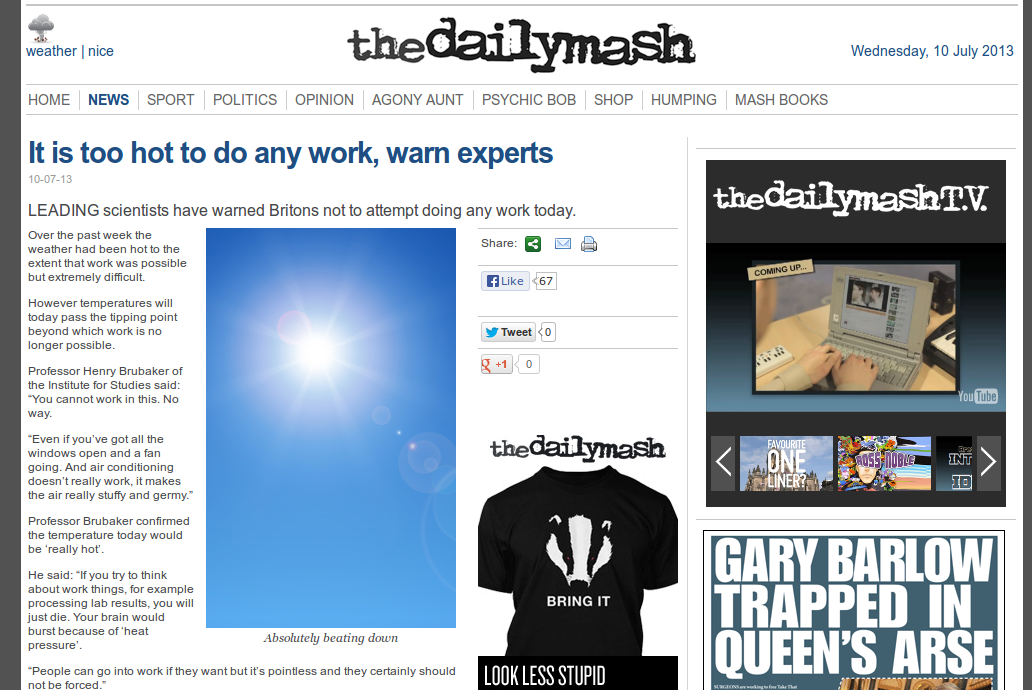
It is too hot to do any work, warn experts
LEADING scientists have warned Britons not to attempt doing any work today.
Over the past week the weather had been hot to the extent that work was possible but extremely difficult.
However temperatures will today pass the tipping point beyond which work is no longer possible.
Professor Henry Brubaker of the Institute for Studies said: “You cannot work in this. No way.
“Even if you’ve got all the windows open and a fan going. And air conditioning doesn’t really work, it makes the air really stuffy and germy.
Hat-tip to @CllrSuzanne
Event Report: Airports Commission talks #climate in #Manchester #redemptionritual
Around sixty rich white university-educated people gathered today in Manchester to discuss aviation’s contribution to global climate change, a crisis that is already harming millions of non-white, non-rich people around the world. At the end of an hour and a half, witnesses had given testimony, commissioners had pressed them on that testimony and members of the audience had had the chance to vent. Everyone seemed happy enough. [Update: See another attendee’s account here! He stuck it out for the whole day!!]
The hearings were set up by the Airports Commission, one of the sorts of arms-length investigatory/policy-shaping bodies that is becoming ever-more common in this new age of “governance”. It is chaired by Howard Davies, and he opened proceedings by explaining that the Commission would be producing an interim report on “capacity” by the end of the year, and then a shortlist of “plausible development options” at a later date.
Presentations from three witnesses – Tim Johnson from the Aviation Environment Federation (“the principal UK non-profit making organisation concerned with the environmental effects of aviation“), Jean Leston from WWF and two gentlemen from “Sustainable Aviation,” an industry group of airports, airlines, manufacturers etc who believe that technology and carbon trading will enable aviation to grow but still help the UK meet its legally binding 80% reduction by 2050 target.
First witness was Tim Johnson of the Aviation Environment Federation. The central thrust of what they were saying is that even getting fuel efficiency gains would take both regulatory and political pressure, and neither of these exist. He felt that whatever happens at the next International Civil Aviation Organisation (ICAO) shindig in September, the existing aviation agreement within the European Union Emissions Trading Scheme was “unlikely to come back at any size”, given the resistance from airlines that fly into Europe from beyond. They have managed to “Stop the Clock” and it won’t be starting anytime soon. Part of a funeral for t’species?
Mr Johnson’s “take home” to the commissioners was that No New Runways Are Needed.
Next up was Jean Leston of WWF. She outlined aviation’s role as the biggest carbon generator (per passenger mile) within transport and that mitigation (reduction) within the sector was dwarfed by overall growth. Her main goal seemed to be to highlight the work of WWF around convincing businesses that it was in their interests (financial, reputational) to fly less. To this end she advertised the “Moving On: Why Flying less means More for Business” [pdf] report. She also took a pot shot at the Department for Transport’s “massive underestimation” of the potential for video conferencing.. She also gently chided the Airports Commission’s own work on ‘carbon leakage,’ saying its assumption that other EU countries will have unconstrained aviation growth is unrealistic, given that they’ve signed up to EU climate targets.
Her line, as with both the other speakers was “we can allow aviation to grow within environmental limits” but that “more capacity would be “stranded assets.”
Finally Matt Gorman and A.N. Other (sorry!) from “Sustainable Aviation”, of which Manchester Airport Group is a member, told the commissioners that according to their calculations (and they had a graph, minus a labelled x-axis, to show it), technology would if not Save The Day, it would Save the Industry. That and bio-fuels. Therefore it was going to be possible to keep expanding the industry. They seemed to remain tactically agnostic about the need for further capacity-building…
Then it was over to questions. Howard Davies asked the WWF woman about one of her suggestions – that landing slots be re-allocated. He wondered how this could happen, given the general EU-ness of it all. WWF punted the ball to AEF chap, who said something about auctions for slots, and the chair then made a UKIP jibe.
Next up Julia King (“Vice Chancellor of Aston University and a member of the Committee on Climate Change, with a background in the aerospace industry”) pressed the Sustainable Aviation people quite hard on this “technology” question. Which technologies? When? Does that include “open-rotor” engines which, while more fuel-efficient are a lot noisier, with all that that implies for local wildlife and voters. Does that include blended-wing and delta wing aircraft, with the implications they have for width of runways? What is being done to “pull through” the technologies quicker than they otherwise would.
It’s hard to judge these things, but she didn’t seem totally convinced by the Sustainable Aviation people’s replies on all this. The folks from AEF got the chance to say that the Sustainable Aviation “roadmap” was – on the subject of technology turning up quickly “”unusually optimistic” and that anyway, new planes efficient planes don’t replace existing ones, given that the fleet is growing, so existing “inefficient” planes will still be around for many years to come.
Other commissioners then entered the fray. Geoff Muirhead, former MAG supremo, challenged the WWF factoid that by 2017 on current rates of infrastructure building we will be “locked in” to emissions taking us into dangerous climate change . As his fellow commissioner Julia King clarified, this recent IEA report refers to power stations as well as airports. Mr Muirhead’s pondering of “where do we find the right balance in the absence of a global deal?” was countered by various witnesses who pointed to the existence of EU and G8 commitments to keeping climate change to less than the “dangerous” two degree limit. He didn’t seem convinced either.
Commissioner John Armitt mentioned UK population growth (and the likelihood that people will continue to fly for leisure and “VFR” (today’s acronym; stands for Visiting Friends and Relations”). Jean Leston from WWF said that cheap flights had boosted UK aviation usage since 1990 but that there were signs of market maturity [if only we could have species’ maturity!!], given that the flights may be cheap, but all the hidden extras aren’t, and people have a limited amount of holiday time. Therefore, again, no need for new capacity.
Finally, Commissioner Ricky Burdett asked whether the absence of witness statements on substituting surface transport for short-haul meant it wasn’t significant. Kate Hewitt of AEF said the main UK challenge is around long-haul flights, Matt Gorman of Sustainable Aviation cited a Committee on Climate Change report saying limited modal shift was possible and Tim Jackson of AEF pointed out that reducing short-haul flights might increase availability of slots that could then be used by long haul…
Then there were questions from the floor. Kevin Lister of Plane Stupid (to be honest I didn’t know they were still in existence) pointed out that new aviation technology had been coming in every year since the Wright Brothers, but still the emissions go up (it’s a good line, which bears repeating!), that BiofuelWatch had challenged Tesco on the sustainability of its biofuels and Tesco had dropped the whole campaign, that Carbon Trading would drive up prices for the poor “how many inner city riots are acceptable?” (I think that may have been rhetorical) and that given the starkness of the climate science about the short-term global temperature rises, it wasn’t exactly clear where people were going to be doing their VFRing in 30 years time. “where will people go on holiday on a boiling planet?”
A PCS union representative called for a “publically-owned integrated transport system. A chap from Stop Stansted Airport Expansion asked about whether the Airports Commission will be looking at non-carbon dioxide emissions (the much-loved Department for Transport is not doing so, it seems).
Jeff Gazzard of the Aviation Environment Federation asked for real-life examples of where the “reduction” wedges around biofuels and better navigation systems have reduced emissions at the rate we need to.
Some hothead (no name) berated the Sustainable Aviation people for producing a colourful graph with no x-axis, saying it reduced the levels of knowledge in the room.
Ruth Wood from Tyndall Centre (or possibly SCI, I can never tell) pointed out that we need emission reductions now, that we can’t reply on techno-optimism and that lots of other sectors are saying they will use biofuels to reduce their emissions and that it is therefore not at all clear there are enough sources of biofuels on the planet to do this.
Last up the Friends of the Earth Aviation campaigner requested that the Airports Commission get clarity over whether they are making planning recommendations on the basis of a specific emissions constraint, and what methodology it would use.
What happens next:
a) The Airports Commission produces an interim report about “capacity” by the end of the year
b) The Airports Commission produces a longer report on capacity in about June 2015.
c) Whoever forms the next government either uses or ignores the report, depending on what they want to do. (Bismarck said that laws were like sausages – it doesn’t do to look too closely at how they are made. Ditto that for aviation [policy]).
Meanwhile d) We all keep flying – or keep expecting to be able to fly.
to be followed by
e) At some point in the not-to-distant-future, the future – with all its assumptions of continuity and manageable risk – unravels. Fast or slow, I don’t know, but unravels. Money will protect some people, for some time, but not in a world you’d much like to be part of.
Marc Hudson
mcmonthly@gmail.com
Random observations:
All the witnesses were saying, with subtle-ish differences, the same thing; that it is going to be possible to have our cake and eat it. Whether it was technology, or jiggery-pokery with landing slot auctions or whatever, they claim that circle can be squared. All were at pains to say they were not “anti-aviation.” This is ludicrous, confused Green Confucianism (see disclaimer.)
No-one whatsoever from any Manchester-focused campaigning group was present.
MCFly says:
These events are rituals. They are rituals of safety, rituals of redemption. People attend/participate/lend their good names to the process because, well, that’s just what people of their social class do. And they want to nudge the policies of the State in one direction or another. While, understandably, paying their mortgages.
All perfectly “reasonable,” and a theoretical improvement on the bad old days when policy discussions were held Behind Closed Doors.
But you can have a Reasonable Ritual that is totally inadequate to the scale of the problem.
The infrastructure we have built, and in all likelihood will continue to build are the mother of all stranded assets. Twenty or thirty years hence we will be able to see this very clearly, I suspect. By then it will of course be twenty-five to thirty-five years too late to do anything meaningful about it. So it goes.
Disclaimer: I’ve flown a lot. Most recently, I flew from London to Australia in 2010 (VFR) and from Australia to Shanghai in 2011 (swimming wasn’t an option). I thought about flying out to watch cricket, VFR this year, but didn’t (the reasons weren’t to do with emissions reductions – personally, I believe it’s too late in the day to worry much about how much more wood we throw on the fire. We should be using our brains do design asbestos suits). I, like everyone else, want to be able to fly. I have no moral superiority whatsoever. But what we want as individuals and the responsibilities we have for future generations are two different things. What struck me most forcefully today was what the austere Victorian men looking down from the walls (the meeting was in the Manchester Town Hall reception room, which is rotten with the portraits of 19th century mayors) would think of us. They sorted out the air and water pollution. It took them time, it looks like they knew what they were doing with the benefit of a retrospectively imposed narrative. Maybe it was every bit as frustrating and messy a process as what we are doing. The difference is, if you didn’t like the consequences of Manchester’s industrialisation, there were other places to go. The planet’s a lot fuller nowadays…
Newsflash: #Manchester City Council reduced C02 by 7% last year, missing 10% target #beyondthecarbonbudget
UPDATE Fri 12th July: The trouble with Newsflashes is that you can end up accepting the “framing” of the people who gave you the info or the format of the report. The reality is that Manchester City Council’s emissions would have gone UP if it weren’t for responsibility for traffic lights moving to Transport for Greater Manchester (TfGM). See here.
Manchester City Council has released its fourth Annual Carbon Reduction Plan. It reveals that “a 7% reduction in carbon emissions was achieved between 2011/12 and
2012/13, against a target of 10%.” Although this is the third successive failure to achieve a targeted 10% reduction, the report states “this reduction is in line with the interim target to end-2013/14, with emissions having been reduced by 14.4% over the three
years since the baseline year, 2009/10.”
The 18 page report, which you can download here goes on to look at the last year’s performance, the plan for 2013/14 and the “Governance, Delivery and Performance Management” for the coming year.
MCFly is gathering opinions from various stakeholders about this report, and will be publishing news and views over the coming days.
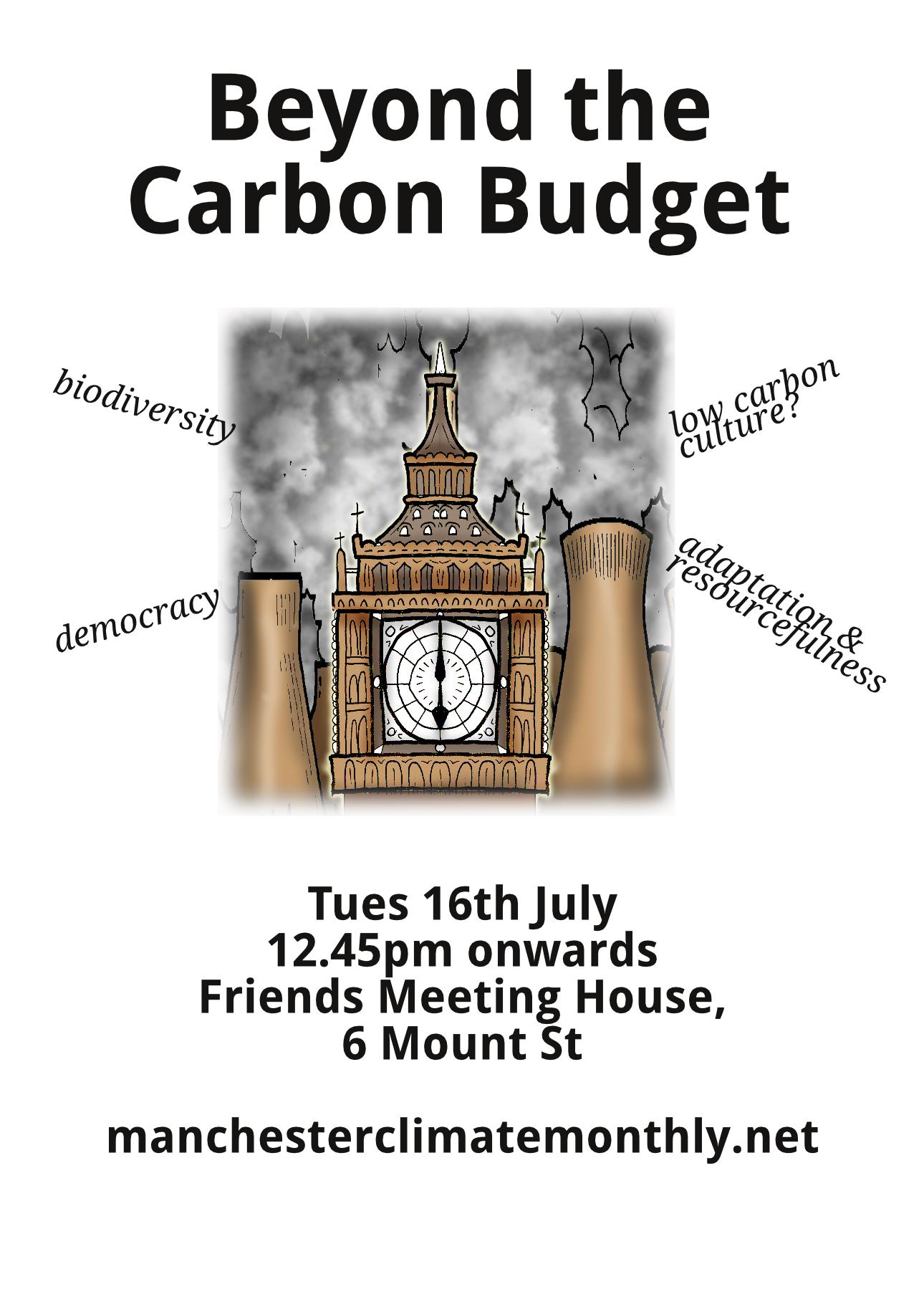 The report will be scrutinised by a committee of elected members (councillors) next week. All members of the public are invited to attend this meeting, of the Neighbourhoods Scrutiny Committee meeting next Tuesday, 16th July from 2pm. (See MCFly’s youtube video about the committee here.) It will be held at Manchester Town Hall. Before the meeting there is an opportunity to meet other concerned citizens at an event called “Beyond the Carbon Budget” organised by Manchester Climate Monthly. That event will see the launch of a report on the state of Manchester’s biodiversity, written by local campaigner Dave Bishop.
The meeting starts at 12.45pm, and is held at the Friends Meeting House, 6 Mount St, very close to the Town Hall.
If you want to get involved in making this event a success, please get in touch via mcmonthly@gmail.com. We have jobs small and big, simple and difficult to meet your every whim!
Upcoming Event: “ECO South #Manchester” – Tues 18th July, 7pm #afsl #climate
If you can’t make it to “Beyond the Carbon Budget“, on Tuesday 16th July at 12.45pm (Friends Meeting House, city centre), then how about getting along to this, which is happening a couple of days later…
ECO South Manchester: YouTube Short Films and Shaping the Future of an Environmental Network for Manchester
Thursday 18th July from 7-9pm at Green Fish Resource Centre.
ECO South Manchester is an evening to help you network, share your ideas and be inspired. This month, we’re going to ask you to bring your best eco YouTube videos for us all to watch and talk about together. Bring your YouTube favourites on the day or for best chance of showings, send links in advance to steph.lynch@afsl.org.uk.
Aside from that, well, we’ve been hosting ECO South Manchester for a while so in addition to the usual networking and talk, we also want to ask you what you want from an ECO network in Manchester and maybe even get you involved in shaping it.
So save the date – Thursday 18th July from 7pm at the Green Fish Resource Centre, 46-50 Oldham St, Manchester, Greater Manchester M4 1LE. Steph will be at the door to let you in from 6.45 – 7pm. If you arrive later than 7pm, please call her on 07756344263 to let you in.
MCFly says–
I still say “South Manchester Environmental Groups Monthly Assembly” was a better name than “ECO South.” Think of the acronym-fun you could have!
#Manchester #climate nuggets July 8th 2013
Hi all,
The latest (July) Manchester Climate Monthly is out now!!!
Wanna flex your creative muscles, and maybe win £200? Here’s the details of our short story contest all sorted. Two thousand words (in English) on the subject “Manchester (UK) in a warmer world.”
Marc Hudson
Coming up this week
Tues 9th, 9.15 – 11.00 Airports Commission hearings in Manchester at Manchester Town Hall, but you have to book!
Tues 9th , 2-4pm – networking lunch from 1:00pm Ageing and Energy Consumption: Rethinking Policy and Practice from Research
MICRA (Manchester Interdisciplinary Centre for Research on Ageing) /MARC (Manchester Architecture Research Centre) Joint Seminar
Venue: G306A and B Jean McFarlane Building, University of Manchester (no.92 on the campus map)
Speakers:
Professor Andrew Dobson (Politics, Keele University) – Making energy discussable: the role of community knowledge networks
Dr Rosie Day (Geography, Earth and Environmental Sciences, University of Birmingham) – Older age and energy justice
Dr Alan Lewis (Architecture, University of Manchester) – Thermal Comfort and Sustainable Technologies in Extra-Care Housing
Discussant: Professor James Goodwin (Head of Research Age UK and Visiting Professor at Loughborough University)
Chair: Professor Chris Phillipson
Booking: http://ageingandenergyconsumption.eventbrite.com/
Tues 9th, 6.45pm to 9pm Manchester Friends of the Earth Full Group Meeting, Greenfish Resource Centre, Oldham St. http://manchesterfoe.org.uk/
Wed 10th, 7pm to 9pm: Manchester Friends of the Earth climate campaign meeting
At this month’s climate campaign meeting (which is on a Wednesday instead of the usual Thursday), we’ll be continuing to develop our plans for a new campaign aimed at improving the energy efficiency of rented homes. If you’d like to join us, please contact Ali (ali@manchesterfoe.org.uk / 07786 090520) so we know to expect you.
Green Fish Resource Centre, 46-50 Oldham Street, Manchester, M4 1LE
Stories you may have missed on the MCFly website
- Upcoming Event: “Carbon Literacy for Businesses” Tues 16th July, 8am #Manchester
- Anti-capitalists! Your chance to cause businesspeople pain and help the oppressed!
- Interview: Professor Tony Travers (LSE) on local democracy, #climate #lgaconf13
- Exclusive: Interview with Sir Merrick Cockell, Local Gov Assoc chair #lgaconf13 @LGAcomms
- Video: #Manchester Council Neighbourhoods Scrutiny Committee; #climate Tue 16 July #beyondthecarbonbudget
- Volunteer opportunities with @EMERGERecycling and FareShare #interview #lucydanger
- Grow #organic food for #Manchester – July dates of “Land Army”
- Appeal: Volunteer to make #beyondthecarbonbudget a big success #manchester #climate
Upcoming Event: “Carbon Literacy for Businesses” Tues 16th July, 8am #Manchester
http://becarbonliteratebreakfast.eventbrite.co.uk/
Demystifying Carbon Literacy for Business
A Free Breakfast Seminar for Business Executives
(Please note this event is for organisations, not for consultants. If you are a consultant please contact us directly to discuss opportunities for working collaboratively.)
Tuesday 16th July 8am – 10am
Manchester Town Hall, Committee Room 1
Many businesses are aware of the potential to increase efficiency and improve their bottom line by reducing their carbon footprint and resource wastage, while at the same time
being able to operate in a more environmentally responsible way. But it rarely seems easy, and winning the hearts and minds of the workforce is always seen as the biggest challenge.
This free breakfast seminar introduces you to the idea of Carbon Literacy – the award-winning project working across Greater Manchester – and how it can directly support your drive to reducing emissions.
You will leave with a new understanding of:
How Carbon Literacy can reduce costs, increase profits and directly drive your business objectives
How you can overcome barriers to implementation
How you can achieve it in a cost effective way
What other organisations are doing about it
Contact Clare Macintosh on clare@becarbonliterate.co.uk or 07808 214712 for further information. For more information about Be Carbon Literate visit our website at www.becarbonliterate.co.uk
“A 20% cut in energy costs represents the same bottom line benefit as a 5% increase in sales in many businesses” The Carbon Trust
Be Carbon Literate is a network of professional and inspirational carbon literacy trainers working collaboratively to design and deliver effective training as part of the Carbon Literacy Project for more details visit http://www.manchestercarbonliteracy.com.
Anti-capitalists! Your chance to cause businesspeople pain and help the oppressed!
Right, that may have got your attention!
Some MCFly readers are probably slightly to the right of Genghis Khan. Others probably rub ideological shoulders with Noam Chomsky. Most will, Mr Gauss would say, are in the middle.
If you are the type who like to see business folks suffer, why not emotionally-blackmail some of them into completing gruelling runs and swims and so on. They’ll then take the money you blackmail them with and give it to some decent charities. Everyone’s a winner, yes? See below!
Hi,
The Artemis Great Kindrochit Quadrathalon is just 9 days away!
Thank you so much to everyone who has already sponsored us, your support is really appreciated and will definitely spur us all on during the torture!!
If you don’t already know, some of the M4C team (with a little help from their friends) are taking on the UK’s toughest one day event on the 13th July and we need your support!
On Saturday 13th July Rachel and Ann will be swimming 0.8 miles across Loch Tay, Alastair and his friend Ed walking/running approximately 16 miles over 7 munros (including the UK’s 10th highest mountain!), Rachel and her friend Adam kayaking 7 miles and finally Ann and her friend Elizabeth cycling 34 miles around Loch Tay.
Training has recently been stepped up a gear, and last weekend saw Ann, Alastair, Rachel and her friend Sofia took the 6-hour trip up to Scotland to prepare themselves for the big day.
They have all written blogs following their practice weekend, so if you want to keep updated with the teams progress (and enjoy some light entertainment on their behalf) take a look here.
The purpose of this challenge is to raise as much money as possible for two amazing charities:
Mercy Crops – an international development charity working in over 41 countries worldwide helping people to turn the crises of natural disaster, poverty and conflict into opportunities for progress.
Mary’s Meals – an international movement that sets up school feeding projects in communities where poverty and hunger prevent children from gaining an education.
Any donations however big or small will be greatly appreciated and will hopefully make all the sore feet, legs and arms worthwhile!
If you would like to sponsor the team, please donate here by selecting ‘SPONSOR OUR TEAM’.
If you would like any more information about the event, you can find it on our quadrathalon page.
Thank you for your support (we need it!),
The M4C team.
Interview: Professor Tony Travers (LSE) on local democracy, #climate #lgaconf13
Professor Tony Travers, director of British Government at the London School of Economics spoke at a breakfast meeting of the Local Government Association conference. MCFly editor Marc Hudson caught up with him to talk about bureaucracy, democracy and, surprise!, climate change. By the way, if you’re concerned about local action on climate change, well, THIS.
 To paraphrase your speech, you said that local government had many fine qualities around innovation and efficiencies, and central government had some things to learn. Above and beyond Weberian analysis – or maybe a Parkinson’s Law analysis – of the bigger the bureaucracy the more the inefficiency – are there any other explanations that you’d posit for the difference between the effectiveness of two levels of bureaucracy and governance.
I think it isn’t just a matter of scale. It has to do with the proximity between the people who are making the decisions about the way public resources are used and the people who vote for them. So if you’re in Manchester, or any individual authority, having decisions made in the [local] Town Hall just means that there is easier access to the people who make the decisions, and the people who make the decisions have a closer knowledge of what’s going on locally. And therefore I think they’ll just use resources more efficiently. There is some economic literature on this subject in fact, and so you’ll get more sensitive government. And there’s also some academic research that suggests the public are more content with services provided at a local level than the same services if they’re provided more distantly.
So I think it just creates a greater understanding amongst those who are delivering services of what people want. I’m not saying they get it right every time, but it’s simply more likely to be an accurate representation of what people want.
I completely agree. I mean, I can get hold of local politicians that even if I lived in London I’d never get hold of central government because there’s layers of, well, flak-catchers, basically. But conversely, local politicians are famously kicked out of office no matter how good they are because local elections are treated by the electorate as a referendum on the popularity of the government and especially the leader. So there’s a little bit of a contrast there in the amount of pain the local government will get, distinct from what it’s actually doing.
There’s no question that local government – not everywhere – not in Manchester, it would appear, but in many places, councillors who are good lose office simply because of changes in national political sentiment. And that isn’t really fair, or indeed good for local democracy. However, people do differentiate,and there’s plenty of evidence that they’ll vote for different parties at local and national level, for example. So I think that we really need to do is empower local democracy more. Britain is a very very centralised country, especially inside England. Though similarly it’s the same inside Wales and Scotland, even though there’s been devolution to Scotland and Wales. And I think that local government would make, on balance, more efficient and effective decisions than the same things done at national level, because national government just can’t understand everywhere.
Central government is unlikely to voluntarily give up power, so what sorts of things need to happen. So with Rewiring Public Services – when will we know if the LGA’s campaign has been successful or not?
I think it won’t happen overnight. With all these things you’re talking about drip drip drip on a stone. It’s possibly years of effort to get changes. Britain is a small-c conservative democracy in many ways. It doesn’t change radically. However, I think there is some mood change. Two things really suggest that. One is that the scale of the need to reduce public expenditure and the concentration of that effort on local government is a unique and unusual factor. And secondly, within England, I think there’s a perception that devolution has had no real impact. The Scots have had devolution, the Welsh have had devolution, Northern Ireland has had devolution – and what’s England got? I think that is a fairly powerful idea, and might well drive at least city-regional devolution, which is something of course that Greater Manchester Local Authorities have been working on for some years and to effect.
Just a couple more questions. So, more power to local councils. And Eric Pickles is apparently happy for council tax to go as high as you like, as long as you can get a referendum through. Now here in Manchester in 2008 there was a Transport Innovation Fund referendum. And it was overwhelmingly rejected. And it seems to me that the public want the services, but the public, famously, don’t want to pay the taxes.
Well, I think the Manchester referendum on the Transport Innovation Fund, and of course the endlessly complex issue of road pricing, or congestion charging, does test the limit of the public willingness to pay taxes or charges that they really feel. The difficulty for local government is that with the council tax, and indeed with a congestion charge were it to exist, people understand that. Whereas many of the taxes they pay to central government are buried. You know, VAT, or income tax which is taken away before you get the last number at the bottom right-hand side of your pay slip. And as a result of that, national government raises money much more easily than local government does. Local government has to argue its case much more.
So of course, nobody wants to pay taxes, but there is a moral case to be made for paying taxes, and personally I think that politicians who want to expand the state – and that’s a legitimate thing to want to do if that’s your view – then they have to argue the case for taxes. And very few politicians in any party are willing to do that.
Final question… So it’s ten years in the future, and there are city deals and earn backs and referendums have been won on local taxation. And central government is still doing defence, because you can’t really have local militias. What about climate change? Because someone has to demand/enforce carbon emissions reductions, and local governments aren’t going to do it because they can always play a”beggar thy neighbour” policy. So how do we drive down carbon emissions while still having the local democracy that we want?
I think obviously there is a risk that local areas will say “well, we can’t do anything because other areas won’t do something.” But countries can do that as well of course.
But on the other hand, more positively, at the local level, councils do understand that local detriment caused by climate change and also by other environmental issues. These things show up. All politics are local, so if there are risks for flooding, or heat islands, or whatever the consequences might be, it will be local government at some level that ends up picking up a lot of those issues up and trying to deal with them. I think the other thing is that cities are places where lots of people live together, and that requires the management of spaces between streets and buildings. Cities generally are relatively efficient in environmental terms, in the sense that people tend to live closer together, fewer of them use cars, and it’s easier to make more of them take public transport if you have policies [for that]. So cities I think are good for the environment. They look bad because you get high levels of pollution, and additive effects, but actually per capita big cities can be very very efficient. So I think this is an argument for cities doing things that are good for reducing the impacts of climate change, which are also good for city life in a common sense way. So who’s going to disagree that we should have more or better public transport. Or that we should have higher densities in big cities because that allows more people to walk to work. And these are things that work for several different policy reasons at once. And I think that the more those who are trying to reduce the impacts of climate change can ally their cause with common sense good government in the way cities function, then you’re getting two agendas for the price of one.
Anything else you’d like to add?
Well, I take the risk of “beggar my neighbour” policies, but I think it’s the C40 group [that’s doing work]. Cities have taken a lead in elements of climate change, partly because in many cities around the world there are many concerned people who are interested in the subject, and that’s something else to go with.
[Interview conducted Weds 3rd July at 9.20am by Marc Hudson]
Exclusive: Interview with Sir Merrick Cockell, Local Gov Assoc chair #lgaconf13 @LGAcomms
In an exclusive interview with Manchester Climate Monthly, Sir Merrick Cockell [@Sir_MRC] expressed his desire to see real debate about the future scope of local government happening not only in Council chambers but also further afield. He also pointed to Manchester as an indicator of how things might look if the Local Government Association‘s “Rewired Public Services” campaign achieves its objectives.
Sir Merrick, who was re-elected for a third and final term as chair of the Local Government Association at its AGM yesterday, said “I think out there in the country… there is a feeling that we need to bring decision-taking and power much closer to people and away from the remoteness of Westminster and Whitehall. But somebody has to start generating that debate and seeing whether there is an appetite out there. If there is an appetite, then the political parties will respond because they’re out to get votes.”
Asked about how residents and rate-payers might experience changes from increasing devolution of powers, he stated “Clearly Manchester is ahead of the game in many respects already, through the Greater Manchester grouping of councils. So perhaps it may be slightly less visible [in Manchester] because so much of it is already happening here.”
[Interview conducted by Marc Hudson, editor of Manchester Climate Monthly. Full transcript below the rather slick video about “Rewired Public Services”.]
In your speech to the general assembly yesterday you used the words shield and sword, which older people may recall Neil Kinnock used, and I’m wondering if that was a conscious echo?
Of Neil Kinnock? No, I don’t think I recall that he’d used them. I remember other people using them, not Neil Kinnock.
“Better a dented shield than no shield at all.” I’d like you to imagine that it’s this time next year and the [Rewired Public Services] campaign has achieved many of its objectives. How does that show itself to local tenants, and residents and rate-payers?
Well, it’s not going to happen this time next year. I can guarantee that because actually the ask wasn’t made of this government. They’ve got enough going on. We know that they’ve got only a limited amount of legislation they can put through, so it’s beyond that. It’s the writing of [party] manifestoes and whoever forms the next government – that’s the opportunity. In a year’s time I think things will be pretty much as they are at the moment. I think maybe 2016, 2017, hopefully if whoever forms the next government goes with it or a good part of it, people will then be beginning to see a real and obvious shift from decisions being taken in the centre down to areas. Clearly Manchester is ahead of the game in many respects already, through the Greater Manchester grouping of councils. So perhaps it may be slightly less visible [in Manchester] because so much of it is already happening here.
By that time, if we had a minister or Secretary of State for England that we talked about [in the LGA General Assembly, Mon 1st July] who had a seat at the negotiating table with the equivalence of Scotland, Wales and Northern Ireland making the case for England to the United Kingdom government with the appropriate sort of powers, then I hope we’ll see a fair equity. Hopefully Scotland will still be in the United Kingdom. But in those negotiations we’ll see equity between the various parts of the United Kingdom. Hopefully some of the powers they’re becoming used to in Scotland, Wales and Northern Ireland, we’ll also have an opportunity to have in different ways in different parts of England.
Final question – how can people who are passionate about local democracy but are not council members help the Local Government Association in achieving this longer term objective of devolving power to English [local] governments?
Well I think it’s about generating some debate. This isn’t something that people talk about … in a pub or a club or wherever. It’s not a matter of day-to-day debate, and I think it would be good to make it a matter of more general discussion. Councils can do that, they can actually have set piece debates in their Council chambers, maybe on the Rewiring Public Services document as something to start talking about . It would be good to hear, because I think out there in the country – it may not be recognised yet – but I think there is a feeling that we need to bring decision-taking and power much closer to people and away from the remoteness of Westminster and Whitehall. But somebody has to start generating that debate and seeing whether there is an appetite out there. If there is an appetite, then the political parties will respond because they’re out to get votes and they recognise populist issues. So we have to make it a bit more populist.
Thank you very much. We’ll try to make that happen in Manchester.
Video: #Manchester Council Neighbourhoods Scrutiny Committee; #climate Tue 16 July #beyondthecarbonbudget
The video is not going to win any awards, it’s true. The point of it is this; we need to make Manchester City Council an exemplar in its actions, its transparency, its willingness to innovate and engage around climate change. It did pretty damn well in 2009, but since then it has – frankly – fumbled the ball tragically.
Please email us if you want to help publicise the “Beyond the Carbon Budget” event. I suppose we really need to make a video “top five reasons you should attend.” And make it a bit snazzy. Any helpers?


 manchester climate monthly