Round-up of groups’ views on #Manchester Council’s Carbon “Reduction” Plan #beyondthecarbonbudget

Today the Neighbourhoods Scrutiny Committee discusses the City Council’s “Annual Carbon Reduction Plan.” MCFly asked various groups for a statement. Here’s what we got;

Steady State Manchester‘s take Inaccurate Figures Risk Complacency in Manchester City Councils Carbon Reduction Plan.

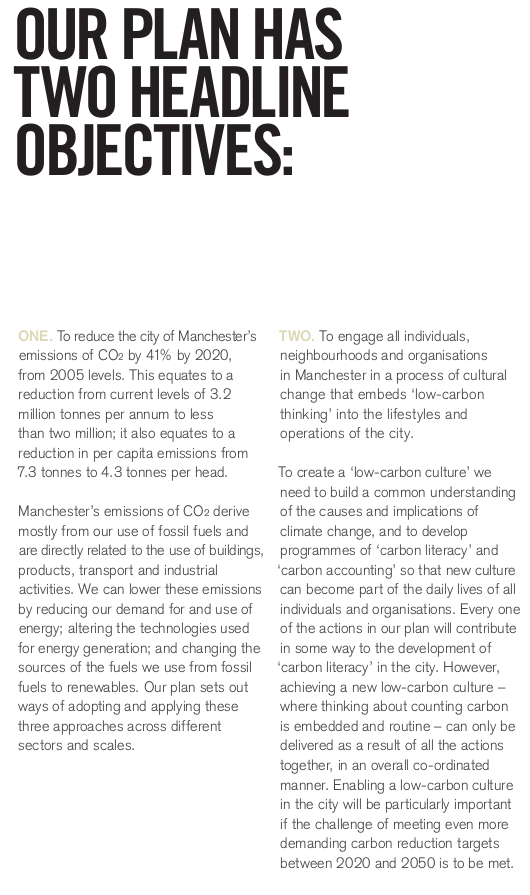
twogoalsIn essence;

“Steady State Manchester is wholeheartedly in support of Manchester City Council in its ambitions to create a low carbon city and its commitment to reduce the councils direct emissions by 41%, relative to 2010 levels, by 2020. [sic]  It is unfortunate that despite numerous effective projects the council missed its target of a 10% reduction this year with emissions increasing by 1.6%, if the emissions associated with ‘Traffic Signalling’, which moved out of MCC’s direct responsibility this year, are taken into account.”

[Why sic? Because the actual agreement was that the “baseline” year for the 41% reduction would be 2005, a tougher ask than 2010.  It’s like having to go on a diet to get back into the wedding kit you wore for your first marriage, at 22, rather than your second, at 35… MCFly]

Manchester Friends of the Earth are aware of the increase in emissions and are submitting a statement to the Neighbourhoods Scrutiny Committee

Manchester Green Party have posted the following on their website;
The results of Manchester City Council’s Annual Carbon Budget Report are highly disappointing. The aim of a 10% decrease in carbon emissions have been missed again, the reported result is 7%.

But while this is not good news , the disappointment lies in the detail. As spotted by ‘Manchester Climate Monthly’, the reduction is not due to any action by the Council itself, but the transfer of responsibility to another body. To then present this as a ‘reduction’ is bad faith.
Without this trick, the Council’s carbon emissions actually increased, with particularly in buildings and air travel. The council has direct control over these areas.

If, in essence, the Council is going to lie about its carbon reduction, then the whole Annual Carbon Budget Report process is a farce.

Deyika Nzeribe
Chair
Manchester Green Party

Posted in Climate Change Action Plan, Manchester City Council | Tagged , , | Leave a comment

Last days to donate to “Get the Greater #Manchester #food revolution moving!”

From here;

Support Greater Manchester’s small-scale farmers and organic growers by donating to Manchester Veg People (MVP).

We grow and supply local, organic and sustainably grown veg to the people of Greater Manchester. We are a unique non-profit distributing co-op of farmers and buyers, beavering away to create a fairer food system, and we really need your help to make it work here and now.
crowdfunder
We got together because we were worried about the impact of the current food industry: on the environment, on small-scale farmers and on consumers.

We decided we should do something about it by creating a fairer way of doing business – a co-operative where growers and buyers work together creating relationships of trust and understanding.

MVP supports existing growers (who have particularly struggled over the last two growing seasons due to the unpredictable weather), and crucially new people who want to get into farming – making food growing a viable way to make a living by paying a fair price for their produce (a price that covers the cost of production – which shockingly often isn’t the case).

We have been going for 18 months now, and things are starting to take off. We are at an exciting and very crucial stage. The demand for our wonderful fresh produce is growing and we are currently gearing up to supply local primary schools. But we need to raise funds to grow the capacity of the co-op to enable us to do this.

The problem is that until now we have been operating using shared vans and storage space – we need more space and our own van to be able to meet this new demand. Excitingly a knock on effect of this is that we’ll need more supply too – which means we’ll be increasing the income for our farmers (and providing a fair market for new growers) and as a result, growing more local organic veg!

It’s time to get serious, to show that this fairer business model can really work.

So, we’re crowdfunding to buy a van, cold store and packing equipment so we can get more local veg from the fields around Gtr Manchester onto Mancunian’s plates.

Posted in Food | Leave a comment

School for Scandal: #Manchester school C02 emissions UP 17% in last year #climate #beyondthecarbonbudget

Tomorrow the Neighbourhoods Scrutiny Committee looks at the Annual Carbon “Reduction” Plan of Manchester City Council.  The headline claim is that a 7% reduction in carbon dioxide emissions was made the last year. Reading the fine print (always advisable) reveals that this 7% “reduction” is entirely down to traffic signage no longer being on Manchester City Council’s carbon “books.”  In fact, but for this piece of accounting luck, emissions would have been UP by over 1%.  Still, increase pales into insignificance compared with this, grabbed from the 2013/4 plan –

schoolforscandal


The report states “Schools and academies are not included within the scope of the Council’s direct carbon emissions since they are increasingly independent organisations, outside of the direct control of the authority. However, schools have a significant impact on the level of carbon emissions in the city, directly from their day-to-day operations, through to the key role they have in ensuring that pupils have a clear understanding of climate change and the action they can take to address it.”

Angry yet? Scared yet? You should be.  Want to get involved, even though you can’t make daytime meetings?  Or any meetings!  mcmonthly@gmail.com is our email. Wear it out!!

Posted in education, Manchester City Council | 1 Comment

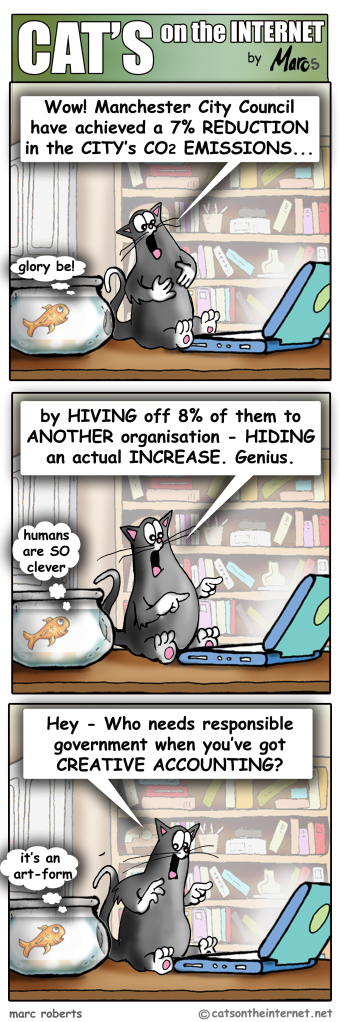
Even cats and goldfish can see #manchester #climate cooking of books #beyondthecarbonbudget

Delilah (that’s the cat) has clearly been reading this analysis of Manchester City Council’s Annual Carbon “Reduction” Plan…  Tomorrow that plan comes under scrutiny, at a free and public meeting. Starts 2pm, Committee Room 11, Manchester Town Hall.

cats00093manchester

Posted in Climate Change Action Plan, Democratic deficit, Manchester City Council, Transport | Tagged | Leave a comment

“Tree-planting vs climate change” is like “drinking more water vs sea-level rise” #beyondthecarbonbudget

Tomorrow’s”Beyond the Carbon Budget” meeting (12.45 at the Friends Meeting House, 6 Mount St) sees the launch of abeyondthecarbonbudget-page001 report entitled “States of Nature: Reflections on the threats to Manchester’s biodiversity and what ordinary people can do about them.”  It has been written by local bio-diversity campaigner Dave Bishop. Here is a sneak-preview…

Does Planting Trees Counter Climate Change?
We often hear that we need to plant trees in order to counter climate change. Oliver Rackham tells us that Britain is far too small to make an appreciable difference to global CO2 levels;
“… exhorting people to plant trees to sequester carbon dioxide is like telling them to drink more to hold down rising sea level.”

Recently Miles King, Conservation Director of the Grasslands Trust commented on the Woodland Trust’s ridiculous plan to plant 6 million trees, in 2012, to mark the Queen’s Silver Jubilee. He wrote:
The Woodland Trust press release extolled the virtues of trees as carbon stores. The planting scheme will be making Britain greener in more ways than one – as well as the beauty of the trees themselves, they will reduce the impact of pollution; the carbon lock-up potential from six million trees is roughly equivalent to the annual carbon dioxide output of a million cars.
This statistic didn’t look quite right to me so I did some calculations – and yes, what it actually means is that over the lifetime of the trees – a couple of hundred years – and assuming a lot of caveats, they will soak up the CO2 produced by a million cars in one year.”

He went on to write:
“What’s really interesting is that converting intensively managed grasslands to wildlife-rich grasslands creates the same amount of carbon storage as planting trees. And you can carry on grazing them, unlike plantations.”

Posted in Biodiversity, Climate Change Action Plan | Tagged | 3 Comments

#Manchester #climate nuggets July 15th 2013

Hi all,

Tomorrow sees the launch of a report on Manchester’s biodiversity by MCFly correspondent Dave Bishop AND the City Council’s scrutiny of its Annual Carbon “Reduction” Plan.  Why “reduction” in quote marks? Because by any reasonable measure, emissions went up 1% rather than down by 7%.  Come be part of the event from 12.45pm at Friends Meeting House, 6 Mount St, to be followed by the “Neighbourhoods Scrutiny Committee” meeting at 2pm in the Town Hall.  More details here.

Wanna flex your creative muscles, and maybe win £200?   Here’s the details of our short story contest all sorted.  Two thousand words (in English) on the subject “Manchester (UK) in a warmer world.”

 Marc Hudson

Coming up this week

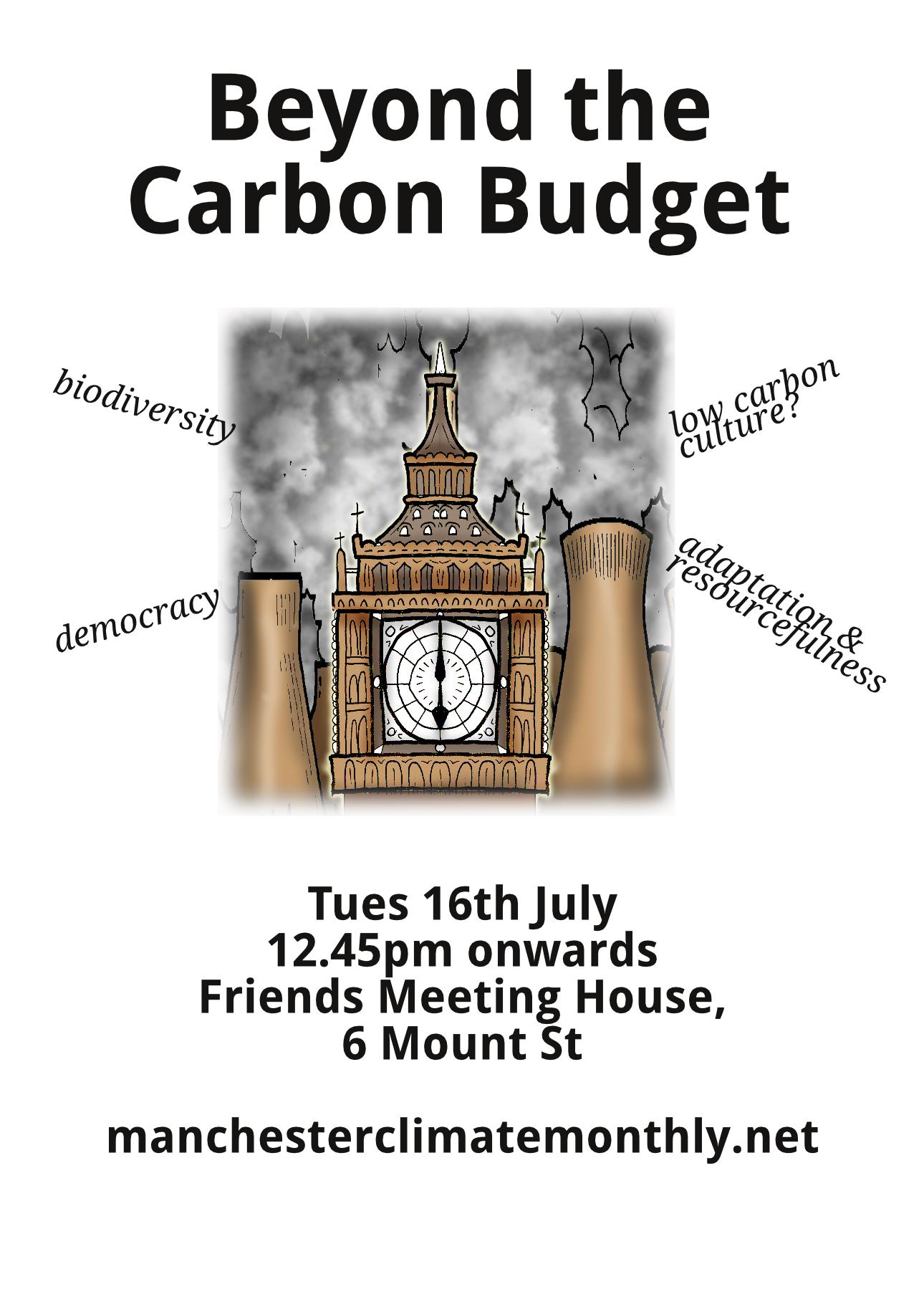
Tues 16th, 12.45pm onwards “Beyond the Carbon Budget”  Friends Meeting House, 6 Mount St- see front page of Manchester Climate Monthly July 2013 for details!

Thurs 18th  7-9pm ECO South Manchester: YouTube Short Films and Shaping the Future of an Environmental Network for Manchester at Green Fish Resource Centre.

Fri 19 July 6-9pm Film Night at Biospheric Foundation:  Best Before, UK dur 32 mins  Truck Farm, USA dur 48 mins

UK Film-maker Ben Mann’s new documentary Best Before, looks at the food revolution happening in London where local communities are taking it upon themselves to address access to affordable and healthy food. Ben along with Erin Wolson also from the Best Before team will be on hand to introduce the film.
Best Before is then followed by food road movie Truck Farm, which tells the story of a new generation of quirky urban farmers. Viewers are trucked across New York to see the city’s funkiest urban farms, and to find out if America’s largest city can learn to feed itself.

Stories you may have missed on the MCFly website

Posted in Weekly bulletins | Leave a comment

#beyondthecarbonbudget letter in MEN; Tues 16th July #climate #biodiversity

It’s been a while since the MEN has published a letter from MCFly (which is distinct from a while since ones were sent!).  But yesterday, well the times are perhaps a-changin’…

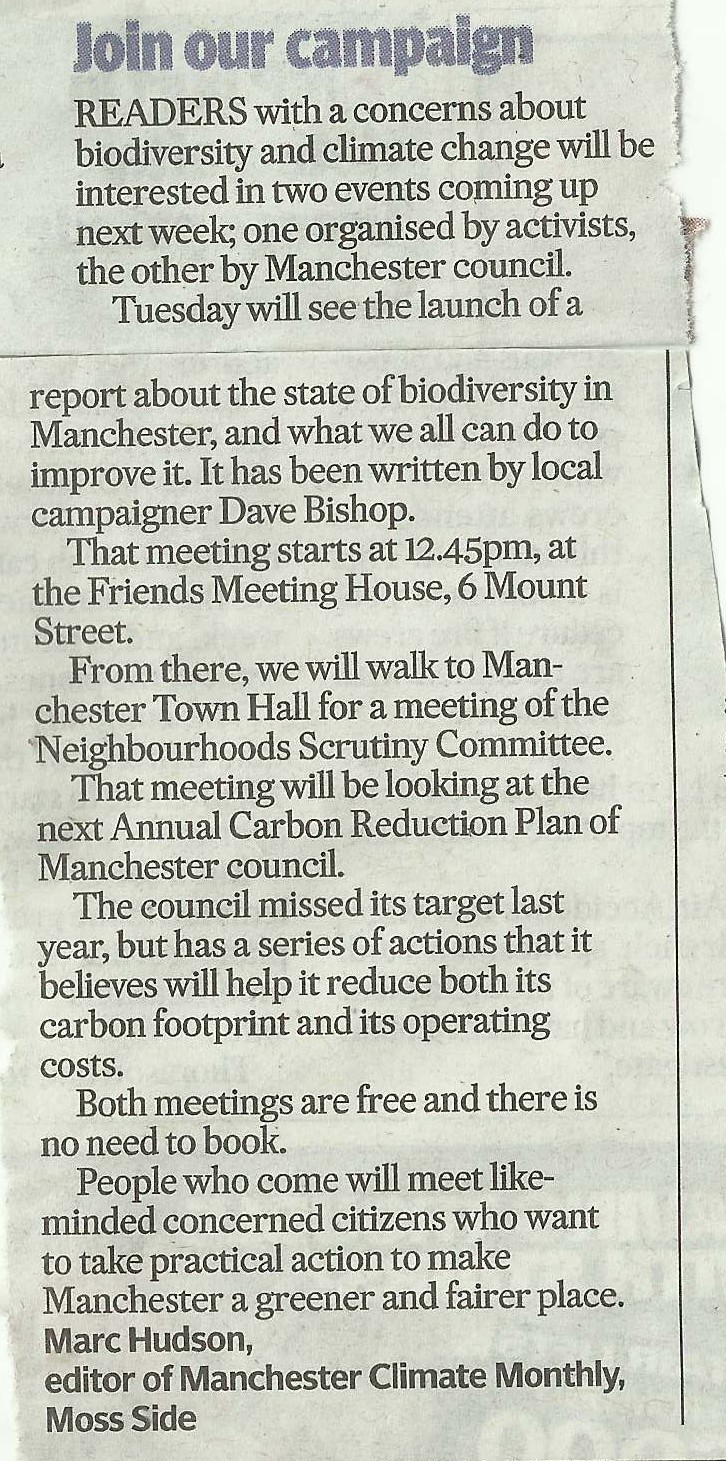
lettertomenReaders with a concern about biodiversity and climate change will be interested in two events coming up next week; one organised by activists, the other by Manchester City Council.

Tuesday 16th July will see the launch of a report about the state of biodiversity in Manchester, and what we all can do to improve it. It has been written by local campaigner Dave Bishop. That meeting starts at 12.45pm, at the Friends Meeting House, 6 Mount St.

From there, we will walk to Manchester Town Hall for a meeting of the Neighbourhoods Scrutiny Committee. That meeting will be looking at the next “Annual Carbon Reduction Plan” of Manchester  City Council.  The Council missed its target last year, but has a series of actions that it believes will help it reduce both its carbon footprint and its operating costs.

Both meetings are free and there is no need to book.  People who come will meet like-minded concerned citizens who want to take practical action to make Manchester a greener and fairer place.

Posted in Biodiversity, Climate Change Action Plan, Manchester City Council, Upcoming Events | Tagged | Leave a comment

#Manchester #climate credibility turns to Ashes: #StuartBroad and trust

On Tuesday 9th July, Manchester City Council published its latest “Annual Carbon Reduction (sic) Plan.” It stated there was a 7% reduction in emissions from its operations in the last year.

broaddidntwalkOn Friday 12th July, on the 3rd day of the first Ashes Test, English cricketer Stuart Broad got a thick edge, was caught at first slip but did not walk. The umpire didn’t see it, so he stayed at the crease.

What on earth could join the two?

It’s this; in both cases, the players were acting within the letter of the law, but not the spirit.

 As reported yesterday, the entirety of the 7% “reduction” can be ascribed to the fact that Transport for Greater Manchester (TfGM) now has responsibility for traffic signage. There has been no “real” reduction in emissions. Although Manchester City Council is entitled to claim their reduction, even they admit “while this represents a carbon saving to the City Council, this does not constitute a net saving to the city’s overall emissions”

In both cases, everybody who is looking knows what they saw. Partisan supporters will use the “well, other people do it” argument or the “it’s not illegal” one.

And they’re right – other people/institutions do do it, and it’s not technically illegal.

But what sort of message does it send? Is there pride in such actions? Dignity?

We are going to need trust in our institutions in the turbulent years and decades ahead. The days of deference are, thankfully, gone. Trust has to be earned. It is easily lost and devilishly hard to regain. These sorts of accountancy manoeuvres in the dark are a tragic mistake.

As far as the Ashes goes, well, it’s just a game. And anyway, speaking as an Australian by birth, I am certain that today’s 10th wicket 200-run partnership between Clarke and Agar will win us the match.

Speaking as a Manchester-resident, I am not so sure that anything quite so heroic can be pulled out of the bag. We are four years into an alleged 10 year programme. Is anyone truly happy with how the team is performing?

This is not a game, and Nature is going to bat last.

Marc Hudson
mcmonthly@gmail.com

PS Yes, I know Michael Clarke refused to walk in Adelaide in 2010. He at least had the good grace to apologise.

Posted in Climate Change Action Plan, Democratic deficit, Manchester City Council | Tagged , , | 4 Comments

#Manchester C02 “7% reduction” illusory; down to traffic lights moving to TfGM’s books #beyondthecarbonbudget.

City Council’s emissions would have risen but for accountancy measure. Aviation emissions also up. MCFly editor Marc Hudson reports.

beyondthecarbonbudget-page001The latest annual carbon reduction plan of Manchester City Council will come under the spotlight next Tuesday, 16th July. The Neighbourhoods Scrutiny Committee (see video) will meet at 2pm in the Town Hall, and look closely at last year’s efforts and the plan for the years ahead. The meeting is open to the public, and many Manchester residents are expressing an interest in attending. There is a “pre-meeting” organised by Manchester Climate Monthly from 12.45pm at the Friends Meeting House, 6 Mount St.

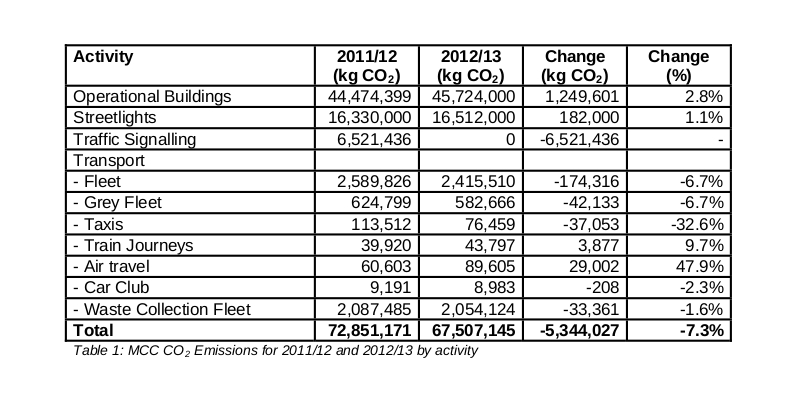
Last year’s official plan spoke of a 10% reduction target in the Council’s own emissions, as part of the wider “Manchester Climate Change Action Plan” created in 2009. The “achieved” result was a 7% reduction. On closer examination however, much of this reduction is due to an accounting measure.

Traffic signalling contributed 6,521 tonnes of C02 in 2011-2. The report states “the contract for traffic control signalling and signage network has been transferred from MCC to TfGM (Transport for Greater Manchester), providing the most significant proportion of the savings achieved this year.”

emissionsarcp2012

In fact, that amount is higher than all the rest of the savings made, so if traffic signally still “belonged” to Manchester, the actual percentage reduction would be … an increase of 1, 177 tonnes.

This sort of “windfall” will not be repeated, and does not actually reduce the overall emissions of Greater Manchester. As the report itself concedes “while this represents a carbon saving to the City Council, this does not constitute a net saving to the city’s overall emissions.”

Also of note is a dramatic rise in aviation emissions from 60 tonnes to 89 tonnes. According to the report;

“In 2012/13 emissions from air travel accounted for 0.1% of total MCC emissions, but within that there was a 48% increase from 2011/12 due largely to the exceptional events surrounding Manchester’s contribution to the London 2012 cultural festival. The We Face Forward exhibition included artists from 7 West African countries resulting in a temporary increase in flight bookings. The exhibition had a strong environmental theme highlighting the devastation of West Africa for Western commercial need, and received substantial positive media coverage. All flight costs were covered by external exhibition sponsorship, however it does raise awareness of the need to consider the full impact of otherwise very positive cultural activities. Other flights included those made as a result of contractual obligations to European Commission funded projects where tele/videoconferencing could not be used on those occasions.”

This scrutiny meeting is taking place during the Manchester International Festival.

From next year the annual carbon budget process will be changed to a three year plan with “annual milestones.” It remains vital that activists engage pro-actively and constructively with individual members of the Neighbourhoods Scrutiny Committee which has primary (but not exclusive) responsibility for examining the Council’s environmental performance and leadership.

Marc Hudson
mcmonthly@gmail.com

Posted in Aviation, Climate Change Action Plan, Manchester City Council | Tagged | 3 Comments

Interview with Greater #Manchester Environment Team chap #retrofit #climate #GreenDeal

Michael O’Doherty, who was until recently “Head of Climate Change, Buildings & Energy” for Manchester City Council, but is now “Assistant Director, Greater Manchester Environment Team” gets the sock-of-wet-sand treatment from MCFly editor Marc Hudson. Green Deal or no Deal? Fuel Poverty? Irresponsible Journalism? It’s all in here, and more. And, gentle readers, Mr O’Doherty will probably be helping to present Manchester City Council’s fourth carbon budget to a committee of councillors next week. It’s on Tuesday 16th July, at 2pm, and you’re all very welcome

Could you lay out some of the threats and opportunities the retrofits agenda/Green Deal for Greater Manchester.
The threats are we don’t manage to retrofit our homes to the standard we need to in the time frames we’ve got, so we don’t get the carbon emissions [reductions], that’s the first threat. Beyond Green Deal, beyond EC, that’s the task at hand. We need to invest £12 billion into the GM housing stock by 2030, 2035. We need to have shifted the average Energy Performance Certificate (EPC) levels up from a low E to a high B. And anyone who knows anything about EPC knows that is a really challenging target. We need a complete market shift. We need to create a new market. And Green Deal and ECO is the framework that’s been put in place to do that.

As far as I am concerned, the basics of that framework – pay as you save with the Energy Companies Obligation subsidy supporting it, with other public sector incentives around it… that principle is supported by all three main political parties. However, it will need tweaking as it’s introduced. The principle of pay as you save to unlock that investment is an important one. And in Greater Manchester we see the opportunity to stimulate the market early, to get the supply chain to really mobilise, to get our organisations, our companies to get the right skills and accreditations in place and to link our procurement of main Green Deal and ECO partnership with the local supply chain, to hit the targets we need to stimulate the market in the first three or four years.

The risks are of course if you go too fast, or you don’t have control over who is entering the market, or who is representing which organisations, you could have work that’s done to a poorer quality, that you could have work that’s done without the proper engagement with the residents to ensure that the savings are made; so the principles of “pay as you save” are lost. And all of these issues hitting the press in the wrong way could really knock the opportunity. So if we expect too much in the first few years, we risk undermining the principles that need to be supported by the three parties over the next twenty to thirty years. We need some policy stability, and if we get too hung up with the fact that there will be a bit of argument about the level of ECO funding, or the level of cash-back funding, then we actually lose sight of the long term opportunity. What’s important is getting local authorities and particularly cities to take the lead with the private sector to drive this market to ensure that it’s got strong foundations for the next twenty to thirty years.

One of the observations that I think that people who’ve been following climate change and the responses to it would make is that there always seems to be a bit, or a lot, of slippage. Are we significantly further behind than you expected us to be say two or three years ago, or are things generally proceeding at the pace you thought they would?

Two or three years ago we expected to have a Green Deal in place as an offer in October 2012. And we would have hoped to have had a GM Green Deal ECO offer in and around the same time as that. The reality is that the Green Deal is not really going to kick in with any serious momentum until probably August/September this year. Companies are just now being registered with the Green Deal facility, so the numbers for Green Deals have been very small. We will have in Greater Manchester a Green Deal ECO partnership in place by January 2014, so the time frames work reasonably well. Yes, it would have been great if the whole thing could have been a year earlier, but the reality is that it’s taken a little bit longer. And for a major policy issue that’s not surprising. We’ll be in place with our Green Deal offer from January next year. We’ve already brought in place our ECO partners, so [we] will be developing the market for that period. As I said earlier, Green Deal/pay-as-you-save is the long-term opportunity. It will need a lot of stimulation in the first few yeas. So actually ECO and the other [government initiatives] and incentives such as Go Early will be crucially important. We’re actually bang on target, we’re in place with an ECO offer. We’ve just delivered a really successful Go Early scheme with government. We completed on 90% of the £3m funding that came to GM against the coldest winter on record, performing better than any other City. I think that tells us not only have we got the right programmes in place being procured right now, but we’ve got the right governance structures in place, the right relationships between the public sector, the ten authorities, between businesses, social housing providers , who will be crucial in delivering this as well.

So I think generally slightly behind, but given where the main market is, we’re probably in a good place.

What are the known known threats as Donald Rumsfeld might say– what are the things coming up in the next year that have the potential to derail progress with the Green Deal and ECO?

The biggest threat is that we expect too much too soon from Green Deal. One of the problems is that we’re confusing terms; the term Green Deal is used to describe both the whole policy framework and the finance model. Separate out Green Deal and ECO first. Green Deal finance is getting all the headlines, but in my view, the whole package, finance, subsidy – i.e ECO – and the accreditation framework, are all required and the last two need to be fully established before we get large numbers of Green Deal loans.

That’s just one of the tools, but it’s an important one, because it allows you to offer these energy saving measures at no up-front costs. So psychologically I think that’s really important. And a lot of people will look at that and then maybe look at other finance routes. There’s an issue there for the Green Deal finance companies about sustainability but in terms of driving the programme, let’s not get caught up too much in the number of Green Deal loans. Let’s look at the number of housing retrofits that happen over that period. There’s something about getting the wrong message and looking for negatives. And certain organisations out there do look at the negatives in all this and I think we just have to understand the importance of getting some momentum.

Of course there are risks in terms of poor quality work being done, people mis-selling things, people being over-promised things, people not being properly educated and hand-held through the process so that they aren’t making the savings in energy that they were planning to, so that the Golden Rule then doesn’t work. Ideally this needs to be seen as a positive step for households, particularly in the first few years. So [we have] to make sure that households are happy with the quality of the work, the quality of the customer service and do make the expected savings in their bills. Other risks relate to the businesses involved – will they be able in the first few years to recoup their investment? A lot of organisations have invested significantly in this market, and it’s quite a complex market. It’s got many sub-sectors; the replacement boiler market has been there always for example, but now it’s more linked to other renewables and insulation schemes, which are less mature. We need our businesses to be growing, and they need the flow of work. So, ECO in particular, and other incentive schemes and the relationship between the local supply chain and public-private schemes are really important.

I’m sure some of our readers will be thinking “what about fuel poverty”? And I see that in a report to the Environmental Strategy Programme Board in May you mentioned that “a detailed report on fuel poverty is currently being drafted for the wider GM leadership team.” When will that report be finalised, and when will it be in the public domain? And what does it say?
It’s a draft report and workstream which is bringing together various different elements of fuel poverty work, both good and bad, recognising that as an issue it’s never really quite got to the top of the strategic agenda, or at least it hasn’t stayed at the top. It’s bringing together three GM commissions – the housing and planning commission, the Low Carbon Hub and the health and well-being commission and looking at where we can work differently. Certainly, from my perspective with Green Deal and ECO [it’s looking at] how we maximise the value of the Affordable Warmth element of Eco, to fuel poor households in GM and how we align different funding streams and work practices. It recognises and builds on a lot of work that is already in place – the GM Poverty Commission , the work in Oldham around community budget for fuel poverty for example. It’s simply a next step of the way as health services become more integrated back into local government, it’s recognising that this is an area of public sector reform that we can do something about right now. A draft is already in the public domain. [Found it!!]

Great, thank you. Is there anything else you’d like to say. Any questions you were afraid I’d ask, that I didn’t ask could you just answer them please.
What I’d say is that the role of public sector, private sector, voluntary sector, activists, in Greater Manchester is going to be really important in the next few years in engaging the different stakeholders, particularly households and communities. We’ve got what you might call a top-down programme. We think that’s right. We’ve got to drive the market in Greater Manchester. We’re [also] really looking to encourage bottom-up approaches that sit within that. So this is not about doing it in a one standard-size-fits-all way. This is about establishing a market, establishing the skills, the education and training, the quality assurance elements of that, but then over that period look at how we can be innovative in terms of making retrofit work, how we get community engagement to drive retrofit in neighbourhoods. And most importantly, learning from that in an iterative way. Learning from that locally – at a GM level – and sharing that learning nationally. Because I do think cities, particularly GM and the links we’ve got with our academic colleagues, with the third sector mean that we are in a really strong position to share that knowledge and learn from the development. We’re in a learning development phase right now, so I think that people need to accept that mistakes may be made in the short term, but the test will be how we learn from them so that we’ve got a sustainable programme over the next thirty years.

And can we come back in a year’s time and find out what progress has been made?
Of course you can!

Posted in AGMA, Climate Change Action Plan, GM Climate Strategy, Manchester City Council, Mitigation | Tagged , | 1 Comment