Of Green Deals, politics, the media and … Saving the World #CarbonCoop #climate

Jonathan Atkinson of Carbon Coop reflects on Green Deals, (ir)responsible journalism and messy political realities…

So Green Deal, the Government’s flagship domestic sustainability programme is screwed. It’s been going six months and only a handful of people have signed up for loans. Time for us on the Left to rub our hands with glee. Told you so. Empty government promises, energy company interference and simple bad planning have scuppered it.

But hang on, is it that simple? At the heart of Green Deal is a sound idea. Householders who want to reduce their energy emissions get an assessment on their home which indicates which low carbon measures they should do first, they choose a company with lots of guarantees and quality kite marks to do the work . An upfront loan to pay for it is repaid from fuel bill savings over time.

The execution so far has been flawed. The assessments cost too much, make too many assumptions and deliver too little detail for householders. The loans are too expensive and too complicated. The companies involved are untrusted by consumers and Green Deal itself has become a target for fraudsters and mis-sellers. There’s too little post-occupancy monitoring to ensure the measures implemented are working.

But the scope, scale and ambition of the programme is huge. We’ve 26 million homes in the UK and most of them are performing in energy terms like the age of cheap fuel hadn’t ended. Bills are sky-rocketing and our ambitious carbon reduction obligations require us to reduce household emissions by a staggering 80% by 2050. To top it off, it’s becoming increasingly evident that millions of people are suffering the respiratory health effects of living in under-heated, draughty homes.

For politicians the Green Deal presents a dilemma. Those of us in the real world, faced with a complex problem or task, would break it down in to manageable phases. We’d trial our approach, see how effective it had been, tweak our methods accordingly and re-test. Such and approach requires time and patience.

But Government doesn’t operate like that. They’re on a five year cycle. The pressure is to scrap what the last lot did, re-invent the wheel. Launch your approach with a big bang and hey presto, the world is saved.

But it hasn’t happened and the national press love a bad story. The hubris of politicians is revealed, egg on their faces. On the whole the press are uninterested in the complexities of the story, it doesn’t fit with the news cycle or make a splash headline.

But 26 million radically different homes indicate Green Deal needs 5-10 years of small scale roll out, testing, trialling and re-testing. The technologies are new, the supply chain unfamiliar with new tools and techniques. We must avoid the situation where cheap materials are rolled out at scale, with social housing tenants around the UK acting as guinea pigs. In this context it’s actually encouraging that so few people have taken up the Green Deal.

The big danger in the failure of Green Deal to date is not that it confirms prejudices on the left but those of the right. That this eco nonsense is a waste of time and money, another dodgy deal. Worse, an attitude purveys that ‘it’s all too complicated’, and because saving energy in the home is complex we shouldn’t even care about it. Like the dilemma of food miles and whether a flight to Australia is worse than a Mediterranean cruise. ‘If I can’t do it right what’s the point in doing anything?’

The danger is that Green Deal becomes an embarrassment, a political hot potato, a way for the opposition and national press to beat the coalition up, and is quietly dropped. It’s a lesson in short term politics and the almost total unsuitability of modern day culture to deal with the long term challenges presented by climate change.

The Green Deal is a good idea. Carbon Co-op and other community organisations are pioneering ways to deliver retrofit in a fair, equitable and environmentally sustainable fashion – at the moment we are doing so outside of Green Deal but that doesn’t mean the programme should be scrapped.

We think Green Deal is a great opportunity to encourage the whole house ‘deep’ retrofit required to hit out 2050 targets and a better place for government to invest in as oppose to new roads and nuclear power stations.

Ultimately it’s in all our interests to make this work. Otherwise we’ll be left with 26 million problems and a lot of carbon on our hands

Jonathan Atkinson
Carbon Coop

Posted in Energy | Tagged , | 10 Comments

“Carbon Conversations” training in #Manchester Friday 5th July, #climate #dialogues

MCFly interviewed Rosemary Randall, psychoanalyst, a while back.  Cracking interview it was too (not the questions – the answers!!).  She was involved in setting up “Carbon Conversations”.  Here’s an “advert” – unpaid – for their upcoming training day(s).

 carbonconversations

Intensive Experience Friday 5th July 2013

Carbon Conversations is a set of structured, creative and fun workshops which helps people help themselves and each other reduce their carbon footprint. It is run by The Surefoot Effect.

peopletalking

This evidence-based programme gets small groups to deal with inertia, resistance and – hopelessness – by connecting to values, emotions and identity. Practicalities are woven together with discussions of what changes mean to them.

Individuals typically make an immediate personal reduction of 1 tonne, and a long term plan to halve their footprint.

You can find out much more on the website at:

http://carbonconversations.org/what-carbon-conversations

The community programme is run by volunteer facilitators. Surefoot provides high-quality training to these facilitators.

The usual route to becoming a facilitator is to first participate in a full Carbon Conversation. This is difficult in areas where carbon conversations is not yet embedded and to overcome that we run an “Intensive Experience” from time to time, where participants are able to learn, in one day, much of what Carbon Conversations is about.

The next “Intensive” is on Friday, 5 July at Manchester University. If you are interested, details and contact information can be found at:

http://carbonconversations.org/training/2013/intensive-experience

This is designed to be a stand-alone experience, a taster, but there is also a full facilitator training in Manchester over the weekend 6/7 July for anyone who feels interested enough to get right into it. It is a requirement for this training that participants have attended the Intensive Experience or completed a full “Conversation”. Details of the facilitator training are found at:

http://carbonconversations.org/training/2013/community-facilitator-training.

Costs: we don’t want cost to be a barrier to participation.

So, if you are unwaged or low-paid, let’s talk about it.

Our training, by skilled and experienced trainers costs £80 per day to put on. We expect a professional person in full-time employment or those who are funded to meet the full cost.

Call Jane Orton on (01295) 262975 or Tony Wragg on 07771 820 619.

surefoot

Posted in Campaign Update, education, Upcoming Events | Tagged , | Leave a comment

Destruction and Disconnected Policies: The real state of #biodiversity in Greater #Manchester and the UK

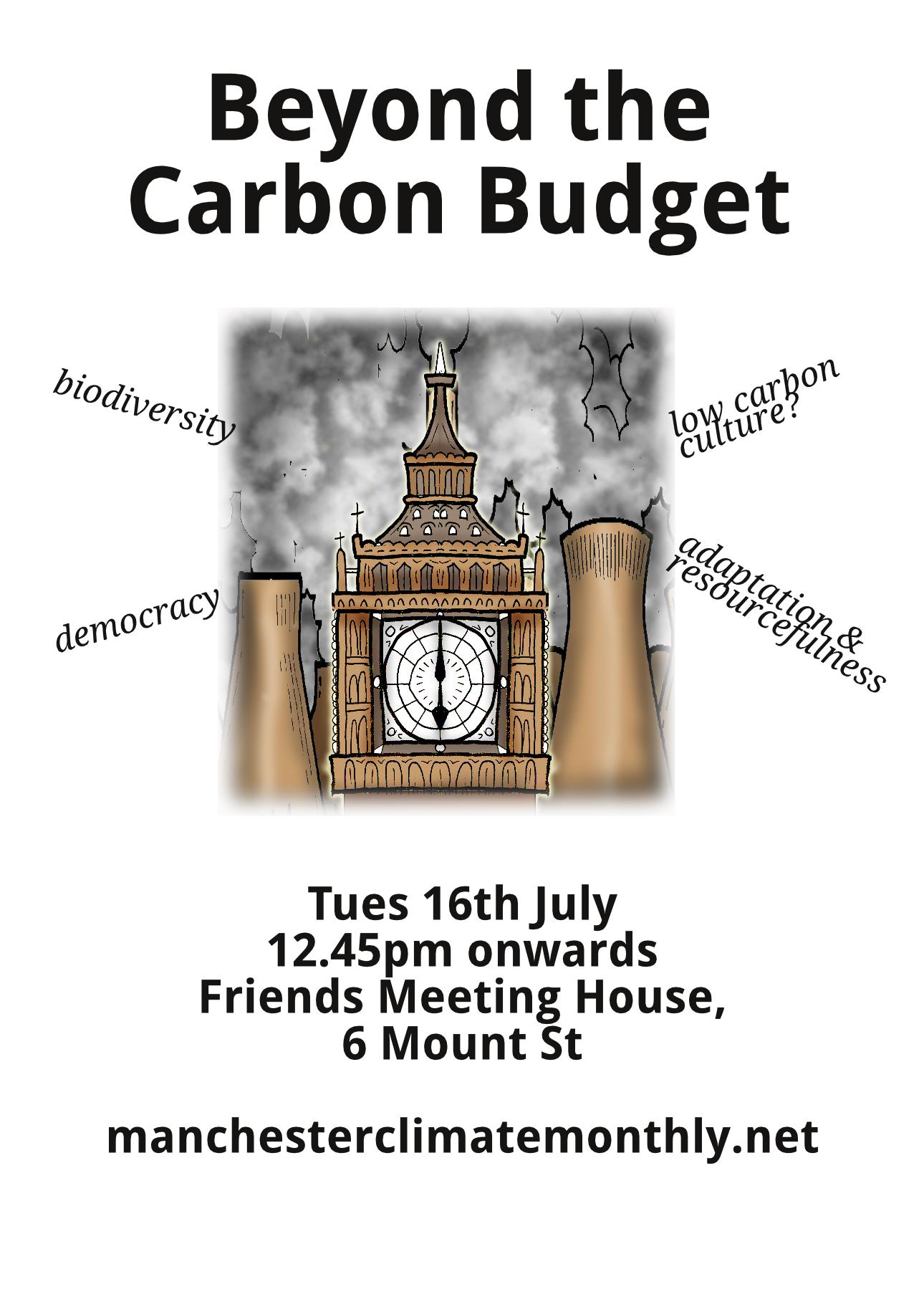
Dave Bishop, a regular writer for Manchester Climate Monthly, explores the damage being done to Manchester’s biodiversity – and what we can do about it. Dave will be launching his report on the state of Manchester’s biodiversity on Tuesday 16th July, at 12.45pm at the Friends Meeting House, as part of our “Beyond the Carbon Budget” event.  Book your ticket here

beyondthecarbonbudget-page001The Convention on Biological Diversity was established in 1992. Following a first meeting in Rio de Janeiro in 1994, the UK produced its first national biodiversity action plan. In 2002 world leaders agreed in Johannesburg on the urgent need to reduce the rate of loss of biodiversity by 2010, and in 2007 they recognised the need to take action to mitigate the impacts of climate change following the 2005 Millennium Ecosystem Assessment.

Globally, the 2010 target was missed, but it prompted at least some conservation action, including here in the UK.

In Nagoya, Japan, in Autumn 2010, the 192 parties to the Convention on Biological Diversity renewed their commitment to take action to halt the alarming global declines of biodiversity and to ensure that by 2020 our natural environment will be resilient and can continue to provide the ecosystem services that are essential for life. Soon after, the coalition government produced an interesting White Paper entitled, ‘The Natural Choice: securing the value of nature’ (2011). This was a fairly bold and imaginative document, although, sadly, it now appears to have “fallen-off-the-radar” (recent statements from the Government suggests that some ministers now tend to see nature conservation as an impediment to economic growth).

But it would appear that, on the ground, in the ‘real world’, the UK is failing dismally to meet its obligations. Recently, a wide-ranging alliance of wildlife conservation groups published a report entitled ‘The State of Nature’  – a comprehensive audit of what has happened to the natural world in Britain over the last half century. The report was co-ordinated and produced by the Royal Society for the Protection of Birds (RSPB) but 24 other bodies took part, ranging from the Bat Conservation Trust to the British Lichen Society.

The report is, essentially, a catalogue of loss. It examines the fates of 3,148 species of mammals, birds, reptiles, amphibians, invertebrates and plants in the British countryside since 1962. It concludes that 60% of these species have declined in numbers, 30% have declined by more than half and 10% are threatened with extinction. Populations of many species – like the House Sparrow or the Garden Tiger Moth – which were common only a couple of decades ago are now in steep decline.

Those of us who take an interest in natural history are not at all surprised by the findings of the report; most of us have had to look on with horror, for the last few decades, at the depressing spectacle of the natural world being brutally dismantled around us. When I arrived in South Manchester 40 years ago, it was surprisingly rich in wildlife, but here biodiversity is as much threatened as it is everywhere else. The reasons for this local decline are blindingly obvious; they are mainly:

Over-development
In the last two decades or so countless green spaces have been built on or concreted over. This includes many suburban gardens which have either been turned into hard standing for cars or ‘decked’. Few recent housing developments seem to include gardens at all.

Inappropriate Management
Few, if any, of our remaining green spaces are managed with nature conservation in mind. They are either ‘manicured to death’ or completely neglected.

Expanding on that last point, I’m convinced that the sympathetic management of grasslands is a major key to saving Britain’s wildlife. Recently, for example, the charity ‘Plantlife’ looked at the management of roadside verges. They found that:

Councils in the UK are destroying wildlife habitats by cutting grass verges too often. The verges supported hundreds of species of flowering plants and should be cut twice a year.

It said that three-quarters of councils it surveyed cut them multiple times. Plantlife received many calls from people “distraught” about the issue.

It is calling on councils to better manage the almost 600,000 acres (240,000 hectares) of roadside verges across the country. The verges support up to 1,000 plant species – including the rare bastard balm and long-leaved helleborine which are among 33 wayside flowers faced with extinction.

Wildflowers are also a vital food source for bees and butterflies, which have seen a significant decline in numbers in recent years.

Wildflowers that are left to seed also feed birds and small mammals.

Plantlife said verges should be cut – and the cuttings removed – once early in the year and again in the late summer. Its survey found they were often cut multiple times over the summer.

None of the councils surveyed collected the cuttings, which rotted down and added nutrients to the soil – making it too rich for most wildflowers

Plantlife’s Trevor Dines said the way road verges were managed encouraged “coarse and thuggish plants” such as nettles, docks and coarse grasses.

“Most verges, smothered in cuttings, might as well be just strips of concrete,” he said.

Returning to South Manchester, one day at the end of May, I walked across Chorlton Park. The park was full of long (ish) grass and profusely flowering dandelions, daisies and other common wild flowers (or “weeds” as our Council probably traditionally thinks of them). The park was also full of bees and other insects seeking out the pollen and nectar from these plants. The next day I had occasion to walk across the park again and all of this richness was in the process of being destroyed by a man on a mower.

Last year, Manchester City Council informed me, in answer to a question that I put to them, that it spent £1.96m per year on mowing grass. Scale that figure up to the whole country and the UK must be spending, at a time of economic crisis, hundreds of millions of pounds per year on a purely cosmetic exercise which is making a major contribution to the destruction of our wildlife. I hear a lot about cutting people’s benefits but I don’t hear anything about cutting the grass less!

And the loss of bees and other pollinating insects is also likely to cost our country dear. A recent report from the University of Reading (‘The Decline of England’s Bees’ by Breeze, T.D., Roberts, S.P.M. & Potts, S.G., 29.04.2012) puts the value of insect-pollinated production for the UK as a whole at £510.2m and North West England alone at £9.5m. But they also acknowledge that:

Beyond crops, bees also pollinate clovers and other nitrogen fixing plants that are important to improving the productivity of pasture systems for livestock grazing which are themselves major agricultural enterprises in Wales, the Highlands and northern and western parts of England. The economic benefits of this are presently unknown but likely to be high.”

But the costs arising from the loss of bees and other pollinators, and the ecosystem services they provide, are likely to be much higher than the cost of conserving them. The Reading report states that:

“To replace pollination services with hand pollination could cost farmers around £1.8bn per year in labour or pollen alone.” This would, of course, render many fruit and vegetables unaffordable and it is highly likely that that it would be uneconomic for growers to produce them in the first place.”

Leaving aside considerations connected with pesticides (e.g. neonicotinoids) and agricultural intensification the report also recommends changes in planning laws to protect and enhance bee habitats:

Despite the importance of bees to the economy and human well-being, new planning guidelines do not provide detailed information for local authorities to develop green infrastructure that can significantly benefit bees, such as allotments and flower-rich road verges. The report recommends that new guidelines are made available to local authorities that better integrate these beneficial options and that environmental damage regulations are strengthened to reduce the negative impacts of development on bee habitats.

As well as visiting Chorlton Park on that day at the end of May, I also took an opportunity to walk along the new cycle path that parallels the new Metrolink line from the East Didsbury station at Parrs Wood to Didsbury village. After noting that the former Parrs Wood allotment site had been tarmacked over to produce a massive car park (more loss of habitat and biodiversity – soon to be followed by a similar car park at Sale Water Park) I set off. Mainly as a result of the recent ground disturbance, many different species of wild plants grew on both sides of the path – many of them in full flower. These flowers were being visited by bees, butterflies and other pollinating insects. Nevertheless, I reflected that, in the summer of 2011, a similar display of biodiversity at the St. Werburgh’s Road stop in Chorlton had been destroyed by being sprayed with herbicide. I hope that the Parrs Wood path-sides will not suffer a similar fate – but it wouldn’t surprise me if they did!

In my opinion Transport for Greater Manchester (TfGM) have completely failed to keep the promises made in their ‘Wildlife Habitat and Tree Replacement Policy’ (http://www.tfgm.com/Corporate/environment/Pages/environment_policy_documents.aspx). In that document they maintain that:

The development of transport infrastructure must ensure the protection and enhancement of protected landscapes, habitats and sites; and take opportunities to protect and enhance biodiversity, for example, through the sympathetic design and location of infrastructure.”

In addition:

In carrying out its development programmes TfGM recognises an obligation to conserve, protect, and where possible, enhance the natural environment and to mitigate the impact on biodiversity and therefore to protect important wildlife habitats and to take full account of new developments on wildlife itself. In addition management and after-care arrangements should be put in place for new habitats to ensure they remain safe, attractive and good for wildlife in the longer term, balanced with the need to provide sustainable public transport.”

All that I have seen so far, as a result of the new Metrolink developments, is massive destruction of local biodiversity and I can think of no credible examples of protection, enhancement or mitigation.

One of (TfGM’s) ‘Best Practice Principles’ described in the document cited above is the following:

improve nature conservation habitat by enhancing habitat connectivity and, where appropriate, by replacing lower nature conservation value (such as mown grassland) by higher value habitat (such as wildflower meadows), for example, the development of wildlife corridors should be considered and the possibilities of linking habitats examined, to enable species to move from one habitat to another (the highest biodiversity benefit is obtained where new habitat is connected to existing habitat);”

I assume that this principle means that Metrolink lines represent wildlife corridors and have the potential to enhance Great Manchester’s biodiversity by linking key sites together (an important principle of modern thinking on biodiversity enhancement). Nevertheless, I use the network frequently and I can see no signs that it is being actively managed as a series of connected wildlife corridors. Indeed, as far as I can ascertain, there appears to be no overall Biodiversity Management Plan for Metrolink embankments. Surely, if TfGM were serious about protecting and enhancing local biodiversity, such a plan should have been in place before any development commenced (?)

Before leaving Metrolink, it’s worth pointing out that the striking disconnect between the promises made in TfGM’s ‘Wildlife Habitat and Tree Replacement Policy’ and what is actually happening ‘on-the-ground’ is not unusual. Most biodiversity action plans and policies, on global, national and local levels appear to be mainly aspirational. Meanwhile, in the ‘real world’, the relentless destruction goes on.

As reported in the Guardian;

In his Autumn statement for 2011, George Osborne stridently attacked environmental regulation describing green policies as a “burden” and a “ridiculous cost” to British businesses.

In a clear attempt to redirect the coalition’s green policies, the chancellor told parliament: “I am worried about the combined impact of the green policies adopted not just in Britain, but also by the European Union … if we burden [British businesses] with endless social and environmental goals – however worthy in their own right – then not only will we not achieve those goals, but the businesses will fail, jobs will be lost, and our country will be poorer.”
Mr. Osborne gave £250m worth of assistance and rebates to the most energy-intensive companies, scrapped a planned rise in fuel duty, announced a massive road-building scheme and hinted at a watering down of regulations to protect British wildlife.

This view that achieving a healthy environment is optional and that in times of economic trouble we should abandon such goals is monumentally wrong on so many levels. Nevertheless, I suspect that what Mr. Osborne said in that statement is what many politicians, of all of the mainstream parties, privately think – that wildlife and the environment are trivial and of no consequence. Mr. Osborne, and his fellow politicians, should heed the words of the American environmental philosopher, David Suzuki:

“Now there are some things in the world we can’t change – gravity, entropy, the speed of light, the first and second Laws of Thermodynamics, and our biological nature that requires clean air, clean water, clean soil, clean energy and biodiversity for our health and well-being. Protecting the biosphere should be our highest priority or else we sicken and die. Other things, like capitalism, free enterprise, the economy, currency, the market, are not forces of nature, we invented them. They are not immutable and we can change them. It makes no sense to elevate economics above the biosphere, for example.”

We must protect the environment – we have no choice.

Dave Bishop,  June 2013

Posted in Biodiversity | Tagged , | 2 Comments

Un-news flash: #Manchester City Council Executive silent on airport #emissions

In perhaps the most unsurprising news since Pope Francis announced he was not in fact Protestant, Hindu, Muslim or Buddhist, the Executive of Manchester City Council this morning approved an update on the “Manchester Airport City Enterprise Zone.” And it did so without even a whisper about the carbon dioxide emissions that are cooking the planet.  MCFly editor Marc Hudson reports.

scrutiny spotters card executive 2014-page001The meeting has already whipped through 12 items at supersonic speed before item 15 was announced. After a brief presentation on the update by the Chief Executive Howard Bernstein, the Deputy Leader of the Executive, Jim Battle (Richard Leese is Away) opened the floor for questions.

The other Deputy Leader, Sue Murphy (see MCFly interview here) welcomed the report and stated that the Council “need to pressure” the Airport (the City Council still owns 35% of it) so that the (skilled and unskilled) jobs that will be generated by building the “Airport City” in fact go to Manchester residents. Simon Wheale, the leader of the ever-shrinking Liberal Democrat group (1), echoed Cllr Murphy’s point and threw in some approving comments about High Speed 2. This was one of the few agenda items on which he was not heckled by Labour councillors.

And none of the other six Executive Members present mentioned the, ahem, “tension” between a planned reduction in the City’s emissions and the growth of Airport City. None of the Assistant Executives present (Akbar, Lone, Rahman and Reeves) spoke.

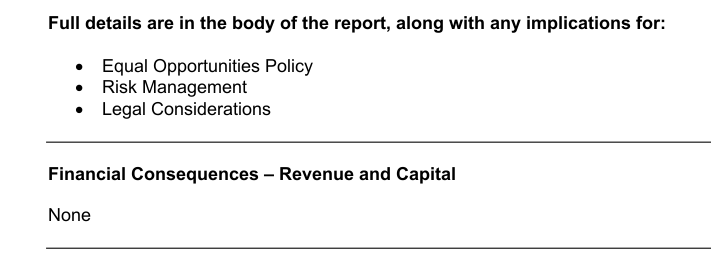
At a Scrutiny Committee meeting earlier this year there had been a proposal – that caused some excitement – that reports should not just name potential implications for the Council’s goals around Equal Opportunities Policy, Risk Management, Legal Considerations and the like, but also environmental goals. No progress yet on this, it seems (the screen grab below is from item 15).  It’s the silences you have to listen to…
implicationsandconsequences

MCFly editor silenced – by himself
Theoretically there could have been an intervention. After all “Members of the public do not have a right to speak at [Executive] meetings but may do so if invited by the Chair.” As it was I fought, and lost, a battle with myself. It seemed, tbh, a little pointless.   If only there was some sort of coalition of campaigners and residents trying to Stop Expansion at Manchester Airport. Or rather, if only there were some sort of actually -existing coalition of campaigners and residents trying to Stop Expansion at Manchester Airport.

So, the health spa will be built, ensuring prosperity for all… And meanwhile, you’re left asking yourself whether Labour will decline to stand candidates against the last remaining Lib Dems in next year’s council elections. After all, if they go, who will the Exec have to sneer and catcall at, in the manner of a rather bored cat toying with an arthritic mouse. Watch this space.

Footnote
(1) There are 9 Liberal Democrats out of the 96 councillors (85 Labour, one Independent). All these Lib Dems were elected in 2010, days before Nick Clegg did his deal with David Cameron. They all face a mildly-challenging re-election campaign next year.

Posted in Aviation, Climate Change Action Plan, Democratic deficit, Manchester Airport, Manchester City Council | 1 Comment

Campaign Update: Friends of the Earth “stunt” Sat 6th July #Manchester

From here

The Campaigns working group have decided that the first campaign shall be a youth-led Make it Better campaign

image
If you don’t know about the National Make it Better campaign, check it out here

Can you help us keep up the pressure on Apple and take part in our tagging stunt on Saturday 6th July?

The Make It Better campaign has been asking Apple whether they use tin from Bangka Island in their products, but so far Apple have refused to publicly answer our question.

We’d like to repeat the stunt in Apple stores:

– Leicester
– London
– Manchester

We’ll provide a full briefing and the materials required, we just need 2 or 3 volunteers to go into each store and attach the tags.

If you’re interested, please email us ASAP – by Friday 28th June at the latest.

It’s an exciting time for Young FoE right now, and here’s a fantastic chance for you to get involved. We hope you can join us!

Posted in Campaign Update, Upcoming Events | Leave a comment

Newsflash: #Manchester City Council to abolish “Head of #Climate Change” role. #tory #greenestgovernmentever?

Council chiefs are about to do away with the role of “Head of Climate Change, Buildings & Energy”, a post only created in 2011.  This move follows closely on the Council’s abolition in March this year of the post of Director of Environmental Strategy, a victim of central government cuts.

In a report entitled “Growth and Neighbourhoods” that will be signed off by the Personnel Committee on Wednesday morning, Council leaders announce

“It is proposed to disestablish the existing post of Head of Climate Change, Buildings & Energy (£57k) and replace this with a post of Assistant Director, Greater Manchester Environment Team (£65k) which will be fully funded by AGMA. This new post will work alongside the Manchester Environmental Strategy Team led by the Head of Policy, Partnerships & Research.”

We asked Manchester City Council for a comment as to what gaps the promotion of an experienced individual would leave, and whether any of the £57k saved would be spent on hiring additional staff within the “Manchester Environmental Strategy Team.”

They quickly gave us the following statement;

Councillor Nigel Murphy, Manchester City Council’s executive member for the environment, said: “We have had to review all of the City Council’s services following the savage government cuts, and the establishment of a new AGMA-funded post makes perfect sense, particularly as much of the work we now do is focused on working with our colleagues across Greater Manchester to address the challenges and opportunities of climate change across the city region.
“This move demonstrates that we still put this issue at the heart of everything we do and, while the harsh reality of the spending cuts mean it will not be possible to hire additional officers, the new assistant director will still use his experience to support the City Council’s own highly skilled team.”

I think Councillor Murphy may be referring to the same government led by one David Cameron, who announced on May 14th 2010 that he wanted the Coalition government to be “greenest ever.”

Marc Hudson
mcmonthly@gmail.com

Posted in Manchester City Council | Tagged , | Leave a comment

Steering Group Chair? A Multiple Choice quiz #manchester #climate #acretinfuture

The story so far; In March an advert was put out for someone to take over the unpaid role of Steering Group chair (#poisonedchalice).

At the time the original deadline closed only one entry (#MCFly #tongueincheek) had been received.

So the deadline was extended for a month and two more applications were received (#arm-twisting).

These other two were short-listed (#MCFlysnubbedandgutted), and interviews took place in the week beginning 20th May.

Since then? (#silence)

A couple of weeks ago we asked for an update – (#whassup?)

After two emails and a phone call (#exemplarytransparency #exemplaryresponsiveness) we were told “I will liaise with colleagues and either myself or Jonny will respond to your questions in due course.” (#fobbedoff)

So we thought we’d be pro-active…

Dear [officer],

we know how busy you are, so we thought we ‘d try to be helpful, and lay out the four (well, three and then we cheat) possible answers to the basic question of what has happened to the appointment process for a New Chair.

a) A candidate was offered the job when interviewed a month ago, and has accepted. In keeping with Manchester’s high-profile commitment to the Green (Growth) Agenda , the City Council’s Press Team have (sic) been trying to build an air of anticipation, hoping that national press would become interested by our waiting game. Sadly, this hasn’t quite worked out. Painful as it is to admit, Manchester Climate Monthly is the only media outlet that has been paying any attention whatsoever. We’re announcing the new chair tomorrow, and we’re giving the Didsbury East Bugle the scoop.

b) Unfortunately neither of the highly-qualified candidates who were offered the job a month ago felt able to devote the time to it that was needed. One told us “I only applied because you promised me you wouldn’t offer me the damn thing. This amount of arm-twisting is not humerous.” Therefore the Steering Group and Groundshirk have decided to boldly distribute the roles and responsibilities that would have been undertaken by chair among themselves. Manchester City Council looks forward to working with the Group to ensure a Greener and More Prosperous future for the city [cont page 94)

c) Sigh. Out to advert again. Don’t bother applying, Marc.

d) None of the above.

And with the time we have saved you,  could you contact the Steering Group admin people and ask them to explain why the page that used to host the Steering Group minutes – http://www.manchesterclimate.com/node/3768 is now coming back “page not found”? And why the minutes are nowhere else to be found (by me at least) on the manchesterclimate.con website. #memoryhole?

Don’t worry though, months ago we downloaded the pdfs of all those wonderful productive meetings.   They made for highly entertaining reading.

Posted in Climate Change Action Plan, Democratic deficit, Manchester City Council | Tagged | Leave a comment

#Manchester #climate nuggets June 24th 2013

Hi all,

The next Manchester Climate Monthly comes out on Monday July 1st. So you just have 4 days to get us all your news for that edition. Don’t delay, spam mcmonthly@gmail.com today!

Also, with the departure of MCFly co-editor Arwa Aburawa for wealthier climes (London), volunteering for MCFly becomes even more attractive (everyone knows she was the bad cop in the good cop/bad cop dyad, no?) mcmonthly@gmail.com for more details

Wanna flex your creative muscles, and maybe win £200?   Here’s the details of our short story contest all sorted.  Two thousand words (in English) on the subject “Manchester (UK) in a warmer world.”

 Marc Hudson

Coming up this week

Thursday 27th June 10.30-5pm, Seminar 2 – Community Building Retrofit – investing in large scale energy efficiency

Bridge 5 Mill, 22a Beswick Street, Ancoats, Manchester

  • Do you run or own a community building such as a Community Hub or Church Hall?
  • Is the building cold and under-heated yet utility bills skyrocketing?
  • Would you like to invest in energy efficiency but don’t know where to start

Carbon Co-op is delivering a free seminar on community building retrofit. This seminar is for organisations that wish to make investments in their building to achieve large savings in energy bills and carbon emissions. We will go way beyond measures such as changing light bulbs or turning computer monitors to standby.

Issues covered:

  • Assessments: understanding energy usage and creating an action plan
  • Heating systems eg biomass boilers, solar hot water
  • Installing energy generation eg solar panels
  • Case studies from organisations who have delivered successful community building retrofit projects
  • Finance options
  • Featuring advice on retrofit from award winning consultants URBED

Speakers:

  • Marianne Heaslip, URBED
  • Frank McGrath, Riversmeet, Cockermouth
  • TBC: Cumbria Action for Sustainability

Cost: Free

To book: the seminar is open to any community organisation but those who own or run community buildings in Greater Manchester will be prioritised. Complete and return this application form to jonathan@carbon.coop to attend.

Thurs 27th June, 6pm “Fuelling Manchester,” Manchester City Centre.

Stories you may have missed on the MCFly website

Stuff to read if you think you’re too happy

Wars a-comin’

The Antarctic is melting from underneath

Six extensive adaptation plans.  Manchester not among them?!

Ally Fogg, who has a minor gig with Kindling Trust,  on a “How a Manchester co-op is getting the food revolution going”

Posted in Weekly bulletins | Leave a comment

Cross Post: “Oxford Road Consultation – Respond Now!” #cycling #consultation #manchester #tfgm

From Mad Cycle Lanes of Manchester…

This is the most important consultation for cycling in many years in Manchester. This consultation is for the bus priority package along Oxford Road, but it is also the busiest cycle route in Manchester so if TfGM get this route right it sets the standard for the rest of the city.

The closing date is Friday 5 July 2013.

The current plan is to remove all lorries, vans, private cars, motorbikes and private hire vehicles from the section covering the university and hospital and impose a 20mph speed limit. As a result there will be many motoring groups, shop owners and others lobbying against this scheme.

Cycling could lose out if we don’t all respond to support the main principles of the scheme. However the details of the cycle route are not all as good as they should be, so we need to respond to agree with the removal of the traffic and the principle of protecting people cycling from the buses and then press for a much higher quality of cycle route design than is currently proposed.

Here is a video showing how this kind of cycle route is designed in the Netherlands with continuous cycle tracks that give priority across junctions and pass round the back of bus stops without conflict.

———————

How to Respond.

Take a look at this video to see what is proposed, and notice how the cycle tracks could be improved.

If you need more information you can download the leaflet but it doesn’t show the same cycle track details.

Then compose your response in a text editor of some sort because there isn’t space in the web form to see everything you have written.

Write as little or as much as you feel appropriate, but please remember to:-

1) Support the removal of the traffic from this route.

2) Support the 20mph speed limit.

3) Support the idea of a high quality cycle route, protected from the bus traffic.

4) Call for the cycle route design to be improved – if necessary by employing experienced engineers from the Netherlands to finalise the design.

5) And if you regularly cycle along Oxford Road then include this information in your response and write about your current experience and how you want it to improve.

Once you have written your response, then visit the online form, fill in your name, full address, postcode and email address. It is important that our responses are seen to come from individuals who live in the area.

Then copy and paste your text into the box marked “Your views*”, scroll through to check it’s all there and hit the submit button.

Then tell every cyclist you know to do the same…

———————-
You can also send your response by email to buspriority@tfgm.com or post it to

Transport for Greater Manchester bus priority,
FREEPOST RRHE-RKUU-KSJY,
Manchester,
M1 3BG

———————-

Update:

I’ve now sent my response in.

I’ve also called for the cycle tracks to be suitable for all types of cycles including hand-cycles, rickshaws and cargo cycles.

I’ve also called for physical barriers between the cycle track and the Bus/Taxi lane to stop taxi drivers pulling off onto the cycle track to drop off passengers.

————————-

Further update

I have just received an email admitting that the cycle tracks along Oxford Road will be inconvenient for many cyclists and the writer will be using the road.

We must call for high quality Dutch provision. In the Netherlands you do not see lots of people refusing to use the cycle tracks because they are crap!

Posted in Campaign Update, Manchester City Council, Transport | Tagged , | 3 Comments

Airports Commission Public Evidence Session #Manchester Tues 9th July

The government has a policy – don’ t laugh – about “Making sure UK airports and airlines are safe, secure and competitive while reducing their impacts on the environment and communities.

To this end, they’re holding some “public evidence” sessions…

Airports Commission Public Evidence Sessions
The Airports Commission will hold public evidence sessions on Tuesday 9th July 2013 in Manchester.
The sessions will be chaired by Sir Howard Davies and he will be joined on the panel by the other Commissioners.
The sessions are focused on the Commission’s work assessing the nature, scale and timing of the UK’s aviation needs. They will develop the evidence base on the subjects of the discussion papers – demand forecasting, connectivity, climate change and airport operational models – published by the Commission earlier this year.
The purpose of these evidence sessions will not be to discuss any specific potential locations for new aviation capacity. The Commission intends to hold further public evidence sessions on this issue in 2014, should it conclude in its interim report that additional aviation capacity is needed.

Evidence Session Timetable
July 9th – Reception Room, Manchester Town Hall, M60 2LA
09.15-11.00: Aviation and Climate Change
11.30-13.15: Aviation Demand and Connectivity

Evidence Session Structure
The Airports Commission has invited a small number of witnesses to take part, in parallel, in each session and each session will be structured as follows:
Part 1
Part 2
Part 3
Each witness gives a presentation setting out their key arguments and evidence (c. 20 minutes in total)
Questions from the Commissioners to witnesses (c. 60 minutes)
Statements from stakeholders in the public gallery (c. 25 minutes):

How to Participate
The Airports Commission invites stakeholders and the media to attend the evidence sessions. This is an excellent opportunity to hear the key issues debated in a public forum and to contribute to the debate.
Each venue is set up to accommodate stakeholders and media in the public gallery but access to each venue requires prior notification to the Airports Commission. Please notify david.elvy@airports.gsi.gov.uk whether your organisation intends to attend and the name of the person or persons representing you.
The Commission’s communications manager, David Elvy, can provide further details and he can be contacted on 020 7227 5343.

What Happens Next?
Full transcripts of the evidence sessions will be published on the Airports Commission website.

Posted in Aviation | Tagged , | 1 Comment