Of #Manchester and its carbon budget – interview with Dr Joe Blakey

Dr Joe Blakey is a Lecturer in Geography at The University of Manchester. His research focuses on the ways in which carbon accounting shapes politics surrounding decarbonisation. He also works with the Manchester CO2 Monitoring Group to maintain the aviation emissions inventory for flights departing Manchester Airport and tracks progress against the Manchester’s previous 2005-2020 carbon budget.


In simple terms, what is a carbon budget, and why does Manchester need one?

It’s a well-worn analogy, but a carbon budget is a diet plan. The ideas is that you restrict the amount of carbon we consume over a period of time. Limiting the amount of carbon we can emit is a really good idea because continuing to pump carbon in to the atmosphere is a little like having someone pile lots of blankets on you when you are already too hot. The planet is going to get hotter and we cannot simply kick these extra layers of carbon off. The effects of this are already being felt – the planet has already warmed by 1 degree against pre-industrial levels.

Ideally, we need to limit the amount of carbon we can use by as much as possible as soon as we can. The trouble is, carbon emissions underpin pretty much everything we do. So scientists have said that if we really must keep emitting carbon it would be best to limit warming to somewhere around 1.5 degrees (gain pre-industrial levels) to avoid the worst effects and definitely not more than 2 degrees. As such, there is a limited amount of carbon we can pump in to the atmosphere whilst staying within this safer (but still not safe) level of warming. But with a finite amount of carbon who gets to emit what?

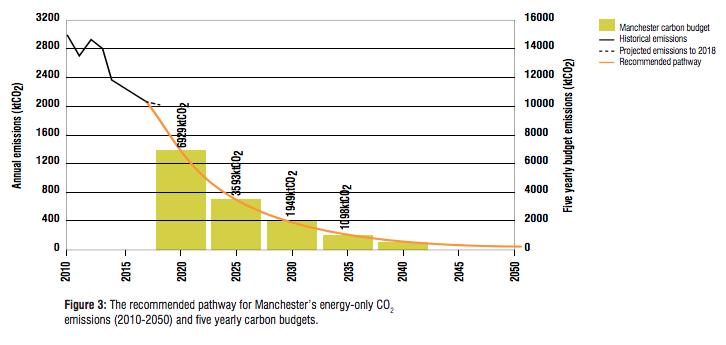
Last year Manchester adopted a carbon budget of 15 MtCO2 (‘million tonnes of carbon dioxidet’), which is the amount of carbon that its allowed to use between 2018 and 2100. This is also the amount that the Tyndall Centre think is Manchester’s fair share to stay within 2 degrees of warming without gambling on yet-unrealised technologies to suck carbon out of the atmosphere. Manchester has not presently considered what role it could play in holding global average temperature to 1.5 degrees. We used just over 2 MtCO2 last year so we now have around 13 MtCO2 left for 2019 and onwards. If we keep emissions at this level we will have no budget left by 2025. We need to start cutting our emissions if the budget is going to last us. We’d be foolish to use all of our carbon budget now. That’s why Tyndall have said we should start making pretty substantial cuts – now of around 13.5%  – every year.

Everyone seems to be talking about ‘zero-carbon’, ‘net-zero’ or ‘carbon neutral’ lately. Manchester has said it will go zero-carbon by 2038. On the one hand, there’s good reason for this, but I also want to stress that it is not the most important thing to think or debate about and it risks becoming a major distraction. Given that we have such a small budget, it’s pretty obvious that we need to get our emissions down to pretty much nothing as soon as we can and live our lives that way subsequently. That’s where the idea of zero-carbon comes in and why it matters. An earlier target also gives a sense of urgency and facilitates less of a time span to keep emitting at high levels. But what matters even more than the date we go zero is the total (‘cumulative’) amount of emissions that we emit year on year from 2018 to 2100. We have got to stay within that 15 MtCO2 budget. It’s completely possible that we could completely blow this budget by a few million tonnes and then subsequently reduce our emissions to go zero by 2038, 2035, even 2030. Although this would require some pretty steep and unprecedented reductions. On the other hand, we could make our 15 MtCO2 budget last longer by using less now. This is why we should not be too distracted by the zero-carbon target date and should focus instead on how much of the budget we are using up each year.

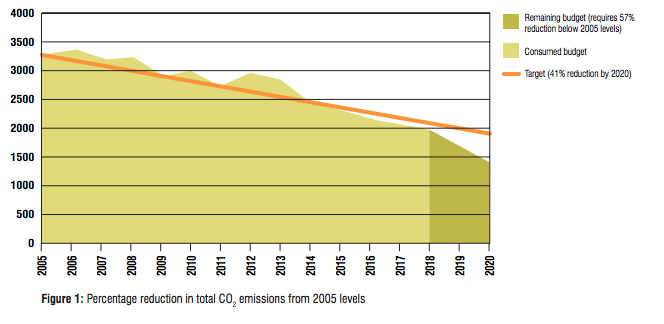
We can see a similar issue with the Manchester’s previous budget even though we are not too far off track for that. Way back in 2009, the city’s climate change action plan Manchester: a Certain Future said that by the year 2020 emissions will be 41% of what they were in 2005 and this will probably be the case. This is all well and good if emission decrease in a straight line, but that’s not what happened. This is why in 2015, the CO2 group translated this end-year target in to a cumulative carbon budget of 41.7 MtCO2, counting all of the emissions released 2005-2020. As we struggled in the first few years it looks like we are going to slightly exceed this. If we decarbonise at the same rate across 19/20 and estimates for previous year do not change too much, we are probably going to use around 0.5 MtCO2 extra than budgeted. This would be a relatively small overshoot, but it is still an overshoot. My broader point here is that the 41% end-year target (much like the zero-carbon target date) is not the important thing to focus on as it is not the whole story. That’s like saying you are sticking to your diet on the basis of your actions today, but ignoring yesterday’s indulgence. The same is true for zero-carbon, we absolutely need to get there but what matters more is how much we emit between now and then – regardless of when ‘then’ may be.

In sum, the weight of our footprint is tipping the scales to ‘dangerous’. We are risking the planet’s health more than ever and its serious time we all got ourselves in to shape. To do so, we need to budget carbon and we need to stick to this budget. When we go ‘zero’ matters, but the more important thing is the amount of carbon we use in the meantime. We had 41.7 MtCO2 to last us 15 years (2005-2020) which will probably exceed, we have now got just 13 MtCO2* to last us 81 years (2019-2100). We really need to spend it wisely.

*Deducting emissions in 2018 that are already locked in.

What does the current budget include and what does it NOT include?

This is where it gets a bit complicated. But that’s okay, because our carbon footprints are complicated things! I’d argue we need to complicate simplistic understandings that do not grasp the complex role cities play in emissions all across the planet. So the more people that understand this the better. There’s a few things we can think about under two main categories: the first is about what share of the global emissions budget we get, the second is about what emissions we count as belonging to Manchester.

A really radical perspective would be to say that because the UK has used so much carbon historically to its gain – and often to the disadvantage of other nations – that the UK (and its cities) should not have an equal share to everyone else. However, we have emitted so much historic carbon that there would already be no budget left! This idea, historical emissions responsibility, is usually ignored, therefore. But if we can use less that 15 MtCO2 2018-2100 then that means nations, cities and people who have emitted less historically have that little bit more wiggle room in their own budgets or that global emissions are further limited, which is a good thing as that might go some way to limiting temperatures closer to 1.5 degrees.

Now, it’s also important to think about what emissions we count and assign to Manchester each year. As a Geographer, I’m keen to point out that different spaces, cities, regions – even nations – cannot be neatly parcelled off, despite carbon accountants’ best efforts! Manchester has people, goods and money flow into, out of and through it every single day. Imagine a cup of Kenyan coffee consumed in an American coffee chain in Manchester city centre by a visitor from Liverpool. There are a whole host of emissions that can be associated with this cup of coffee – but who gets the blame?

It’s interesting to compare this thought experiment to what we presently account. Picture a map of Manchester in your mind and draw a line around the political boundary. The carbon that is emitted within that line is what is counted – we call this ‘scope 1’ or direct emissions. We also count the emissions that are consequent of the electricity consumed within it, regardless of where it is generated. We call this ‘scope 2’ emissions. Combine the number of tonnes of carbon for scope 1 and scope 2 and you pretty much have the footprint of Manchester as we presently count it. So to return to the coffee analogy, we might count the emissions from the electricity that enables the grinding the beans, the preparing of the cup of coffee and heating the building, but none of the emissions that accompany the transport of the bean.

So you’re beginning to see that there are other ways that we can count our footprint. We can count the emissions that go in to producing and transporting the coffee – along the rest of the goods and services – that we consume in the city regardless of where they are emitted. This is a consumption-based or ‘scope 3’ footprint and it shows a different perspective on our carbon footprint. Equally, if something is produced in Manchester but is consumed elsewhere these emissions would not be counted under this approach. It’s a little harder to count these emissions but it’s important we have a rough idea of them and reduce them. The C40 reckon that cities footprints are around 60% larger under a consumption-based perspective. This makes sense as we’re primarily a service sector economy, much of our food and goods come from elsewhere. Similarly, I’d argue you might also count emissions consequent from investments made from Manchester. These are known as downstream-enabled emissions or income-based emissions. There’s not much research on this, but cities like Manchester and London would clearly have quite large footprints from this perspective.

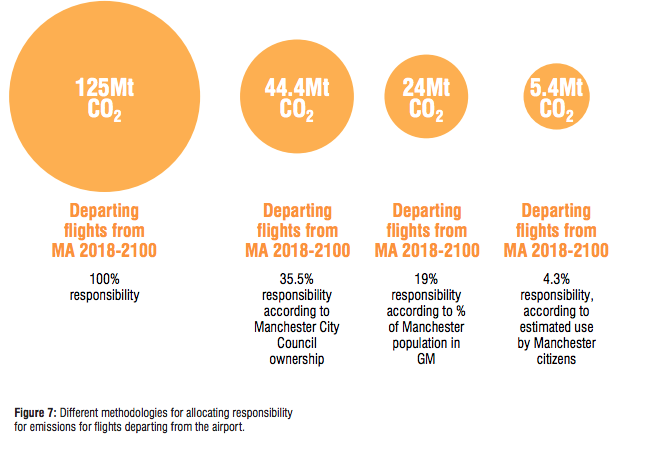
Then there’s everyone’s favourite elephant in the room – aviation. Technically speaking, aviation would be included in a consumption-based inventory but it is worth mentioning separately given its significance. Everyone says that aviation is not including in the city’s zero-carbon budget, but in a way it is. It has been relegated to the background and it is not included in the total yearly figures for the city. Let me explain. The airport is within the city’s boundary, the city council own a 35.5% share of Manchester Airports Group (which also owns London Stansted and East Midlands airports), I’m told it has a massive effect on our local economy, whilst simultaneously flights serve the wider region, the economies of flight destinations and tourists from elsewhere. It is a messy, messy thing to say what responsibility the city should take for these flights. Most people will argue that quite intuitively we should only take responsibility for the emissions of flights taken by citizens of Manchester, but this is only somewhere in the region of around 4.5% of flights from Manchester Airport. A stark difference from our 35.5% ownership! I think this would be selling our capacity to intervene short. Though of course, it’s important to note that Manchester citizens take flights from elsewhere too.

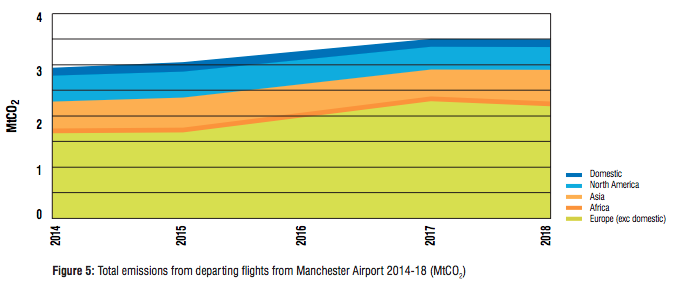
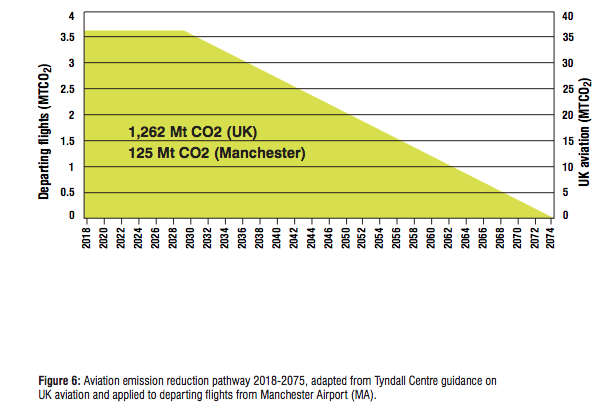
Now, here’s the interesting thing. In order to set the city’s zero-carbon budget and to keep it in line with a probable chance of keeping within 2 degrees, the folks at Tyndall had to make certain assumptions about what happens to aviation (and shipping too). The assumption is, that for UK aviation as a whole, emissions should hold steady from 2018 until 2030 and then decrease linearly (in a straight line) until 2075. This is a huge amount of headroom for aviation – a budget of 1,262 MtCO2. That’s about the same as 84 Manchesters. The emissions profiles of all airports and indeed Manchester citizens needs to do the same. I really want to stress this point, the council have signed up to the budget of 15 MtCO2 for the city and that budget only holds if these assumptions about aviation are realised. So my solution here is to suggest that we start monitoring aviation emissions separately – and that’s what I’ve been doing working with colleagues in the Manchester CO2 Monitoring Group. Emissions from flights departing Manchester Airport were around 3.6 MtCO2 last year, so we know we need to hold it at or below this level until 2030 before expecting some pretty deep cuts. This works out as a carbon budget of about 125 MtCO2 for all flights leaving the airport between 2018 and 2075. This is the equivalent to Manchester’s budget around 8 times over, but again, this isn’t a simple comparison as the airport serves other cities. But the point is there are lots of roles the city can play and we need to keep them all on the table.

So as you can see – there’s not one ‘correct’ way of counting a carbon footprint – be that the footprint of the city or the airport. ‘Science’ does not have an answer for this. This is a political question and, I’d argue historically this has probably been a bit of a pragmatic question too in terms of what is manageable to measure. If you like, these perspectives all correspond to different levers we can pull in reducing our carbon footprint. But as far as I can tell, most of our efforts have gone into pulling the lever that corresponds to our scope 1 and 2 emissions. It strikes me that in a climate emergency you grasp every lever you can and pull them with as much might as you can muster. I’m not saying that there isn’t any action in these areas, there’s lots of good work. But we need a better sense of how our action in these other domains stacks up against what is necessary to mitigate planetary emissions and that’s hard to judge. Though I’d argue that our relative inaction in these other areas is nonetheless quite tangible. I look around and I see the new buildings going up, with heaps of consumption-based emissions, I see new burger restaurants, I see plans for airport expansions, I see a thriving financial-services sector and wonder where the money is being invested, I see the protests outside the Greater Manchester Pension Fund HQ in my hometown of Droylsden. We clearly need a tighter rein on what’s happening here. If we’re not doing very well with our scope 1 and 2 budget we should be trying much harder to pull these other levers of change too. I’d argue we have a moral imperative to.

One final thing I’d mention here is that it’s important to think about zero-carbon in the context of these other levers of decarbonisation. Imagine if we carried on measuring, monitoring and ‘managing’ our emissions as we do and that, incredibly, we managed to go zero-carbon yet at the same time China’s emissions were still high. Would this be their fault when we’re still investing over there and consuming the goods they produce? This is why the term makes me gravely uncomfortable – it risks ‘greenwashing’. I’d argue we’d be better off talking about zero-carbon energy for this reason over the catch all of ‘zero-carbon cities’.

How are we doing in meeting our current budget?

Not very well! In the latest annual report Dr Jaise Kuriakose of the Tyndall Centre noted that we reduced our scope 1 and 2 budget by 2.5% against the 13% we are aiming for. This is why we now have to aim to reduce emissions by 13.5% year on year. I think it’s important to keep the order of magnitude in mind here. We need to make cuts that are over 5 times greater. This will probably be even more than 5 times harder as we tend to do the easy stuff first. Emissions from flights departing Manchester Airport actually stayed pretty level between 2017 and 2018, so who knows, we might actually be within a chance of keeping these emissions steady until 2030 yet.

Given that, does it make any sense to push for a steeper target?

A difficult question. At some point we have got to question what role these targets are serving and whether they are effective. We’re clearly way off our present target which – as it’s aimed keeping us within 2 degrees warming – is arguably the minimum role we can play. Action just isn’t aligning with the targets and that needs to change first and foremost. But it would be wonderful if we could just use 10 MtCO2 2018-2100 or less, though given the present lack of progress this is highly unlikely. It would be pointless revising the target if it is just going to be ignored, so I’d argue that effort might be better spent making the city more accountable and more reactive to its present carbon budget. We need year-on-year emissions reductions to be as deep and as radical as possible and we should do everything we can. The previous carbon budget was about having slightly smaller portions of carbon. The 2018-2100 budget now needs to be full-on carbon rationing. We need to treat this emergency as an emergency.

It’s also interesting you mention a steeper target. Our emissions reductions will de facto have to be steeper to stay in budget if we keep up our current level of inaction. We’ve literally just seen that this year, because we’ve not made the cuts of 13% required we need to make 13.5% year on year reductions. We probably won’t make the target this year and the target will be steeper again next year. The longer we delay the steeper – and therefore less feasible – this reduction gets.

This means making some uncomfortable choices right now, sacrificing at least some short-term economic benefits where we can without compromising the wellbeing of your everyday citizen if we’re really serious about our reductions. If we get our reductions up to scratch and we can realise we can make even deeper cuts then let’s go for it, but presently this appear a pipe dream. I would also argue that we should be pulling some of those other levers too and pressing for action on them, especially if we’re failing on the usual front, which I guess leads me on to your next question…

e. What sorts of things would we have to start doing that we aren’t doing, that we aren’t even TALKING about to get to a better target.

I’m going to deliver my answer to this one as a list. I’ll take the target as meaning ‘avoiding dangerous levels of warming’ – which is surely the best target!:

  1. 2018-2038 is a long period and we’re already way off track. I think we need more short term focus as part of this and that Manchester should be held to account over shorter sub-budgets. We especially need action in the near term.
  2. I understand the want to increase ambition in Manchester. However, instead of pressing for an earlier zero-carbon date, pressing for a smaller cumulative emissions budget would be more effective in limiting dangerous warming (but the likelihood of this translating in to action given current levels of inaction is perhaps questionable).
  3. We should think about the ways we can repay historically low-emitting nations in other ways if we can no longer make good on our historical emissions debt.
  4. We should stop talking about our scope 1 and 2 footprint as ‘our carbon footprint’. Simply put, it isn’t. It’s one perspective on what our carbon footprint is and as I discussed above there are other levers we can pull. This general assumption depoliticises other perspectives on how we can act.
  5. Closely related to this, we need to make other levers of decarbonisation visible – divestment, consumption-based emissions, aviation, transport beyond the city boundary and so forth. These need to be made visible, we need to understand their role in decarbonisation and we need to act on them.
  6. We should talk more specifically about what the current zero-carbon ambition actually refers to, which is mostly to do with how we heat and fuel the city, it should not be a city branding exercise. We are currently nowhere near zero-carbon and if we did become ‘zero-carbon’ we would probably still be responsible for other carbon emissions.
  7. I think we need to stop focusing on decarbonisation as solely a collective pursuit. It is, sure, and this helps to bring people together which is good. But we talk so often about decarbonisation being a common responsibility we forget that the United Nations Framework Convention on Climate Change enshrined the principle of common but differentiated responsibilities. In other words, there’s a whole politics to how we divide up responsibility for action that science does not have the answer to and that we should debate more in deciding what nation, what business, what person does what. For instance, I would argue that the people who profit most have a greater capacity to act. The world’s richest 10% are responsible for almost half of consumption-based emissions. Sure, turning the lights off here and there will help, but not to the same extent as if the top 10% stop leading carbon-intensive lifestyles. We all have a part to play but some have an ability – or an ought – to play a much bigger part! If you earn more than about £53,000 before tax you’re in the top 10% of earners in the UK, but in reality this threshold is much lower given inequalities between the average UK wage and the rest of the world. There’s more people in this category than you might initially think.
  8. Finally, targets are a promise for tomorrow that may go unfulfilled. We need action that corresponds to targets too.

What would an open and transparent process to discuss changing the target involve, in your opinion? Who would do what when to make that process open and transparent.

The way in which the climate has been governed in this city over the past decade might be called governance beyond the state. In other words, a group of stakeholders comes together to represent the city, decides what we ought to do and makes recommendations to the City Council. As part of this, expert advice from the Universities – and in particular the Tyndall Centre – plays a key role.

Getting the right people together to decide on the fate of their lives is clearly a good idea, but the idea of a stakeholder is actually really complicated. Who ultimately is a stakeholder? Is it people who have knowledge about climate change, is it someone who will be affected by the decisions, is it someone that just lives in the place? Might we argue that communities subject to drought are also stakeholders? What about species under the threat of extinction that cannot speak for themselves? There’s so many ways of cutting the cake of who is a stakeholder. Even when you have ‘stakeholders’ in a room they’re not all going to agree on absolutely everything but decisions nonetheless have to get made. As much as we might try to include people – and we should absolutely try – there will always be voices that go unheard. In short, there’s not one way that we can best govern the city’s climate change policy so I have no perfect answer for you here. This is why there will always be a place for activism to make the unheard heard and the better governance arrangement is surely the one that is receptive to that.

So that’s why I’m not going to offer an all-singing all-dancing vision of a ‘process’ as my suggestion would be imperfect too. But acknowledging the limitations of the stakeholder process can surely push us in a helpful direction. I feel this should be the central principal of how proceed and this should mean three things: that the city is open to suggestions of how better to do things, that citizens hold the process to account and that, despite these difficulties, we still give it a really good shot at being inclusive. But this of course – as you mention – requires transparency on all levels, be this in providing minutes, holding public meetings or providing a diversity of data. Science can help to this end by showing us multiple perspective on our carbon footprint and reduction targets. This at least it creates a broader space of debate about what levers we should be pulling, to what extent and when that is not confined to meeting rooms.

Posted in Interview, Manchester City Council | 2 Comments

Exclusive: Great Ancoats St – #MANCHESTER COUNCIL EXEC IGNORES RESIDENTS & COUNCILLORS

Manchester City Council is NOT intending to undertake any additional consultation on the controversial Great Ancoats St raod-changes, which would see existing cycle lanes axed. Despite the best efforts of many many citizens, and the unanimous agreement of the Neighbourhoods and Environment Scrutiny Committee last week that the consultation was inadequate, the Council intends to plough on.  Last week the NESC said the matter would be referred to ‘the Executive’. Well, in this case it turns out to that that means one officer and one councillor.

More reaction to this soon, but for now, the full text of the email sent by the relevant Executive Member for the Environment, Angeliki Stogia (Labour, Whalley Range), to a resident.

Posted in Uncategorized | Leave a comment

Greater #Manchester Climate Emergencies, Pension Funds and… shark jumping?

Two pieces of news and one mild-by-MCFly-standards rant.

News the first –
1. It seems that the airport-expanding greenfields-building chaps (and it is mostly chaps) at Greater Manchester Combined Authority have decided that they’d best join the crowd and declare a ‘climate emergency’.   According to this exclusive report in the Local Government Chronicle, the declaration will be made today.

Greater Manchester will then become the fourth combined authority to have declared a climate emergency, after West Midlands CA did so earlier this month,

Liverpool City Region declared on 28 May and West Yorkshire CA declared on 27 June.

News the second –

2. Activists are going to gather in Tameside to protest outside the meeting of the Fossil-Fuel-loving Greater Manchester Pension Fund (see MCFLy previous post) . As per a tweet-

@FFFManchester is taking at team tram trip to Droylesden to encourage Manchester pension fund to divest. See you there at 12:30. Deets here: facebook.com/events/9050012


3.  Can this get any more shark-jumpy?   Who will next declare a Climate Emergency?  Virgin Airlines? BP?  The Global Warming Policy Foundation?

I know it is obvious, but it bears repeating.

In. The. Absence. Of. Innovation. From. Social. Movements. Away. From. Emotacyclic-Peak-Emotional-Resonance-Moments. Towards. Granular- Day-In-Day-Out-Engagement. With. Local. Policy. And. Local. Policymakers. We. Will. Probably. End. Up. With. The. Same. Result.

And even if we do all that, we’re still probably toast. But let’s at least give ourselves a fighting chance? FFS.

Posted in Campaign Update | 1 Comment

Campaigners call on GM Pension Fund to help tackle the climate crisis (Fossil Free Greater Manchester)

From a press release,  which doesn’t mention that in its Climate Emergency Declaration last week, Manchester City Council committed to the following (Item 19)  Through our role on GMPF, encourage divestment in fossil fuels as early as possible


Campaigners will demand that Greater Manchester Pension Fund (GMPF) join the growing movement to tackle climate change when they gather at the Fund’s offices at 12.30 on 19 July .

The Fund is the largest local government pension fund in the UK. [1] According to a 2018 report, over 10% of the fund – up to £2 billion – is invested in oil, gas and mining companies, making it the dirtiest pension fund in the country. [2]

“We need to act together to tackle climate change. GMPF is totally out of touch with the public mood and has no clear plan for urgently taking pensioners’ money out of fossil fuels” said Fossil Free Greater Manchester member Stuart Bowman [3].

Scientists have been warning of the climate crisis for years. The UN’s Intergovernmental Panel on Climate Change (IPCC) has made it clear that immediate action is required to limit global warming [4].

Parliament, the Labour Party and several Greater Manchester councils have declared a climate emergency. The GM Combined Authority want the region to be one of the greenest places in Europe. Young people are demanding urgent action and both the Governor of the Bank of England and the Pensions Minister have warned of the danger of continuing to invest in fossil fuels as we move towards renewable energy. Yet still GMPF invests in companies that are driving climate change.

“The carbon budgets we developed for Greater Manchester are intended to meet the Paris Agreement’s temperature objectives. To keep within this limit 80% of exploitable coal, oil and gas reserves have to remain under the ground. We need to tackle both the demand for fossil fuels and the supply and divesting is an effective way to do this.” Dr John Broderick, Tyndall Centre on Climate Change, University of Manchester.

Bowman added “Despite the changing public mood, GMPF is failing to act, putting pensioners’ money at risk and adding to the climate crisis. Where it was once considered a leader, GMPF is now lagging behind other pension funds in its glacial response to the climate emergency”.

A growing number of local authority pension funds have already begun to sell their investments in fossil fuels, including South Yorkshire, Lambeth and Haringey. Globally over 1,000 institutions have done so, with commitments to divest over US$9 trillion. [5]

ENDS

NOTES TO THE EDITOR

[1] The Greater Manchester Pension Fund (GMPF) is the UK’s biggest local authority pension fund with over 370,000 members and over £22 billion in assets.

[2] See Fuelling the Fire.

[3] Fossil Free Greater Manchester is a coalition of organisations and individuals calling upon the GMPF to:

Make the fund fossil free within the next 2 years.

Immediately move all investments out of the most polluting fossil fuels (coal, tar sands & fracking).

Develop a strategy to invest in local climate solutions in Greater Manchester.

[4] The International Panel on Climate Change (IPCC http://www.ipcc.ch) is the leading world body on climate change. Its Special Report on Global Warming of 1.5°C https://www.ipcc.ch/sr15/ published on 7th October states that global emissions of carbon dioxide (CO2) need to fall by 45% by 2030 or we risk catastrophic change. It has been estimated that over 80% of fossil fuels must be kept in the ground to limit global warming.

[5] See 1000+ Divestment commitments.

Posted in Campaign Update | Leave a comment

#climate & Great Ancoats cycle lanes & on the scrutiny agenda in #Manchester. Pre-meeting, Weds 17th July, 1pm

Reposted from here.

You are invited to attend the next meeting of Climate Emergency Manchester. It is this Wednesday, 17th July, from 1pm at the Waterhouse Pub, 67-71 Princess St..  It’s a chance to mingle, meet like-minded souls and then, at about quarter to two, head over to the next meeting of… brace for it.. the Neighbourhoods and Environment Scrutiny Committee.

On the agenda at that meeting – the recent report by the Manchester Climate Change “Agency” where it was admitted that Manchester’s climate change targets are being missed by a very wide margin indeed (aimed for a 13% reduction, got… 2%).  ALSO up for discussion will be the Great Ancoats St bike lane removal decision.

On the whole, though, as can be seen here, in Climate Emergency Manchester’s handy overview of the agenda of all six scrutiny committee meetings, no other Scrutiny Committee is discussing climate change.  It seems Business as Usual will take a little longer to be shaken loose…

If you have questions about the above, or want to get involved in Climate Emergency Manchester’s work, please get in touch on climateemergencymanchester@gmail.com

Posted in Campaign Update | 1 Comment

After the #climateemergency declaration: What is to be done in #Manchester on#climate #oldfartclimateadvice

Repost from Climate Emergency Manchester.


Writing in a personalish capacity, Marc Hudson of Climate Emergency Manchester repeats himself. Again.

So, great, we’ve got a “climate emergency” declaration in Manchester. Besides the strikers and the campaigners, this is thanks in part to some gutsy councillors who were able to overcome internal opposition and attempts to water it down.  And that declaration, in-and-of itself. has already caused an emission reduction of …  0.0kgs.

six things you can doThis blog post (which is quite long – make a coffee and get comfy – or skip to part four) opens with a thanks, then turns to a few observations about Climate Emergency declarations in general, and Manchester’s in particular before crystal-balling what is likely to happen in the coming weeks and months. Thirdly it does what it says on the tin – it tries to answer the ‘what is to be done?’ question(s) for individuals and then groups.  You may not like the answers, or the tone that they are delivered in. I have tried to de-snark, but sometimes I’m like that scorpion hitching a ride on the frog.  Finally, it promotes actions Climate Emergency Manchester will/could/should undertake. And here is where I shout: THESE ACTIONS CAN ONLY HAPPEN IF MORE PEOPLE GET INVOLVED.  Involved does not mean coming to terrible meetings, or being emotionally blackmailed into taking on more than you actually can, or signing away all your spare time.  Involved means looking at our jobs list, looking at our roles list and seeing what you could do.  Involved can right now, mean that you simply fill in the ‘get involved’ form.

Part the First Thanks

Thanks to all the various citizens of Manchester who contacted their councillors. In the end, just before the debate, we had confirmation from over 70 councillors that they would be supporting the motion.  We made some new contacts in various parts of the city, and learned some useful lessons about how to run lobbying campaigns. Btw, if you didn’t contact your councillor, it’s NOT TOO LATE.  You can find out who they are by entering your postcode here and then find their web pages and email addresses.  You could just drop them a line and say “thanks for voting for the motion.  Now, what do you think needs to happen in this ward, sooner rather than later?” Trust us, councillors rarely get any thanks – it’s mostly “why isn’t that pot hole/street light/dogshit sorted?”  Let us know what reply you do/don’t get. Our email is climateemergencymanchester@gmail.com ,
Part the Second. Of climate kumbaya
It cannot be repeated enough that this is not the first time that Manchester City Council has held hands, sung council kumbaya  (every bit as irritating as activist vuvuzela) and made big promises about climate change.  We. Really. Have. Been. Here. Before.   If you buy me drinks I’ll tell you the whole sorry tale of 2009’s Call to Real Action. History is not doomed to repeat; it’s just that in the absence of social movement innovation, she probably will… #1sttimetragedy2ndtimefarce)

As per an earlier post, there are two dangers from the declaration of a Climate Emergency. Firstly, after the declaration those in power use the magic words as an excuse to just keep on with Business as Usual and offer soothing blandishments – “well, we’ve declared an emergency… you have to be patient… these things take time…come be on our advisory panel and tell us what we need to do….”   Meanwhile, busy and stressed people take the declaration as a signal that matters are in hand, and that they can step back from campaigning/being involved, rather than stepping up.

The second danger, which need not detain us in thinking about Manchester, is that dictatorship and destruction of democracy get a leg up – “If this is an emergency, then no more protest is allowed, nor debate.”  Couldn’t happen here…

Finally, before we get too carried away with Manchester’s declaration, let’s remember the following

  • Manchester City Council was sort of forced into this, because almost every other one of the ten ‘core cites’ had declared an emergency earlier this year, and CEM is collecting signatures on its own motion. Holding out much longer was going to leave the Council in an very awkward PR position.
  • There are councillors who have signalled their support of the July motion who have, over the last 10 years, proved themselves to be at best disdainful, at worst obstructive of the ‘climate’ agenda (but who knows, maybe they have had a change of heart?)
  • The target for even hitting a 2038 zero carbon target (already full of get outs) was 13.5% year on year reductions. And last year, Manchester managed… 2.5%. And that’s an optimistic view on it all.
  • The national level political gridlock is unlikely to end any time soon.

So, after a brief honeymoon period, reality will reassert itself.  Obvious flashpoints will include Ryebank Fields, the Hulme trees situation, the skyscraper in the Northern Quarter, the (missing) cycle lanes of Great Ancoats St.  Campaigners will be quick to shout betrayal and hypocrisy, sometimes justifiably, sometimes not, at various councillors. Morale will take a hit all around, and as economic shit hits the fan, priorities and attention may shift. However, climate will not drop off the radar, not least because the 2020 COP is being held in London, and there are now a whole lot of people convinced (hopefully wrongly) that we only have 14 hoursweeks/months to save the earth.

Part the Third. What is to be done?  

a-warning-ranting-ahead-use-caution-i-whats-pissing-you-8562324

Let’s get the “Einstein” quote out of the way early.  “The definition of insanity is doing something over and over again and expecting a different result.”

If we leave it to the councillors, if we go on annual (or more regular) feel-good marches, if we get stuck in a cycle of always-building-up-to-the-next-Big-Protest (the emotacycle) we will lose (1) We. will. lose.

Those who want a better world are forever insisting that governments and businesses innovate.  Well, here’s the thing. ‘We” have to innovate if we want to lose more slowly, and less totally.

In the coming weeks, months and years – yes – years, we have to do things differently. That means learning new skills, stepping outside our comfort zones, abandoning or scaling back zombie repertoires (2) which make us feel good but are useless or worse than useless. We have to steal good ideas from other groups and use them consistently, persistently.  We have to assess whether the new ways are working, modify them further as required. We are going to have to keep innovating. This will be exhausting, frustrating, painful.  Welcome to the 21st century.

So, if you’re still reading after all that exhausting exhortation, let’s get down to what you can do.

Individuals

  • The absolute minimum thing would be to sign the climate emergency petition which we set up in March (either online here or download a petition sheet, print it off, sign it and get others to sign it and take it to the Sandbar (Grosvenor St) or Patagonia (King St). [Why are we still collecting signatures after a climate emergency declaration has been made? Here’s why!)
  • Find other people who live near you, and start thinking about how you can work together on local projects and lobbying. A little googling/facebook searching and twitter searching will probably give you some leads.
  • Form/strengthen relationships with the three councillors who represent your ward. Go to meet them, in person. Take other people with you. Explain that while you are happy the councillors voted for the climate emergency motion, you have your doubts about what is going to be achieved. When is the ward going to start ACTING on all the fine words?  What do the councillors want to see happen?  How are they planning to work with individuals and groups in the ward to achieve this? You can find out who your councillors are here. They also have ‘surgeries’ – specific times and places where they meet constituents.  But when you go to see them, go for the end of the surgery – the worst thing would be to taking up time while the councillor was trying to help someone about to be evicted/deported etc.

But that’s not enough, obviously.

Look, sorry, but you’re gonna have to demand more of yourself, especially if you don’t have young kids or caring commitments.  Take a look at your life and see if there are some things which you cut that you won’t miss (Game of Thrones, much?)  Skill yourself up on something(s) Then you could use the time you have freed up,  to become good at something – public speaking, project management, whatever that groups you are involved in or want to be involved in need as a skill (and fwiw, meeting design is a HUGE gap right now).

Wait, I didn’t tell you to change your light bulbs and reducing your meat eating and your flying.   Okay, consider yourself told, because, you know, personal change, not system change, right?  (3)

Finally, please understand that this is a marathon, not a sprint. Put another way, over-committing yourself/plugging the holes in your self-worth with ostentatious displays of activity , followed by burnout as sure as melt follow fossil fuel combustion. Self-induced burnout is a self-indulgence that ‘the movement’ cannot afford, could never afford.  Burnout affects other activists, and after people fry themselves, groups go into death spirals of lower numbers, lower ambition, frustration… and more burnout. Meanwhile stories of burnout circulate more broadly, making activism even LESS attractive as an option for concerned citizens.  To repeat: marathon, not sprint.  Self-care without lapsing into the lazy.  Tricky balance…

Groups facing citizens

Innovate. Start holding meetings that are planned, organised, motivating. Make sure that you have ways for people to be involved that don’t involve physically turning up, because most of them won’t. come to meetings. They’ve been to too many terrible ones, they can’t afford the time/energy, whatever. If your group can’t keep people involved without them coming endlessly to endless meetings, then it is toast. Your group will inevitably shrink to a hard-core of meeting addicts who are either students or retired. Cue hand-wringing about diversity. And burnout. I talked about burnout already, right?

If the group you are part of is dysfunctional, it is probably going to alienate people who come along looking to get involved. Those people will rarely if ever shop around for a different group, but instead will be ‘lost’ to activism, and will tell their friends, who will be lost to activism before they are even found. Result!

So, you have, imho, a responsibility to

  1. make all reasonable efforts to fix the dysfunctionality in any group(s) that you are part of. That means not public battles –they usually end in blood and tears – but making sure the leaders (and there are always leaders) are supported but also held to account, that lessons are learned from debacles and that – for example – meetings are actively designed around the needs of new participants rather than to meet the emotional/status needs of the old hands

Now the controversial bit

  1. you ALSO have a responsibility to LEAVE dysfunctional groups. You don’t have to flounce, you don’t have to do it publicly, but you do have to leave because the dysfunctionality will eat your soul, and your warm body still being there is tacit support for a group that is worse than useless. Now, your leaving may well accelerate its decline, but how is that a bad thing? It also means that you are free to
  2. take your time, energy, passion, commitment, intelligence, humour, fear, hope, etc and find another group to be part of. Or, worst case scenario, to found a group. But Climate Emergency Manchester, well, we’re right here. We won’t bore you, underuse you, overuse you, blackmail you, turn you into a drudge or a droid.  We’re right here.

Btw, in terms of dysfunctionality, I really  – and I am deadly serious in this – think a film showing Life of Brian and having a discussion about the People’s Front of Judea and how it came to be and to persist for 2000 years in different guises and be alive and well and living in Manchester – is worth organising..


Groups facing council

Manchester City Council doesn’t know it, but it desperately needs citizens who are critical but supportive. Supportive, but critical.  So refuse to be drawn in to pal-y relationships where it becomes awkward/impossible to tell the truth. (4)

So, keeping them honest.  Hmm, tricky. Be aware of the temptation to believe that you are changing the system from within, when you are in fact being changed by it, becoming a fig leaf that never speaks the truth for fear of banishment.

Groups must build up their understanding of how the council works – how policy is made/unmade, how it is implemented (if in fact it is), how it is scrutinised (if in fact it is).  Learn all the tricks that are used to obfuscate, to hide, to distract, and develop counter-measures, while being aware that the Council cares little for climate adaptation but will be very good at adapting to your counter-measures.  You will have to keep… innovating.

One obvious practical red line would be taking part in “advisory panels” which meet in private.  If we’re going to have openness and transparency, then groups that meet regularly with council outfits need to know that the bureaucracy is keen to divide the sheep from the goats, to create an appearance of consultation while all along intending to continue with a greenwashed business as usual. Do. Not. Be. A. Friend. To. This. Sort. Of. Shit.

Part the Fourth. Climate Emergency Manchester (CEM)

Hello if you are coming here straight from the introduction.  You’ve missed some Zeus-level ranting, and one or two bits of sententious advice. It’s still there if you want after you’ve read the following.  First off, a bit about CEM and what it wants to do, what it pledges.  Then some specific suggestions for things that you can do that help the climate movement generally, and some short term jobs we’d like people to take on.  Then dates for your diary.  There really is more to say, but this blog post is already running at 3k…

Climate Emergency Manchester is new, small and with a reach further than its grasp. We want to get Manchester City Council to adopt policies that are right for the climate emergency, and then we want to work with councillors, community groups, individuals, trades unions, religious groups etc to make sure that the policies are IMPLEMENTED.  And improved. And those improvements implemented. And so on, until the waters close over our heads, or 4 January 2023, whichever comes first.

We know that people are busy and/or terrified and/or defeated. We know that they are (rightly!) suspicious and cynical about groups that promise the world and deliver nowt, that go up like a rocket and down like a stick, that hold awful meetings where they are ego-fodder for the insatiable appetites of a few.  We know that suspicion and cynicism are perfectly sensible responses to past experience (“once bitten, twice shy” after all).

So, in that context, we make the following pledges-

  • We will use your talents at the level you want them to be used, publicly or anonymously as suits you best
  • We will offer – where we can – opportunities to learn new skills, knowledge, and form new links with people local to you
  • We will keep an up-to-date ‘jobs’ list, divided into jobs that are simple and quick, simple and long, complex and quick, complex and long. For each job we will explain what needs doing, by when, and how it contributes to our aims.
  • We will not bore you with unnecessary meetings that you feel guilty for not attending or exasperated for having attended. If/when we hold meetings, there will be time for you to properly meet other people (the clue is in the name, after all)
  • We will remain independent and radical. We will not allow ourselves or our organisation to be co-opted by the Council or anyone else, or slide into “technology will save us” nonsense. This is an emergency (the clue is in our name).

In the short term, things you can dot,

  • Sign the petition here, share the petition online on social media. Download a petition sheet print off copies and get folks to fill in their details (they need to give a full address – house number, street, suburb, postcode).
  • Help us get to 1000 online signatures (details to follow on how to help with this!).
  • Identify other people in your neighbourhood who give a small or large damn about the issue. Talk with them. Try to form mutually supportive relationships for the marathon that lies ahead. If you don’t know anyone, contact us, we may (but obvs we’d be giving YOUR details to those people, not the other way around). We will happily publicise your name and whatever contact details you want to share (mobile, twitter, email) on the ward page (we’ve got pages for all 32 wards– our dream is that by the end of 2019 all 32 pages will include contact details for folks, links to groups active in those wards.)

Repeating what was said earlier –

  • reach out to your councillors. Meet them face-to-face. Find out what they think can be done in their wards in the short/medium term. If they have questions/uncertainties about climate science, find out what they are and go away and do the research (ask us too, we may be able to help).
  • “Adopt” one of the elements of the July 10 Climate Emergency Declaration. You can see the elements here, and an adoption page. Simply put, adopting will mean find;ing out who is going to be responsible for implementing it, how and when.  Get regular updates (hopefully without having to resort to the Freedom of Information Act, but we will help you with that if it comes to that).  NB Adopting an element of the motion does NOT mean that you have to turn up to any meetings – either CEM or Council.  Life is too short. It means that you send emails, keep track of response (or lack of them) and then share with us.

CEM will produce quarterly reports (the working title is ‘Hung, Drawn and Quarterly’) on the Council’s progress against the motions. We need researchers, writers, layout people, cartoonists, tweeters etc  These will be released on or close to 10th of October, January, April and July.  A launch event will accompany each of these reports, providing opportunities for people to exercise their meeting design and facilitation skills.

CEM wants to produce proactive reports about what COULD be done in Manchester. In a perfect world, with enough people, we would produce one of these a month.  The questions would always be around a) what is happening in Manchester that’s good b) how can this be amplified (and what can the Council do to help that amplification) and c) what are other cities doing that Manchester could/should be doing?

Obvious topics to be starting with (other suggestions sought) –

  • environmental education in Manchester,
  • the psychological impacts on children, parents and adults of climate breakdown
  • what is a low carbon culture and how do “we” create it?
  • What does practical solidarity with countries and peoples alreadybeing affected by climate change look like?
  • What can environmental groups in Manchester do better to attract and keep new members, co-ordinate among themselves, and be critical friends of the Council and other bodies.

CEM want to do workshops, discussions and so on, beyond the green bubble.  So, invite us to come do a workshop etc in your ward (especially if it’s not Chorlton, Levenshulme and Rusholme. Of COURSE we will come there if invited, and gladly, but we’re especially interested in getting beyond the usual south Manchester suspects…)

Dates for your diary

Wednesday 17th July, 1pm.  CEM meeting at Waterhouse Pub, Princess St, and then going to the 2pm meeting of the Neighbourhoods  and Environment Scrutiny Committee, with a couple of suggestions to make…

Wednesday 4th September, 1pm. CEM meeting at Waterhouse Pub, Princess St, and then going to the 2pm meeting of the Neighbourhoods  and Environment Scrutiny Committee, with a couple of suggestions to make…

Thursday 10th October (ish)  The first “Hung Drawn and Quarterly” progress report is launched.  In the three months since the Climate Emergency declaration, what has been accomplished? What hasn’t?  Fun, frolics and #climatebreakdown hi-jinks to be had at a city centre location (venue tbc)

Thank you for reading to the end of this ridiculously long blog post.

Footnotes

(1)   Take it as given that the author knows we have already lost almost everything that makes human civilisation fun, we just don’t know it yet).

(2)  A repertoire is the habitual behaviours of an individual or group. So, petitions, reports, arrestable stunts, public order situations, dreary meetings, drearier marches, rallies. That kind of thing. Mostly these say hooray for our side.  See the Onion’s take here.

(3) Okay, that’s a bit glib. But as Mary Louise Helgar recently wrote “I don’t care if you recycle.”   We do not need people to have completed lousy ‘carbon literacy’ that means nowt.  We need people to be carbon citizens… You should reduce your carbon footprint as best you can, if only to reduce the size of target you are for the ‘green hypocrites’ crowd.  Of course, if you go full ‘off the grid’ etc, they will call you a zealot. The hypocrite/zealot trap is an old and effective one, which is largely best ignored…

(4) We have had quite enough softly-softly. It. Has. Not. Worked. It really hasn’t

Posted in Unsolicited advice | Leave a comment

Breaking- #Manchester Climate Emergency declaration passed.

Manchester City Council has just declared a climate emergency.

An amendment by the Liberal Democrats to strengthen the motion so that looking at a 2030 target is done sooner rather than later, was accepted.

After very articulate speeches by the proposer and seconder of the motion (Annette Wright, Labour, Hulme and Eve Francis Holt, Labour, Chorlton), the meeting heard from two youth representatives.  Various Labour and Liberal Democrat speakers then spoke in favour of the motion, which was passed on a loud vote of ‘Ayes’.
Now what/  Well, Climate Emergency Manchester is looking for you to get involved in the ward and city level task of turning all these fine words into deeds, preventing backsliding, equivocation and blamestorming.  Their get involved form is here.

Tomorrow, a detailed set of ‘what next’ suggestions will appear on this site and on Climate Emergency Manchester.

In the meantime, perhaps reach out to councillors and say ‘thanks, and btw, we aren’t gonna demobilise. We are in this for the long haul…’

Posted in Uncategorized | Leave a comment

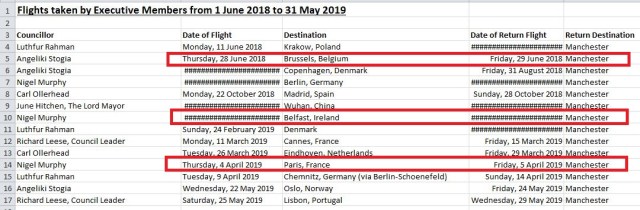
If it’s a #climate emergency, can we fly to Paris, Belfast & Brussels from #Manchester? (Spoiler – “no”)

Flying eh?  The number one thing that people and organisations can do to reduce their carbon footprint, basically.  And it really isn’t easy.  Some places are just hard to get to (Australia, USA, etc).

But Paris? Brussels?  Belfast? From Manchester? You’re kidding me, right?  You get on a train to London. You walk 800m. You get on  another train.  Bish bosh. Or you take a train a ferry. across the Mersey Irish Sea.

Now, perhaps the organisation you work for insists that you take the cheapest option, or simply doesn’t have a policy, and isn’t discussing having one. Ten years after proclaiming it will lead on climate change.

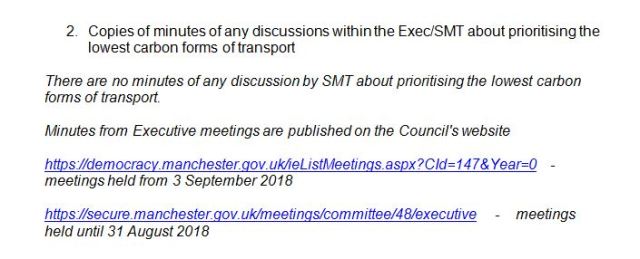
discussions about flying

Re: Request for Information – Reference Number: SOL/BCSBSD

And aviation, which doesn’t pay the real cost of the damage it does – it receives a subsidy from all the dead future generations – is usually the cheapest option. So it goes.

Still and all, if you are one of the leaders of your organisation – say either the former or present people charged with the Environment portfolio, surely you can put your foot down, insist on better thinking, and set a good example into the bargain?

flights of exec

Re: Request for Information – Reference Number: SOL/BCSBSD

And who knows, perhaps you could even just, you know, release this information as a matter of course, instead of creating aggravation all round by forcing citizens to resort to the bureaucratically costly Freedom of Information Act? Watch this space…


Posted in Aviation, Manchester City Council | 2 Comments

#Manchester annual emissions reduction target was 13.5%. Achievement? …. 2.5%

Manchester is missing its emissions reductions targets by an enormous margin. The latest report from the Manchester Climate Change “Agency” was released yesterday, at a two hour “conference.”  One of the authors of the report (full disclosure – Dr Joe Blakey is a good friend) has summed up what you need to know in 6 succinct tweets.  For those of you who don’t do Twitter, here it is.  I’ve highlighted my takeaway, but the whole thing is terrifying, and a stunning indictment of the failure of the official election-cancelling, stakeholder-conference-canceling, meet-in-secret, incompetent apparatus that has passed for a proper response to climate change, these last ten years…

Tweets begin –

The 2019 report has been released. It’s been a pleasure to contribute some accounting and write up along with rest of the CO2 group and . However there are some stark warnings in here

Mcr’s scope 1&2 emissions are 40% lower than in 2005 and the city is expected to achieve its 41% target by 2020. *However* the city exceeded its yearly budget 2005-2014 so a 57% reduction by 2020 is required to stay within the ‘old’ cumulative emissions budget


. advise we need to reduce emissions by 13% year on year to stay within their new Paris-aligned ‘zero’ carbon budget. has reported that last year we achieved just 2.5%. Much more radical urgent action required. 3/6


We’ve been working to gain a picture of aviation emissions from flights departing Manchester airport. It looks like this. They were sharply rising (by half a million tonnes 2014-2017), however they pretty much stayed stable 2017-2018. 4/6


. have said UK aviation emissions need to stay stable 2018-2032 and decrease until 2075 for the zero carbon budget to hold. Departing flights from the airport must *at least* do the same. If we transpose this pathway on to Mcr aviation emissions, we get this… 5/6


Finally, the city can pull many levers in bringing about this aviation pathway. There are many perspectives on the role the city can take. I’d argue we shouldn’t pick one or the other, but keep this debate open and pull every lever at our disposal. 6/6


MCFly says: We heard on the grapevine that  there is at least one councillor walking around saying that campaigning for a climate emergency declaration is going about things completely the wrong way, and criticising folks for “forcing an agenda that they’re already working on, we just need to be patient”.

Yeah, right.  Thanks for that.


S

Posted in Manchester Airport, Steering Group | 1 Comment

Farcical #Climate “Agency” staggers on. A few questions… #Manchester

Tonight there is a two hour “conference” about climate change at the University of Manchester.  It’s by something that calls itself the Manchester Climate Change “Agency” which is actually not a statutory body, but a community interest company which has received a LOT of money from Manchester City Council. And cannot be forced to reveal awkward information about what it spends and achieves, and how, through the Freedom of Information Act. What a fortunate state of affairs for certain people, eh?

The “agency” is an outgrowth/successor to the “Stakeholder Steering Group” established in 2010. The Stakeholder Steering Group was supposed to have elected members (the elections were never held, despite promises). It was supposed to hold a day-long annual conference for all stakeholders, so progress could be assessed, failures learnt from, connections made. It managed to hold one full-day conference (2010), two half-day jokes (2012 and 2013) before unilaterally cancelling them in 2014. Its meetings were held in private (not bad for a ‘stakeholder’ group and…

Right about now, readers will be yawning, and asking ‘why does any of this matter? It’s ancient history. ‘  That’s a fair question.  And the answer is this.

Exactly The. Same. People. Who. Presided. Over. Ten. Years. Of Abject. Failure. Are. Still. Running. Things.

They have had ten years to show what they are capable of.  They have done that. They have shown precisely what they are capable of.

The second goal of the Climate Change Action Plan, the plan the Steering Group was supposed to, erm, steer,  was this

“To engage all individuals, neighbourhoods and organisations in Manchester in a process of cultural change that embeds ‘low carbon thinking’ into the lifestyles and operations of the city. To create a ‘low carbon culture’ we need to build a common understanding of the causes and implications of climate change, and to develop programmes of ‘carbon literacy’ and ‘carbon accounting’ so that new culture can become part of the daily lives of all individuals and organisations. Every one of the actions in our plan will contribute in some way to the development of ‘carbon literacy’ in the city. However, achieving a new low carbon culture – where thinking about counting carbon is embedded and routine – can only be delivered as a result of all the actions together, in an overall co-ordinated manner. Enabling a low carbon culture in the city will be particularly important if the challenge of meeting even more demanding carbon reduction targets between 2020 and 2050 is to be met.”

Reader. Has this been achieved? No. Has this even been attempted?  No.

So if you think that cancelling elections is the way to build legitimacy.  if you think that not holding annual stakeholder conferences is the way to build political and cultural support for radical action, if you think that shovelling council money into unaccountable stabvests that call themselves ‘Agency’ and hold two hour ‘conferences’ is an adequate response to a climate emergency then you will be happy. If not, you’ll weep.

And you certainly won’t ask the simple question – how close did the city, under the auspices of the ‘Agency,’ get towards its aimed for 13.5% emissions reduction in the last year>  Was it 12.5%?  7%?  lower?  And will there, unlike previous years, be any accountability for that failure>? Any assessment that maybe the glib smiling pale male and stale men have had long enough in post and ought to be asked what they have actually achieved?  Don’t go holding your breath.


See also

2015 AGM report (back when they were honest enough just to call it an AGM)

2016 AGM report (warning – this one is hilarious, and you will spit out anything you are drinking, like that girl in the meme…)

Their 2016 ‘reboot’….

PS If anyone wants to ask the process by which some groups (Friends of the Earth, Extinction Rebellion) were invited to have stalls and other groups never received invitations, that’d be great.  Surely publicly=funded bodies, even if they are actually community-interest-companies, need to have some sort of transparent process in place – it can’t, surely, just be ‘let’s invite our mates, but not anyone who has embarrassed us in the past’….

Posted in Steering Group | Leave a comment