Press release: US expert slams proposed #Davyhulme incinerator, #Trafford

The Breathe Clean Air Group have sent us the following press release. (We interviewed Mason Corbishley of the group back in July.)

US EXPERT SLAMS INCINERATOR.
Leading biomass expert, Dr Mary Booth, a specialist in ecology and biochemistry from Massachusetts USA, has said that the Barton Renewable Energy Plant “strikes me as one of the most dangerous I have seen in terms of potential impacts to human health”.

The Breathe Clean Air Group has invited Dr Booth to give her witness statement at the forthcoming Public Inquiry into the Davyhulme incinerator, in Greater Manchester, which starts on 13th November at Manchester United Football Ground.

Dr Booth says “My testimony will largely focus on emissions of heavy metals from the facility, which I believe will represent a very serious threat to the health of the surrounding community. I will also comment on the net greenhouse gas emissions impact and I am dismayed by the inadequacy of the controls for nitrogen oxides”.

Dr Booth adds that the “pollutants have been consistently underestimated or even actively misrepresented. This means that the Barton facility will present a greater threat to human health and the environment than the Environment Agency or the developer admits”.

Chairman of the Breathe Clean Air Group, Pete Kilvert said “Dr Booth’s testimony highlights the dangers of an incinerator burning waste wood,
using old technology, in a populated area. I urge local people to attend the Public Inquiry on 13th November and have their say.

The Group is planning to provide a coach to take residents who don’t have their own transport, to the first day of the Inquiry. Please see
www.BreatheCleanAirGroup.co.uk for details.

Posted in Democratic deficit, Upcoming Events | Tagged , | Leave a comment

Event Report: We need to talk about growth, #Manchester #Tyndall

Is economic growth “sustainable” – in either the sense of being able to continue,  and in the sense of it being compatible with a habitable planet?  This was – more or less – the central question that four panellists and about 70 members of the audience tried to wrestle with last Thursday at an event organised by Tyndall Manchester.

A proper write-up will follow, but for now, here are three of the four speakers giving their initial spiels. Apologies to the first speaker – I didn’t capture his speech.

Alice Bows, Sustainable Consumption Institute

Mark Burton (Steadystate Manchester)

Richard Sharland (Manchester City Council)

Of note: the speaker from “New Economy” had said he was coming. This meant that his name appeared on the publicity, and the organisation did not look like it was running away from the debate. Then, on the day of the event it turned out he wasn’t able to come.  No substitute was sent, and no copy of the speech that had presumably been prepared was sent through for someone else to read. So it goes.

Posted in Event reports | Tagged , | Leave a comment

#Permaculture: article about Bill Mollison in Jeremy Seabrook’s “Pioneers of Change”

Jeremy Seabrook is an author and journalist specialising in social, environmental and development issues. He wrote a book, Pioneers of Change: experiments in creating a humane society, about winners of the Right Livelihood Awards. One of those winners is Bill Mollison, the co-founder of the idea of permaculture. Here is the relevant chapter from Mr Seabrook’s book.

Posted in inspire | Tagged , , | Leave a comment

Crosspost: Egyptian climate change campaigner interviewed

MCFly co-editor Arwa Aburawa also writes for Green Prophet,”a sustainable voice for green news on the Middle East region.” Here’s an interview she recently conducted with Sarah Rifaat, an Egyptian climate change campaigner.

Egyptian Campaigner: ‘Corruption not Climate Awareness is Holding Us Back’

| October 8th, 2012 | Comment | Email this

sarah-rifaat-350-arab-climate-egypt-corruptionWe speak to Egyptian campaigner Sarah Rifaat about the environmental movement and why bureaucracy and corruption are still the biggest barriers to change in Egypt 

Sarah Rifaat, like many people in Egypt, suffered from childhood asthma caused by the high levels of pollution in her city. What Sarah did differently when she grew up however, is refuse to accept this as the norm. Sarah’s asthma was her first lesson in the importance of a healthy and sustainable lifestyle which led her down the path of environmental campaigning. Today, she works with 350.org as the Arab world co-ordinator and is also part of a new Arab Youth Climate Movement. I caught up with Sarah to find out more about her work and what she would change if she was Egyptian president for a day.

Tell us a little about yourself and how you got involved in the climate change movement?

I’ve always had a passion for environmental conservation ever since I was a young girl. I can attribute that to specific moments in my life, such as the time when my grandfather taught me to name flowers in his garden, or when I used to watch Captain Planet. All these moments made me feel that I had a responsibility towards the world around me.

In college I studied mass communication and wanted to be a graphic designer, but I took a course on Environmental Issues and used my design skills for environmental awareness initiatives. After I graduated I volunteered to facilitate workshops for children at the World Environment Day celebration which is held in Cairo every year. I tried to lead a more environmentally conscious existence, but an activist I was not, climate or otherwise. That all changed in 2009 when I got an email inviting me to go to a 3-week climate advocacy workshop organized by 350.org and IndyACT in Turkey.

I and 20 other young Arabs went on a sponsored trip to Turkey to learn about climate change and also about using the tools of art and media for climate advocacy. We were there with participants from 39 other countries to learn about how to organize for the first 350 global day of action on October 24th. I’ve been part of the movement ever since as a volunteer field organizer till 2011, when I assumed the role of the 350 Arab world coordinator.

So you’ve been involved in the 350.org  campaign for a couple of years now. Can you tell us about what you feel the campaign has achieved in Egypt so far?

I feel that the campaign has managed to involve more Egyptian youth in climate activism and organizing, as well as link climate change to local issues such as sustainable transportation. The campaign has also managed to encourage local collaboration between different groups and NGOs.

What changes have you noticed in the environmental movement in Egypt over the last 5 to 10 years?

The environmental movement has become more developed and more widespread than ever before – especially among youth. There’s a lot more recognition now of the link between environmental issues and social justice issues, which has led many groups that haven’t been involved in environmental activism to join forces with environmentalists.

I understand you were also part of a recent campaign to setup a Arab Youth Climate Movement. How did the meeting go and what can we expect next?

The workshop was about uniting youth climate activists from around the Arab World, with the aim of launching a strong regional youth network on climate. The activists came from 14 different Arab countries and got a chance to jointly discuss global and regional climate politics and acquire organizing skills, such as activists story-sharing, action planning and campaigning. In addition we also managed to bond as a team and formulate a common vision for the regional network. The AYCM is now focused on organizing the first Arab Day on Climate Action on November 3rd and is gearing up for participation at the Conference of Youth and COP18 in Qatar later this year.

What do you think are the unique barriers that Egypt faces in terms of tackling its environmental issues?

Corruption, outdated policies, vested interests and extremely bureaucratic governmental institutions are the biggest barriers for many environmentalist. There are those who might argue that lack of mass awareness on some issues is a barrier, and while that is true in some cases, the events of last year have proved that you only need a dedicated few to bring about massive change. However, in order for us to create lasting change, we need to transform the systems and institutions that have long kept the status quo.

What one thing would you change if you were leader of Egypt for the day?

I would create more open and intuitive channels of communication between government and civil society and try to launch some process by which governmental planning is truly inclusive, transparent and decentralized.

:: Images courtesy of Sarah Rifaat and 350.org

For more on Egypt’s environmental movement see: 

Frack Off Shell! Egyptians Launch Anti-Fracking Campaign

Recycle Art Workshops @Darb 1718 this October

Sun, Soak and Dive Holidays in Sinai’s Sharm El Sheikh

Posted in Interview | Tagged , , , | 1 Comment

Councillor Murphy interviewed! (Sue Murphy, Deputy Leader of #Manchester City Council)

Cllr Sue Murphy has given an extended interview to MCFly. In it she was quizzed on the action the Council has taken around climate change, the nature of a “low carbon culture”, community cohesion, the return (or not) of economic growth and much more.

An edited version of the interview has appeared in the latest Manchester Climate Monthly (issue 11), and you can now read the full transcript here.

Thanks to Councillor Murphy for her time, and to her PA who organised the time slot.  We will ask the PAs of the other Executive Members for interviews, and let readers know how we get on.

Posted in Interview, Manchester City Council | Tagged | Leave a comment

Looking back from 2030 at how #Manchester became really cycling-friendly

This is well worth a read.

“I am not going to spend much time talking about the health, environmental, social and economic benefits of increasing cycling levels. For me they are a given – and I do not have the time in my 4 and half minute provocation to dwell on them – happy to debate afterwards.
Put simply – increasing the number of people cycling and the number of journeys made by bike is a NO BRAINER.
So – I am going to look forward to both 2015 and 2030.

continue reading


Disclaimer
– MCFly co-editor Marc Hudson owes Mr Pete Abel many pints. Hopefully one less now, after sending so much traffic to his blog…

Posted in Transport | Tagged , , | Leave a comment

Ash Dieback and Tree Planting: An Intimate Connection?

Dave Bishop, MCFly’s biodiversity correspondent, on Ash Trees and Manchester…

A couple of years ago, persons unknown planted an Ash tree on Chorlton Ees. The tree is elaborately staked and mulched and protected with a rabbit guard – in an area with no rabbits! The ‘guerrilla planters’ probably thought that they were doing a good and noble deed by planting a tree and probably also thought they were doing something a bit defiant and radical by planting it surreptitiously.

If they had examined their planting site more closely, they would have found a number of interesting wild plants, including Yellow Rattle, Common Catsear and several different species of vetch including Grass Vetchling – a priority species for conservation in Greater Manchester. Several different species of wild grasses are also present. If the planted Ash ever reaches maturity (now a big if!) it will dry out the site and shade out all of the other plant species, thus reducing our local biodiversity. And if the planters had wandered just a few more yards beyond their planting site they would have seen that Chorlton Ees is currently being invaded by countless thousands of Ash seedlings. Up to now Ash has
been a prolific self-seeder and planting it has made as much sense as planting dandelions or nettles!

But if you have been paying attention to the news recently you will have seen that our Ash trees now face a deadly threat: ‘Ash Dieback’ disease – caused by the fungus Chalara fraxinea – which has been creeping across Europe for some years now. In yesterday’s ‘Independent’ newspaper the distinguished tree and woodland expert, Peter Marren laid the blame fairly and squarely on the shoulders of the tree planters:

Marren writes:

“Future generations might wonder who was to blame for the holocaust of our most graceful woodland tree. They might point a finger at the hapless, failed guardians of our woodland heritage, Defra and the Forestry Commission. They would be wrong. What is about to cause the worst disaster in woodland history is not so much law as love. Everyone loves a planted tree. We thought planting trees was the solution but it wasn’t. It was the problem.”

He explains that many of the tree diseases that are now running rampant in our countryside, such as Sudden Oak Death, Chestnut Canker and the disease which has devastated our wild Juniper populations, were probably brought in on imported trees, all to satisfy the, often irrational, obsession with tree planting. He castigates the Woodland Trust, who claim to be, “passionate about [tree] planting”. Ash Dieback has recently appeared on one of their Suffolk estates, in a plantation next to an ancient wood (!) He asks where their plantation trees came from; were they imported?

As it happens I wrote to the Woodland Trust, several days ago, asking the same question. I have had no reply.

I don’t know whether Manchester City Council have ‘put two and two together’ yet (?) but this Ash disease could represent a sort of ‘Hurricane Sandy in slow motion’ for both Manchester and other British cities. There are literally thousands of mature ash trees throughout the city (not counting millions of seedlings and saplings – see above). Many of these are in prominent positions where the presence of a dead tree will represent a serious hazard. I believe that felling mature trees can be very expensive – so it’s likely that Manchester could be facing a bill of many millions of pounds!

In a recent post on his blog entitled ‘Green and Blue‘ , Sir Richard Leese mentioned tree planting and, as usual, the implication was that it is a sort of universal panacea for all our environmental problems. I submitted a comment quoting ‘Bishop’s First Law’, i.e. ‘An organisation’s knowledge of, or concern for, its environment is inversely proportional to its propensity to plant trees.’ This was probably seen as facetious – but it’s based on several decades of observation and is deadly serious. I have come to believe that much
of the thoughtless tree planting that goes on is really about, simultaneously, both our culture’s disconnection from Nature and our need to control it.

Dave Bishop, 4th November 2012

[MCFly says – we will be making a youtube about “Bishop’s First Law”!]

Posted in Biodiversity, Manchester City Council | Tagged , , | 4 Comments

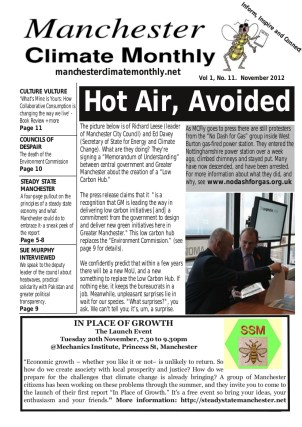
#Manchester Climate Monthly #11, November 2012 out now!

What is Steady State Economics and why does it matter?  What is a “low carbon hub” when it’s at home? What does Sue Murphy, Deputy Leader of Manchester City Council have to say about climate change, transparency and democracy?  What is “collaborative consumption?”

All this and much more in a bumper-sized 12 page Manchester Climate Monthly.  Tell your friends!!  This picture to the right is a link through to downloading the pdf (9M!). Alternatively, scroll down for the “scribd” version…

If you’re after a print copy, we will be handing them out at the Friends of the Earth/Unlock Democracy event on Tuesday 6th November. It’s an election hustings (which means candidates answer questions) for the Manchester Central bye-election. It’s from 6.30pm at the Friends Meeting House, Mount St.

And see you at the launch of “In Place of Growth” on Tuesday 20th November.

As ever, your thoughts and comments welcome – mcmonthly@gmail.com

Posted in print editions | 1 Comment

Speech and alternative format for a “Sustainable Stories” event…

Attention Conservation Notice:  In a hypothetical universe, here is the short speech and format-of-a-genuinely-radical-event that I would have given to the seventy or so well-meaning people who turned out on Friday afternoon for an exhibition launch (see previous post).

Hello everyone. Thank you very much for coming. It’s great that you care about the future of the city, the future of the planet.  Whatever you are doing, I beg you to do it more, to get more people doing it, to learn from your mistakes and your successes, and to press on, no matter what.

I’m not going to tell you about the sponsors of this event. You can read about them in the turgidospheric leaflet we’ve had printed. Instead, I’m going to very briefly give a score card of where we are up to. Then it will be over to you, the participants – not the audience, the participants –  to hold our two guests’ feet to the fire.

In 2009 Manchester City Council, with stakeholders, created a climate change action plan. It is, as they never tire of saying, for the city not the council. There’s a reduction target and a “low carbon culture” target.  So, pop quiz, shout out the answers if you know them.

What was their target for the number of organisations they wanted to endorse it? (That’s right, 1000).

So, how many have endorsed it? (220ish)

And how many have got their own implementation plans? (2)

And what action is the Council taking to increase those numbers? (0)

At the Greater Manchester level, there’s a Climate Strategy that calls for a 48% cut in emissions by 2020. The Implementation plan for the 2012 to 2015 setion of that plan was due to be agreed – any takers? (before April)

Anyone want to hazard a guess on when it might see the light of day?
What does this tell us?  This city has limitless supplies of boosterism. Some of it is even connected to reality. Manchester has indeed pulled in investment from elsewhere. However The city does not have limitless time to sort out its resilience and justice issues. And the city leaders do not, despite what they may think, have an unlimited and unquestioned legitimacy. Just sayin’.

I want to put forward a proposition; So much of what passes for discussion is just the recirculation of bromides. If sustainability is so inherently attractive, how come we’ve been doing it so badly? How come we are in this horrific mess?

As a trouble-making Australian says – “Sustainability is like teenage sex. Everybody says they’re doing it, very few people actually are doing it. Those that are doing it are doing it badly.

Somebody once said that it’s the job of intellectuals to expose lies and tell the truth. Well, not all academics are intellectuals, and not all intellectual are academics. But here, today, this non-academic is going to try to expose a few lies and tell a few truths.

Here are four lies

1) We can have our cake – as uber-consuming westerners – and eat it. Technology will provide the solutions.

2) You can have infinite growth on a finite planet.

3) People who talk about sustainability and attend events like this are morally superior to those who don’t. I’m not going to ask if there’s anyone here who has given up flying, because even if there is, they are in such a tiny minority as to inspire me to slash my wrists.

4) The response by this species to climate change since that first came onto the political agenda in the late 1980s has been within a gazillion miles of adequate.

Here are some truths

1) Any vaguely intelligent eight year old should be able to see that we are in deeply trouble.

2) A lot of scientists, at least the ones who can read graphs, are terrified. Most are too scared to speak out (Link to The Onion.) Some are not. Some are telling the truth. We are lucky that some of that rare breed work right here in Manchester. Their absence at this event is noteworthy. Maybe they weren’t invited?

3) The word “sustainability” is a lullaby to soothe us while the fricking planet burns –

4) This event, where we all sit around and sing Kumbayah and witter about “sustainability”could have been held any time in the last twenty years. And there’s probably another three or four years to go until the impinging reality of the ecological debacle makes this sort of event impossible. So I suppose enjoy it while you can, eh?

5) We are radically unprepared for the unexpected. If there were seven consecutive days of heavy snow this winter, we’d be stuffed. The emergency plans are simply not in place. A decent heatwave next year, lots of people would die. We are pretending that the road ahead is a smooth ride to a slightly warmer world. It’s not. It’s full of potholes and missing bridges, and we are driving blindfold with no brakes.

So, that’s the end of my rant. Now we do the participation (airquotes with fingers and grimace.)

First the bad news. If you came here to sit and nod and be seen and then air kiss afterwards and blow smoke up each other’s asses, then well, you’re shit outa luck. If you came here to ask a sycophantic or absurdly technical question in the Q and A, it ain’t gonna happen. This is going to be genuinely participatory. If that’s outside your comfort zone, well, cry me a river. I think people in Bangladesh, and Mali and most other places in what we conveniently call the “developing world” have been outside of their comfort zones for quite some time now, thanks to our emissions. So suck it up. We’ve locked the doors, by the way.

You’re going to get into pairs, or threes, or at most fours. Please try to have at least one person in your group you don’t know. You are then going to introduce yourselves to each other, very briefly. Swap emails and business cards if that’s your thing. And then the two or three or four of you are going to come up with awkward questions. The awkwarder the better. They can be to either one of the speakers here. What hasn’t the University of Salford done that it really has no excuse not to have done, around sustainability? Why is there so little work by academia on the alternatives to growth? How can the general citizenry force Manchester City Council take faster and broader action on climate change, given that we are in a one-party state?   What sorts of pressure does Richard Leese least enjoy?  How can civil society amplify that? What about the Airport? Stuff like that. The world’s your oyster, and your responsibility.

You’ve got five minutes. And if you come up with questions so awkward you’re afraid to be seen asking them, then write them down on a bit of paper, put them in the box that will be circulated by my glamorous assistant in a few minutes, and I will ask them, without even knowing which group they come from.

During

Right, sounds like we have got ourselves some questions. Keep them short. And I won’t let the speakers “talk out the clock” by giving unnecessarily long answers as a tactic to minimise the numbers of questions they face.

By the way, we are going to video and audio record this, and put it on the web, for all the people whose “participation” in this event is limited by lousy publicity, them having jobs, or having to care for family members, or not having cash to be here.

After

Right. Thank you everyone for coming. A favour and a few final questions.

The favour is to help us out because we’ve kind of screwed up. We have what we think is a worthwhile exhibit next door. And it’s not cheap. But we have simply not publicised it adequately. Our bad, we will learn. However, if all of you went through and saw it now, and took photos and posted them to twitter and facebook, and to your blogs. And if you encouraged your friends and family and work colleagues to come, that would surely boost numbers. The alternative is periods when the staff will outnumber the punters by a factor of six. That would be a pity…

Now, the questions. Although they may seem rhetorical, I mean them sincerely.

Who here thinks that we – as a species – as a city, are responding with sufficient speed to this crisis?
Who here thinks that we can sit back and trust governments and businesses to fix it?
Who here thinks that the way we have been holding events and meetings is adequate?
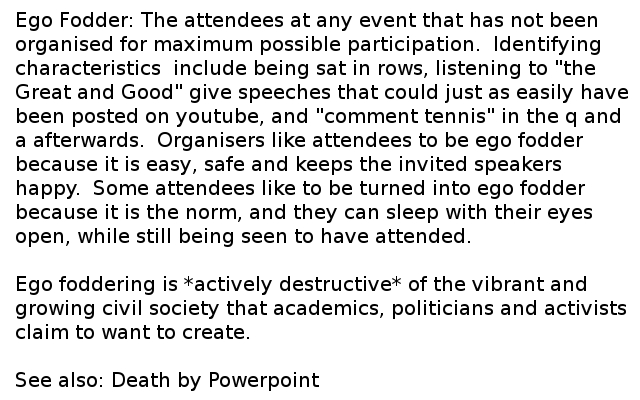
Who here thinks that event organisers have the skills and the motivations to change the format from sage on the stage/ego-fodder to something that is genuinely transruptive?
Who here thinks that their children will forgive them, in twenty years time, for not getting out of their comfort zones, for colluding in ego-fodder, for not monkey-wrenching dire meetings like this one could have been, into something that at least has a snowball’s chance in hell of building the civil society we need?

Posted in Event reports | Tagged , , | Leave a comment

Non-event report: SURF’s not up, and the stories of “sustainability” are, um, rubbish #Manchester #smugosphere

Attention Conservation Notice and disclaimer all in one: MCFly went to “Sustainable Stories,” an event and exhibition organised by some academcis. Truly soul-destroying – wasted food, wasted time, wasted opportunity. It *could* have been different. The next post explains how… (NB We are not dissing the researchers or the people doing stuff whose work and efforts appear in the exhibition.)

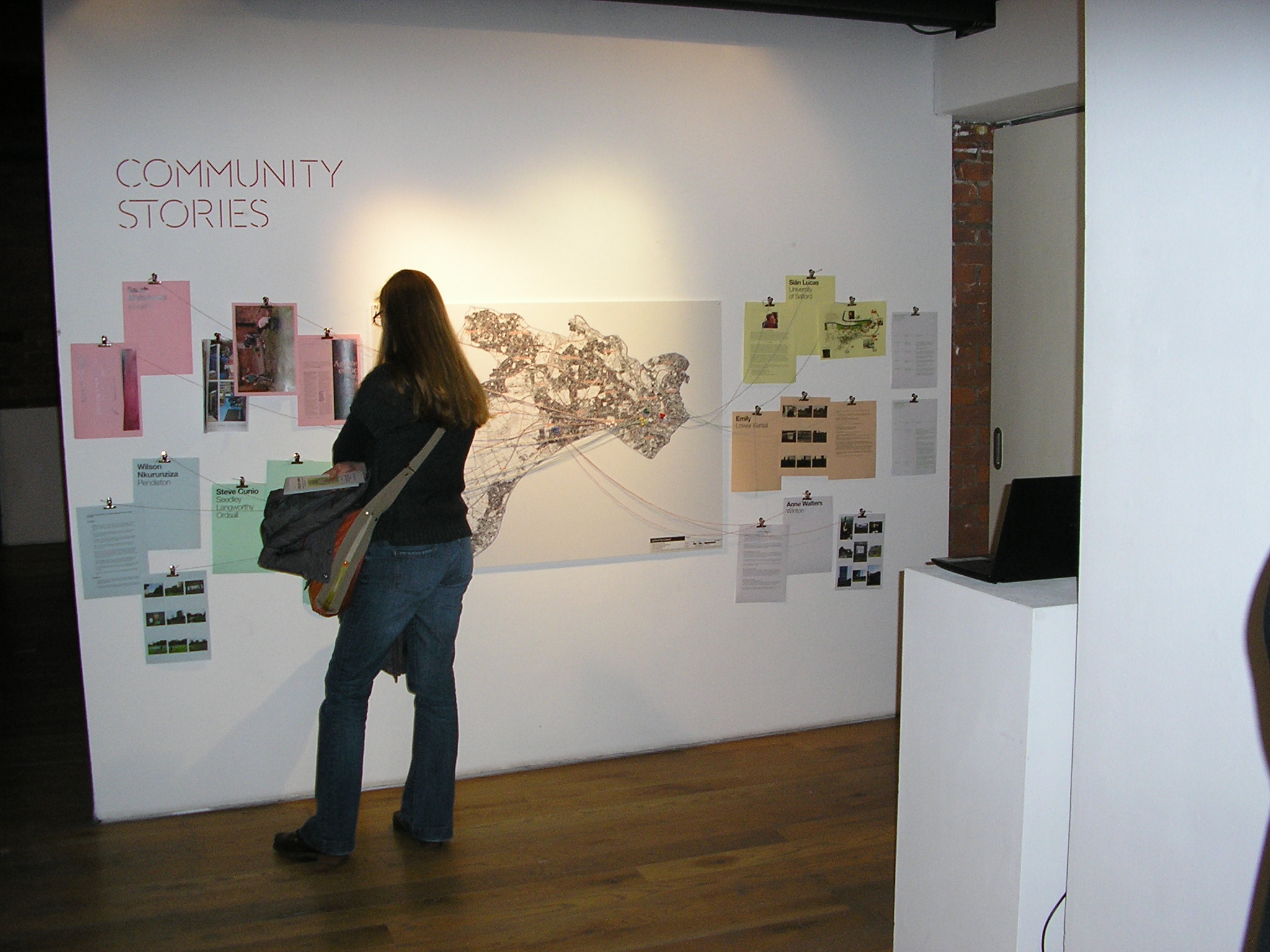
Talk, of as they say, is cheap. Which means there is a lot of it. And there certainly was at the launch event that MCFly went to on Friday 3rd November. The Centre for Sustainable Urban and Regional Futures at Salford University (SURF) is one of the outfits behind “Sustainable Stories” at the Cube gallery on Portland Street.  What’s that? Well, it claims to be “an interactive exhibition to share and provoke discussions about the future of Greater Manchester.” Er, no, not really.

After an extended introduction by Beth Perry, two speakers spoke, at length (these were not “short presentations” as per email invite. The first was Professor Martin Hall, Vice Chancellor of Salford University and the second Sir Richard Leese, Leader of Manchester City Council,

The organisers do not seem to have organised either audio or visual recording of the speeches. I did, with my video camera. Sadly the quality is not really worth putting on the internet.

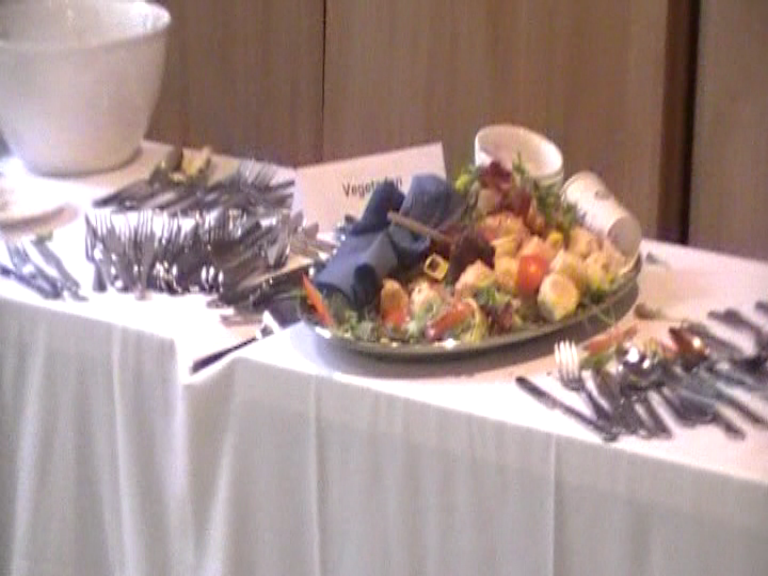
While Professor Hall was speaking the uneaten food from the buffet was cleared away. A piled high plate (at least) of it. Oh the irony. Did nobody think to supply doggy bags so that people could take it away? Er, no. Epic fail.

Richard Leese’s talk was unsurprisingly, a mash-up of previous speeches. There were a couple of new bits though.

Firstly on “Growth” and what he calls “no-growth” (during which he was heckled by local institution Carol Batton).

Secondly he gave a shout out to “Carbon Literacy” (see MCFLy report of its launch event here)

So, seventy or so people were ego-fodder. Then there was the obligatory question and answer session and it was unsurprisingly low-energy and desultory. Most people then sensibly left before what was, in the pre-publicity, labelled a “workshop”. This had actually been a big part of the reason I decided to use up three non-renewable hours of Annual Leave from my wage slavery. Oh dear….

When is a workshop not a workshop? When it is death by powerpoint followed by eight (8!!) speakers. With everyone in rows. That’s when a workshop is not a workshop.

I’d spotted that the “workshop” was actually a panel discussion in a more recent email from the organisers, after I’d booked my annual leave. But once in the room I found it had metastasised from four to eight people. And this “workshop” was going have the format of everyone sat in rows. Fortunately, someone insisted on creating a circle. Fortunately everyone over-rode the chair’s lukewarmness to this, so we formed an oval shape. Better than nowt…
After a few minutes of DBP, your brave MCFly editors had had enough. We legged it (law of two feet and all that). People who have told us we did the right thing. We are reliably informed that the eight panellists kept to their three minutes (miracle of miracles).

This event lacked any sense of the past failures of the “sustainability” “movement” (is there such a thing). This event made no mention of likely disruptive incidents coming up (has nobody been watching the news?) There was no sense that sustainability is so radically different from where we are now that these no-pain gradualist stories are just a lullaby.

Making it better
Realise that if you want to create dialogue you need to overcome;
* the shape of the room/scrum for food
* the typical British reserve about talking to strangers
* the tendency of people to clump in (unintentionally intimidating) groups of friends/colleagues.

You can lessen the impact of this by
* name badges
* “turn to the person behind you and talk about a sustainability challenge”

Make sure you don’t waste food. Seriously. It may not have been a huge amount, but wouldn’t supplying doggy-bags help create an expectation/pressure on future events?
Call things what they are – if it’s a panel discussion, then call it that, so people who would have to take annual leave can make an informed decision about what they are letting themselves in for.

See the speech I would have given, and the format of the event, in the next post.

Why am I writing this?
For the lulz
For revenge (three hours of Annual Leave I will never get back)
To warn people not to waste their time with events put on by this organisation, unless there is clear and credible evidence of learning (don’t go holding your breath)
In the vain (cough cough) hope that things might change. There are precedents (from this to this) .

Exhibition
When I arrived I was outnumbered by staff by a factor of about 6 to 1.
I left just as the first lot of “speakers corners” speakers arrived. And came back just before the second lot. It never seemed much busier than two or three people, besides the very very cool artists doing the “visual minute taking.”
The exhibition, which finishes today, is achingly light on local realities. So it goes.

It’s tragic that it was so poorly advertised. It’s tragic that none of the displays talked about the reality of Manchester and Greater Manchester’s Climate “Action” Plans. With the former, the target was for 1000 organisations to endorse it. 220 or so have. Only two of those have actually written their own implementation plans. On the latter, there is a missing “Implementation Plan” that was due over six months ago and still seems no closer to completion.

Public health warning People at SURF used to like us. We got invited to a couple of seminars. We wrote them up [Manchester and Nottingham]. They stopped inviting us. Go figure. They also passed on our details to an academic researcher doing work on Tesco and its sustainability policies. We said yes to an interview on the condition that we got a transcript. We never got a transcript. We didn’t even get the courtesy of a pro-active message from that academic to the effect that the recorder had not worked. All we got was waffle. We pointed this out to her bosses, along with a proposed disclaimer form for avoiding this sort of mess in the future. These bosses decided we were aggressive and unhelpful.

We also know that MCFly’s name was put forward as one of the potential “speakers” for the speakers corners on the weekend, but rejected.

So maybe all this above is just sour grapes. But we don’t think so.

PS We’re not anti-academites.  Some of our best friends are academics.  Honest.

Posted in academia, Event reports | Tagged , , , | 4 Comments