#Manchester Council’s extraordinary and humiliating failure of #climate scrutiny

Manchester City Council has refused to answer basic questions about when councillors became aware that quarterly climate reports had been unilaterally abolished.
Two weeks after all councillors on the Neighbourhood and Environment Scrutiny Committee (NESC) were sent a short specific list of questions, the chair of the committee has replied – with a prepared statement from the politician her committee is supposed to scrutinise!

Quarterly climate reports had been agreed by the ‘scrutiny’ committee (at the urging of activists)  in 2014 because a cycle of “annual promise but not much delivery” had been noted. The committee wanted to keep closer tabs on things, rather than let officers and Executive Members assure councillors that things would be on track soon at a single meeting every year.

The quarterly reports were unilaterally abolished earlier this year, by the Executive Member for the Environment. A series of questions were posed to the councillors about when they found out, what they thought about it. One  councillor (a member of the opposition Liberal Democrats) replied immediately.  All other (Labour) members of the NESC kept silent. On Wednesday, over a week after the questions were asked,  a reply was promised. Late on Thursday night it was received. It was not worth the wait, containing a prepared statement from… the Executive Member that the committee is nominally there to scrutinise. Such sock-puppetry!

The reply (see bottom of this post) answered none of the questions. Manchester Climate Monthly now replies with this open letter:

Dear Councillor Igbon,

thank you so much for your response (but not reply) to a set of simple questions from almost two weeks ago. Those were simple questions to each councillor of the NESC.

You have provided a statement from … the Executive Member for the Environment. I have already been in contact with Councillor Stogia, as you will have known from a cursory reading of my letter two weeks ago.

Let me say this very simply. I. Was. Not. Asking. Her. Questions. I. Was. Asking. You (all NESC councillors). Questions.

Let me repeat these questions.

1. When did you become aware of the Executive Member for the Environment’s intention to abolish quarterly climate reports?

2. Do you think that Executive Members should be able to unilaterally decide what reports are and are not available to scrutiny committees?

3. Do you agree with her assessment that abolishing quarterly reports was the right decision and sends the right message about climate action urgency?

a. If so, what does that mean for the ability of the Neighbourhoods and Environment Scrutiny Committee to do its job on climate change policy throughout the year?

b. If you do NOT agree with her assessment, how have you expressed your disagreement to her, and what – if anything – do you intend to do about it?


Your statement – or rather, the one you got Councillor Stogia to write, after an almost two week delay – does NOT answer ANY these questions. But it actually reveals even more (unintentionally) about what “scrutiny” means in Manchester Labour. Even questions about how scrutiny will be conducted will be answered by the people at the centre who are being “scrutinised”. The North Koreans could learn a thing or two, I think.

It also reveals that until I asked (repeatedly), you, as Chair, had not even questioned the absence of quarterly climate reports.

I find all this quite extraordinary (as well as laughable and repugnant). Kafka and Orwell would be rolling in the aisles.

I cannot “contact her direct” because my questions are to YOU and your fellow councillors. I do not understand how this is so hard to understand.
I still expect answers to these questions. They are straightforward, and important.

Yours, in disbelief at how democratically elected councillors refuse to answer very very simple and straightforward questions.

Marc Hudson

This is the reply MCFly received late on Thursday night:

Hi

I have asked for information from the executive member for the reasoning for the decision , there is additional item for scrutiny on air pollution. The committee will continue to scrutinise and make recommendations that are of benefit to the residents. Enclosed is the statement from the executive member Cllr Angeliki Stogia.

“Our Council’s Climate Change Action Plan covers the period 2016-2020. The Plan contains 20 actions which set out how we will deliver a 41% reduction in our CO2 emissions by 2020 (based on a 2009/10 baseline). Until recently, quarterly reports have been produced by officers and published on the Council’s website. These reports comprise a quantitative report on the CO2 emissions data which is available on a quarterly basis and also a qualitative update on progress against the 20 actions in the plan. Having reviewed the effectiveness of these reports, it has become clear that the data is lagged meaning that the reports do not give an accurate picture of quarterly progress. It has also been increasingly difficult to provide meaningful quarterly updates against the actions in the Plan. The number of unique hits to these reports on the Council’s website average between 10 and 15 per quarter. ”

I hope this answers you question if you need further information it would be best to contact her direct.

Kind Regards

Cllr Lee-Ann Igbon
Labour Member for Hulme Ward
Chair of Neighbourhoods & Envirnoment Scrutiny
Town Hall
Manchester
M60 2LA
0161 234 3235
07908759042
cllr.l.igbon@manchester.gov.uk

Posted in Democratic deficit, Manchester City Council | Tagged | Leave a comment

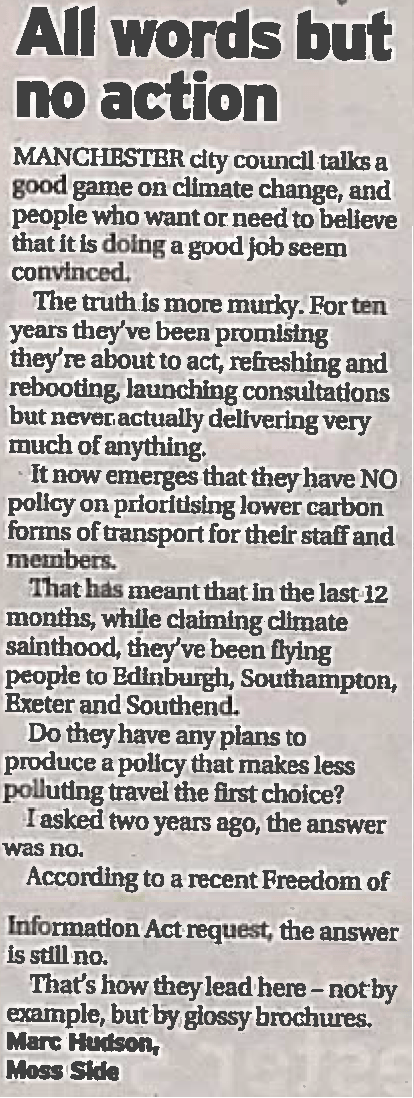
Letter in MEN: Leadership by glossy brochure, not example. #Manchester #flyingcouncillors

So, I may be off Richard and Angeliki’s Christmas card lists.  #gutted.

This* appeared in yesterday’s Manchester Evening News:

2018 12 05 men letter

* I’ve tidied it up so it’s in one column

Posted in Letters to the MEN | Leave a comment

#Tameside Council taking #carbon literacy super-seriously #climatebreakdown

So, someone had the bright idea to send Freedom of Information Act requests to councils in Greater Manchester, asking how many senior figures (politicians and bureaucrats) had undertaken the much-vaunted “Carbon Literacy” training, and how much money had been spent recently. Tameside’s answers are refreshingly clear, and free of the cant and equivocation of certain other councils which we won’t name (Manchester and Stockport).

tameside foia answer

And they had that nice event recently, so that’s alright then.

Posted in Uncategorized | Leave a comment

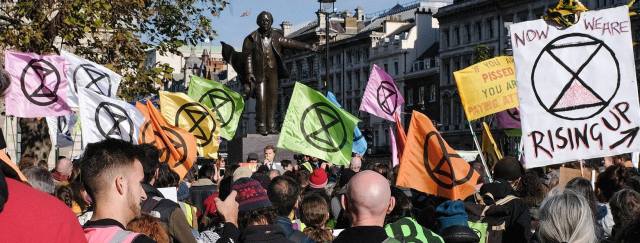
Upcoming event: Extinction Rebellion, Friday 14th December, #Manchester

From Facebook-

er 2018 12 14

Extinction Rebellion is founded on historical movements of civil disobedience. On Friday 14th December we will stand in honour of one of these movements, demonstrating that change is possible. That change will happen.

We demand deeds, not words.

Arrive in St. Peter’s square at 11am. Action to commence at time tbc.

The latest IPCC report called for “rapid, far-reaching and unpredented” changes at every level of society to avoid utter catastrophe.
Rising seas, more powerful storms & hurricanes, flooding, wildfires, spreading deserts, extreme heat waves, drought, famine, 100s of millions of displaced climate refugees…
Societal collapse around the world.
Climate breakdown represents the greatest emergency in history.

With this future no longer just around the corner, but here RIGHT NOW, did the government use their latest budget to announce a raft of massive sweeping radical policies to bring about urgent decarbonisation and build resilience for this unstable future?
Nope. They announced NOTHING.
They intend to do NOTHING.
The climate crisis wasn’t even MENTIONED in the budget!

It’s time to get active.
It’s time to get disruptive.
It’s time to rebel.

On Wednesday 31st October, peaceful Rebellion was declared against the criminally negligent government in Parliament Square.

On Friday 14th December we will be bringing to light the power of direct action in St. Peter’s Sqaure.

Posted in Upcoming Events | Leave a comment

Going through the “democratic” motions: a complaint about #Manchester Labour and #climate inaction

UPDATE:  The email I went to for complaints was only for officers’ behaviour.  It turns out you have to go here, download a pdf, fill it in (if you have the software to do that – elsewise presumably you have to print off, fill in by hand and then either scan and send or post). No word doc, no online form. How VERY VERY strange that the council should make it as difficult as legally possible to make a complaint.   Anyway, email sent to demserv@manchester.gov.uk this morning. No receipt/acknowledgement yet…

From previous experience, and seeing how others’ complaints have been dealt with, you know to expect nothing from the formal complaints process at Manchester City Council. About ten years ago a then-sitting Labour councillor forged a statement of mine and circulated it. Because she didn’t do it from her official email account, no crime was judged to have taken place.  It’s a racket, basically, with the people undertaking ‘investigations’ knowing full-well what outcomes will make their lords and masters happy.  Truth? Integrity? Yeah, right.

So, there’s actually no point in having sent this below (I have added hyperlinks), but I have done it anyway.  Because all our resistance is futile anyway, isn’t it?  Mario Savio, come back.

On Monday 26 November I wrote to all members of the Neighbourhoods and Environment Scrutiny Committee.  I got one automated response, and one human response (from Councillor Richard Kilpatrick).

I have had precisely zero communication from any other councillor since then, not even a ‘we will get back to you’ email.

The questions I raised are simple, basic, and important. They deserve more of an answer than being studiously ignored. This is contemptible behaviour, and you doubtless will tell me that the councillors have not broken any rules, that there is no guidance on how speedily replies should be made. Doubtless you’ll do what Lucy Powell did when trying not to answer straightforward questions, and point to how much case work this (wretched wretched) Tory government is creating, and how that has to be a priority.

In anticipation of these responses, this:

I think their behaviour brings the Council into disrepute, and lessens trust of the public in the job they are supposed to do as “scrutineers” of our lords and masters..

I want to know what you are going to do about it.

Yours sincerely

Marc Hudson

Posted in Democratic deficit, Manchester City Council | 2 Comments

Andy Burnham says we all will have to reduce our #carbon footprints. Flies to/from Paris. Twice. #climate #Manchester

So, we’re all going to be zero-carbon (whatever that means) by 2038. Because, you know, we have kids. The kids are so important. And leadership. Leadership is so important.

But we’re still going to, like, fly to Paris and back.

burnham flights

And we’re not going to have any policy about avoiding flying if possible. Here’s another part of the FOIA the above table came from. I asked

Any policy/protocol/guidance etc that is in place about their travel and the minimisation of carbon. Or is it all down to price?
GMCA: The information you are seeking is not held by the GMCA.

Laugh? I almost cried. Am just grateful I don’t have kids, because there is the mother of all shitstorms coming, and there is nothing we will do to protect them, prepare them.


Also worth a  laugh: The speech Andy didn’t give at the last Green Vomit.  Maybe next time…

Posted in Aviation, Greater Manchester | 4 Comments

Interview with an academic: Stuart Capstick #climate #engagement researcher

MCFly is going to interview some researchers (and activists?) about the Big Questions.  Here is Stuart Capstick (biog at the bottom)

What has your climate research entailed?  What have been some surprising findings?

My background is in Psychology, and my research relates to the ways in which people understand and respond to climate change. Probably the first surprise I encountered, is that the way people talk about this issue is pretty predictable: the same ideas, arguments, excuses, emphases come up time and again. Think for example of the claims made about ‘natural cycles’ or ‘I do my recycling’ – these are easy tropes we reach for when this subject comes up.

I’ve increasingly moved into survey-based research, to assess how different types of attitudes, values etc relate to people’s views and actions on climate change. Some recent research I’ve been doing has looked at how ‘green’ behaviour tends to be linked to subjective wellbeing – basically, whether people say they are happy and satisfied – across quite different contexts. In India, China, the UK, South Africa and other countries, this relationship holds. Cause and effect is hard to disentangle, but people who are environmentally-friendly tend to be happier too. Among other things, I’ve also done research looking at how experience of extreme weather can affect attitudes towards climate change; as well as some work on public understanding (or lack of) about ocean acidification and opportunities to communicate about this lesser-known problem.

How did you come to be a climate researcher?

I started my PhD fairly late on, having pretty much drifted through various jobs up to my early 30’s. I was doing a research assistant job in New Zealand in 2007, and thinking about how I could pursue a PhD in something – anything! – when at that time I started to grow much more aware of the issue of climate change: it was a time of a major IPCC report, and Inconvenient Truth and so on. It occurred to me that Psychology should be very relevant to this issue, and it turned out I wasn’t the first person to think this. I funded my own Masters to try to get into the field, and was fortunate to take a PhD and then a series of post-docs at Cardiff University.

It’s all looking pretty grim, isn’t it?  You mentioned that you’ve two young children.  What will you be telling them once they start asking questions?

Yes, it is looking utterly, bleakly, horribly grim. Some days I can barely stomach it, and I struggle to understand why others don’t feel this too (despite that I know the ‘official’ answers for that). One thing that gives me hope is uncertainty: we don’t yet know for sure where it becomes too late, and so we have to keep trying in the hope that it isn’t yet. There is still so much at stake that even if the chance of turning this around is miniscule, we simply have no right to turn our backs yet.

I am not sure what I will tell them. It’s very hard to know. Perhaps I’ll say that nobody meant for this to happen, and that all we can do is do our best from now on. But really, that’s not much of an answer.

Have you taken advice from other climate researchers, with slightly older children? If so, what did they tell you?

I’m not sure I have – but that’s a good idea.

What is your relationship with Extinction Rebellion?  Do you have doubts/hesitations about it?

I think I started to hear murmurings about XR in early October. It felt like this was something very different – for better or worse – and I wanted to see how this might go. What has struck me most about it is the brutal honesty and recognition of the awful place we’re in – and a real anger that our government and decision-makers are failing in their duty to act on it. Lots of NGOs have drawn attention to climate change, but never in quite this way. I guess it chimes with my own feelings and frustrations. I do have doubts and hesitations, and certainly some of the messages seem unhelpful: such as ‘climate chaos: we’re fucked’. I mean, what are you actually supposed to do with that? Likewise, I’m not convinced about targeting traffic and roadblocks– though I have done this twice myself now with other XR activists. I’m not sure the gung-ho attitude to getting arrested is all that helpful either. But even though I’ve got my doubts, I sense that there may be – possibly, just possibly – something bigger that could come out of this. There are clearly a lot of people who feel something similar and are trying to shape this in various ways. I hope that things will keep moving, developing, maturing – if so, this could become a powerful movement.

Anything else you’d like to say?

I think that non-violent direct action is absolutely a last resort, and in a decent, fair society shouldn’t be necessary. But we don’t live in a decent, fair society: our government and law-making is captured by the wrong people, who couldn’t give a damn what happens to the future. There is all the scientific evidence we need that climate change is happening and is an existential threat to humanity and the natural world, but this is being ignored – or at best, only vaguely acknowledged.

I’m off to the COP24 talks in Poland shortly, and who knows, maybe I’ll come back glowing with optimism at the ability of governments around the world to finally take this seriously. But in case that doesn’t happen, I’ll be wanting to know what XR are up to next…


Stuart Capstick is a Research Fellow who is interested in public understanding of climate change and sustainability. His present research entails cross-cultural analyses of environmentally-significant behaviour in eight countries worldwide, and he is co-investigator on a separate project assessing techniques for enhancing public engagement with climate change. He has previously published on the relationship between material consumption and well-being, interdisciplinary approaches to achieving radical emissions reduction through lifestyle change, and the communication of health impacts from climate change. His views on direct action are expressed in a purely personal capacity, and do not represent the views of his employer.

Posted in academia, Interview | Tagged | Leave a comment

#Manchester City Council flies staff to Southampton, Exeter, Edinburgh, while boasting about #climate policy

Manchester City Council has paid for flights to Exeter, Southampton, Belfast, Southend and Edinburgh in the last year, while simultaneously telling everyone how seriously they take climate change.

In addition to these numerous domestic flights, there are a number to easily accessibly by other means destinations, such as Dublin, Brussels and Amsterdam. (Sure, it takes a little bit more time, but do we give an actual damn about leading by example or doesn’t it? Because – and this is the fun bit – the Council still doesn’t have any policy about favouring other forms of transport.

Quoting from correspondence –

Me: I would also for each of these flights, (and especially domestic and short-haul) were any alternative methods of travel (e.g. train) considered. If they were considered, why was air travel given priority?  I note that two years ago you said “Generally when booking domestic and short haul flights the cost of air travel is compared with the cost by train. When booking air travel the Council considers the notice given to arrange travel, time taken to arrive at the destination, start time of the events and return to Manchester. In these instances air travel is the most cost effective.”

Council: I can confirm that this still applies.

This strongly implies that you’d rather pay for air travel than put someone up in a Travellodge.  Has any thought been given, by anyone, to the emissions implications?  If so, please supply the paperwork

There is no formal Council staff travel policy. However, the Council only uses air travel when it is the most viable option.

But it gets better still.

Me: … Two years ago you wrote ” There is no specific written guidance regarding reducing the amount of air travel, nor are there any plans to produce such guidance at present” Is that still the case?

Council: Yes. There is no specific written guidance regarding reducing the amount of air travel, nor are there any plans to produce such guidance at present” (emphasis added)

You have to weep for this city, for this ‘democracy’.

Tomorrow: Andy Burnham and his flights.


MCFly says.

Doubtless the Council and its apologists will bleat about what a small proportion of their total carbon budget flying is (while cancelling quarterly climate reports, and refusing to ever release how many council buildings they’ve sold off, which contributes to the alleged ‘reduction’ in their carbon budget).  But this doesn’t get to the crux of the issue – they fly people to EDINBURGH for Christsakes. They have NO POLICY about reducing their flying.  And yet they happily produce these idiotic glossy reports, and people who ought to know better – who DO know better – play along with it.

By the way, all information comes not from a scrutiny committee: these are made up almost entirely of loyal Labour councillors. It does not come from the local media, which basically reprints the City Council’s press releases as front page ‘journalism’. It doesn’t come from ‘campaigning’ environmental groups that claim to be friendly with the earth. Nope, it comes rather from a Freedom of Information Act request submitted by an unpaid citizen.


flights screenshot3

Posted in Aviation, Manchester City Council | 2 Comments

Interview: Andrew Dana Hudson and #climate artwork #solarpunk

Every Friday (except when I forget) I’ll post something ‘cultural’ about climate change. To kick that off, here’s an email interview with Andrew Dana Hudson (own website)(no relation) on his WW2-themed climate posters.

Could you say a little about your work
I’m primarily a science fiction writer, and much of my work falls in or around the “climate fiction” or “solarpunk” genre buckets. My (cowritten) story “Sunshine State” won the Imagination and Climate Futures Climate Fiction Contest in 2016, and my story “Mend and Make Do” was runner up in the Kaleidoscope Health Writing the Future Contest in 2017. Links to some of my other work are on my website. My stories often seek to envision the lived experiences coming in our climate-changed world, and the struggle to make good choices that can navigate our civilization through the sustainability crisis. I study at Arizona State University in the School of Sustainability, where my research involves using fiction to illustrate scientifically-modeled climate scenarios. I also research sci-fi narratives about artificial intelligence as part of the Policy Futures project at the Center for Science and the Imagination.

Talk about the world war 2 theme posters a bit – where did the impetus come from, which one(s) are your favourite. Is there any downside to using ‘war’ imagery for talking about the climate struggle, in your opinion
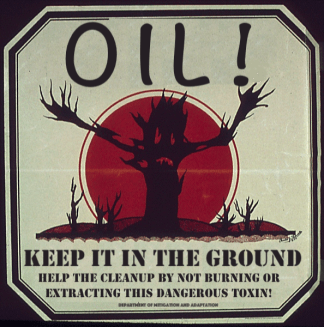
oil keep it in the groundThese posters were for a class I took on Designing for Public Participation in Science, which dealt in part with some of the ethical and political complications in science. In its self-skepticism and political disengagement, science has allowed climate change to be defined by a vocabulary that enables inaction. Every other sphere of our society is complicit in this error as well. This speculative artifact shows us an alternate approach, and asks us whether the window for such a mobilization has passed or may still be possible, through a Green New Deal or other big acts of dynamic government.
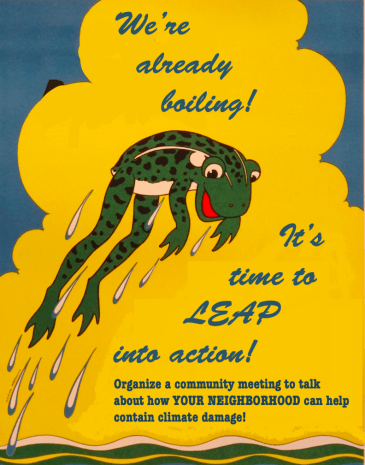
I am not a visual artist or a designer by training, but I enjoyed playing a bit in the strangely familiar medium of propaganda. I looked up actual posters from the world war eras, from America and elsewhere, and edited them to promote new slogans and ideas. I wanted to explore the problem of how we talk about climate change as something in the future, that we should get around to dealing with eventually. I was somewhat inspired by this talk by fellow traveller m1k3y. Climate change is not something that is coming, a cancer we might get if we don’t stop smoking one of these days. Rather a meteor made of oil crashed into the earth 100 years ago, and the impacts have been worsening ever since. We must mobilize at a massive scale to contain the damage, just as we do when fires or floods ravage our homes.

frog leaping.pngThe posters are meant to take the audience into an alternate history in which climate change was framed in a very different way. Imagine if the discovery of the climate-changing effects of carbon dioxide by Guy Stewart Callendar were better understood (including by Callendar) and taken seriously, particularly by America. Instead of decades of denial and delay, driven by business interests and the psychological difficulty of making costly investments to prevent a vague, remote calamity, America saw the climate disaster as already present, requiring urgent remedy. The nation sprung into action in a style reminiscent of our idealized memories of mass mobilization during the world wars, instituting a green draft, national service, and aggressive curtailing of polluting industry. 100 years later (perhaps in an alternate 2060) the imaginary Guy Steward Callendar Memorial Museum of the Climate hosts a small exhibition of the vibrant propaganda that drove citizen engagement in this mobilization.
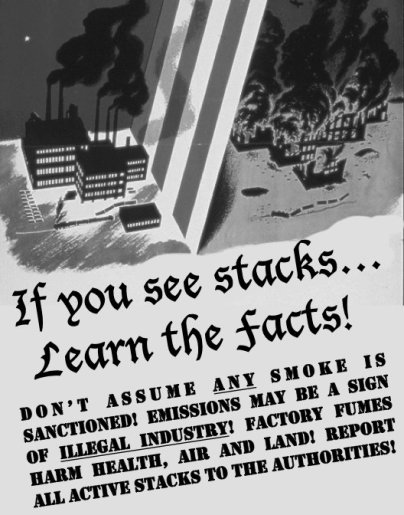
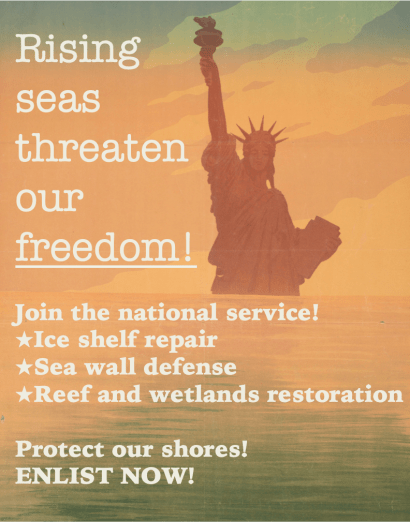
Five posters explore varied elements of this mobilization. Citizens are encouraged to enlist in national environmental service, to labor to fix more carbon in the soil soil, to leave oil in the ground, to report smoke and emissions to authorities, and to organize their neighborhoods. These collective and productive actions are meant to contrast with the many ways we are told to respond to climate change by altering our individual consumption (changing our light bulbs, eating less meat, driving less). They do not frame their demands as acts of prevention, but rather containment, cleanup, protection and prohibition.

if you see stacks
My favorite is probably “If you see stacks…” Greenhouse gasses should be contained by heavily regulating industry at the point of extraction and production, not by passing the buck to consumers, making us all feel vaguely guilty for leaving the lights on. Viewing it as a lifestyle choice only benefits the wealthy capitalists who profit by passing the true costs of their business on to the working class. A ban on carbon-intensive industry is a policy choice that makes a great deal of sense, but feels extremely remote in our present politics, so I wanted the audience to inhabit a world in which that was the case.

And yes, there are significant problems with framing all this mobilization as a future world war—World War C—even if that is the scale of action the problem requires. War is a terrible scourge on humanity and the planet, inherently unsustainable. For the average person, a world with a hostile climate but no militaries or large scale violence might be preferable to one with a pristine environment but ongoing war. And of course there is every chance that climate change will breed conflict and strife—in fact it already is. A WWC that is because of climate change rather than against climate change is probably one of the worst case scenarios.

rising sea levels.png
But war also distorts wildly in our collective memories, producing idealized nostalgias that are very potent material to work with as a creative. I wanted to use the cartoonish memories we have of the world wars to show us how the future might remember our struggles of today.

Perhaps the biggest problem with harkening back to WW1/2 is that these were wars amongst nations, whereas the climate crisis is really a class war. Many of the old posters I looked at were about promoting labor peace for the sake of the war effort, asking workers and bosses to put aside their differences and keep up productivity. But our present situation demands the opposite approach, because the enemy is not another nation but the global capitalist system itself and the wealthy individuals and companies that make short term profits off the planet’s long term ruin.

Who are some other climate-inspired/relevant artists that you admire?
 I’m not an expert on climate-minded visual arts at all, but in the fiction world I’ve been quite influenced by the climate fiction and adjacent work of Paolo Bacigalupi, Kim Stanley Robinson, Malka Older, NK Jemisin, Omar el Akkad, many others. Science fiction is very vibrant on these topics lately, and literary writers are getting in on the climate game. My hope, however, is that the genre will be remembered as activating on these matters, rather than escapist. I would hate these posters and my fiction to be read by my grand children as utopian could’ve-beens that rub salt in their solastalgic wounds.
Posted in Interview | Tagged | 1 Comment

Do #Manchester Labour councillors care about #climate? Hard to say…

Manchester City Council has 96 councillors. Ninety-four of them are Labour Party.

Manchester City Council launched (with help from activists) a climate change strategy in 2009.

And then, after not much happened, there was a refresh in 2013.  And then, after not much happened, there was another ‘strategy’ in 2016.  And then, after not much happened, there’s been another one in 2018. A long long list of broken promises, swept-under-the-rug failures etc.

And through all this, the bold and careful councillors who sit on the Scrutiny committee that is supposed to scrutinise (the clue is in the name) the top bods (elected and unelected) has… basically done (less than) nothing.

In 2014 they were finally successfully lobbied into requesting quarterly updates on the climate plans, because the Executive and officers were able to make promises in one year that were then forgotten/not-reported on the next year.

The “scrutiny” committee never actually used those quarterly reports very well to, er, scrutinise. And earlier this year, in the kind of North Korean democracy we have come to expect, the Executive Member for the Environment chose to abolish those quarterly reports.  After repeated asking from MCFly, she eventually said she thought it was the right decision and sent the right message about how seriously the Council takes climate change.

Three days ago Manchester Climate Monthly wrote to all the members of the scrutiny committee, asking some basic questions.  One committee member (Liberal Democrat Richard Kilpatrick) replied with concise answers in 20 minutes.  There was one other auto-reply.  And from the rest….

The usual deafening silence.

Do they not care?  Are they circling the wagons, getting a spin doctor to write a long and irrelevant reply that they will send collectively?  My money is on the latter. Watch this space.

Posted in Neighbourhoods and Environment Scrutiny Committee | Leave a comment