Deyika Nzeribe, a beloved son, brother, friend and father of three passed away suddenly on New Year’s Day 2017. This came as a great shock to all who knew him.
Deyika was a tireless advocate for human rights, equality and more than anything he was a believer in people. Manchester Green Party’s mayoral candidate, he worked for many years to make Hulme and the city a better place for all.
Deyika just couldn’t say no; always putting others needs before his own.
Please consider supporting Deyika’s family by making a donation to assist with the funeral arrangements (estimated costs £4000).
Any funds exceeding the funeral costs will go towards an appropriate and lasting memorial within the community that benefitted greatly from his activism in the arts and politics.
The tl:dr. Professor Kevin Anderson, one of the most plain-spoken and photogenic* climate scientists on the planet still isn’t willing to say that we are definitely doomed. Graphs and well-aimed barbs at policy-makers and climate scientists ensued….
[* he’s a bloke, so I am allowed to objectify him, ‘kay?]
Today he was explaining (and eviscerating) the 2015 Paris climate agreement, sticking the boot into “BECCS” and explaining what would need to be done. Anderson believes he is not wasting his time, and we should probably pretend likewise, if only for the sake of our consciences. What follows is basically bullet-points and [sarky asides in square brackets]. There may be a more extended reflection on this, but it’s unlikely, since TDWT (Theses Don’t Write Themselves.)
In a typical gibe he pointed out that we seem content to doubt 13 billion years of physics but swallow 30 years of economic orthodoxy unblinkingly and unthinkingly. He used the lovely Richard Feynman quote from the Challenger explosion [see article about Sigmund Freud and NASA and organisational decay – no, really]
“For a successful technology, reality must take precedence over public relations, for Nature cannot be fooled.”
He pointed out that since 1990 annual (anthropogenic) emissions have gone up by 60%, and that “people with no hair, grey hair and dyed hair have failed the young”, that his (okay, our) generation has failed.
Paris
(for my take on why it would be pointless see here. For my cod-psychology on why it was greeted so effusively by people who really ought to know better, see here).
Anderson started by reminding us of the US’s last minute kerfuffle on the use of the word ‘shall’ (would imply legal consequences) versus ‘should’ (yeah, nobody cares about empty promises) over emissions reductions. He pointed out that science was absent from the penultimate draft, and that fossil fuels were absent from the final draft, that aviation and shipping are exempt from the agreement (as they were from the Kyoto Protocol) and that the pre-Paris pledges, even if fulfilled (big if) would deliver not 2 degrees but 3 to 4 degrees over pre-industrial levels, and that the first proper review of those pledges isn’t until 2023 or “300bn tonnes of carbon dioxide from now.”
He argued that the deal is reliant on negative emissions (also absent from the text) – we will come back to them, and that the promised (see above on big ifs) $100bn in adaptation finance is a piddling sum – “crumbs off the rich people’s table” – compared to the direct and indirect subsidies that the IMF reckons the fossil fuel industry gets annually – 5.3trillion, since you ask (this includes, for example, not picking up the tab for health impacts. Externalities, schmexternalities).
Anderson’s focus is on energy, but he acknowledged that agriculture – 20 to 30% of emissions – matters, and that it can by definition never be zero carbon, so energy needs to be.
How to do that? Well, need to cut energy demand massively (“we can’t build our way out of it. We’re spending pennies on renewables.” ) And don’t even start him on fracking…
He argued in 3 to 13 years (depends – lots of imponderables) we will have used up our energy budget for 1.5 degrees (source of that is table 2.2. of the IPCC Fifth assessment synthesis report).
So “it is too late for 1.5 degrees” and the only reason we’re not already there is the sulphate pollution already up there. Oh, and “two degrees is not safe.” [For a – okay , ‘my’ – review about a book that discusses that, see here]. The two degrees target comes from a political process, and that is dominated by rich people in the north, insulated from the problem. “The framework we’ve had since 1990 is going to kill a lot of people in the global south.”
To even have a 50% chance of achieving two degrees we’d need a ‘war footing’ and there is no sense of that, we’re just tweaking at the margins. Remember, climate change doesn’t care about which technologies we use, just the fossil fuel emissions. In his typical plane speaking manner, Anderson asked how many of us would get on a plane that only had a 33% chance of landing safely. (Indeed…)
He pointed out that China’s current emissions per capita are only equivalent to the EU because they’re making stuff we consume (laptops, shirts, tables, you name it). [Gee, wasn’t Manchester City Council going to move to embedded carbon accounting? Yes, they were. Broken promise number 254].
He then riffed on how IF China kept all their promises and were fully decarbonised by 2050, then the budget to have a shot at two degrees would, for the rich world involve ten percent per annum reductions, starting … now. And given its wealth, the UK would have to do more. We’d need to be zero carbon for energy (not just electricity) by 2035. In an aside, he pointed out that pre-Brexit the UK had pushed for the EU to make a 50% by 2030 target for the Paris conference (it went for 40%) and so maybe now, free from Brussels’ shackles we can have a higher target. I think he may have had his tongue in his cheek. It’s hard to tell, what with his chiselled cheekbones.)
So why the euphoria at Paris? Well, because they’re pulling rabbits out of hats, and promising ‘negative emissions technologies’ (he had some scathing words on Integrated Assessment Models, where economics play with numbers [and other social scientists sort of enable them, MH]. What are these technologies? Well, they’re all unproven at scale and involve planting trees and plants, harvesting them, shipping them around the world (new infrastructure) and then burning them and capturing the CO2 and sequestering it for a few thousand years.
Anderson pointed out that ‘Boundary Dam’ CCS plant in Canada has not been very successful [and relies on Enhanced Oil Recovery and grants to make the economics work, MH] and that is with far more homogeneous C02 – biomass is trickier – different plants, different times of year etc). There’s also a huge energy penalty (i.e. the power plants are less efficient both in terms of physics and cash) and limited biomass availability (we live on a round planet), and it would need to be done way beyond the end of this century.
“Is this” he asked (I think rhetorically) a “reasonable way to develop policy?”
Anderson is on record as saying that economists do have a use – as biomass – but he didn’t use that line tonight. He instead turned to their use of discount rates – basically everything in the future is cheaper to do than today, so leave it to tomorrow. And tomorrow leave it to the day after – it will be cheaper still. Such is the hyperbolic discounting function.
Anderson feels we should research BECCS, and even Solar Radiation Management [Grant title: “We need our heads in the clouds”, MH] although the latter is “a sticking plaster on gangrene” in his view. But we should also assume that they’re not going to work….
By now things were still incredibly upbeat, so Anderson decided to cite a recent Nature paper on how, in a 2 degree warmer world, soil will not be a carbon sink (soaking up our emissions) but instead release 200bn extra tonnes. [can only find this, from 2009] Oh how we cheered.
Anderson then outlined what he called “a litany of scams” – offsetting, the Clean Development Mechanism (‘state-sponsored offsetting’), Emissions Trading Schemes without caps, and now BECCS. [See also this for people who want to offset their adultery. Straight up.]
When, he asked (definitely rhetorically this time) will we actually try mitigation?
To show us the importance of recycling, Anderson brought out that Feynman quote again.
“For a successful technology, reality must take precedence over public relations, for Nature cannot be fooled.”
So, what will the impacts of 3 or 4 degrees be?
Anderson has previously lamented how hard it was to get funding to study this, but that’s apparently now beginning to change, though the results aren’t in yet. Crucially though, we must remember that average temperature rise is a very unhelpful metric. We don’t live in climate, we live in weather, and extra ‘baseline’ temperature will make extreme weather events (especially heatwaves) much worse. So, in 2003 the European heatwave killed between 20 to 30 thousand people, but 2 degrees could make peak temperatures 8 degrees higher in those heatwaves. Good luck driving during that – the tarmac will be melting. Good luck on a train – the rails will buckle. Underground power cables, currently cooled by soil will be expected to cope with bigger loads (air conditioners etc) while the source of their cooling may not be quite so effective. Imagine London, 8 million (or is it 12?) people without electricity and water….It’s the zombie apocalypse basically.
Infrastructures take hundreds of years to change, and we’re not making the right moves…. A brief digression on Chinese buildings [see this about ghost cities] and thermal mass, before a mention of food crops – in a warmer world 30/40% reduction in maize and wheat yields in low latitudes, a 30% reduction in rice yields. [Will make the Arab Spring look like a picnic]
Sea level rise – at least a meter by 2100, which will change the map. Greenland will go, but not all in the twenty-first century, but causing major changes (7m) over the next 3 to 400 years [Anderson didn’t mention the West Antarctic Ice Sheet, perhaps mercifully]. Oh, and gravitationally, the lack of Greenland’s icesheet will mean higher sea level rise in the Southern Hemisphere. [Bye bye Sydney. It was nice…]
Anderson said that people who look into this stuff think that 4 degrees of warming will be “incompatible with an organised global community”, that it’s beyond our ability to adapt (“who will pollinate our crops?” ) and that our institutions are already creaking under the “weight” of a dribble of refugees. Beyond two degrees, some of the”positive” [very very negative, humanly speaking] feedbacks may well kick in – [permafrost burps, anyone?]
So, four degrees should be avoided at “all” costs (regardless of discount rates). Is two degrees still viable? Anderson says yes, and when he thinks it isn’t, he’ll quit. [Hey Kev, I want that exclusive for Nature Climate Change, ‘kay?].
While demand side gives us near term options [the radiators are heating the stairwells in the Pariser building, which has its windows open], supply side takes longer (decades).
After saying ‘sociotechnical systems’ was NOT meaningless social science gibberish and explaining why carbon capture and storage is a crock Anderson reminded us that electricity is only 20% of final energy demand, so we are going to need to find ways to electrify lots of things. Cars maybe – but ships? Well, you could use the wind [kuhrazy idea but it just might work] but this would have implications for the speed of journeys and the size of cargoes.
Anderson argued that NGOS often ignore this point about electricity only being 20% of final energy demand, before saying “UK shale gas is incompatible with a two degree target.”
He then explained that private cars, 12-5% of EU emissions, could be made much more efficient at no price premium. Given that 2/3 of car travel is in cars less than 9 years old he advocated setting a stringent CO2 target (ignore the lobbyists who will protest it’s impossible – they did that for 85g/km) and that this would work at no additional capital cost, no additional operating cost, the same infrastructure and the same employment. Oh, and in the US car efficiency is going backwards – cheaper fuel and heavier cars… [doomed I tell you, all doomed]
But you’d need to do something, policy-wise, about Jevons Paradox
So, we need rapid deep changes in what we do, how often we do it. But let’s remember, there are massive inequalities in emissions (he cited a Chancel and Piketty paper), with 50% of the emissions coming from 10% of people. The top 1% of US emitters (3.4m people) have C02 emissions 2500 times higher than the bottom [yeah, missed this – will insert. Presumably about 40% of t’planet]. If the top 10% of global emitters were to reduce to the level of a typical EU citizen the C02 reduction would be 33%.
Who are these nefarious 10% ers? Oh, climate scientists, business leaders, policy makers, frequent fliers… audience at climate events, Manchester climate bloggers. You know, people you see in the mirror….
Most of the 7.4bn people on the planet have little scope to reduce their emissions, but those who do have a chance to lead by example… Anderson said policies are never/rarely just top-down, but usually a mix of top down and bottom up and need examples of ‘having worked’ as pilots (official or unofficial). He invoked Naomi Klein’s argument that if we’d started in 1990, then the climate problem could have been dealt with within ‘normal channels’ but we’ve done nothing [actually, made things much much worse, MH] so now we need a Marshall style plan, a transition in physical and institutional infrastructure, shifts in behaviour and practices, we need to develop cogent economic models (‘not an oxymoron’), have inclusive values and a serious consideration of inter/intra-generational values (buying a 4×4 to ‘protect’ your child on the school run is, um…). Anderson argued that people only seem to care about their kids as long as they (the parents) are alive to enjoy the kids. After that? Well, apres moi, le deluge. Au sens propre.
Yeah, “we need to start now, and be completed in 30 years. It’s doable, but we will (probably) choose to fail.”
And because this is Kevin Anderson, and because he believes in recycling, he ends with the Unger quote he always ends with –
“At every level the greatest obstacle to transforming the world is that we lack the clarity and imagination to conceive that it could be different.”
The future will be different, whether we act or not…
Why have NGOs failed? Marches, petitions, glossy reports, camps. What should we be doing differently? /NGOs silent these days on climate change.
Anderson invoked Naomi Klein’s (long) argument that NGOs have been co-opted, along with research councils that dish out dosh to grant-grubbing academics – “we have been co-opted by orthodoxy, and only fight within the orthodoxy. Not all organisations, not all people with in them, but mostly we’re not prepared to challenge. There’s a lack of integrity and honest. We cannot fit the (Nick) Stern view of the world, of ‘green growth’ into reality. NGOs mostly won’t say ‘degrowth’, for example. “Our paradigm will kill us.”
CO2 is too cheap. We need to be more draconian on the rich. We need to think radically about population.
Kevin – I’m in two minds. For some (many) C02 is too expensive – poor people’s emissions should go up. (Skeptics accuse him of wanting the poor to stay poor and miserable). High emitters are inelastic to price. And extra “5 quid on a 100 quid ticket won’t stop many people flying to Rome for the weekend. So a price signal has equity issues. How about rationing – personal carbon accounts – or frequent flyer levies, with radical increases for each additional flight. Sarkozy suggested a CO2 levy on US goods if Trump scraps the Paris agreement –economists are working on it. Handled well, a reduction in globalisation might be a good thing.
Shouldn’t the INDCs be annual? What has happened since Paris? Why does the fossil fuel industry need 5.3bn?
Kevin – The Global Carbon Project is tracking annually, but new pledges would need to go through legislatures. The 5.3bn includes the cost of things like inhalers for people breathing dirty air.
Globally emissions have flatlined for the last three years principally because of China using less coal and lots of hydro (they had a wet year)
Role of education and what kinds of partnerships with manufacturing?
Educating adults matters! Kids have a certain amount of pester power. Anecdotally they lose the ‘save the world’ perspective when they hit puberty and become consumption monsters.
Some manufacturing, yes – not “the bad guys.” Anderson said would prefer Esso (Exxon) because at least they are wolves in wolf’s clothing, while Shell and BP are wolves in sheep’s clothing.
During the war we knew who the enemy was and what to do. We need clear instructions and rationing.
Kevin – “we are not going to achieve action at scale through altruism and voluntarism.” We need more sophisticated way of thinking about relationships between policy-makers and the public. Re: rationing – we already have it, via our salaries [An etymological aside – ‘salary’ comes from the stick of salt you’d get if you were a Roman soldier. What have the Romans ever done for us?. MH]
Events of the last year perhaps help us think of new economic model?
Kevin – we had our chance in 2008, when the model failed, and we blew it. We didn’t fix the model, the same will probably happen again. Bernie Sanders asking some of the right questions, that haven’t been asked before. The Scottish referendum was a more mature debate (than Brexit). But Scotland and Norway are as morally bankrupt as Qatar. If the educated populations there don’t see this is all about keeping fossil fuels in the ground, then we’re stuffed. They are the bellwethers [for seriously bad weather, MH].
And with that, applause….
Climate Envoi
As I walked back to my bike, past the mostly dismantled Santa Claus in Albert Square (“You blew it up! Ah, damn you! God damn you all to hell”) and the lights blazing at 7.30 in the Town Hall extension, I pondered what has changed in the nine years and eleven months since Kevin Anderson gave a talk (on the Fourth assessment report of the IPCC) at the first ever ‘Manchester Climate Forum’, in the self-same building. Well, Kevin has introduced some new numbers and new denunciations of new fantasy technologies to his well-established format of numbers and reminders that it’s the space under the curve, not some silly mythical 2050 promise that will save or doom us. The atmospheric concentration of C02 is now 406ishppm, when then it was, what, 385 or so?. We have built more infrastructure, both physical and psychological, (probably) locking us in to a high carbon future (in the short-term, until the collapses).
But that’s not the biggest change, at least for me. Ten years go, if you squinted and pretended, you could believe that the state would (finally) respond, that a growing movement of committed activists (including the Climate Campers, despite the heresthetic ‘decision’ to have annual camps) and wider civil society (the Big Ask etc etc) could Be The Change. Does anyone seriously believe that now? Does anyone believe that, presented with a second bite at the cherry we wouldn’t screw it up the way we did last time? I don’t.
Upcoming events Monthly IEMA lectures – watch this space.
Well, it will be interesting to see if this version of Green Drinks lasts longer, and is less boring and corporate, than the previous attempts . Kudos to whoever is trying to get it going again… Watch this space, I guess…
upstairs space in The Old Monkey on Portland Street. (Note change of venue)
Guest Speaker: Phil Korbel (Carbon Literacy Project)
Phil will be giving a short talk to facilitate discussion on where now for the environmental movement, considering the increasing movement towards the political right.
Congratulations on finding Green Drinks Manchester!
You are now one of a select group of lucky people who can come to share a drink and talk the night away about our shared passion for a sustainable and flourishing environment.
Green Drinks is open everyone (academia, business, community, local government, student or member of the public), and is an opportunity to connect with likeminded individuals, collaborate, and share advice that can help make our city, its businesses and its communities, become something that we can all be proud of. Welcome.
Meetings are centred around a short presentation by a keynote speaker each month followed by discussion, and then as many drinks as people feel like having. Our team of culture vultures are in the process of identifying the location of our first event, and we hope to visit as many different venues as possible in the future to experience the best of what Manchester has to offer – from comedy gigs, the arts, movies, or the odd bite to eat.
If you haven’t already, please connect with us on Facebook and Twitter, where we will share all sorts of articles that we think will be of use to you.
Once again, welcome to the club. We can’t wait to meet you.
Get in Touch
If you would like to find out more or fancy being a speaker, then please email us at GreenDrinksManchester [at] gmail.com
These beautiful words are from Deyika’s friend Peter Kalu, reposted with permission.
Deyika Nzeribe (1966 -2017) Tribune of the People
The first visual memory I have of Deyika is from close to a couple of decades ago. It’s Summer. He’s coming towards me, crossing Piccadilly Gardens in Manchester’s city centre, a white bedsheet wrapped round him in the style of a Roman senator. He was celebrating a graduation – I can’t remember whether it was his own or his friends’. As you can guess, they were in high spirits. He stopped to chat with me a few seconds then they sailed on. There’s a good friend, I thought, and a guy who knew how to party!
It is little known that Deyika was a fine poet. He had a poet’s sensibility for emotional nuance, for divining people, a poet’s generosity of spirit. We ended up working together for what was then a small community writing project, Commonword. He had so many callers at Commonword that sometimes the reception room at Commonword filled up with people wanting to see Deyika. I doubt he ever ate lunch alone during those times.
Years sailed by and I got to know him. And it was from the cramped store-room -cum kitchen of the Commonword project that a second stingingly sweet memory comes. He called me in there to tell me something important. His hands came up, fingers spread in a gesture of openness yet uncharacteristic inarticulacy. ‘I don’t know how to tell you this,’ he said to me. ‘You’re going to become a father,’ I completed for him. He burst out laughing, amazed that I’d guessed. ‘How did you…?’ ‘Lucky guess.’ Actually he ‘d been brimming with a barely containable happiness all week, and this made it easy for me. Afterwards, I thought maybe I should have let him squirm a bit longer trying to find the words. He took as naturally to fatherhood as he did to riding a bike.
You can run out of fingers and toes counting your fair-weather friends: there’s an endless supply of them ready to celebrate your lottery win, your prize, your financial or status-achieving victory, large or small. When the going is good, you never lack companions. Deyika was that rarity – a friend for all seasons. Life has a way of finding which part of you will hurt most and then kicking you there, repeatedly. Whenever I got kicked and I was at my lowest, Deyika was the one who would roll up in that kinetically intriguing open walk of his and put an arm around me. Pick me back up. Simple as.
Only after he had attended to the human, to the humanity within a situation did he turn to the political, to the fight. And what a fighter. He was resolute. Uncrushable. Yet he didn’t believe in bombast. He had charm and he boxed his opponents in with the polite rigour of his arguments. He once floored me with a question that remains my favourite inquisitorial line: “Is there anything you know that I ought to know but which you have not told me?” How do you answer that question except with a full confession!
This acuity wrapped in charm – the fist in velvet glove -he used instinctively to help others. I’m sure he died poor because he gave everything: time, mind and money. To the rejected. The indigent. The outnumbered. The out-gunned. You were never alone if Deyika was with you. You were never beat if Deyika was by your side.
He was running for Mayor when he died. He would have made a fine Mayor, a great Senator for the people, a great Tribune – a real Voice of the People. I met him first in robes. It is in robes I see him ascend to the Ancestors.
This beautiful summation below, republished with permission, is from Zahra Alijah, a Councillor for Fallowfield Ward, Manchester.
Deyika Nzeribe taken too soon
When I last saw Deyika, whose passing I still cannot believe or process, it was in great spirits, just before Christmas at that period when ‘work do’s’ are about to begin. We sat around the table, as we had throughout the year, fellow board members at the charity he chaired with a flair, diligence, terrific humour and a graciousness belied by the authority, challenge and assertiveness he exercised as the great public servant he was: his head shaking, eyebrow raised, fist occasionally thumping the table, the odd chuckle passing his lips whilst he ensured each item was scrutinised critically for the organisation he championed. He had a tremendous physical presence that is likely to be a void around so many other tables too, and which I cannot begin to imagine.
To Commonword, as he had with the diverse organisations and great causes to which he contributed, he dedicated himself with integrity and energy for social, political and cultural equality. Typically, he never mentioned his candidature in the coming Greater Manchester Mayoral elections, and not because we served different political parties, rather he focused on what was important for Commonword, enthusiastically arguing in a critical animated debate on what current arts agendas could mean to an organisation that had nurtured and promoted writers larger publishing houses consign to specialist categories.
It was a flair and dedication I admired from our first encounters, appropriately enough at meetings in and around Moss Side and Hulme – places we both loved – in the cause of social equality and anti-racism and later, for his other passion, environmentalism, as a board member of Manchester Environment Education Network, a charity educating children and young people on environmental issues. That, to me was Deyika, a man who knew that social justice and equality is a complex of causes and solidarities, including Black Lives Matters, for whom we marched together.
I remember, early on in our acquaintanceship, at an event he had co-organised to commemorate the 50th anniversary of the killing of Malcolm X, his swan-like cheerfulness as he greeted me warmly – and with so much to think about, still remembering to remind me of an upcoming meeting. The panel he had co-convened had been typically well-pitched offering a current as well as historical perspective, like Deyika – pulling back the curtains to reveal the present very much is part of a road into the past paved with injustice and activism, and that our tiny psychogeographical space as individuals in Manchester, is part of global events and history.
As is ‘dinner party’ etiquette we rarely spoke about our political party affiliations and when we did it was with respect and humour. I was – still am – proud to say Deyika was a comrade of mine. I’m also immensely privileged to have known and worked with him.
Deyika leaves a lasting personal legacy and I can only imagine his loss to his family and close friends. I am still in disbelief and shock at his passing – such a vibrant vital presence and lovely man. I can’t imagine Manchester’s campaigning and activist scene without him. What a loss.
On Thursday 19th January, from 4pm, Professor Audley Genus of Kingston University will deliver a seminar on the following –
In the seminar, I argue that a more rounded understanding of how to respond effectively to the challenges posed by human-made climate change may be obtained by drawing on an institutional perspective. In particular I advance an approach which combines neo-institutional theory and critical discourse analysis in a complementary way. Such a discourse-institutional view has a number of benefits: (1) institutionally, it moves analysis beyond the usual if understandable focus on the activities and policies of government; (2) due attention is given to a view of institutions as stable but potentially changeable norms, professional standards, culture, and ingrained habit; (3) the language basis of institutions is duly recognized; and (4) connections among language in text, and in discursive and social practice are acknowledged, as are their role in processes of (non- or de-) institutionalization. The presentation summarizes the suggested approach, and illustrates it with reference to the example of the diffusion of renewable energy technologies.
Deyika Nzeribe, who I have known for 20 years or probably more I guess, passed away late on 1st January. I had three phone-calls this morning to inform me, the third being from his brother. Unexpected to all, a deeply sad loss. I did not know him too well personally, but I knew him regularly and had plenty of chats with him over the years, our work crossing over many times in both race and environmental politics and with creative work. I knew him as someone full of tireless positivity, encouragement, kindness and reflection. He will certainly be missed and remembered by many. My thoughts go out especially to his family and close friends at this time, I certainly know what deep loss is after my own ongoing troubles this year. Deyika, you have helped sow wisdom and you will continue. x
This below is from Jonathan Atkinson (republished with permission). There are many wonderful tributes to Deyika, and I will – with the authors’ permission – keep posting them. This is a man who will not be forgotten, and should not be forgotten. He taught us a great deal by his fine example.
-Really shocked to hear about sudden and unexpected death of activist and friend Deyika Nzeribe at just 50. He was great on so many levels, a committed campaigner on community, environmental and anti-racism issues, he took up radical but never fanatical positions bringing together disparate but likeminded groups and individuals.
But he wasn’t just an activist, he was warm and funny person and just good to hang around with. He was always busy, always up to something and usually quite a lot of things. The picture below makes me smile because it was taken as part of the publicity for his Green Party council election campaign in Hulme and he persuaded me to forgo my deep rooted craving for anonymity and pose as a ‘local (social enterprise) businessman’ supporting his campaign.
I did it for him because I thought he’d make a great councillor and because he persuaded me to do it with good arguments and good humour. That’s the way he was. It’s so sad he died and doubly so that he was so young.
The outpouring of grief and incomprehension at the passing of Deyika Nzeribe tells you something of the regard in which the man was held. A lot of that has appeared on Facebook, which not everyone chooses to be a user of. This below, republished with permission of its author, Dr Tanzil Chowdhury, beautifully captures his spirit.
Rest in Power my dear, dear brother and mentor Deyika Nzeribe
I can’t understand and believe what has happened. Deyika was the most self-less, tireless campaigner I ever had the pleasure of saying I worked with. We organised together over the last 6 or so years. He was so important to the struggle. Anytime I knew Deyika was a part of something, I always felt so comfortable and confident that it would be a success. People in Manchester may not realise this, but this amazing man is responsible for so much that is positive in the community.
More important than all of this though is that Deyika was an amazing human. He exuded knowledge, love and kindness. He listened to others and genuinely worked to bring people together. I’ve never met anyone in my life who worked so much and so hard.
That was Deyika. ALWAYS putting others before himself. Whether it was raising money for the Duggan family, organsing community events for refugees, fighting Prevent, racism or climate change (I could go on for days), Deyika’s natural disposition was to consider others before his own well-being. All of the great heroes of history that he admired, you could see in Deyika.
Remembering his legacy is vital, not just to honour and celebrate his life but because it will genuinely inspire the next group of youngsters to achieve fantastic things for their community. All of us that knew him have a responsibility to make sure this happens.
I only hope that he was able to be with us for 1 more day at least, so that he could see how much he was loved. My love and support to your family. Respect my dear friend. Thank you for everything you’ve done for us. xx
Deyika Nzeribe, who has died suddenly aged 50, , was a much-loved and respected figure in Manchester. His many admirable qualities included not just intelligence and concern about the state of the world, but a compassion and joviality that enriched those who knew him. His ability to listen and consider other points of view, as well as talk (and he was a good public speaker) made him an effective advocate. Beyond this, his energy and passion helped him straddle ‘green issues’ (he had stood as a Council candidate for the Green Party, and was also their candidate in the forthcoming Mayoral elections) and issues of racial justice, both domestically and internationally. Deyika, rightly, saw no contradictions in this.
Deyika took his causes very seriously, but did not take himself too seriously. He was always willing to ask awkward questions, contest the answers he got in a calm and humorous manner. He was able to consider opposing points of view or criticism without becoming angry or defensive. But beyond this, he was just great fun – always ready to have a drink, a laugh, always approachable.
It is a tragic loss, far too young. Condolences to his family , to his colleagues in the Green Party and to the many hundreds of people whose days were made brighter whenever they met this fine man.
If you have memories of Deyika, and the other (creative) aspects of his life, please feel free to share them below. [Update – for example, he was chair of Commonword].
If there is a public celebration of the man’s life, we will give details.
Updates: There is a celebration of his life happening now (2nd January, 6.30pm) at Zion Centre, in Hulme
Our "leaders" are going to keep making empty promises. It makes them feel good. It gets the activists to act like zombie kittens. If you want to have some self-respect and perhaps make a difference (actual facts may vary), then find a functioning group that cares about your skills and knowledge - what you have, what you want.
One useful group might be www.climateemergencymanchester.net - you can email them on contact@climateemergencymanchester.net

 Deyika Nzeribe, a beloved son, brother, friend and father of three passed away suddenly on New Year’s Day 2017. This came as a great shock to all who knew him.


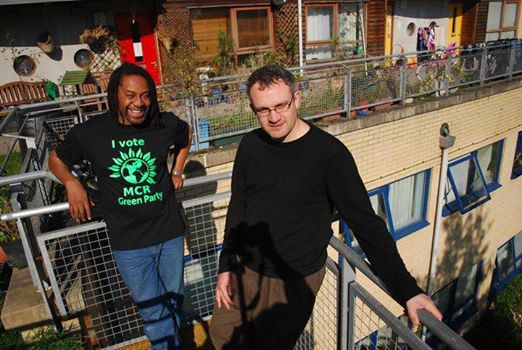
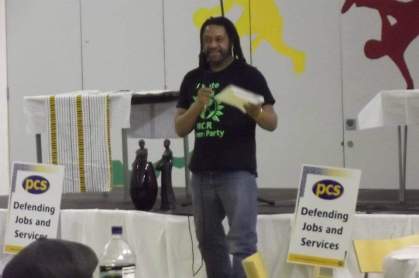 Deyika Nzeribe, who has died suddenly aged 50, , was a much-loved and respected figure in Manchester. His many admirable qualities included not just intelligence and concern about the state of the world, but a compassion and joviality that enriched those who knew him. His ability to listen and consider other points of view, as well as talk (and he was a good public speaker) made him an effective advocate. Beyond this, his energy and passion helped him straddle ‘green issues’ (he had stood as a Council candidate for the Green Party, and was also their candidate in the forthcoming Mayoral elections) and issues of racial justice, both domestically and internationally. Deyika, rightly, saw no contradictions in this.


 manchester climate monthly